














TL;DR:
- Remote hiring requires clear technical, cultural, and logistical expectations for success.
- Specialized platforms reduce hiring time to 7-30 days, offering a competitive advantage.
- Effective onboarding, trust, and leadership mindset shift are crucial for long-term remote team success.
Hiring remote developers sounds straightforward until you’re three months in, a key product milestone is slipping, and your newest engineer hasn’t synced with the team once. The challenge isn’t just finding talent; it’s finding the right talent, fast, and integrating them without productivity loss. Traditional local hiring for tech roles takes 45 to 85 days on average, but specialized remote platforms can cut that to 7 to 30 days. For growth-focused product leaders, that difference is a competitive edge. This guide walks you through every stage, from defining requirements and sourcing candidates to screening, onboarding, and sustaining high performance, so you can build a world-class remote engineering team with confidence.
Table of Contents
- Define your requirements and assess readiness
- Source candidates: Where and how to find top remote talent
- Screen, interview, and evaluate: Ensuring skill and culture fit
- Onboarding, productivity and ongoing collaboration
- Our perspective: What most remote hiring guides miss
- Accelerate with proven remote development solutions
- Frequently asked questions
Key Takeaways
| Point | Details |
|---|---|
| Preparation is key | Clarifying requirements and readiness prevents costly remote hiring mistakes. |
| Sourcing saves time | Remote hiring through platforms cuts average time-to-hire from months to weeks. |
| Culture fit matters | Most failed hires are due to poor cultural alignment, not just technical gaps. |
| Ongoing support maximizes value | Structured onboarding and collaboration tools sustain long-term remote productivity. |
Define your requirements and assess readiness
Now that you understand why remote hiring is crucial, let’s lay the groundwork by defining exactly what you need and whether your current setup supports remote success.
The most expensive mistake in remote hiring isn’t a bad interview. It’s starting the search without a clear picture of what success looks like. Before you post a single job description, align your leadership team on three dimensions: technical requirements, collaboration needs, and cultural expectations.
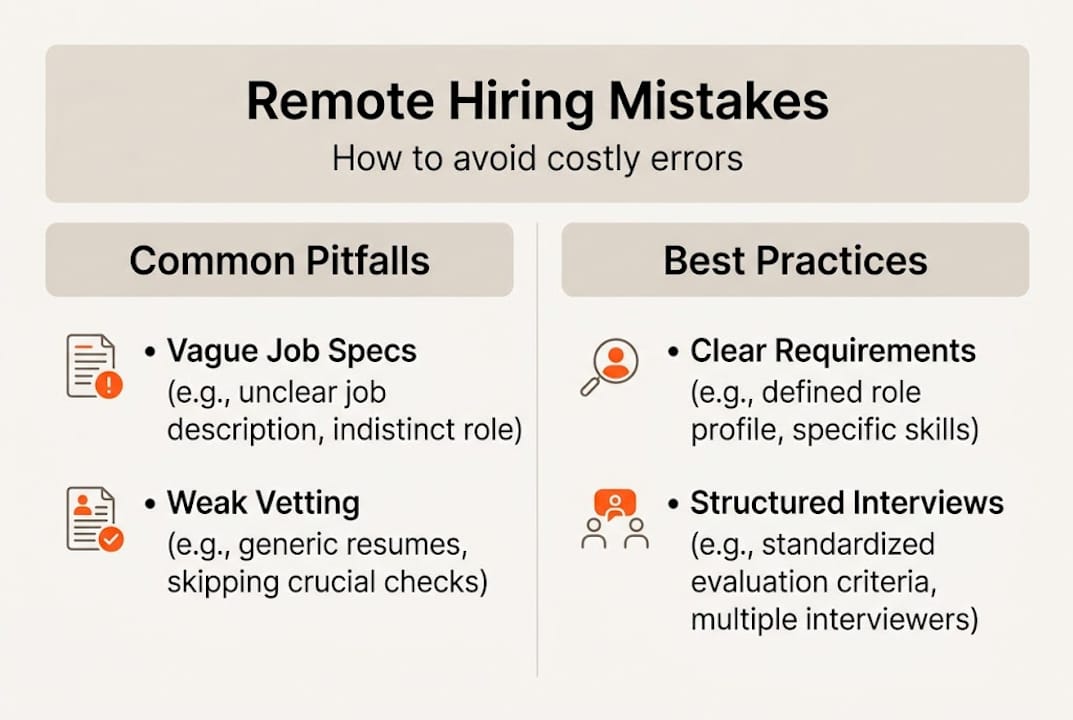
Technical requirements go beyond programming language. Define the seniority level, the specific stack (React, Node.js, Python, Kubernetes, etc.), and any domain expertise your product demands, such as HIPAA compliance knowledge for healthcare or security-first thinking for cybersecurity platforms. Be specific about whether you need a generalist or a specialist.
Collaboration and timezone coverage matter just as much as raw skill. If your core team is in New York and your product roadmap requires daily syncs, hiring a developer in Southeast Asia with zero overlap hours is a setup for friction. Define your minimum acceptable timezone overlap and non-negotiable availability windows upfront.
Infrastructure readiness is often overlooked. Ask yourself: Do you have async-friendly documentation? Are your tools (Slack, Jira, GitHub, Notion, Confluence) set up to onboard someone remotely on day one? Understanding the types of remote teams that work best for your stage can save weeks of painful realignment.
Here’s a quick reference table to clarify your pre-hire requirements:
| Requirement category | Key considerations |
|---|---|
| Technical skills | Stack, seniority, domain expertise |
| Timezone coverage | Overlap hours, async vs. sync ratio |
| Communication tools | Slack, Jira, GitHub, Notion, Confluence |
| Legal and compliance | Contractor vs. employee, IP protection, NDAs |
| Culture alignment | Autonomy, ownership mindset, feedback receptivity |
Do not underestimate culture. 46% of new hires fail within 18 months primarily due to culture misfit, not technical gaps. Understanding the advantages of remote IT teams is useful, but only if you have a culture they can genuinely integrate into.
Key infrastructure and communication tools to have in place:
- Version control and CI/CD: GitHub or GitLab with branch protection rules
- Project management: Jira or Linear for sprint tracking
- Documentation: Confluence or Notion for async knowledge sharing
- Communication: Slack with defined channel structures and response norms
- Security: Zero-trust access controls and VPN for sensitive systems
Pro Tip: Run a culture fit stress-test during early interviews. Ask candidates to describe a time they disagreed with a technical decision and how they handled it remotely. Look for transparency, constructive communication, and a bias toward written documentation over verbal escalation.
Source candidates: Where and how to find top remote talent
Once you know your requirements, the next step is identifying exactly where and how to reach developers that fit your needs.

Not all sourcing channels are equal. Freelance marketplaces like Upwork or Toptal offer speed but vary widely in vetting quality. Specialized engineering platforms such as Arc.dev or Hired apply technical screening before candidates ever reach your inbox. Development agencies and nearshore partners offer managed teams with accountability built in. Developer communities, including GitHub, Stack Overflow, and niche Discord servers, can surface high-intent candidates who aren’t actively job hunting.
Remote hiring through platforms can reduce time-to-hire to as little as 7 days, compared to the 45 to 85 days typical of traditional hiring pipelines. That speed advantage matters when a feature release is on the line.
Here’s how common sourcing channels compare:
| Channel | Avg. time to hire | Vetting standard | Cost level | Retention risk |
|---|---|---|---|---|
| Freelance marketplaces | 1 to 7 days | Low to medium | Low | High |
| Specialized platforms | 7 to 21 days | High | Medium | Medium |
| Dev agencies or partners | 14 to 30 days | High | High | Low |
| Developer communities | 14 to 45 days | Self-assessed | Low | Medium |
| Internal referrals | 7 to 14 days | Trusted | Low | Low |
For outsourcing software development at scale, agencies and dedicated team models tend to offer the best ROI over a 12-month horizon despite higher initial costs.
Follow this sourcing sequence for best results:
- Write a role-specific job description. Avoid generic language. Name your stack, your product domain, your team size, and your async expectations explicitly.
- Post on two to three targeted channels simultaneously. Don’t limit yourself to one platform.
- Craft a brief, personalized outreach message for passive candidates in developer communities. Generic recruiter messages get ignored.
- Build your employer brand. Share engineering blog posts, open-source contributions, or team culture content on LinkedIn and GitHub to attract inbound interest.
- Screen applications within 48 hours. Top remote developers have multiple offers and move fast.
A critical warning: Beware of low-cost platforms with no vetting standards. The short-term budget savings are often wiped out by turnover costs and rework time. Review outsourcing best practices before committing to any vendor relationship.
Screen, interview, and evaluate: Ensuring skill and culture fit
With candidates sourced, you must now rigorously screen and evaluate, as remote hiring adds new variables beyond in-person vetting.
The remote screening process needs more structure than traditional interviews, not less. Without physical presence, you’re relying entirely on documentation, asynchronous signals, and designed test scenarios to assess fit. A four-stage process works well for most engineering roles.
- Async screening: Send a short written questionnaire covering past projects, technical decisions made, and availability windows. Evaluate clarity of communication, not just content.
- Live technical screen: A 45 to 60 minute video call focused on system design or debugging. Assess problem-solving approach, not just syntax recall.
- Scenario-based skills test: A realistic, time-boxed task that mirrors actual work. Avoid generic LeetCode puzzles. Use a problem your team actually solved last quarter.
- Culture and soft skills interview: Explore collaboration style, conflict resolution, and how they give and receive feedback asynchronously.
- Reference and portfolio review: Contact at least two professional references. Review public code repositories if available.
Common pitfalls to avoid:
- Scheduling live interviews without confirming timezone compatibility
- Using technical tests that reward speed over code quality
- Ignoring written communication skills entirely
- Skipping reference checks because the candidate interviewed well
Pro Tip: Design your scenario-based test to have two layers. The first tests the technical solution itself. The second tests remote work discipline by asking candidates to document their approach in writing as if explaining it to a teammate asynchronously. Candidates who do both well are rare and worth pursuing.
The real cost of a bad remote hire: Research consistently puts it at 1.5 to 2 times the employee’s annual salary when you factor in lost productivity, rehiring costs, and team disruption. With 46% of new hires failing within 18 months, a structured evaluation process isn’t optional; it’s financial risk management.
Using structured scorecards is one of the highest-impact things you can do to reduce bias and improve decision quality. Score each candidate on the same rubric across technical skill, communication quality, culture alignment, and remote work readiness. This also helps when using dedicated teams and needing consistent standards across multiple hires. Reference engineering team management tips for building evaluation frameworks that scale.
Onboarding, productivity and ongoing collaboration
After you hire, effective onboarding and ongoing management are vital to make remote developers productive and aligned with your goals.
The first 30 days determine whether a remote developer becomes a high performer or a churn statistic. A structured onboarding process removes ambiguity and signals to new hires that your organization is organized and worth their long-term commitment.
Your remote onboarding checklist should include:
- Day 1: Grant all tool access (GitHub, Jira, Slack, VPN, cloud environments). Send a structured welcome document covering team structure, communication norms, and sprint cadences.
- Week 1: Introductory calls with key team members and stakeholders. Assign a low-stakes first task to build confidence and familiarity.
- Week 2 to 4: Pair with a senior developer for code reviews. Establish a regular 1:1 cadence with their direct manager.
- 30-day review: Structured check-in on progress, blockers, and cultural integration.
Here’s a productivity framework to sustain performance beyond onboarding:
| Practice | Frequency | Purpose |
|---|---|---|
| Async standups (written) | Daily | Visibility without meetings |
| Sprint planning and retrospectives | Bi-weekly | Alignment and continuous improvement |
| 1:1 manager check-ins | Weekly | Feedback and relationship building |
| Team video calls | Monthly | Cohesion and culture reinforcement |
| In-person or hybrid meetups | Quarterly | Strategic alignment and trust-building |
Remote work boosts individual productivity by 13 to 62%, but spontaneous collaboration can lag by 10 to 20%, which means you have to intentionally design the collaboration touchpoints you’d normally get for free in an office. AI tools can automate workflow steps and accelerate junior developer output, but they require consistent senior code review to prevent accumulated technical debt.
For strategies on scaling your IT workforce as you grow, the principles are the same: systems over heroics, documentation over tribal knowledge, and feedback loops over assumptions.
Our perspective: What most remote hiring guides miss
Most remote hiring frameworks treat the challenge as a process problem. Get the steps right, use the right tools, and success follows. We’ve seen enough post-hire situations to know that’s incomplete.
The real challenge is a leadership mindset shift. Async work, genuine autonomy, and radical transparency matter far more than hours tracked or cameras on during meetings. Developers who thrive remotely tend to be self-directed, clear communicators, and proactive about surfacing blockers. Hiring for those traits is harder than testing for React proficiency, but it’s what separates teams that scale from teams that stagnate.
AI is changing this dynamic in ways many CTOs underestimate. Agentic AI tools can accelerate junior developer output significantly, but they also generate hidden technical debt that burns senior engineering hours downstream. If your remote team lacks experienced reviewers, AI becomes a liability, not an asset.
Long-term remote success is built on trust, continuous feedback, and periodic in-person connection. Even one annual team gathering dramatically improves cohesion and psychological safety. Don’t skip it because it’s expensive. Skip it and pay more in turnover.
Accelerate with proven remote development solutions
If you’re ready to move from strategy to execution, DevPulse builds and scales engineering teams that deliver. Whether you need to modernize a legacy platform, integrate AI capabilities, or expand your product team with senior remote talent, our approach connects technical depth with real business outcomes.

Explore our engineering services to see how we structure remote development engagements for maximum velocity. If AI integration is on your roadmap, our agentic AI solutions are built for production environments, not demos. And if you want evidence before committing, our real-world case studies show how we’ve helped SaaS companies, healthcare platforms, and enterprise clients ship faster with distributed teams. Let’s build something that scales.
Frequently asked questions
What is the average salary for remote developers in 2026?
Remote developer salaries range from $50,000 to $175,000 USD depending on region, seniority, and specialization, with global talent pools offering significant flexibility across budget tiers.
How long does it take to hire a remote developer?
Time-to-hire via platforms typically runs 7 to 30 days, compared to 45 to 85 days for traditional local hiring, making remote channels a clear advantage for time-sensitive product needs.
What are the biggest risks when hiring remote developers?
Culture misfit and poor async communication are the top failure drivers, and a bad remote hire can cost 1.5 to 2 times the annual salary when you account for lost productivity and rehiring expenses.
How does using AI change the remote hiring process?
AI augments developer output but introduces quality risks when senior oversight is lacking, so teams should treat AI-generated code as a draft requiring rigorous review, not a finished product.