












TL;DR:
- IT staffing agencies serve as strategic talent partners, providing rapid access to specialized tech professionals.
- They offer faster scalability, reducing hiring time from months to days and managing compliance risks.
- Choosing the right engagement model depends on scope, timeline, control needs, and strategic goals.
Most engineering leaders assume IT staffing agencies are just a faster way to fill a seat temporarily. That framing costs companies time, money, and competitive ground. In reality, these agencies function as strategic talent infrastructure, connecting organizations to specialized engineers, data scientists, and AI practitioners across contract, project-based, and direct-hire arrangements. IT staffing fills 11% of all technology roles in the U.S., making them a significant force in how modern tech teams are built and scaled. If you’re a CEO, VP, or Director of Engineering evaluating how to close skills gaps and accelerate delivery, this guide will give you the clarity to act decisively.
Table of Contents
- What is an IT staffing agency?
- How IT staffing agencies work: The engagement process
- Types of IT staffing engagements: Choosing what fits your needs
- When to partner with an IT staffing agency: Signs and scenarios
- A practical perspective: What leaders should really look for in IT staffing partners
- How DevPulse can support your IT staffing strategy
- Frequently asked questions
Key Takeaways
| Point | Details |
|---|---|
| Strategic partner | IT staffing agencies offer more than temporary labor, serving as key partners for rapid scaling and specialized tech needs. |
| Faster scalability | Staff augmentation enables engineering leaders to achieve up to 30% faster team expansion and project launches. |
| Choosing engagement models | Selecting the right agency model—augmentation, project, or direct hire—depends on your business priorities and goals. |
| Optimal timing | Engage with IT staffing agencies proactively when you anticipate growth, skill gaps, or mission-critical delivery deadlines. |
What is an IT staffing agency?
An IT staffing agency is a specialized talent partner that sources, screens, and places technology professionals within client organizations. Unlike general staffing firms, these agencies focus exclusively on technical roles, which means their recruiters understand the difference between a backend Java developer and a JVM performance engineer. That distinction matters enormously when you’re racing against a product deadline.
The core services these agencies provide go well beyond posting job listings. A full-service IT staffing partner typically handles:
- Talent sourcing and recruitment: Proactively identifying candidates from curated networks and passive pipelines
- Technical vetting: Skills assessments, coding evaluations, and reference checks calibrated to your stack
- Compliance and payroll management: Handling W-2, 1099, and employer-of-record arrangements so your legal team stays out of it
- Onboarding support: Accelerating time-to-productivity with structured onboarding processes
- Workforce management: Ongoing performance tracking and contract renewals
Consider a VP of Engineering at a SaaS startup preparing to launch a new product feature in 90 days. The internal team is stretched, and the open roles have been sitting unfilled for six weeks through traditional recruiting. An IT staffing agency can step in, present three to five pre-vetted senior engineers within days, and have someone contributing within the first week. That’s the core value proposition: speed, precision, and reduced hiring risk.
“The right IT staffing agency doesn’t just send you resumes. It sends you engineers who are ready to build.”
The staff augmentation benefits extend beyond just filling gaps. For organizations navigating rapid growth, regulatory change, or technology modernization, agencies provide the workforce flexibility that internal HR teams simply cannot match at scale. According to industry benchmarks, IT staffing agencies fill 11% of technology hires in the U.S., a figure that reflects just how embedded this model has become in enterprise talent strategy.
How IT staffing agencies work: The engagement process
Now that you know what IT staffing agencies do, let’s see how the engagement process actually works. The workflow follows a structured sequence, and knowing where your team fits at each step helps you get faster, better results.
- Requirements gathering: You brief the agency on the role scope, technical requirements, team structure, and timeline. The more specific you are about your stack and delivery goals, the better the candidate match.
- Sourcing and screening: The agency activates its network, runs technical assessments, and filters candidates against your criteria. This phase typically takes two to five business days.
- Candidate presentation: You receive a shortlist of pre-vetted profiles, often with screening notes and technical assessment results attached.
- Client interviews: Your team conducts focused interviews to assess technical fit and team compatibility. The agency facilitates scheduling and feedback loops.
- Offer and onboarding: The agency manages contract terms, rate negotiation, and logistics. Onboarding support varies by agency but can include equipment setup and access provisioning.
- Performance management: Strong agencies stay engaged post-placement, collecting feedback and managing any performance concerns proactively.
Pro Tip: Before you sign with any agency, ask for a sample technical assessment from their vetting process. If it doesn’t map to your actual stack, their screening won’t filter for what you need.
The speed advantages are real. 30% faster scalability through staff augmentation compared to direct hiring is a documented outcome, giving engineering leaders a measurable ROI argument for the model. For teams that need to optimize the end-to-end IT staffing workflow, this structured approach removes most of the friction that slows traditional hiring cycles.
| Metric | Direct Hiring | IT Staffing Agency |
|---|---|---|
| Average time to hire | 30 to 45 days | 5 to 15 days |
| Technical vetting | Internal burden | Agency managed |
| Compliance risk | Internal | Largely transferred |
| Scalability speed | Slow | Up to 30% faster |
| Ramp-up support | Variable | Often structured |
Types of IT staffing engagements: Choosing what fits your needs
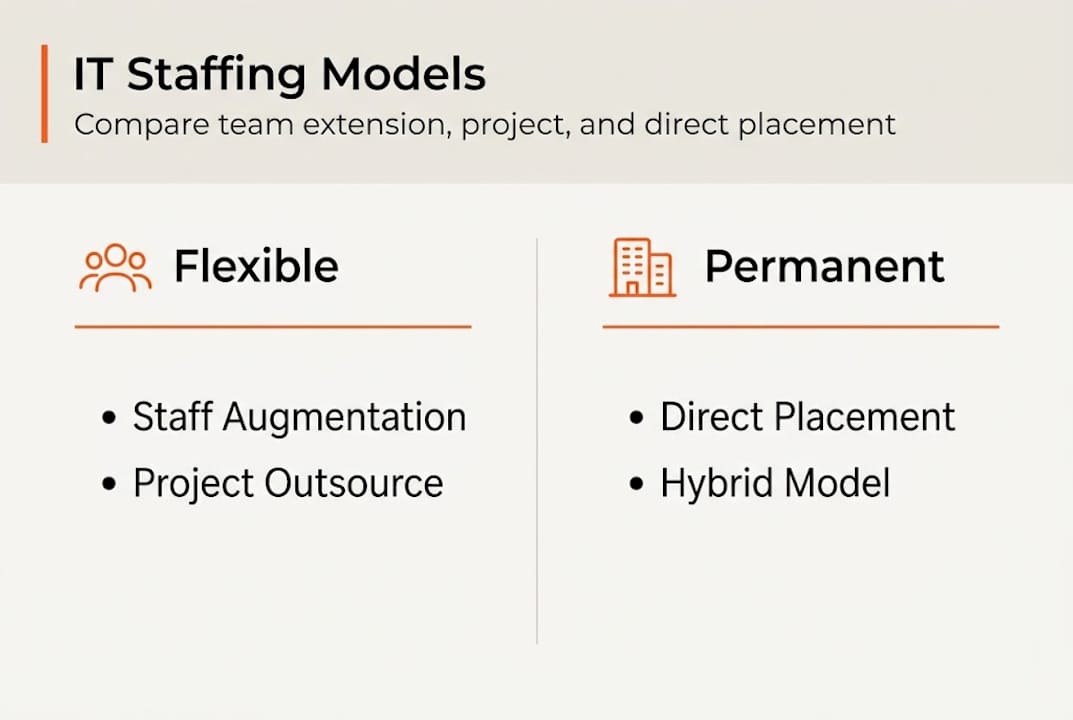
Understanding the engagement process, it’s crucial to choose the model that best fits your immediate and strategic goals. IT staffing agencies typically offer three primary engagement structures, and each one serves a different business scenario.
Staff augmentation places external engineers directly within your existing team. They work under your processes, your tools, and your technical leadership. This is ideal when you need to scale delivery capacity quickly without changing your operating model.

Project-based outsourcing hands a defined scope of work to an agency or a team they assemble. You own the outcome specification, the agency owns delivery execution. This works well for discrete initiatives like building a new microservice, migrating a database, or developing a mobile app.
Direct placement (also called permanent placement) is when the agency sources and screens candidates for full-time roles on your payroll. You pay a placement fee, and the professional joins your team directly. Best suited for senior or specialized roles where long-term retention matters.
Here’s a quick comparison to guide your decision:
| Model | Best for | Speed | Control | Cost structure |
|---|---|---|---|---|
| Staff augmentation | Scaling active projects | High | High | Hourly/monthly rate |
| Project outsourcing | Defined deliverables | Medium | Medium | Fixed or milestone |
| Direct placement | Long-term senior hires | Low | Full | One-time placement fee |
The augmentation model achieves 30% faster scalability compared to direct hiring, which makes it the go-to for fast-moving product teams. You can explore the full spectrum of staff augmentation for scaling your engineering capacity, or look at how outstaffing scalability can support distributed team models without sacrificing delivery speed.
Key considerations when choosing a model:
- How defined is the scope? Vague scopes favor augmentation; clear deliverables favor project outsourcing.
- How long is the engagement? Short-term surges favor contracts; strategic needs favor direct hire.
- How much day-to-day control do you need? If integration with your internal team matters, augmentation wins.
When to partner with an IT staffing agency: Signs and scenarios
With clarity on engagement models, let’s discuss the business triggers that make partnering with an IT staffing agency the right move. Waiting until your team is underwater is the most expensive time to start.
These are the clearest signals that it’s time to engage a staffing partner:
- Project surge without headcount approval: A major client win or new product initiative requires more engineers than your current team can absorb
- Failed direct hiring cycles: A role has been open for 60-plus days with no viable candidates from internal recruiting
- Specialized skills gap: Your roadmap requires AI/ML, cloud infrastructure, or legacy modernization expertise that doesn’t exist in-house
- Digital transformation initiatives: Large-scale re-platforming or migration projects that need dedicated engineering bandwidth
- Tight delivery windows: A product launch, compliance deadline, or contract milestone that cannot move
Recruiter demand surges tracked by ASA and Gartner consistently signal tightening IT talent markets, which means the window to secure specialized engineers through agencies narrows during high-demand periods. Moving early gives you better access to top-tier talent before competition intensifies.
Pro Tip: Start evaluating and qualifying staffing agencies three to four months before you anticipate needing them. Agency relationships take time to calibrate, and you’ll get meaningfully better results when the relationship isn’t built under pressure.
Real-world scenarios where staffing partnerships deliver the most value include SaaS teams scaling feature development before a major release, AI product teams needing data engineers for model training pipelines, and enterprise organizations modernizing legacy systems while keeping current operations running. Investing in workforce scalability strategies before a crisis hits, and exploring the advantages of remote IT teams for high-impact project coverage, are both moves that experienced engineering leaders make well in advance.
A practical perspective: What leaders should really look for in IT staffing partners
Here’s what most executives wish they had known before their first major staffing engagement: negotiating the lowest bill rate is not a strategy. It’s a shortcut that almost always produces a slower ramp, more management overhead, and higher true cost. The agencies that offer the deepest discounts often compensate by cutting corners on technical validation or maintaining shallower talent pools.
What most selection guides completely ignore is the feedback loop. The best staffing partnerships we’ve seen work like ongoing calibration, where the business and the agency continuously exchange performance data, adjust candidate criteria, and refine the matching process over time. That loop produces compounding returns.
Experienced CTOs increasingly treat augmentation benefits for tech leaders as a capability-building strategy, not just a gap-filling tactic. When you work with the same agency over multiple engagements, they learn your architecture, your team culture, and your delivery standards. That institutional knowledge becomes a genuine competitive asset.
The contrarian truth: in high-stakes projects, relationship fit outperforms lowest cost every time. Evaluate agencies on their ability to ask smart technical questions, their honesty about candidate limitations, and their responsiveness when something goes wrong. Those signals tell you far more about the partnership than their rate card.
How DevPulse can support your IT staffing strategy
If you’re evaluating partners who understand both the strategy and technical delivery, here’s how DevPulse can help.
At DevPulse, we work with SaaS companies, enterprise clients, and growth-stage product teams across healthcare, cybersecurity, legal tech, and edtech to deliver reliable, scalable engineering outcomes. Whether you need to accelerate a product roadmap, modernize a legacy platform, or build AI-powered capabilities, our engineering services are designed to integrate with your delivery goals, not just your open headcount. Explore our real-world case studies to see how we’ve helped organizations solve complex technical challenges, or review our AI and data expertise for teams building next-generation intelligent systems. Schedule a consultation with our team and let’s build a staffing and delivery strategy that actually fits your roadmap.
Frequently asked questions
How do IT staffing agencies differ from traditional recruiters?
IT staffing agencies specialize in technology roles, offer contract-based engagements, and manage compliance and workforce logistics, unlike general recruiters who typically focus only on direct-hire placements. Per the New Staffing Productivity Report, agencies manage workforce logistics that traditional recruiters do not.
What types of roles do IT staffing agencies typically fill?
They commonly place software engineers, data scientists, AI/ML specialists, cloud architects, and DevOps engineers for both short and long-term engagements. Industry data confirms that agencies support filling a wide range of critical technology positions across sectors.
When is using an IT staffing agency most valuable for a tech organization?
Partnering is most valuable during rapid scaling, specialized skill gaps, or time-sensitive product launches where internal hiring cycles can’t keep pace. Staff augmentation achieves 30% faster scalability compared to traditional hiring for these scenarios.
How fast can an IT staffing agency fill a technology role?
Vetted IT professionals can be placed in as few as five to fifteen business days, significantly outpacing conventional hiring timelines. Agencies enable faster hiring because technical screening and compliance work happen in parallel, not sequentially.