














Scaling your engineering team shouldn’t take 90 days and a full HR cycle. Yet for most mid-sized and large tech companies, that’s exactly the reality when demand spikes, a product launch accelerates, or a key initiative needs immediate firepower. Outstaffing offers a fundamentally different approach: external engineers integrate directly into your team, under your management, with the speed and flexibility that traditional hiring simply can’t match. This guide breaks down how outstaffing works, why it’s a strategic scalability lever, and the proven practices that separate companies who do it well from those who struggle.
Table of Contents
- What is outstaffing and why scalability matters
- How outstaffing enables rapid, flexible team scaling
- Hybrid models: maximizing agility through team augmentation
- Best practices for managing outstaffed teams at scale
- What most tech leaders get wrong about outstaffing scalability
- Ready to unlock your team’s scalability?
- Frequently asked questions
Key Takeaways
| Point | Details |
|---|---|
| Rapid scaling advantage | Outstaffing lets tech teams adjust headcount in days instead of months. |
| Flexible team control | You maintain full managerial oversight and process alignment when using outstaffing. |
| Hybrid models boost agility | Mixing core team augmentation with outsourcing raises operational agility by up to 30%. |
| Management is crucial | Clear onboarding and integrated processes are key for outstaffed team success. |
What is outstaffing and why scalability matters
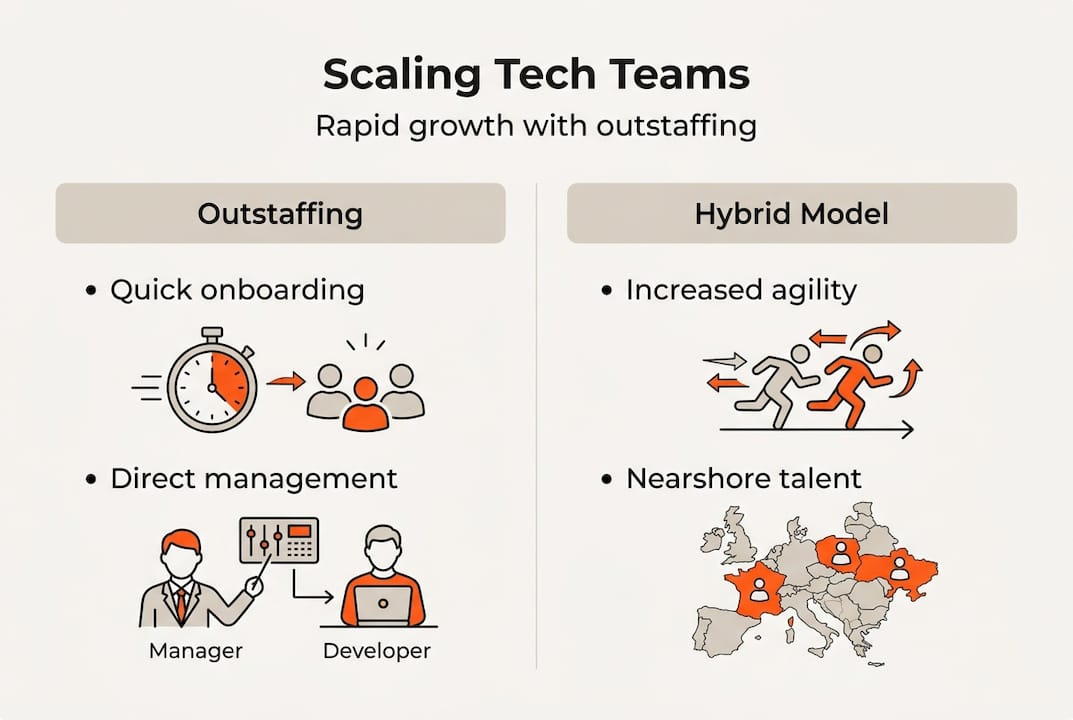
Outstaffing is a staffing model where a vendor provides dedicated engineers who work exclusively for your company, under your direct management, as part of your internal team. This is different from outsourcing, where you hand off a project or deliverable to an external team that operates independently. With outstaffing, you own the workflow, the priorities, and the culture. The vendor handles employment logistics.
That distinction matters enormously for scalability. Outstaffing integrates developers directly into client teams under client management, enabling rapid capacity adjustment that outsourcing simply doesn’t allow. You’re not waiting for a vendor to interpret your requirements. You’re directing engineers in real time.
For CTOs and product managers, scalability strategies for tech leaders often hinge on how quickly you can respond to changing demand. Consider the numbers:
| Hiring method | Time to onboard | Flexibility | Management control |
|---|---|---|---|
| Internal hire | 60-90 days | Low | Full |
| Traditional outsourcing | 30-60 days | Medium | Limited |
| Outstaffing | 7-14 days | High | Full |
The speed advantage alone is significant. But the real value is in the combination: fast access to talent plus full control over how that talent is deployed. That’s a rare combination in enterprise staffing.
Core reasons scalability matters for product development teams:
- Demand is unpredictable. Product roadmaps shift, market windows open and close, and regulatory deadlines don’t wait for hiring cycles.
- Velocity is a competitive moat. Teams that can scale quickly ship faster, iterate sooner, and capture market share.
- Overhead costs compound. Maintaining a large permanent headcount through slow periods erodes margins. Flexible capacity protects your budget.
If you want a broader look at when and why to bring in external talent, the strategic guide to outsourcing covers the decision framework in depth.
How outstaffing enables rapid, flexible team scaling
The mechanics of outstaffing are straightforward, but executing them well requires a clear process. Here’s how a typical scale-up looks in practice:
- Define the role and skills needed. Be specific. A “senior backend engineer” is not enough. Specify the stack, the domain experience, and the expected ramp time.
- Engage your outstaffing partner. Share the role brief. A quality partner will surface pre-vetted candidates within days, not weeks.
- Interview and select. You run the interviews. You make the final call. The vendor handles contracts and payroll.
- Onboard into your systems. The engineer joins your Slack, your Jira, your standups. They operate as a full team member from day one.
- Manage directly. Sprint planning, code reviews, performance feedback — all yours. The vendor stays in the background.
This process can move from brief to active contributor in 7-14 days, compared to 90 days for a traditional internal hire. For proven tech team scalability strategies, that speed differential is often the deciding factor.
Scaling down is equally fast. With roughly 30 days’ notice, you can reduce headcount without the legal and financial complexity of layoffs. This matters enormously during post-launch ramp-downs or when a product line is deprioritized.
“The ability to scale engineering capacity up or down within a single sprint cycle changes how you plan. You stop building buffers into headcount and start building buffers into your process.”
Pro Tip: Use outstaffing to staff proof-of-concept builds or pilot launches before committing to permanent hires. If the initiative succeeds, you have a running team. If it pivots, you adjust without severance costs. For teams focused on scaling engineering teams for SaaS, this approach reduces both risk and time-to-market.
Realistic scenarios where this model excels: a seasonal e-commerce platform that needs three additional engineers for Q4, a SaaS company that wins a large enterprise deal requiring custom integrations on a tight timeline, or a healthcare tech firm that needs to staff a compliance sprint before a regulatory deadline.

Hybrid models: maximizing agility through team augmentation
Direct outstaffing is powerful. Hybrid models take it further. A hybrid approach combines a core outstaffed team for ongoing, strategic work with project-based outsourcing for peripheral or time-boxed deliverables. The result is a staffing structure that’s both stable and elastic.
Hybrid models boost agility by 30% compared to single-model approaches, and for US tech companies, nearshore talent adds another layer of advantage through time zone alignment and cultural overlap.
| Model | Scalability | Control | Cost efficiency | Best for |
|---|---|---|---|---|
| Fully in-house | Low | Full | Low | Core IP, long-term |
| Outsourced | Medium | Limited | High | Defined deliverables |
| Outstaffed | High | Full | Medium | Ongoing capacity |
| Hybrid | Very high | Mixed | High | Complex, evolving needs |
Here’s what a hybrid setup looks like in practice:
- Core team (outstaffed): Three to five engineers embedded in your product squad, working on your primary roadmap, attending all standups, fully integrated.
- Peripheral layer (outsourced): A QA team or a design sprint handled by a separate vendor on a fixed-scope contract.
- Flex capacity: Additional outstaffed engineers added during peak periods, released after.
For optimizing IT staffing workflow, this layered structure reduces single-source dependency and prevents bottlenecks when one vendor or team hits capacity.
Pro Tip: Nearshore partners in Latin America offer US tech companies strong time zone overlap, typically within one to three hours of Eastern Time. This makes real-time collaboration practical and reduces the async communication lag that can slow sprint velocity. For teams adopting agile IT outsourcing best practices, nearshore hybrid models are increasingly the default choice.
Best practices for managing outstaffed teams at scale
The model only works if the management layer is solid. Outstaffing requires clear communication and aligned processes to deliver consistent results. Here’s what that looks like in practice.
Onboarding and knowledge transfer:
- Document your architecture, coding standards, and deployment processes before the engineer starts, not after.
- Assign an internal buddy or tech lead for the first two weeks.
- Give access to all relevant systems on day one. Delayed access is one of the most common ramp-time killers.
Process standardization checklist:
- Defined sprint cadence and ceremony schedule
- Clear definition of done for all ticket types
- Shared documentation in a single source of truth (Confluence, Notion, or equivalent)
- Regular 1:1s between outstaffed engineers and their direct manager
- Structured feedback loops at the end of each sprint
Common mistakes to avoid:
- Weak handoff documentation that forces engineers to reverse-engineer context
- Unclear role boundaries that create overlap or gaps with internal team members
- Treating outstaffed engineers as contractors rather than team members, which erodes integration and morale
For deeper guidance on remote team management tips, the principles of visibility, accountability, and tooling alignment apply directly to outstaffed setups.
Pro Tip: Invest in shared tooling from day one. When outstaffed engineers use the same project management, communication, and CI/CD tools as your internal team, silos don’t form. Transparent roadmaps and shared OKRs (objectives and key results) keep everyone aligned on priorities, not just tasks. Review engineering outsourcing tips for a practical framework on tooling and governance.
What most tech leaders get wrong about outstaffing scalability
Most companies treat outstaffing as a headcount lever. Need more engineers fast? Outstaffing. Need to cut costs? Reduce outstaffed headcount. This transactional mindset misses the larger opportunity entirely.
The CTOs who extract the most value from outstaffing use it as a capability-building tool, not just a staffing solution. They bring in outstaffed engineers to pilot new workflows, test unfamiliar tech stacks, or stand up a new product line before committing internal resources. The outstaffed team becomes a learning environment, not just a delivery engine.
Long-term scalability doesn’t come from adding headcount. It comes from the processes, documentation, and team culture that scale with the headcount. Companies that skip this foundation hit a ceiling. They add engineers but don’t add velocity, because the coordination overhead grows faster than the output.
The uncomfortable truth is that outstaffing exposes process debt faster than any internal audit. If your onboarding is weak, your documentation is thin, or your sprint rituals are inconsistent, outstaffed engineers will surface those gaps immediately. That’s not a problem. That’s a diagnostic.
For a deep dive into tech workforce scalability, the leaders who treat outstaffing as a strategic capability rather than a tactical fix consistently see compounding returns over time.
Ready to unlock your team’s scalability?
The strategies in this guide only create value when they’re applied with the right partner. At DevPulse, we help engineering teams scale with precision, whether that means augmenting your core team, building out a hybrid model, or accelerating delivery with AI-powered development.
Our engineering team augmentation services are designed for mid-sized and enterprise tech companies that need speed without sacrificing quality or control. Explore our real-world scalability case studies to see how we’ve helped SaaS, healthcare, and enterprise clients scale their teams and ship faster. If AI-driven development is on your roadmap, our AI-driven development offerings can accelerate that work significantly. Schedule a consultation with our team to map out a scalability strategy tailored to your goals.
Frequently asked questions
How quickly can a team scale using outstaffing?
You can typically scale up or down in as little as 7-14 days, far faster than the 60-90 day timeline of traditional internal hiring. This speed makes outstaffing especially valuable when you’re responding to sudden demand shifts or tight launch windows.
What’s the difference between outstaffing and outsourcing?
Outstaffing integrates developers into your team under your direct management, while outsourcing hands off an entire project or deliverable to a vendor who operates independently. The key difference is control: outstaffing keeps it with you.
Are hybrid outstaffing models more agile?
Yes. Combining outstaffing for core work with outsourcing for peripheral deliverables boosts agility by 30% compared to single-model approaches, while also reducing dependency risk and improving cost efficiency.
What are the risks when scaling with outstaffing?
The primary risks are unclear role definitions, weak onboarding documentation, and poor process alignment. Clear communication and aligned processes are the foundation that prevents these issues from compounding as your outstaffed team grows.