












Many IT executives still believe outsourcing means sacrificing speed and flexibility. That’s a costly misconception. When you apply agile methodologies to IT outsourcing, you unlock faster delivery cycles, higher product quality, and stronger team collaboration. This guide shows you exactly how agile transforms outsourced software development, backed by real data and practical frameworks you can implement immediately.
Table of Contents
- Key takeaways
- Why agile matters in IT outsourcing
- Balancing agile and outsourcing challenges
- Measuring agile success in outsourced projects
- Implementing agile frameworks with outsourced teams
- Maximize agile outsourcing success with DevPulse services
- Frequently asked questions
Key Takeaways
| Point | Details |
|---|---|
| Faster delivery and quality | Applying agile to outsourcing speeds delivery while improving product quality and team collaboration. |
| Two week sprints | Starting with two week sprints helps introduce agile without adding overhead. |
| Nearshore collaboration edge | Overlapping time zones enable real time collaboration and rapid issue resolution. |
| Transparent agile practices | Sprint planning, incremental delivery, automated testing, and transparent backlogs align outsourced teams with business value. |
Why agile matters in IT outsourcing
Traditional waterfall outsourcing locks you into rigid contracts and long delivery cycles. Agile flips that model by emphasizing continuous collaboration, iterative delivery, and adaptive planning. When you bring agile principles to your outsourced teams, you gain the ability to respond to market changes quickly while maintaining high quality standards.
Cisco’s engineering division proved this works at scale. Their agile transformation achieved 25% fewer QA defects and 14% higher defect removal efficiency across multiple product lines. These aren’t marginal improvements. They represent fundamental shifts in how outsourced teams deliver value.
The secret lies in how agile reshapes team dynamics. Daily standups create transparency across distributed teams. Sprint reviews give stakeholders regular touchpoints to provide feedback and adjust priorities. Retrospectives build a culture of continuous improvement where teams identify bottlenecks and fix them before they compound.
Pro Tip: Start with two-week sprints when introducing agile to outsourced teams. Shorter cycles create too much overhead, while longer ones dilute the feedback advantage that makes agile powerful.
Your IT executives benefit directly from improved team motivation. When developers see their work deployed regularly and receive immediate feedback, ownership increases dramatically. Quality improves because teams take pride in shipping polished features rather than checking boxes on a requirements document.
Key agile practices that transform outsourced projects include:
- Sprint planning sessions that align remote teams on priorities
- Incremental delivery that reduces integration risk
- Automated testing pipelines that catch defects early
- Transparent backlogs that keep everyone focused on business value
The agile transformation roadmap shows how breaking down silos accelerates innovation. When your outsourced developers collaborate directly with product owners instead of working through layers of project managers, you eliminate communication delays that kill momentum.
“Agile methodologies reduce the distance between problem identification and solution delivery. In outsourcing, that compression of feedback loops is the difference between shipping competitive products and playing catch-up.”
This matters because software markets move faster than traditional outsourcing contracts allow. Agile gives you the flexibility to pivot when customer needs shift or competitors launch new features. You’re not locked into a specification written six months ago that’s already outdated.
Balancing agile and outsourcing challenges
Implementing agile with outsourced teams isn’t automatic. You’ll face real obstacles that require deliberate strategies to overcome. The biggest challenge is vendor agile maturity. Many outsourcing providers claim agile expertise but still operate with waterfall mindsets underneath.
Offshore teams face particular hurdles with real-time collaboration. Time zone differences make daily standups awkward. Cultural communication styles can create misunderstandings during sprint retrospectives. Research shows offshore agile poses risks for real-time collaboration, which is why nearshore options often deliver better results.

Nearshore outsourcing puts your teams in overlapping time zones. You get three to six hours of real-time collaboration daily instead of relying entirely on asynchronous communication. That overlap is critical for resolving blockers quickly and maintaining sprint momentum.
Pro Tip: Require vendors to demonstrate their agile practices during the selection process. Ask to observe actual sprint ceremonies, not just hear about them in sales presentations.
Hybrid models offer a practical middle ground for complex projects. You can use waterfall planning for architecture decisions and compliance requirements while applying agile execution for feature development. This combination provides stability where you need it and flexibility where it adds value.
Common scenarios where hybrid approaches work well:
- Enterprise systems with regulatory compliance requirements
- Projects integrating with legacy infrastructure
- Multi-vendor initiatives requiring coordination across teams
- Products with both stable core platforms and rapidly evolving features
Backsourcing represents another option when agile offshore relationships fail. Bringing development back in-house increases team ownership and control. The tradeoff is higher costs, but some organizations find the improved quality and speed justify the investment.
| Challenge | Impact | Mitigation Strategy |
|---|---|---|
| Vendor agile immaturity | Ceremonial agile without real benefits | Rigorous vendor assessment and training |
| Time zone misalignment | Delayed feedback and blocked sprints | Nearshore partners or hybrid schedules |
| Communication barriers | Misunderstood requirements and rework | Video-first culture and documentation |
| Complex project scope | Difficulty maintaining agile rhythm | Hybrid waterfall-agile frameworks |
KPIs become essential for monitoring agile health across distributed teams. You need objective measures to know whether your outsourced teams are genuinely agile or just going through motions. Velocity trends show whether teams are improving their estimation accuracy and delivery consistency.
The engineering outsourcing tips guide explains how to structure contracts that support agile flexibility rather than lock you into rigid specifications. Fixed-price contracts and agile principles conflict fundamentally. You need commercial models that accommodate changing priorities.
Measuring agile success in outsourced projects
You can’t improve what you don’t measure. Agile outsourcing requires specific KPIs that reveal team health and project trajectory. Generic metrics like budget variance miss the nuances that determine whether your agile investment pays off.
Velocity measures how many story points your team completes per sprint. This metric helps you forecast delivery dates and identify when teams are over or undercommitting. Consistent velocity indicates mature estimation practices. Wild swings suggest teams don’t understand their capacity or requirements keep changing mid-sprint.
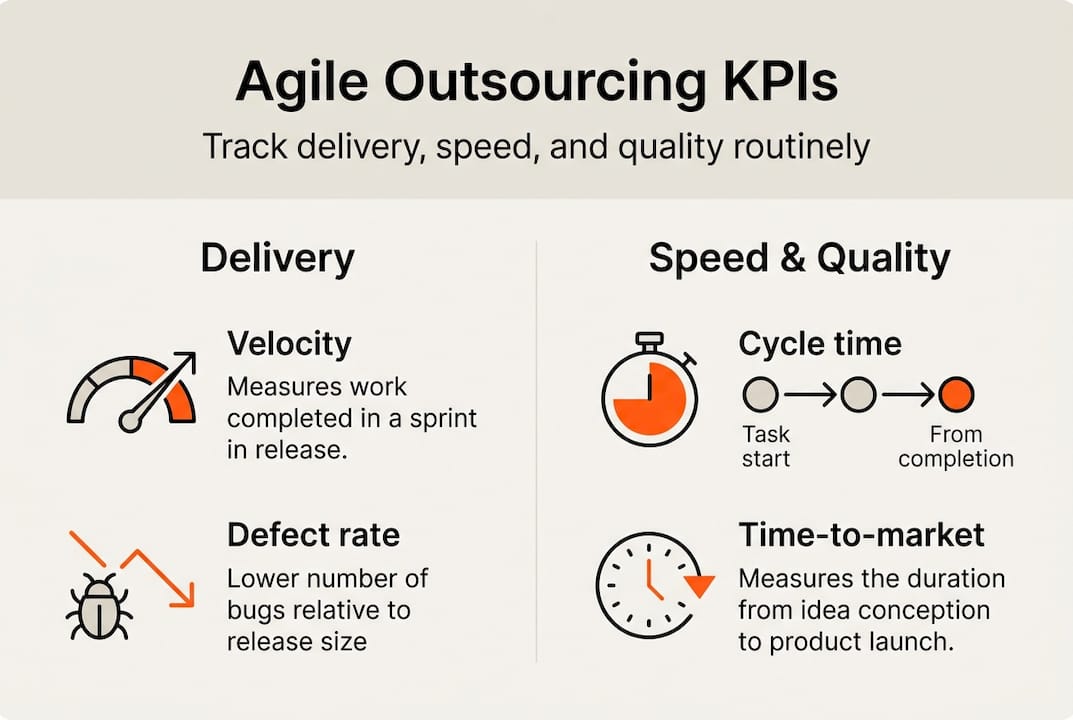
Defect rate tracks how many bugs escape into production relative to features shipped. Agile success is linked to monitoring velocity, defect rates, and time-to-market. Lower defect rates mean your testing practices work and teams aren’t sacrificing quality for speed.
Time-to-market reflects how quickly you move from concept to customer hands. Agile should compress this timeline significantly compared to waterfall. If your sprints deliver working software but releases still take months, you have deployment pipeline problems to solve.
Pro Tip: Track velocity as a range rather than a single number. Teams naturally vary sprint to sprint. A healthy range is 15-20% variance. Anything wider indicates estimation problems or unstable requirements.
| KPI | Definition | Business Benefit |
|---|---|---|
| Sprint Velocity | Story points completed per sprint | Accurate delivery forecasting |
| Defect Density | Bugs per 1000 lines of code | Quality assurance effectiveness |
| Cycle Time | Days from commit to production | Deployment efficiency |
| Sprint Goal Success | Percentage of sprint commitments met | Team reliability and planning |
| Customer Satisfaction | Stakeholder feedback scores | Product-market fit validation |
Regular KPI review enables continuous improvement. Monthly retrospectives should examine trends across these metrics and identify systemic issues. Is velocity declining because technical debt is accumulating? Are defect rates climbing because automated testing coverage dropped?
These metrics also create accountability with outsourced vendors. When contracts tie payments to KPI achievement, vendors have clear incentives to maintain agile discipline. You’re buying outcomes, not just developer hours.
The optimize IT staffing workflow article shows how proper team composition affects these metrics. Unbalanced teams with too many junior developers or missing specialties will show declining velocity and rising defects no matter how well you implement agile ceremonies.
Don’t obsess over metrics to the point where teams game them. Story point inflation and cherry-picking easy tasks can make velocity look good while actual business value stagnates. Combine quantitative KPIs with qualitative assessment of whether shipped features solve real customer problems.
Implementing agile frameworks with outsourced teams
Successful agile outsourcing requires deliberate implementation strategies. You can’t just declare teams agile and expect transformation. Start by clearly defining roles within your agile structure. Who owns the product backlog? Which stakeholders participate in sprint reviews? Ambiguity here creates friction that undermines agile benefits.
Product owners must engage actively throughout sprints, not just at planning sessions. Involving customers and enhancing team capability are critical to agile success in outsourcing. When product owners disappear for two weeks, teams make assumptions that lead to rework.
Follow these implementation steps to build agile maturity:
- Establish communication infrastructure before your first sprint. Video conferencing, shared documentation, and project tracking tools must work seamlessly.
- Conduct agile training for both internal stakeholders and outsourced team members. Everyone needs common understanding of ceremonies and principles.
- Start with a pilot project to validate your approach before scaling. Learn lessons on lower-risk work.
- Define your definition of done explicitly. What testing, documentation, and review must happen before calling a story complete?
- Schedule regular retrospectives and actually implement improvements. Teams lose faith when retrospectives become complaint sessions without action.
- Build automated deployment pipelines that enable frequent releases. Manual deployment processes bottleneck agile delivery.
Communication tools make or break distributed agile teams. Slack or Microsoft Teams provide real-time chat. Jira or Azure DevOps track work items transparently. Confluence or Notion centralize documentation. Zoom or Google Meet enable face-to-face interaction that builds trust.
Pro Tip: Invest in agile coaching for your outsourced teams, especially in the first three months. External coaches identify anti-patterns quickly and help teams develop healthy habits before bad ones calcify.
Hybrid agile frameworks work when full agile is impractical. You might use Scrum for application features while applying Kanban for infrastructure work. Or combine SAFe for portfolio planning with team-level Scrum execution. The key is intentional framework selection based on work characteristics, not arbitrary preferences.
The outsourcing software development guide explains vendor selection criteria that predict agile success. Look for providers with certified Scrum Masters, demonstrated agile portfolios, and references from clients who successfully implemented agile with them.
Different types of remote teams require adapted agile approaches. Fully distributed teams need more structured communication than co-located ones. Nearshore teams can use synchronous ceremonies more easily than offshore ones.
Key practices that accelerate agile adoption:
- Pair programming sessions between in-house and outsourced developers to transfer knowledge
- Rotating sprint leadership so outsourced team members gain ownership
- Transparent metrics dashboards that show progress to all stakeholders
- Regular architecture reviews to prevent technical debt accumulation
- Customer demos at sprint end to validate you’re building the right things
Remember that agile transformation takes time. Teams typically need three to six sprints to find their rhythm. Velocity will be unstable initially as estimation skills develop. Resist the urge to abandon agile when early sprints feel chaotic. That chaos is part of the learning process.
Maximize agile outsourcing success with DevPulse services
Transforming your IT outsourcing strategy with agile methodologies requires both technical expertise and proven frameworks. DevPulse specializes in helping software companies implement agile practices that deliver measurable results. Our software enhancement experts work alongside your teams to accelerate product modernization while improving quality metrics.

We’ve helped clients achieve the velocity improvements and defect reductions that agile promises. Our approach combines hands-on engineering with strategic guidance on team structure, tooling, and process optimization. Whether you’re launching your first agile transformation or refining existing practices, our experience across healthcare, cybersecurity, and enterprise software gives you proven playbooks.
Explore our agile transformation roadmap to see how breaking down organizational silos accelerates innovation. Or review our engineering outsourcing tips for practical vendor selection and management strategies that support agile success.
Frequently asked questions
What are the main benefits of agile in IT outsourcing?
Agile methodologies reduce defects by up to 25% and accelerate time-to-market through iterative delivery and continuous feedback. Teams gain flexibility to adapt to changing requirements while maintaining quality standards. Improved collaboration between stakeholders and developers eliminates costly misunderstandings that plague traditional waterfall outsourcing.
How do hybrid models work in combining agile with outsourcing?
Hybrid models apply waterfall planning for architecture and compliance while using agile execution for feature development. This approach provides stability for complex enterprise requirements while maintaining delivery flexibility. Teams can manage risk through structured milestones while adapting sprint-level work based on customer feedback and market changes.
Which KPIs best measure agile performance in outsourced teams?
Velocity, defect density, and cycle time are the primary indicators of agile health. Velocity shows delivery consistency and forecasting accuracy. Defect density reveals quality trends and testing effectiveness. Cycle time measures how quickly code moves from commit to production, exposing deployment bottlenecks.
What are common pitfalls when implementing agile offshore?
Time zone differences prevent real-time collaboration essential for agile ceremonies like daily standups and sprint planning. Many offshore vendors lack genuine agile maturity despite marketing claims. Cultural communication styles can create misunderstandings during retrospectives. Consider nearshore alternatives or hybrid frameworks that accommodate these constraints while preserving agile benefits.