













Many tech executives still believe outsourcing software development means sacrificing quality or losing control over their product vision. That’s a dangerous misconception in 2026. With US senior engineers averaging over $150K annually and talent shortages in AI and cloud technologies intensifying, strategic outsourcing has evolved from a cost cutting tactic into a competitive necessity. This guide explores how mid-sized tech companies can leverage outsourcing to optimize costs, accelerate innovation, and access specialized skills that drive growth.
Table of Contents
- Why Outsource Software Development?
- Common Misconceptions About Outsourcing Software Development
- Outsourcing Models And Frameworks For US Tech Mid-Sized Companies
- Case Studies: Real World Outsourcing Successes
- Practical Guidance: How To Outsource Software Development Successfully
- Conclusion: Making Outsourcing A Strategic Advantage
- Explore Devpulse Software Development Services
- Frequently Asked Questions About Outsourcing Software Development
Key takeaways
| Point | Details |
|---|---|
| Cost optimization | Outsourcing reduces software development costs by up to 40% by converting fixed overhead into flexible variable spending |
| Speed advantage | Global teams accelerate time to market by 40 to 50% through continuous development across time zones |
| Talent access | Outsourcing provides access to specialized AI, cloud, and cybersecurity skills beyond constrained US markets |
| Model flexibility | Various engagement models from offshore to dedicated teams balance cost, communication, and strategic alignment |
| Success factors | Effective outsourcing requires clear project scope, rigorous vendor vetting, and consistent communication protocols |
Why outsource software development?
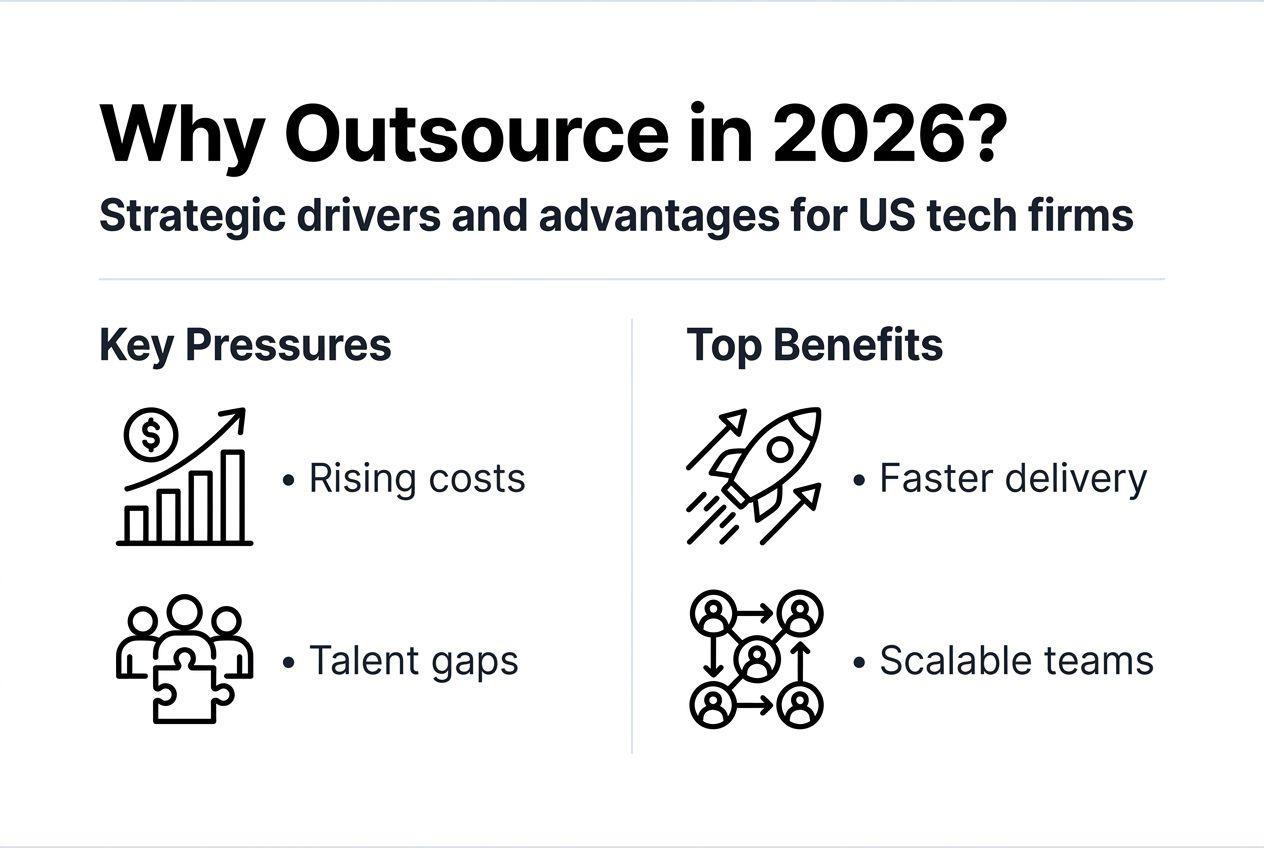
The decision to outsource stems from three converging pressures facing US tech companies in 2026. First, the cost structure of maintaining full time development teams has become unsustainable for many mid-sized firms. Outsourcing reduces total development costs by up to 40% by replacing fixed salary and benefits overhead with variable spending that scales with project needs.
Second, the US faces severe shortages in critical technology domains. Finding qualified professionals in data and AI expertise, agentic AI solutions, and cloud security has become nearly impossible in many regional markets. Global outsourcing opens access to talent pools with specialized capabilities that simply don’t exist locally. Companies can tap into expertise that would take years to develop internally, if it could be recruited at all.
Third, speed matters more than ever in competitive tech markets. Outsourcing accelerates time to market by 40 to 50% through 24/7 development cycles enabled by time zone differences. What your US team completes during business hours gets handed off to offshore developers who continue progress overnight. This continuous workflow dramatically compresses delivery timelines.
The strategic advantages include:
- Cost savings through variable spending models that eliminate fixed overhead
- Access to specialized skills in AI, machine learning, and emerging technologies
- Faster product launches through global collaboration and continuous development
- Scalability to ramp teams up or down based on project phases
- Focus on core business while external teams handle technical execution
These factors combine to make outsourcing a strategic growth lever rather than just a cost reduction tactic. Companies that recognize this shift position themselves to compete more effectively in 2026 and beyond.
Common misconceptions about outsourcing software development
Despite proven benefits, several myths persist about outsourcing that prevent companies from exploring it seriously. Understanding what’s fact versus fiction helps executives make informed decisions.
Myth: Outsourcing inevitably produces low quality code and creates communication nightmares. This outdated view stems from early outsourcing experiences when processes and tools were immature. Modern outsourcing partnerships use collaborative platforms, agile methodologies, and clear documentation standards that maintain quality. When you select partners carefully and establish strong processes, quality and communication become manageable challenges rather than insurmountable barriers.
Myth: Outsourcing means replacing your entire internal development team. Many executives fear losing institutional knowledge and technical capabilities. In practice, strategic outsourcing complements rather than replaces internal teams. You retain core architects and product owners while augmenting capacity with external specialists for specific projects or skill gaps. This hybrid model preserves knowledge while adding flexibility.
Myth: The only benefit of outsourcing is cutting costs. While cost optimization matters, viewing outsourcing solely through a financial lens misses the bigger picture. Access to scarce specialized talent often drives more value than savings alone. When your AI research development team needs machine learning expertise you can’t hire locally, outsourcing becomes essential for innovation.
The reality is that successful outsourcing requires intentional strategy:
- Choose partners based on cultural fit and communication capabilities, not just cost
- Start with pilot projects to test relationships before committing to major initiatives
- Maintain active involvement rather than treating outsourcing as completely hands off
- Invest in collaboration tools and processes that bridge geographic distances
Pro Tip: Schedule overlapping work hours between your internal team and outsourced partners to enable real time collaboration. Even 2 to 3 hours of overlap dramatically improves communication and reduces delays from asynchronous handoffs.
The key insight is that outsourcing outcomes depend heavily on how you structure and manage the relationship. Poor execution creates the problems that fuel these myths, while thoughtful implementation delivers substantial value.
Outsourcing models and frameworks for US tech mid-sized companies
Choosing the right outsourcing model determines whether your engagement succeeds or struggles. Each approach offers distinct tradeoffs between cost, communication ease, and strategic alignment.
Offshore outsourcing to regions like Eastern Europe, Latin America, or Asia provides the lowest costs and largest talent pools. Developers in these markets typically charge 50 to 70% less than US equivalents with comparable technical skills. The primary challenge involves time zone differences that complicate real time communication. Your team may finish work just as offshore developers start their day, creating handoff delays. However, these time differences also enable continuous development when managed properly.

Nearshore outsourcing to countries like Mexico, Canada, or Latin American regions balances cost savings with communication ease. Rates run 30 to 50% below US levels while maintaining overlapping business hours for collaboration. Cultural and linguistic similarities often smooth working relationships. This model works well for projects requiring frequent interaction or rapid iteration cycles.
Dedicated team outsourcing creates long term partnerships where external developers function as extensions of your internal organization. Rather than project based engagements, you build ongoing relationships with specialists who deeply understand your products and business context. This approach suits companies with continuous development needs and strategic product roadmaps. The model trades some cost savings for better alignment and institutional knowledge.
| Model | Cost Savings | Communication | Best For | Key Challenge |
|---|---|---|---|---|
| Offshore | 50 to 70% | Difficult due to time zones | Large scale development, established products | Coordination across time zones |
| Nearshore | 30 to 50% | Easier with overlapping hours | Agile projects, frequent collaboration | Moderate cost savings |
| Dedicated Teams | 25 to 40% | Excellent with deep integration | Long term product development | Higher investment in relationship building |
Selecting your model depends on several factors:
- Choose offshore when cost optimization matters most and your project has clear specifications that minimize need for frequent changes
- Pick nearshore when collaboration and communication outweigh maximum cost savings, particularly for agile or iterative projects
- Opt for dedicated teams when building strategic products that require ongoing development and you need partners who understand your business deeply
- Consider hybrid approaches that combine models for different project components
Companies often benefit from technical support and maintenance services using offshore models while keeping core product development nearshore or with dedicated teams. This hybrid strategy optimizes costs while maintaining quality where it matters most.
Case studies: real world outsourcing successes
Real world examples demonstrate how strategic outsourcing delivers measurable results for mid-sized tech companies facing similar challenges.
A healthcare technology provider faced mounting compliance requirements and needed to accelerate HIPAA audit preparation while launching new patient engagement features. Internal resources couldn’t handle both priorities simultaneously. The company partnered with a nearshore team specializing in healthcare compliance, reducing audit preparation time by 35% while maintaining development velocity on product features. More importantly, the vendor’s expertise helped identify security gaps that would have failed audit, preventing costly remediation cycles.
A financial services startup needed to launch a mobile banking platform within six months to compete with established players. Building an internal team with the required iOS, Android, and backend expertise would have taken over a year. They engaged a dedicated offshore team with proven fintech experience. The partnership delivered a production ready application in five months, six months faster than the internal timeline. Ongoing collaboration evolved into a long term relationship supporting continuous platform improvements.
Key outcomes from successful outsourcing implementations include:
- 30 to 40% cost reductions compared to building equivalent internal capacity
- Accelerated time to market by 4 to 6 months for major product launches
- Access to specialized expertise in compliance, security, and emerging technologies
- Improved scalability to handle variable workloads without layoffs or extended hiring cycles
- Enhanced innovation through exposure to different technical perspectives and approaches
These results didn’t happen by accident. Each company invested time in partner selection, established clear communication protocols, and treated outsourced teams as strategic partners rather than disposable vendors. They also started with smaller pilot projects to validate relationships before committing to larger initiatives.
Explore more real world outsourcing case studies to see how companies in your industry achieved similar results. The technical support case study particularly demonstrates how ongoing partnerships deliver compounding value over time.
Practical guidance: how to outsource software development successfully
Successful outsourcing requires systematic planning and execution. Follow these steps to maximize your chances of positive outcomes.
-
Define clear project scope and objectives before contacting vendors. Document technical requirements, success metrics, timeline expectations, and budget constraints. Vague requirements lead to misaligned expectations and project failures. Be specific about what you need and what success looks like.
-
Identify specific skill gaps in your internal team. Are you missing AI expertise, mobile development capabilities, or DevOps knowledge? Understanding your gaps helps target partners with complementary strengths rather than general development shops.
-
Research and vet potential partners thoroughly. Evaluate technical capabilities through code samples and technical interviews. Verify security practices and compliance certifications relevant to your industry. Check references from companies similar to yours. Review software ownership guidelines to understand intellectual property arrangements.
-
Select the outsourcing model that fits your communication needs and budget. Use the frameworks from earlier sections to match your situation with appropriate engagement structures.
-
Start with a pilot project lasting 4 to 8 weeks. This limited engagement tests the relationship with manageable risk. Evaluate communication responsiveness, code quality, and cultural fit before expanding scope.
-
Establish clear communication protocols and collaboration tools. Define meeting schedules, status reporting cadence, and escalation procedures. Use project management platforms that provide visibility into progress and blockers.
-
Set measurable milestones and review cycles. Break projects into deliverable chunks with defined acceptance criteria. Regular reviews catch issues early before they compound.
-
Integrate outsourced teams into your development processes. Share your agile transformation roadmap and involve external partners in sprint planning and retrospectives. Treat them as team members, not external contractors.
-
Implement continuous integration and deployment practices. Follow proven DevOps implementation guide principles to automate testing and deployment, reducing integration friction.
Pro Tip: Assign an internal technical lead as the primary liaison with your outsourcing partner. This person bridges communication, provides context, and ensures alignment. Having a single point of contact prevents confusion and keeps projects on track.
The most common failure mode is treating outsourcing as purely transactional. Companies that succeed view external partners as extensions of their team, invest in relationships, and maintain active involvement throughout projects.
Conclusion: making outsourcing a strategic advantage
Outsourcing software development has fundamentally evolved from a cost cutting measure into a strategic capability that drives competitive advantage. Mid-sized US tech companies in 2026 face unprecedented pressure from rising labor costs, talent shortages in critical domains like AI and cloud technologies, and accelerating market demands.
Strategic outsourcing addresses all three challenges simultaneously. It optimizes costs by converting fixed overhead into variable spending that scales with needs. It provides access to specialized global talent pools that don’t exist in constrained US markets. It accelerates time to market through continuous development workflows and dedicated expertise.
Success requires moving beyond outdated misconceptions about quality and control. Modern outsourcing partnerships built on clear communication, rigorous vendor selection, and structured processes deliver excellent outcomes. The key is approaching outsourcing strategically rather than tactically, starting with pilot projects, and building long term relationships with partners who understand your business.
Companies that integrate outsourcing into their development strategy position themselves to compete more effectively, innovate faster, and scale operations without the constraints of local talent markets. The question isn’t whether to outsource but how to do it in ways that maximize strategic value.
Explore full cycle development services to see how strategic partnerships can accelerate your product roadmap while optimizing costs and accessing specialized capabilities.
Explore devPulse software development services
Ready to implement the outsourcing strategies discussed in this guide? devPulse delivers end to end software development solutions that adapt to your specific needs and business context.
Our full cycle development solutions cover everything from initial architecture through deployment and scaling. We offer flexible engagement models including offshore, nearshore, and dedicated teams to match your communication preferences and budget constraints.
Beyond initial development, our technical support and maintenance services ensure ongoing reliability and performance. We bring deep industry specific software solutions expertise across healthcare, fintech, and enterprise technology sectors.
Partner with devPulse to transform outsourcing from a cost decision into a strategic growth lever. Contact us to discuss how we can help you achieve cost effective, scalable, and innovative outcomes.
Frequently asked questions about outsourcing software development
What are the main risks of outsourcing software development?
The primary risks include communication breakdowns due to time zones or language barriers, quality issues from inadequate vetting, and intellectual property concerns. Mitigate these through careful partner selection, clear contracts addressing IP ownership, pilot projects to test relationships, and established communication protocols with overlapping work hours.
How do I ensure quality when outsourcing?
Quality assurance starts with thorough vendor vetting including code reviews and technical interviews. Implement continuous integration with automated testing, define clear acceptance criteria for deliverables, and conduct regular code reviews. Start with small pilot projects to validate capabilities before committing to larger initiatives.
Which outsourcing model is best for my company size?
Mid-sized companies typically benefit most from nearshore or dedicated team models that balance cost savings with communication ease. If you need frequent collaboration and agile iteration, nearshore works well. For long term product development requiring deep business understanding, dedicated teams provide better alignment despite slightly higher costs.
Can outsourcing speed up AI and cloud projects?
Absolutely. Outsourcing provides immediate access to specialized AI and cloud expertise that takes years to develop internally. Global talent pools contain specialists in machine learning, cloud architecture, and emerging technologies that are scarce in US markets. This expertise accelerates projects by months compared to building capabilities from scratch.
How do I manage communication with offshore teams?
Schedule at least 2 to 3 hours of overlapping work time for real time collaboration. Use video conferencing for complex discussions and project management tools for asynchronous updates. Assign an internal technical lead as primary liaison, establish clear documentation standards, and create escalation procedures for urgent issues. Regular sprint ceremonies and retrospectives keep everyone aligned.
What should I include in outsourcing contracts?
Contracts must clearly define intellectual property ownership, confidentiality requirements, deliverable specifications with acceptance criteria, payment terms and milestones, communication expectations, and termination conditions. Include provisions for handling scope changes and dispute resolution. Consult legal counsel familiar with international software development agreements.