










Most engineering leaders assume that adding more people to a team will accelerate delivery. The data says otherwise. Optimal team size sits between 5 and 10 members, where coordination overhead stays low and focus time stays high. Push past that threshold and productivity starts to erode, not grow. This guide walks you through the evidence-based strategies that actually move the needle: team structure, psychological safety, methodology selection, performance metrics, AI integration, and diversity practices that translate directly into stronger output and tighter collaboration.
Table of Contents
- Why team size and structure matter most
- Building psychological safety: The hidden performance driver
- Methodologies that accelerate collaboration and output
- Metrics for engineering success: DORA, SPACE, and the AI effect
- AI impact: Supercharging and safeguarding your engineering teams
- Best practices for diverse and resilient engineering teams
- Empower your engineering team with custom solutions
- Frequently asked questions
Key Takeaways
| Point | Details |
|---|---|
| Optimal team size | Small squads of 5–10 engineers consistently outperform larger teams in productivity and focus. |
| Psychological safety | Team trust and openness can drive up to 27% higher performance and reduce turnover. |
| Methodology choices | Agile and async-first models cut meetings nearly in half and streamline delivery. |
| Metrics and oversight | Using DORA, SPACE, and AI-aware metrics enables continuous improvement and safe productivity gains. |
| Diversity impact | Building diverse, resilient teams increases innovation and can boost revenues by 19%. |
Why team size and structure matter most
The foundational decision in engineering team management is not which tools to use or which process to follow. It is how you size and organize your teams. Get this wrong and every other optimization you apply will underperform.
Research consistently points to a clear range. Amazon’s two-pizza rule targets 5 to 9 members per squad, with an average manager overseeing roughly 12.1 reports across the organization. Teams larger than 9 people show measurably lower output. Focus time drops to a median of 4.2 hours per day for larger teams, while elite teams consistently log 6 or more hours of uninterrupted work daily.
Three structural models dominate high-performing engineering organizations:
| Structure | Best for | Key benefit |
|---|---|---|
| Squad/pod model | Product-focused teams | Full ownership, fast decisions |
| Platform team | Organizations with 20+ engineers | Reduces cognitive load 40-50% |
| Feature team | Cross-functional delivery | Broad context, end-to-end ownership |
Smaller squads reduce the coordination tax. Fewer people in a room means fewer status updates, fewer approval chains, and more time writing code. If you are exploring team scalability strategies for a growing organization, structure is the first lever to pull.
Signs your team may be too large:
- Standups regularly run over 20 minutes
- Engineers are unclear on who owns which component
- Pull request review cycles stretch beyond 48 hours
- Onboarding new members takes more than 4 weeks
- Communication overhead consumes more than 30% of the workday
If you recognize more than two of these patterns, restructuring into smaller, dedicated teams with clear ownership boundaries is the highest-ROI move available to you.
Building psychological safety: The hidden performance driver
Structure sets the stage. But what separates good teams from elite ones is psychological safety, the degree to which team members feel safe to speak up, take risks, and admit mistakes without fear of punishment.
The numbers are striking. Teams with high psychological safety show 19 to 27% higher productivity and significantly lower turnover. Google’s Project Aristotle identified it as the single most important factor in team effectiveness, above technical skill, experience, or compensation.
“The highest-performing teams are not those with the most talented individuals. They are the ones where every member feels safe enough to contribute their best thinking.” — Project Aristotle analysis
Here is how to build it deliberately:
- Model vulnerability first. Share your own mistakes openly in team retrospectives. When leaders normalize failure as data, engineers follow.
- Respond to bad news with curiosity, not blame. Ask “what did we learn?” before asking “who is responsible?”
- Create structured feedback loops. Regular one-on-ones and anonymous pulse surveys give quieter team members a voice.
- Celebrate learning, not just shipping. Recognize engineers who surface problems early, even when those problems delay a release.
- Set high standards explicitly. Safety does not mean lowering the bar. It means making it safe to reach for it.
Pro Tip: Psychological safety and high standards are not opposites. The most effective engineering cultures hold both simultaneously. If your team never pushes back on technical decisions, that is a warning sign, not a sign of harmony.
For leaders building this culture from day one, strong team onboarding in IT practices are the fastest way to establish psychological safety before bad habits form.

Methodologies that accelerate collaboration and output
With the right structure and culture in place, the next question is operational: which methodology fits your team’s context?
Agile, Scrum, and Kanban each serve different needs. Scrum works well for teams with defined sprint goals and predictable delivery cycles. Kanban suits teams managing continuous flow work, such as platform or support engineering. Agile as a broader philosophy applies across both. The Spotify Agile framework extends these principles to larger organizations through squads, tribes, chapters, and guilds.
For organizations with 20 or more engineers, platform teams are a structural investment worth making. Platform teams cut cognitive load by 40 to 50% by abstracting shared infrastructure away from product teams, letting feature squads focus entirely on delivery.
Async-first communication is another high-leverage shift. Teams that move to async-first models reduce meeting time by 40 to 60%, freeing engineers for deep work. This is especially relevant for distributed or remote teams.
| Communication model | Meeting load | Deep work time | Best fit |
|---|---|---|---|
| Sync-heavy | High (8-12 hrs/week) | Low | Co-located, early-stage |
| Hybrid | Moderate (4-6 hrs/week) | Moderate | Mixed teams |
| Async-first | Low (1-3 hrs/week) | High | Distributed, mature teams |
How to select the right methodology for your team:
- Map your work type: is it project-based, flow-based, or exploratory?
- Assess team distribution: co-located teams tolerate more synchronous work
- Evaluate delivery cadence: fixed sprints vs. continuous deployment needs
- Consider team maturity: newer teams often benefit from Scrum’s structure
Pro Tip: Async-first works best when your team has strong written communication habits and clear documentation standards. If your engineers are not yet writing decisions down, start there before cutting meetings.
For teams working with external partners, agile outsourcing best practices and remote team productivity frameworks can help you extend these models beyond your internal org.
Metrics for engineering success: DORA, SPACE, and the AI effect
You cannot manage what you do not measure. But measuring the wrong things is worse than measuring nothing, because it creates false confidence.
DORA metrics remain the gold standard for engineering performance. Elite teams deploy multiple times per day, maintain a lead time under one day, keep change fail rates below 5 to 10%, recover from incidents in under one hour, and hold cycle times under 48 hours. These are not aspirational targets. They are benchmarks that top-quartile teams hit consistently.
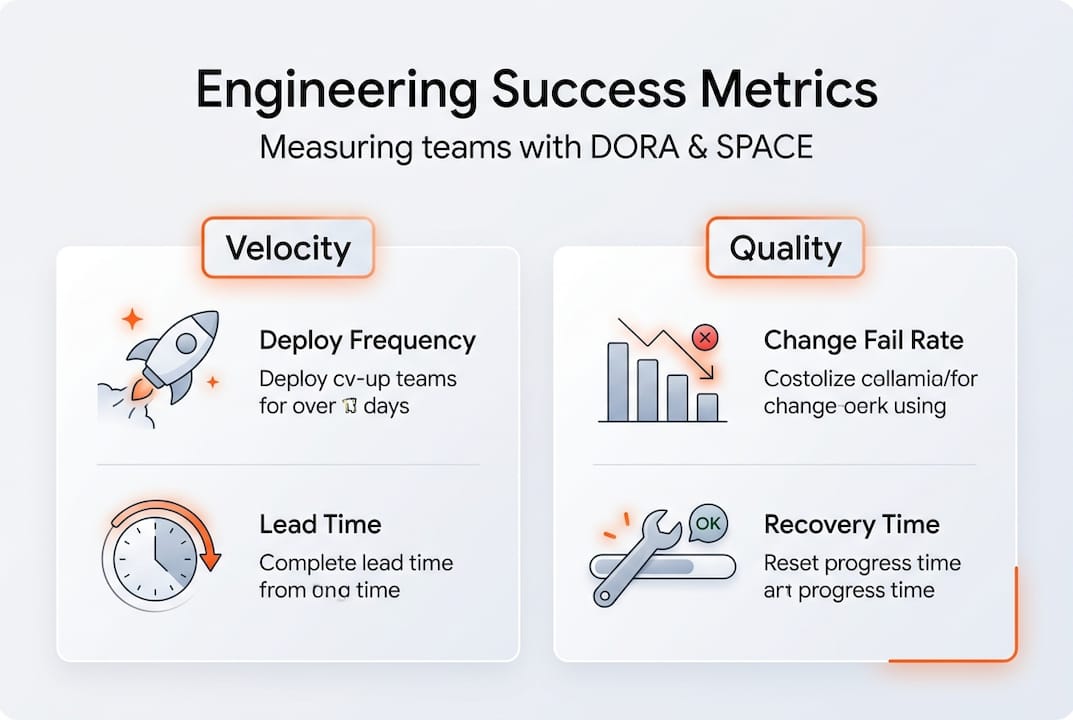
But DORA alone is insufficient. The SPACE framework adds dimensions that DORA misses: satisfaction, performance, activity, communication, and efficiency. The DX (Developer Experience) framework goes further, capturing how engineers actually feel about their tools, processes, and work environment.
What most teams miss when measuring performance:
- Unplanned work ratio: High unplanned work signals poor planning or technical debt accumulation
- Review turnaround time: Slow code reviews are a hidden bottleneck most dashboards ignore
- Onboarding velocity: How quickly new engineers reach full productivity reveals team health
- Documentation coverage: Undocumented systems create invisible risk
Pro Tip: Use metrics to start conversations, not end them. A rising change fail rate is a prompt to investigate, not a verdict on your team. Pair quantitative signals with qualitative check-ins to get the full picture.
For a practical approach to applying these frameworks, the engineering productivity workflow guide covers implementation in detail. You can also reference the DORA metrics guide for benchmark comparisons by team size and industry.
AI impact: Supercharging and safeguarding your engineering teams
AI-assisted development is no longer optional. It is the new baseline. But the productivity gains come with real risks that leaders must actively manage.
The upside is significant. AI tools boost engineering throughput by 20 to 55%, accelerating code generation, test writing, and documentation. The downside is equally real. AI-generated pull requests produce 1.7 times more issues than human-written code, with 40% more critical defects.
“AI dramatically increases output volume, but the 70/30 problem persists: AI handles 70% of cases well and fails on the 30% that require genuine contextual judgment.” — LLM-era productivity research
Implementing trust-but-verify oversight for AI-driven teams:
- Define AI-appropriate tasks. Use AI for boilerplate, test generation, and documentation. Keep complex business logic and security-critical code under human authorship.
- Require human review on all AI-generated PRs. Do not let AI output merge without a senior engineer sign-off.
- Track AI-attributed defect rates separately. This gives you a clear signal on where AI is helping and where it is introducing risk.
- Run regular edge case audits. AI fails most often on unusual inputs and boundary conditions. Build test suites that specifically target these scenarios.
- Invest in prompt engineering skills. The quality of AI output is directly tied to how well your engineers can direct it.
Pitfalls to watch for with AI-driven teams:
- Over-reliance on AI for architectural decisions
- Reduced code review rigor because output “looks clean”
- Engineers losing deep problem-solving skills through disuse
- Compliance and IP risks from AI-generated code in regulated industries
For SaaS organizations scaling engineering capacity, the scaling SaaS teams guide addresses AI integration within a growth context.
Best practices for diverse and resilient engineering teams
Diversity in engineering teams is not just a values statement. It is a performance strategy backed by hard data.
Diverse teams generate 19% more innovation and, according to BCG research, companies with diverse management teams report 19% higher revenue. The mechanism is straightforward: varied perspectives surface blind spots, challenge assumptions, and produce more robust solutions.
Practical ways to build diversity and resilience into your engineering organization:
- Audit your hiring funnel at each stage to identify where underrepresented candidates drop off
- Standardize technical interviews with structured rubrics to reduce evaluator bias
- Create explicit sponsorship programs that connect junior engineers from underrepresented groups with senior advocates
- Rotate team leads on projects to develop leadership depth across the organization
- Build psychological safety as a prerequisite for inclusion, because diversity without safety produces silence, not innovation
- Track retention by demographic to catch systemic issues before they become attrition crises
Pro Tip: Make inclusion measurable. Set specific, time-bound targets for representation at each level of your engineering organization and review them quarterly. What gets measured gets managed.
Resilience follows naturally from diversity when you also invest in cross-training, documentation, and redundant ownership. For workforce planning at scale, IT scalability strategies covers how to build teams that can absorb change without losing momentum.
Empower your engineering team with custom solutions
The strategies in this guide, from right-sizing your squads to implementing AI oversight, require more than good intentions. They require the right technical foundation and the right partners to execute them at scale.
At DevPulse, we work directly with engineering leaders to design, build, and scale the systems that make high-performing teams possible. Our engineering services cover everything from team structure consulting to custom platform development. Our AI services help you integrate AI-driven tools with the oversight frameworks your organization needs to stay reliable and secure. Browse our engineering case studies to see how we have helped companies across healthcare, SaaS, and enterprise software build teams that consistently deliver. If you are ready to move from strategy to execution, we are ready to help.
Frequently asked questions
What is the ideal size for an engineering team to maximize productivity?
Teams of 5 to 10 members deliver the best balance between coordination and output, with Amazon’s two-pizza rule targeting 5 to 9 as the practical sweet spot. Larger teams introduce coordination overhead that erodes focus time and slows delivery.
How can engineering leaders build psychological safety in their teams?
Leaders should model vulnerability openly, frame failures as learning opportunities, and set high standards alongside a culture of open feedback. These behaviors, practiced consistently, build the trust that drives elite team performance.
Do Agile and async-first methodologies really improve engineering efficiency?
Yes. Agile, Scrum, and async-first approaches reduce meeting time by 40 to 60%, freeing engineers for deep work and enabling faster, more consistent delivery cycles.
How can AI be safely integrated into engineering workflows?
AI boosts throughput by 20 to 55% but increases bug rates, so leaders must apply trust-but-verify oversight, require human review on AI-generated code, and maintain human authorship for security-critical and complex logic.
What metrics should engineering leaders track for team performance?
DORA metrics covering deployment frequency, lead time, change fail rate, and MTTR provide the core performance baseline, while SPACE and DX frameworks add team health and developer experience dimensions that DORA alone cannot capture.