













Engineering managers face a constant challenge: coordinating multiple teams, balancing technical leadership with administrative duties, and ensuring projects ship on time without burning out your engineers. Inefficient workflows create bottlenecks that slow delivery, fragment communication, and drain team morale. This guide walks you through proven practices for building engineering management workflows that enhance productivity, streamline collaboration, and scale effectively. You’ll learn actionable steps to structure your team cadences, integrate project oversight with technical leadership, adopt scaling frameworks intelligently, and leverage AI tools to eliminate coordination waste.
Table of Contents
- Key takeaways
- Preparing effective workflows: foundations every engineering manager needs
- Executing project management and technical leadership responsibilities with workflow clarity
- Scaling engineering workflows: adapting frameworks and reducing bureaucracy
- Improving workflows continuously: metrics, reducing waste, and AI-driven solutions
- Enhance your engineering workflows with expert support
- Frequently asked questions
Key Takeaways
| Point | Details |
|---|---|
| Cadences and async collaboration | Structured weekly cadences and async collaboration improve team alignment and throughput. |
| Balance PM and tech leadership | Sustains productivity by pairing project oversight with technical credibility. |
| Scaling frameworks for coordination | Employ scaling frameworks like Essential SAFe to coordinate large teams while avoiding bureaucracy. |
| Waste reduction through metrics | Target waste reduction by measuring cycle time and deployment frequency. |
| AI driven backlog triage | Leverage AI tools to eliminate bottlenecks in backlog triage and velocity prediction. |
Preparing effective workflows: foundations every engineering manager needs
Before you can optimize team productivity, you need foundational structures that create clarity and reduce friction. The best engineering workflows start with predictable cadences, realistic capacity planning, and communication patterns that respect deep work.
Engineering managers use weekly sprint planning, Monday alignment meetings, and 24-hour timeboxed commitments per engineer per sprint to boost productivity. This rhythm establishes clear priorities at the start of each week and prevents scope creep mid-sprint. Sprint planning sessions should be timeboxed to 90 minutes maximum, with pre-work completed asynchronously so the meeting focuses on clarification and commitment rather than discovery.
Capacity tracking forms the backbone of sustainable workflows. Calculate available hours by subtracting meetings, on-call rotations, and planned time off from total work hours. Most engineers deliver 20 to 25 productive hours per week after accounting for coordination overhead. Use this realistic baseline to size sprint commitments and avoid the burnout cycle of overcommitment and missed deadlines.
Async-first communication minimizes coordination overhead and protects focus time. Establish norms where updates, decisions, and discussions default to written formats in project management tools or documentation systems. Reserve synchronous meetings for complex problem solving, brainstorming, or relationship building. This approach particularly benefits distributed teams across time zones and creates a searchable record of decisions.
Cadence comparison:
| Cadence type | Frequency | Duration | Primary purpose |
|---|---|---|---|
| Sprint planning | Weekly | 90 min | Commitment and prioritization |
| Daily standup (async) | Daily | 15 min | Progress updates and blocker identification |
| Monday alignment | Weekly | 30 min | Cross-team coordination and dependency management |
| Retrospective | Bi-weekly | 60 min | Process improvement and team health |
| One-on-ones | Weekly or bi-weekly | 30 min | Career development and feedback |
Pro Tip: Block 2 to 3 hours of uninterrupted time immediately after your Monday alignment meeting for focused execution work. This prevents the common pattern of back-to-back meetings consuming your entire day and models healthy work habits for your team.
Integrating these foundations requires deliberate calendar design. Map out your recurring meetings visually to identify clustering and fragmentation. Batch similar activities together, such as scheduling all one-on-ones on Tuesday and Thursday afternoons. This creates longer blocks of maker time for both you and your team. When scaling engineering teams, these patterns become even more critical to maintain as coordination complexity grows.
Consider how engineering outsourcing tips apply to workflow design when working with distributed or contract teams. Async-first practices and clear documentation standards become non-negotiable for success. Review the engineering management handbook for detailed templates and examples of effective cadence structures.
Executing project management and technical leadership responsibilities with workflow clarity
Effective engineering management requires juggling two distinct but interconnected responsibilities: overseeing project delivery and maintaining technical credibility. Your workflow must accommodate both without creating unsustainable workload or compromising either dimension.
Top engineering managers balance project management duties with technical leadership tasks like code reviews to maintain credibility and team efficiency. This dual focus prevents the common trap where managers become purely administrative, losing touch with technical realities and eroding their ability to make informed decisions or mentor effectively.
Weekly project and people management routine:
- Monday morning: Review sprint boards, identify at-risk items, and prepare for alignment meeting
- Monday afternoon: Conduct alignment meeting, update stakeholders on progress and blockers
- Tuesday and Thursday: Schedule all one-on-ones in afternoon blocks to preserve morning focus time
- Wednesday: Participate in 2 to 3 critical code reviews, focusing on architecture decisions or complex features
- Friday morning: Update project metrics, prepare retrospective topics, and plan next week’s priorities
- Friday afternoon: Administrative tasks, email cleanup, and strategic thinking time
Capacity balancing requires continuous attention throughout the sprint. Track actual versus estimated effort for completed work to calibrate future estimates. When new requests emerge mid-sprint, apply strict prioritization: either swap out existing work of equal size or defer to the next sprint. Resist the temptation to simply add more work, which destroys predictability and trust.
One-on-ones serve as your primary feedback and development channel. Structure these conversations using a shared agenda document that both you and the team member can add to throughout the week. Dedicate the first 15 minutes to their topics and concerns, then use remaining time for your feedback, career development discussions, or strategic alignment. Apply the SBI model (Situation, Behavior, Impact) when delivering feedback to make it specific and actionable rather than vague or judgmental.
Maintaining technical involvement prevents skill atrophy and keeps you connected to ground truth. Allocate 4 to 6 hours weekly for code reviews, focusing on areas where your experience adds the most value: architecture decisions, security considerations, performance implications, or mentoring junior engineers. Avoid reviewing routine changes that other senior engineers can handle. Occasionally take on small technical tasks on the critical path, such as investigating production incidents or prototyping proof-of-concept solutions.

Pro Tip: Use calendar batching for one-on-ones and code review sessions to reduce task switching overhead. Block Tuesday 1pm to 4pm for all your one-on-ones and Wednesday 9am to 11am for deep code review work. This creates predictable rhythms and protects longer focus periods.
Integrate IT staffing workflow optimization principles when planning resource allocation across projects. Consider how tech team scalability strategies inform your approach to distributing work and developing leadership capacity within your team. The engineering management handbook provides additional frameworks for balancing these competing demands.
Scaling engineering workflows: adapting frameworks and reducing bureaucracy
As your organization grows beyond 50 to 75 engineers, informal coordination breaks down. You need structured frameworks to maintain alignment without drowning in meetings and overhead. The key challenge is selecting and adapting a framework that provides necessary coordination while avoiding bureaucratic bloat.
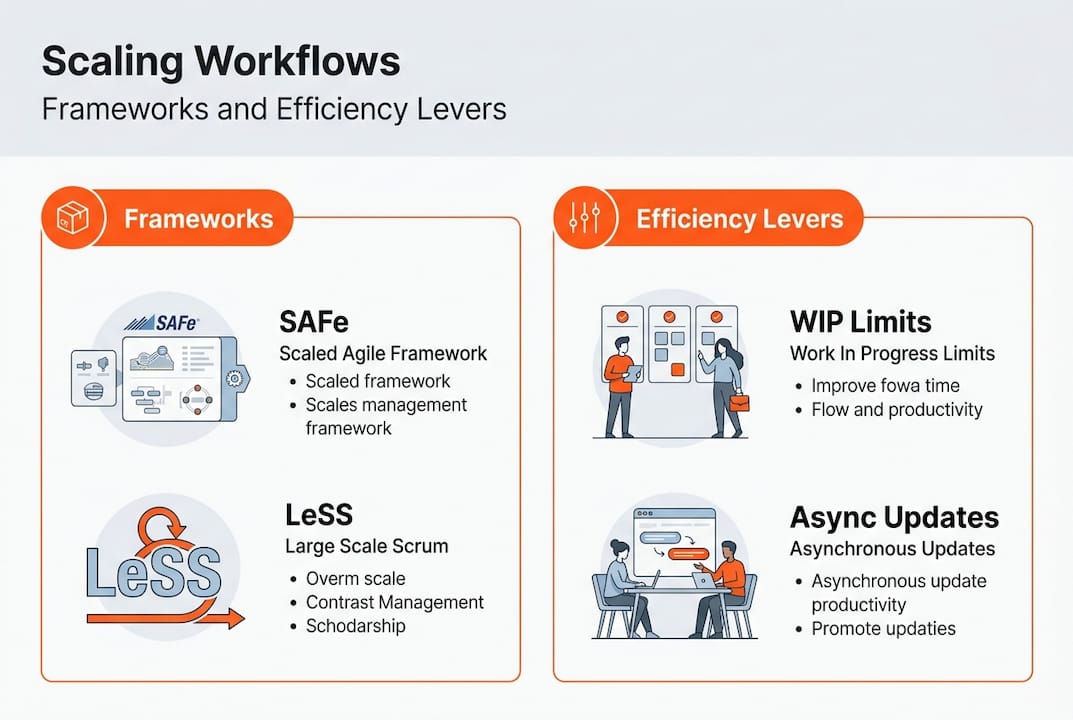
Scaled Agile Framework (SAFe) offers coordination at large scale but risks bureaucracy if rigid; alternatives like LeSS and Nexus provide minimalist scaling options. Each framework makes different tradeoffs between structure and flexibility.
Scaling framework comparison:
| Framework | Ideal team size | Ceremony complexity | Key strength | Common pitfall |
|---|---|---|---|---|
| Essential SAFe | 50 to 125 engineers | Medium | Clear roles and cadences for program-level coordination | Over-engineering with full SAFe too early |
| LeSS (Large-Scale Scrum) | 2 to 8 teams | Low | Minimal additional process, preserves Scrum principles | Requires strong self-organization culture |
| Nexus | 3 to 9 teams | Low | Lightweight integration team model | Limited guidance for portfolio-level planning |
| Spotify Model | Variable | Low to Medium | Emphasizes autonomy and alignment | Often misunderstood as prescriptive rather than descriptive |
Prioritize Essential SAFe and adapt practices to reduce work in progress and improve flow efficiency. Start with the core elements: Program Increment (PI) planning every 8 to 12 weeks, Scrum of Scrums for daily coordination, and a shared backlog with clear prioritization. Resist the urge to implement every SAFe ceremony and artifact immediately. Add structure only when coordination pain points clearly justify the overhead.
Best practices for adopting Essential SAFe:
- Begin with PI planning to establish quarterly alignment and dependency mapping across teams
- Limit initial adoption to 3 to 5 teams to learn the framework before expanding
- Customize ceremonies to fit your organization rather than following SAFe prescriptions rigidly
- Measure coordination overhead as a percentage of total engineering capacity and keep it below 15%
- Establish clear escalation paths for cross-team blockers that emerge between planning sessions
- Create lightweight dependency tracking visible to all teams to surface integration risks early
Work in progress limits form a critical lever for maintaining flow efficiency as you scale. Implement WIP limits at the team level first, then extend to program-level initiatives. A common starting point is limiting each engineer to one to two active tasks and each team to total WIP equal to team size. Monitor cycle time metrics to validate whether WIP limits improve flow or create artificial constraints.
Beware of scaling frameworks becoming “Waterfall in disguise.” This happens when PI planning becomes rigid long-term commitments with no flexibility, when teams wait for centralized approval before making decisions, or when documentation and process compliance overshadow working software. Maintain agility by preserving team autonomy for implementation decisions, keeping planning horizons to 8 to 12 weeks maximum, and measuring outcomes rather than process compliance.
Consider how agile transformation roadmap principles apply to your scaling journey. Review the scaled agile framework documentation for detailed implementation guidance, but remember that successful scaling requires adaptation to your specific context rather than blind adherence to any framework.
Improving workflows continuously: metrics, reducing waste, and AI-driven solutions
Workflow optimization never ends. The best engineering organizations treat their internal processes as products, continuously measuring performance and running experiments to identify improvements. Data-driven process improvement separates high-performing teams from those stuck in mediocrity.
High-performing teams improve flow efficiency by reducing wait times and focusing on throughput, deployment frequency, and cycle time metrics. These Core 4 metrics provide a balanced view of delivery performance without creating perverse incentives.
Core 4 metrics benchmarks:
| Metric | High performers | Typical performers | What it measures |
|---|---|---|---|
| Throughput | 15+ PRs per engineer per month | 6 to 10 PRs per engineer per month | Volume of completed work |
| PR cycle time | Less than 24 hours | 3 to 5 days | Speed from PR creation to merge |
| Deployment frequency | Multiple per day | Weekly to monthly | Release cadence and automation maturity |
| Time to restore service | Less than 1 hour | 1 to 24 hours | Incident response effectiveness |
Identifying waste in your workflows requires systematic observation and measurement. Common sources of waste drain productivity without adding value to customers or the business.
Common waste sources in engineering workflows:
- Code review wait times exceeding 24 hours due to unclear ownership or insufficient reviewer capacity
- Context switching from juggling 3 or more concurrent tasks or responding to constant interruptions
- Production delays from manual deployment processes or inadequate test coverage
- Rework caused by unclear requirements, insufficient design review, or technical debt
- Meetings without clear agendas, decisions, or action items that could have been async updates
- Knowledge silos where only one person understands critical systems or processes
Run reversible experiments to test workflow improvements. Change one variable at a time so you can attribute results clearly. For example, if you want to reduce code review wait times, try assigning explicit review owners for each PR rather than relying on voluntary pickup. Measure cycle time for four weeks, compare to the baseline, and decide whether to keep the change. Document your hypothesis, methodology, and results to build organizational learning.
AI workflows help tackle bottlenecks such as backlog triage and velocity prediction, saving approximately 30% of senior engineers’ coordination time. AI tools excel at pattern recognition and data synthesis tasks that consume disproportionate management attention.
Pro Tip: Leverage AI tools for backlog triage and velocity prediction to reclaim senior leaders’ time. Use large language models to categorize and prioritize incoming issues based on historical patterns, predict sprint capacity based on team velocity trends, and generate draft technical specifications from product requirements. This frees your most experienced engineers to focus on architecture decisions and mentoring rather than administrative coordination.
Integrate Data and AI capabilities into your workflow improvement initiatives. Explore Agentic AI solutions that can autonomously handle routine coordination tasks. Review AI powered change management approaches to smooth the adoption of new tools and processes. The developer productivity metrics guide and AI workflows guide offer deeper dives into measurement and automation strategies.
Enhance your engineering workflows with expert support
Building effective engineering management workflows requires both strategic vision and tactical execution. DevPulse specializes in helping technology leaders optimize their team processes, scale engineering organizations, and integrate AI-powered solutions that accelerate productivity gains.

Our software enhancement services combine deep technical expertise with practical workflow design to help your teams ship faster without sacrificing quality. We work alongside your engineering managers to implement data-driven process improvements, establish sustainable cadences, and build the infrastructure that supports high-performing teams. Explore our data and AI solutions to discover how intelligent automation can eliminate coordination bottlenecks and free your senior engineers for high-impact work. Review real-world software case studies showcasing how we’ve helped organizations transform their engineering workflows and achieve measurable productivity gains.
Frequently asked questions
What is the ideal sprint cadence for engineering teams?
Sprint cadences typically range from one to two weeks, with weekly planning and asynchronous daily updates helping align teams without excessive meeting overhead. Adjust sprint length based on team size, project complexity, and release cycles. Smaller teams or projects with frequent releases often benefit from one-week sprints, while larger initiatives with more dependencies may need two-week cycles to reduce planning overhead.
How can engineering managers balance technical leadership with administrative duties?
By scheduling dedicated blocks for code reviews and one-on-ones and using tools to automate tracking, managers maintain technical credibility without sacrificing leadership effectiveness. Allocate 4 to 6 hours weekly for technical work focused on high-impact areas like architecture reviews or mentoring. Delegate routine administrative tasks such as status reporting or meeting scheduling to free capacity for strategic activities.
What are common pitfalls when scaling engineering workflows using SAFe?
Overloading teams with ceremonies and rigid roles can create bureaucracy that slows delivery rather than improving coordination. Adopting Essential SAFe first and minimizing work in progress helps preserve flow while gaining necessary structure. Continuous adaptation based on team feedback and outcome metrics prevents the framework from becoming “Waterfall in disguise” with inflexible long-term commitments.
How does AI improve engineering management workflows?
AI automates backlog triage and dependency mapping, reducing manual coordination effort by up to 30% for senior engineers and managers. Predictive analytics inform more accurate sprint planning by analyzing historical velocity patterns and identifying risk factors. Natural language processing can generate draft specifications from product requirements, categorize incoming issues, and surface patterns in retrospective feedback that humans might miss.