













Cloud outsourcing is often misunderstood as simple IT task delegation, yet 68% of enterprises use third-party services for cloud migration, representing a fundamental shift in how organizations manage technology infrastructure. Cloud outsourcing involves engaging specialized providers to manage cloud-related IT services, moving from traditional in-house operations to scalable, cost-effective models. This guide clarifies methodologies, quantifies benefits, addresses risks, and provides strategic guidance for CTOs evaluating cloud outsourcing to drive operational efficiency and scalability in their enterprises.
Table of Contents
- Key takeaways
- Understanding cloud outsourcing: definitions and core concepts
- Models and methodologies in cloud outsourcing
- Benefits and measurable ROI of cloud outsourcing
- Risks, challenges, and governance in cloud outsourcing
- Strategic considerations for enterprise CTOs when outsourcing cloud services
- Explore DevPulse’s cloud and software engineering expertise
- Frequently asked questions about cloud outsourcing
Key Takeaways
| Point | Details |
|---|---|
| Cost savings and agility | It enables scalable resources and faster cloud migration while lowering capital expenditures. |
| Flexible engagement models | A mix of managed IT services, staff augmentation, project based engagements, and outcome as a service lets CTOs tailor governance, control, and costs. |
| Governance for risks | Effective governance is needed to manage vendor lock in, hidden costs, and security risks across multi cloud environments. |
| Outcome based and multi cloud | Outcome as a service and multi cloud strategies help balance benefits with risk by aligning contracts to measurable business results. |
Understanding cloud outsourcing: definitions and core concepts
Cloud outsourcing refers to engaging third-party providers to manage cloud infrastructure, applications, and related services on behalf of an enterprise. Unlike traditional IT outsourcing focused on discrete tasks or projects, cloud outsourcing shifts companies from CapEx to OpEx model enabling scalability and operational flexibility.
The distinction matters because cloud outsourcing emphasizes continuous managed services, consumption-based pricing, and dynamic resource allocation rather than fixed-term project delivery. This operational model allows enterprises to scale infrastructure up or down based on demand without significant capital investment in hardware or data centers.
Adoption rates demonstrate the strategic importance of this shift. 68% of enterprises use third-party providers for cloud migration, reflecting widespread recognition that specialized expertise accelerates cloud transformation while reducing implementation risks. These providers bring deep technical knowledge across multiple cloud platforms, security frameworks, and compliance requirements that would take years to build internally.
Key components of cloud outsourcing include infrastructure management, migration services, ongoing optimization, security monitoring, and application modernization. Enterprises typically engage providers for one or more of these areas depending on internal capabilities and strategic priorities.
Main cloud outsourcing service types:
- Managed IT services: Continuous operation and optimization of cloud infrastructure with defined SLAs
- Staff augmentation: Temporary specialists filling skill gaps for specific cloud initiatives
- Project-based: Fixed-scope engagements for migrations, implementations, or modernization efforts
- Outcome-as-a-service: Performance-based contracts where providers deliver specific business results
A well-structured cloud migration strategy guide helps enterprises navigate these options and select the right combination for their needs.
“Cloud outsourcing enables enterprises to access specialized expertise and scale infrastructure dynamically, with 68% of organizations leveraging third-party providers to accelerate migration timelines and reduce operational complexity.”
This foundational understanding positions CTOs to evaluate specific engagement models and methodologies that best align with organizational goals and risk tolerance.
Models and methodologies in cloud outsourcing
Enterprises can choose from several cloud outsourcing engagement models, each offering different levels of control, flexibility, and risk distribution. Understanding these models helps CTOs select approaches that match their strategic objectives and operational constraints.
Key models include managed IT services, staff augmentation, project-based, and outcome-as-a-service. Managed IT services provide continuous infrastructure operation with defined SLAs, ideal for enterprises seeking predictable costs and reduced operational burden. Staff augmentation adds specialized talent temporarily, maintaining internal control while filling skill gaps. Project-based engagements deliver specific outcomes like migrations or implementations within fixed scopes and timelines. Outcome-as-a-service aligns provider compensation with business results, creating strong incentives for performance optimization.

| Model | Best For | Control Level | Cost Structure | Risk Distribution |
|---|---|---|---|---|
| Managed IT Services | Ongoing operations | Medium | Monthly subscription | Shared operational risk |
| Staff Augmentation | Short-term skill gaps | High | Hourly or daily rates | Client retains project risk |
| Project-Based | Defined initiatives | Medium | Fixed or milestone-based | Shared delivery risk |
| Outcome-as-a-Service | Strategic transformation | Low to Medium | Performance-based | Provider assumes outcome risk |
Phased migration approaches reduce risk and improve outcomes by breaking complex transformations into manageable stages:
- Assessment and planning: Inventory existing systems, identify dependencies, and prioritize workloads for migration based on business value and technical complexity
- Pilot migration: Move non-critical workloads first to validate processes, refine procedures, and build organizational confidence
- Incremental rollout: Migrate workloads in waves, applying lessons learned and adjusting strategies based on real-world performance
- Optimization and refinement: Continuously monitor performance, optimize costs, and enhance security posture after initial migration completes
Phased migration reduces implementation time by 60% compared to big-bang approaches while minimizing business disruption. Agile iterative methods allow teams to adapt quickly to unexpected challenges, validate assumptions through testing, and incorporate stakeholder feedback throughout the journey.
Pro Tip: Prioritize outcome-based MSPs with strong SLAs and proven track records in your industry. This alignment ensures providers share accountability for business results, not just technical deliverables, creating partnerships focused on measurable value creation.
Effective tech team scalability strategies complement these engagement models by ensuring internal teams can effectively collaborate with external providers and maintain operational continuity.
Benefits and measurable ROI of cloud outsourcing
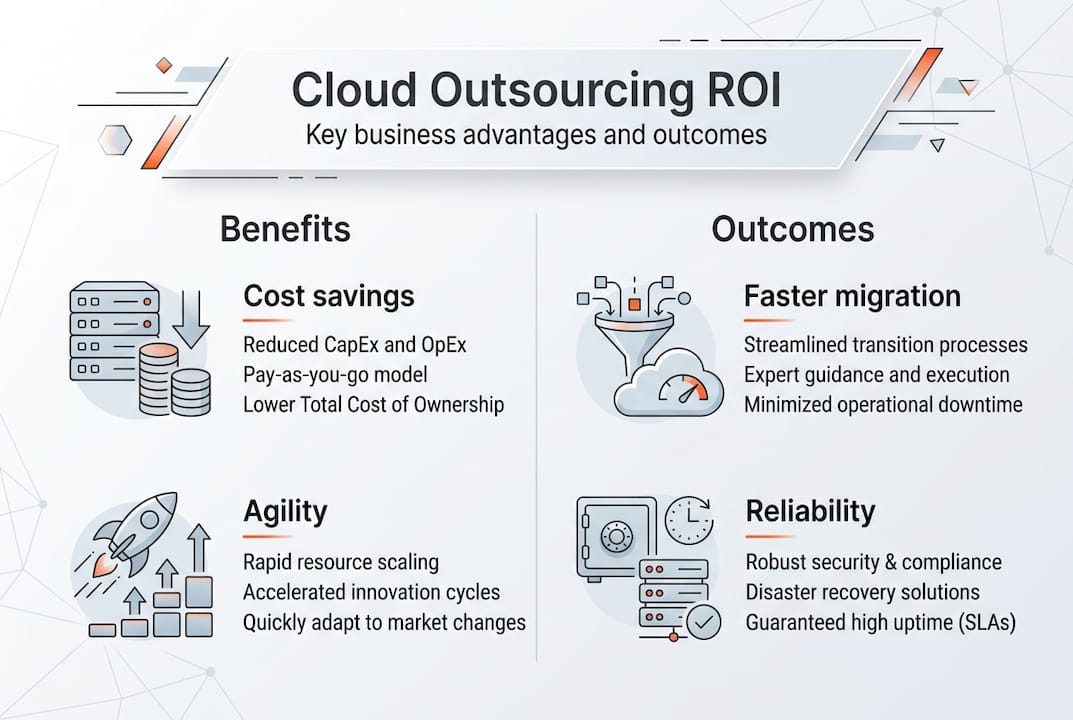
Cloud outsourcing delivers quantifiable operational and financial advantages that strengthen the business case for enterprise adoption. Understanding these benefits through empirical data helps CTOs justify investments and set realistic expectations for stakeholders.
Core benefits of cloud outsourcing:
- Cost efficiency: Elimination of capital expenditures for hardware and data centers, with 50% cost savings projections and 58% IT support cost reduction realistic for enterprises
- Faster deployment: Reduced provisioning times from weeks to hours, accelerating time-to-market for new capabilities
- Scalability: Dynamic resource allocation matching business demand without over-provisioning or capacity constraints
- Access to expertise: Specialized skills across multiple cloud platforms, security frameworks, and emerging technologies
- Core business focus: IT teams redirect effort from infrastructure management to strategic initiatives driving competitive advantage
Real-world case studies demonstrate the magnitude of potential returns. Accenture saved $20M+ via hybrid cloud; Box saved $2.23M via AWS optimizations, showcasing how enterprises across industries achieve substantial savings through strategic cloud outsourcing. Cummins reduced infrastructure costs by 30% while improving application performance through managed cloud services. A financial services firm cut disaster recovery costs by 60% by outsourcing backup and continuity operations to a specialized provider.
These outcomes reflect not just cost reduction but fundamental improvements in operational efficiency, resilience, and agility. Enterprises gain access to 24/7 monitoring, automated scaling, and continuous security updates that would require significant internal investment to replicate.
“Box achieved $2.23 million in annual savings through AWS infrastructure optimizations, demonstrating how strategic cloud outsourcing partnerships deliver measurable financial returns while improving operational performance and system reliability.”
The ROI calculation extends beyond direct cost savings to include reduced time-to-market, improved system reliability, enhanced security posture, and freed internal capacity for innovation. CTOs should establish clear metrics before engagement to track these benefits and validate investment decisions.
Successful engineering outsourcing tips help maximize these benefits by ensuring effective collaboration and clear accountability throughout the engagement.
Risks, challenges, and governance in cloud outsourcing
While cloud outsourcing offers significant advantages, enterprises face substantial risks that require proactive governance and mitigation strategies. Understanding these challenges helps CTOs design resilient approaches that balance benefits with prudent risk management.
Top cloud outsourcing risks include vendor lock-in through proprietary APIs and services, budget overruns from hidden data egress fees and unexpected consumption, concentration risks from single-provider dependency, security misconfigurations exposing sensitive data, loss of internal cloud skills over time, and sovereignty or compliance challenges in regulated industries.
70% of enterprises exceed cloud budgets due to hidden costs and misconfigurations, highlighting the critical importance of cost governance and technical oversight. Vendor lock-in and sovereignty issues present major compliance challenges for enterprises operating in regulated sectors or across multiple jurisdictions.
| Risk Category | Primary Causes | Mitigation Strategies |
|---|---|---|
| Vendor Lock-In | Proprietary APIs, specialized services | Use open standards, containerization, multi-cloud architecture |
| Budget Overruns | Hidden fees, uncontrolled consumption | Implement FinOps, set spending alerts, regular cost reviews |
| Security Gaps | Misconfigurations, inadequate controls | Automated compliance scanning, security baselines, regular audits |
| Compliance Issues | Data residency, regulatory requirements | Bring-your-own-key encryption, regional deployments, audit trails |
| Skill Erosion | Over-reliance on providers | Maintain internal cloud expertise, knowledge transfer requirements |
Governance best practices for cloud outsourcing:
- Establish FinOps discipline with cross-functional teams monitoring costs, optimizing resource allocation, and enforcing accountability
- Create cloud center of excellence (CCoE) providing standards, best practices, and architectural guidance across the organization
- Form cross-functional governance committees including IT, finance, security, compliance, and business stakeholders
- Implement automated policy enforcement through infrastructure-as-code and continuous compliance monitoring
- Define clear escalation paths and decision rights for technical and financial decisions
- Require regular reporting on performance metrics, security posture, and cost trends
Pro Tip: Design for portability from day one using open standards, containerization, and bring-your-own-key (BYOK) encryption. This investment in architectural flexibility reduces switching costs and strengthens negotiating position with providers, even if you never change vendors.
Effective cybersecurity in IT outsourcing requires continuous vigilance and clear accountability frameworks that extend security standards to external providers.
Robust governance transforms cloud outsourcing from a tactical cost decision into a strategic capability that delivers sustained competitive advantage while managing downside risks.
Strategic considerations for enterprise CTOs when outsourcing cloud services
Successful cloud outsourcing requires strategic planning that aligns technical decisions with business objectives while balancing efficiency gains against operational risks. CTOs must consider multiple factors when designing their approach.
Strategic recommendations for cloud outsourcing:
- Prioritize outcome-based MSPs with strong SLAs and multi-cloud strategies to balance efficiency and lock-in risk, ensuring providers share accountability for business results
- Implement phased migration approaches that reduce risk, validate assumptions, and build organizational capabilities incrementally
- Adopt multi-cloud or hybrid architectures that prevent single-vendor dependency while leveraging best-of-breed capabilities
- Enforce FinOps governance from the start with automated cost monitoring, budget controls, and regular optimization reviews
- Maintain internal cloud expertise even when outsourcing operations, ensuring you can effectively manage providers and make informed decisions
- Design for portability using containerization, open standards, and abstraction layers that reduce switching costs
- Establish clear success metrics before engagement, measuring both technical performance and business outcomes
Avoid outsourcing your cloud strategy development itself to external providers. While consultants can provide valuable input, core strategic decisions about architecture, vendor selection, and risk tolerance must remain internal to ensure alignment with business objectives and organizational culture.
Cross-functional teams and cloud center of excellence (CCoE) enhance governance in hybrid and multi-cloud setups by providing consistent standards, sharing best practices, and coordinating across organizational boundaries. CCoE should include representatives from IT operations, security, compliance, finance, and key business units to ensure holistic decision-making.
Pro Tip: Involve cross-functional teams early to codify cloud principles addressing security, compliance, cost management, and operational standards. This shared understanding prevents conflicts later and accelerates decision-making when issues arise during implementation.
Buy-before-build and cloud-first approaches create sustainable scalability by leveraging managed services rather than custom-building infrastructure components. This strategy allows internal teams to focus on differentiating capabilities that drive competitive advantage rather than recreating commodity functionality.
Successful outsourcing for digital transformation requires this strategic mindset, viewing external providers as partners in achieving business objectives rather than simply vendors delivering technical services. A well-designed modern tech stack guide helps ensure architectural decisions support both current needs and future flexibility.
Explore DevPulse’s cloud and software engineering expertise
Navigating cloud outsourcing decisions requires balancing technical complexity with business objectives. DevPulse brings deep expertise in software engineering services that help enterprises build, modernize, and scale cloud-based systems with confidence.
Our team has delivered measurable results across industries, as demonstrated in our software case studies featuring healthcare platforms, enterprise SaaS applications, and complex system modernizations. We combine technical depth with practical business focus, ensuring solutions align with your strategic objectives while managing operational risks.
Beyond initial implementation, our technical support and maintenance services provide ongoing optimization, security monitoring, and continuous improvement that keeps your cloud infrastructure performing at peak efficiency. This partnership approach ensures you gain both immediate capabilities and long-term operational resilience.
Pro Tip: Connect with experienced partners who complement your internal capabilities rather than replacing them. The most successful cloud transformations combine internal strategic oversight with external specialized expertise, creating partnerships focused on measurable business outcomes.
Frequently asked questions about cloud outsourcing
What exactly is cloud outsourcing?
Cloud outsourcing involves engaging third-party providers to manage cloud infrastructure, applications, and related services on behalf of an enterprise. Unlike traditional IT outsourcing focused on discrete projects, it emphasizes continuous managed services with consumption-based pricing and dynamic resource allocation. This model enables enterprises to access specialized expertise and scale infrastructure based on demand without significant capital investment.
How does cloud outsourcing differ from traditional IT outsourcing?
Cloud outsourcing emphasizes managed cloud infrastructure and operational models with continuous service delivery, while traditional IT outsourcing often focuses on discrete tasks or fixed-term projects. Cloud outsourcing shifts financial models from capital expenditures to operational expenditures, enabling greater flexibility and scalability. The focus on managed services, SLAs, and consumption-based pricing distinguishes cloud outsourcing from conventional IT service contracts.
What are the main risks associated with cloud outsourcing?
Vendor lock-in through proprietary APIs and data egress fees can limit flexibility and increase switching costs significantly. Hidden costs from unexpected consumption patterns cause 70% of enterprises to exceed cloud budgets without proper governance. Security misconfigurations, regulatory compliance challenges, and gradual loss of internal cloud expertise represent additional risks requiring active management and mitigation strategies.
How can enterprises maximize ROI from cloud outsourcing?
Choose outcome-based managed service providers with strong SLAs that align provider incentives with business results rather than just technical deliverables. Use phased, agile migration approaches that reduce risk and allow continuous refinement based on real-world performance. Implement FinOps governance with automated cost monitoring, spending alerts, and regular optimization reviews to control expenses. Adopt multi-cloud strategies using open standards and containerization to reduce vendor dependency while maintaining operational flexibility.