














TL;DR:
- Tech talent shortage is primarily a mismatch of skills, not just numbers of workers.
- Rapid technological change, especially AI, worsens the skill gap in critical areas.
- Building adaptable talent ecosystems through upskilling, outsourcing, and partnerships is key.
The tech talent shortage is widely misunderstood. Most leaders assume it’s a simple numbers problem: not enough developers in the market. But capability mismatches between available workers and what businesses actually need are driving most of the friction. The rise of AI, cloud infrastructure, and data-intensive systems has pushed skill requirements far faster than most education pipelines or hiring processes can keep up with. This guide breaks down what the talent shortage really means, what’s causing it to intensify, how to measure its impact on your organization, and what practical steps technology leaders can take to respond.
Table of Contents
- What is a talent shortage in tech?
- Why has the tech talent shortage intensified?
- How leaders measure and validate the shortage
- Business impact: risks, costs, and strategic responses
- Our perspective: What most leaders miss about tech talent shortages
- How devPulse helps you outmaneuver the tech talent shortage
- Frequently asked questions
Key Takeaways
| Point | Details |
|---|---|
| Skills over headcount | The tech talent shortage is more about mismatches in critical skills than just a worker shortage. |
| AI skills top demand | AI expertise now leads the list of hardest roles to fill in technology hiring for 2026. |
| Validate with multiple metrics | Combining employer surveys and job posting analysis gives a truer view of tech talent gaps. |
| Strategic adaptation is key | Leaders offset shortages by upskilling, augmenting talent, and forming key partnerships. |
What is a talent shortage in tech?
The term “talent shortage” gets used loosely. It often triggers images of empty seats and desperate recruiters. The reality is more specific and, frankly, more actionable.
A tech talent shortage is fundamentally a mismatch. It’s the gap between the workers available in the market and the roles, responsibilities, and technical skill sets that businesses actually need. As the OECD notes, tech talent shortage means a mismatch of available workers and required roles and skills, not just raw headcount numbers.
A talent shortage doesn’t just mean “not enough people.” It means not enough people with the right capabilities, in the right place, at the right time.
This distinction matters enormously for how you respond. If the problem were purely about headcount, the solution would be simple: hire more. But when the shortage is about specific capabilities, such as training large language models, designing zero-trust security architectures, or building scalable microservices, the solution space gets more complex.
Understanding your tech talent pool basics is the first step toward diagnosing the real problem. A large candidate pool doesn’t guarantee the right skills are available. And a small pool can still meet your needs if it’s well-matched to your roadmap.
Here are some of the most common myths leaders carry into these conversations:
- Myth: There aren’t enough tech workers. Reality: There are millions of tech professionals. The shortage is specific to certain high-demand disciplines.
- Myth: Paying more solves it. Reality: Wage inflation helps attract talent but doesn’t create skills that don’t exist at scale.
- Myth: The shortage affects all companies equally. Reality: Smaller firms and those in legacy-heavy industries tend to feel it far more acutely.
- Myth: Remote work fixed the access problem. Reality: Remote hiring expanded the pool geographically but also increased competition for the same narrow skill sets.
- Myth: It’s a temporary hiring cycle. Reality: Structural drivers, especially AI adoption, make this a long-term strategic challenge.
Benchmarks for the shortage typically combine two inputs: employer-reported hiring difficulty (gathered through surveys) and labor market proxies like job-posting volume filtered by specific skill keywords. Neither source is perfect on its own. Together, they give a more reliable signal of where the real pressure points are.
Why has the tech talent shortage intensified?
With the foundation set, let’s explore why finding the right talent has become even tougher in recent years.
The pace of technology change is the single biggest driver. Skills that were cutting-edge three years ago are now table stakes. Skills that didn’t exist as job requirements two years ago, particularly in AI development and deployment, are now listed in hundreds of thousands of job postings.
According to CompTIA’s 2026 report, over 275,000 job postings in January 2026 referenced AI skills, making AI-related capability the most hard-to-find skill category in the tech labor market today.
| Skill area | Demand level | Hiring difficulty |
|---|---|---|
| AI model development | Very high | Very difficult |
| AI application integration | High | Difficult |
| Cloud architecture | High | Difficult |
| Cybersecurity (zero-trust) | High | Difficult |
| Data science and analytics | High | Moderate to difficult |
| DevOps and automation | Moderate to high | Moderate |
The table above reflects the current reality for most tech organizations: the skills tied to innovation and growth are precisely the ones that are hardest to source.
Pro Tip: Don’t conflate raw job opening counts with true talent gaps. A spike in postings can reflect urgency, budget availability, or unrealistic job descriptions, not necessarily that the talent doesn’t exist. Use job posting data as one signal, not the full picture.
Beyond AI, demand has surged across scaling IT workforce functions in cloud computing, cybersecurity, and data engineering. These disciplines require deep specialization built over years, which means even aggressive hiring programs face a time lag. Universities and bootcamps are producing graduates, but the curriculum often lags behind actual market requirements by 12 to 24 months.

For businesses competing in fast-moving markets, this lag in capability supply creates direct pressure on product development timelines, data and AI shifts strategy, and the ability to capture market opportunities before competitors do.
How leaders measure and validate the shortage
Once you know the drivers, how do you gauge whether your organization is genuinely affected, and to what extent?
Two primary methods dominate how tech leaders diagnose talent gaps. Each has real strengths and real blind spots.
| Method | Strengths | Weaknesses |
|---|---|---|
| Employer surveys | Captures lived hiring experience and internal sentiment | Subject to bias; reflects perception, not always market reality |
| Job posting analytics | Objective, large-scale, real-time signal | May over-count duplicate or unrealistic postings |
The most reliable approach is to triangulate both. As CompTIA’s 2026 data recommends, leaders should triangulate employer-reported hiring difficulty with labor market proxies like job-posting demand by skill keyword to get the clearest picture. Relying on just one source creates blind spots that lead to poor resource allocation decisions.
Here’s a practical audit process that executives can run internally:
- Map your current skill inventory. Survey your engineering and product teams to document what skills exist, at what proficiency level, and with what capacity headroom.
- Compare against your 12-month roadmap. Identify the specific technical capabilities your upcoming initiatives require.
- Pull job posting data. Use tools like Lightcast or LinkedIn Talent Insights to see how many postings exist for those skills and how long they’ve been open on average.
- Survey your hiring managers. Ask directly: which roles are taking longest to fill, and what’s causing friction? Is it candidate volume or candidate quality?
- Benchmark externally. Compare your time-to-fill and offer acceptance rates against industry benchmarks for your sector and company size.
- Identify your critical gap. Rank skills by business impact and hiring difficulty. That matrix tells you where to prioritize action.
This kind of structured audit turns a vague problem into a set of specific, manageable challenges. It also helps you build the business case for talent pool strategies that go beyond traditional recruiting.
Business impact: risks, costs, and strategic responses
Diagnosing the shortage is just the first step. What does it mean for your business strategy and results?
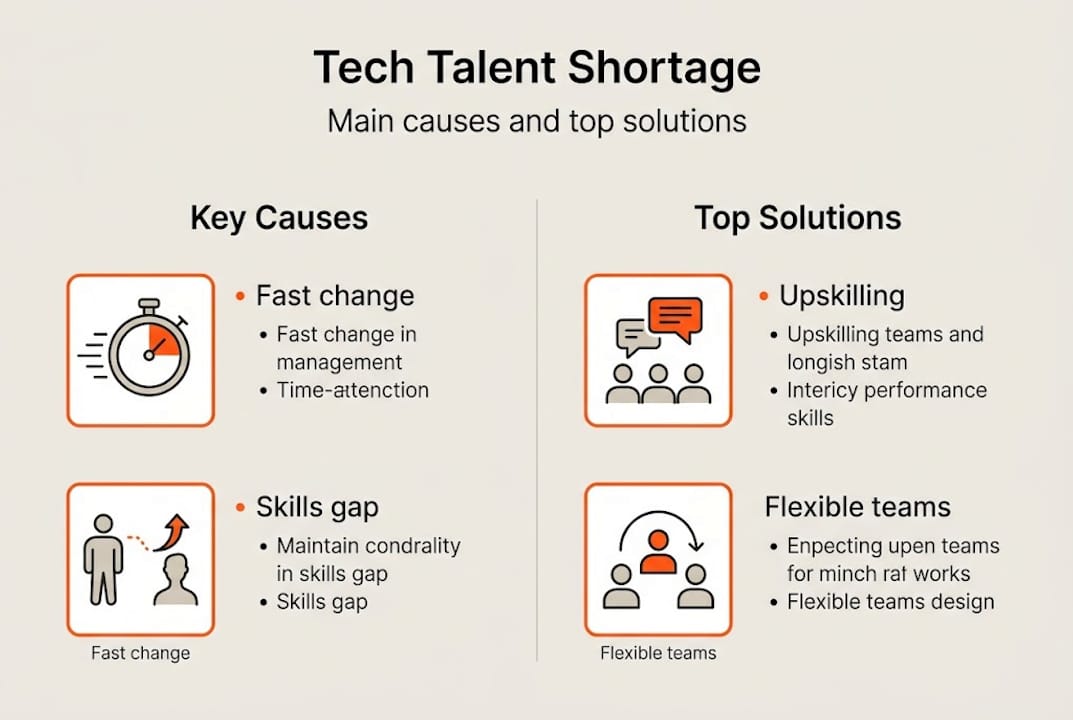
The consequences of an unaddressed talent gap are concrete and compounding. Talent shortages directly depress productivity and innovation for firms, and the effects ripple across multiple business functions quickly.
Here’s where the damage shows up most:
- Delayed product launches. Engineering bottlenecks caused by skills gaps push timelines out, often by weeks or months. In competitive markets, that timing loss is rarely recoverable.
- Wage inflation. Scarcity drives up compensation for in-demand roles. Companies bidding for the same small pool of AI engineers are seeing salary expectations increase well above general tech averages.
- Increased churn. Overloaded teams with skill gaps burn out faster. High performers leave when they’re doing the work of two or three people without the right support.
- Innovation drag. When teams are stretched thin on maintenance and execution, there’s little bandwidth left for R&D, prototyping, or exploring new product directions.
- Loss of competitive edge. Competitors who close their talent gaps faster move faster on product, which translates to market share over time.
Pro Tip: Blending in-house talent with external partners is one of the most effective ways to reduce pressure without overextending your hiring budget. It gives you speed and flexibility while you build internal capability at a sustainable pace.
Strategic responses that tech leaders are using right now include:
- Targeted upskilling programs focused on AI, cloud, and data skills for existing employees
- Staff augmentation to fill specific capability gaps on active projects
- Strategic outsourcing for specialized functions like scaling teams for growth
- Partnerships with software engineering firms that bring both technical depth and delivery experience
- Structured reskilling tracks that move high-potential engineers from legacy disciplines into modern stacks
The most resilient organizations aren’t the ones with the biggest hiring budgets. They’re the ones that build layered talent strategies and treat outsourcing success as a core operational capability, not a last resort.
Our perspective: What most leaders miss about tech talent shortages
Having covered the landscape, here’s a deeper, unconventional take on the issue that we think most discussions miss.
Almost every conversation about the tech talent shortage circles back to hiring: post more jobs, raise salaries, expand your recruiter network. But this framing treats the shortage as a sourcing problem when it’s really a structural design problem.
Organizations that build genuine resilience don’t just fill roles. They design adaptable skills ecosystems. That means investing in staff augmentation as a standing capability, building internal reskilling programs before gaps become crises, and forming engineering partnerships that bring capability on demand.
Forward-thinking firms we’ve worked with achieve more by maintaining a flexible blend of core in-house talent and trusted external teams. This isn’t a fallback position. It’s a deliberate strategy that gives them speed, coverage, and cost control simultaneously. The leaders who win on talent over the next decade won’t be the ones who hired the most. They’ll be the ones who built the most adaptable systems for acquiring, developing, and deploying capability.
How devPulse helps you outmaneuver the tech talent shortage
If you’re ready to address your talent challenges decisively, here’s how devPulse can help.
At devPulse, we work directly with technology leaders who can’t afford to let talent gaps slow down their roadmaps. Whether you need to accelerate AI product development, modernize a legacy platform, or staff a critical initiative quickly, our engineering teams bring deep capability across the exact disciplines that are hardest to hire for today.
Our Data and AI services help companies move from AI strategy to working product without the lengthy hiring cycles. Our software engineering solutions give you experienced teams that integrate cleanly with your existing organization. You don’t have to solve the talent shortage by yourself. Schedule a call with devPulse to see how we can close your capability gaps and keep your roadmap moving.
Frequently asked questions
What are the main causes of talent shortage in tech?
The main causes are rapid shifts in technology, especially AI, a mismatch between available skills and evolving business needs, and cross-industry competition for the same narrow talent pools. AI-related capability is consistently the top hard-to-find skill reshaping tech hiring in 2026.
How does the tech labor shortage impact business growth?
It delays product releases, caps company growth, raises compensation costs, and reduces bandwidth for innovation, making it harder to stay competitive. Productivity and innovation are directly hindered when tech skills shortages go unaddressed.
Which tech skills are in highest demand during the shortage?
AI model development, AI application integration, cloud architecture, data science, and cybersecurity top 2026’s most in-demand skill categories. AI skills dominate a large share of current job postings and are the hardest to fill.
How can technology leaders address their talent shortage?
The most effective approach combines upskilling current staff, using staff augmentation for active gaps, outsourcing specialized work, and building structured reskilling tracks. Strategic responses that blend internal and external talent pools consistently outperform pure hiring strategies.