














TL;DR:
- Outstaffing enables rapid team scaling within weeks, maintaining control and high quality.
- It reduces costs by eliminating recruiting, benefits, and workspace expenses, boosting speed to market.
- Effective integration and proactive management unlock long-term value beyond immediate capacity needs.
Most CTOs assume that hiring in-house is always faster, safer, and more reliable than any external model. The reality tells a different story. Outstaffing can double your team’s capacity within weeks, not quarters, while keeping quality high and overhead low. Yet the model remains widely misunderstood, often confused with outsourcing or dismissed as a short-term fix. If you’re leading engineering at a startup or midsize company and feeling the pressure to ship faster with the same headcount, this guide will show you exactly how outstaffing works, where it delivers the most value, and how to make it work for your team.
Table of Contents
- What is outstaffing and how does it work?
- Scalability: Growing your tech team on demand
- Efficiency gains: Lower costs, faster delivery, less administrative burden
- Building integration and long-term value with outstaffed teams
- What most tech leaders miss about outstaffing
- Supercharge your team with expert outstaff engineers
- Frequently asked questions
Key Takeaways
| Point | Details |
|---|---|
| Rapid scaling | Outstaffing enables tech teams to expand quickly without lengthy hiring processes. |
| Efficiency boost | Lower costs and faster delivery make outstaffing a lean solution for development projects. |
| Direct integration | Outstaffed engineers work as part of your core team for maximum control and collaboration. |
| Strategic value | With careful onboarding, outstaffed talent drives long-term success and innovation. |
What is outstaffing and how does it work?
Let’s be precise about the definition, because the terminology matters when you’re evaluating vendors and setting expectations with your board. Outstaffing is a model where a third-party provider employs engineers on their payroll, but those engineers work under your direct management, follow your processes, use your tools, and function as embedded members of your team. You control the work. The provider handles payroll, compliance, benefits, and HR.
This is fundamentally different from outsourcing, where you hand a project to a vendor and they deliver a result. As explored in this outsourcing vs outstaffing comparison of technology and software engineering models, the key distinction is control. With outstaffing, you retain full authority over sprint planning, code reviews, architecture decisions, and daily standups. With outsourcing, the vendor owns the delivery process.
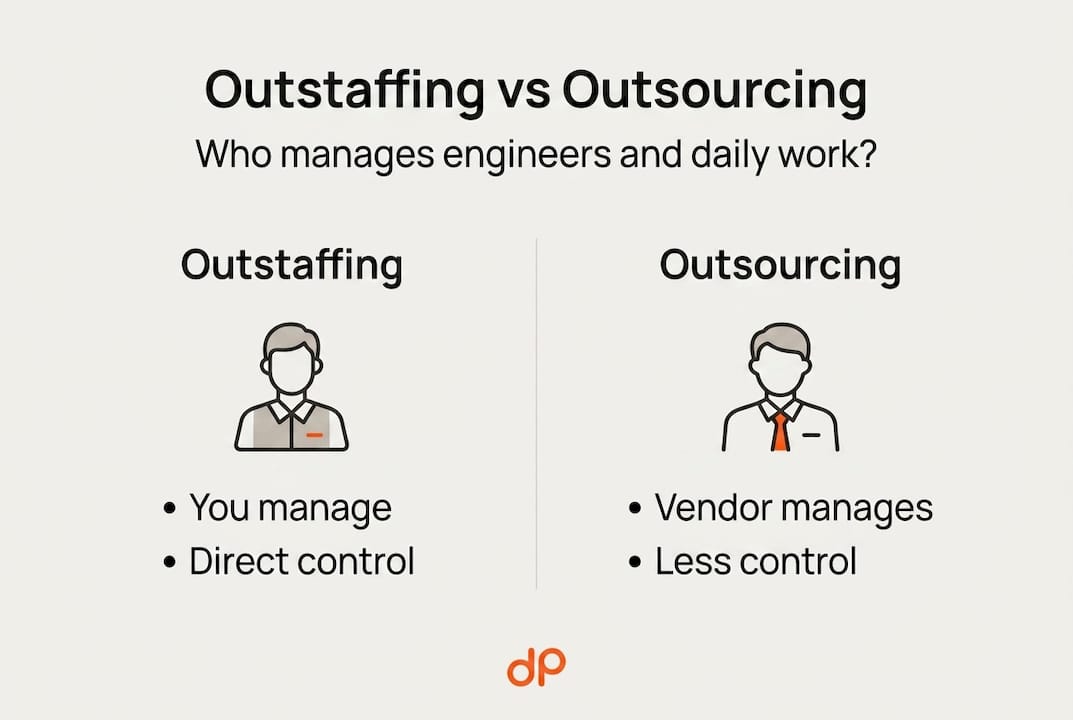
Here’s a side-by-side comparison to make the differences concrete:
| Factor | Outstaffing | Outsourcing | In-house hiring |
|---|---|---|---|
| Who manages engineers | You | The vendor | You |
| Who owns the outcome | You | The vendor | You |
| Speed to onboard | 1 to 2 weeks | Project-dependent | 2 to 4 months |
| HR and compliance | Provider | Provider | You |
| Flexibility to scale | High | Medium | Low |
| Cultural integration | High (direct collab) | Low to medium | High |
| Cost structure | Predictable monthly | Project-based | High fixed cost |
The outstaffing model is especially well-suited for teams that need specific technical roles, whether that’s a senior React engineer, a DevOps specialist, or a data engineer with machine learning experience, without going through a six-month hiring cycle.
Common misconceptions worth addressing directly:
- Outstaffed engineers are contractors, not team members. False. They attend your standups, contribute to your backlog, and collaborate in your Slack channels just like any other engineer.
- You lose IP ownership. Not true. Your contracts govern IP, and outstaffed engineers work within your codebase under your direction.
- Quality is lower with remote outstaffed talent. Also false. Quality depends on your vetting process and onboarding, not the employment model.
For a deeper look at the nuances, including when outstaffing is better than traditional outsourcing for specific tech stacks, the engineering outsourcing tips guide for tech executives covers the tradeoffs in detail.
The bottom line: outstaffing gives you the control of in-house hiring combined with the speed and flexibility of an external model. That combination is rare, and for high-growth tech teams, it’s often exactly what the situation demands.
Scalability: Growing your tech team on demand
With a firm grasp of outstaffing’s structure, let’s explore its biggest strength, which is scalability, and how tech leaders use it to grow capacity without the usual delays.
Speed is where outstaffing creates the most immediate, measurable advantage. Traditional hiring for a senior engineer takes an average of 45 to 90 days from job posting to first commit, and that’s if your recruiter pipeline is running well. With outstaffing, teams can scale in 14 days or less, which is a critical difference when you’re preparing a product launch or responding to a sudden increase in user load.

Here’s what a typical scalability scenario looks like in practice:
| Hiring model | Time to first productive day | Avg. cost to hire | Flexibility to scale down |
|---|---|---|---|
| In-house hire | 45 to 90 days | $28,000+ (US avg.) | Very low (severance, legal) |
| Outsourced project | Variable | Project-dependent | Medium |
| Outstaffed engineer | 7 to 14 days | Low (provider fee) | High (notice period only) |
The ability to scale down matters just as much as scaling up. A startup launching a new product vertical may need four additional engineers for six months, then reduce to one for maintenance. Outstaffing accommodates that without layoffs, severance packages, or difficult HR conversations.
How to do this effectively, step by step:
- Define the role precisely before you search. Vague requirements lead to poor matches. Specify the tech stack, seniority level, and expected deliverables.
- Request candidates with relevant domain experience. If your product is in healthcare or fintech, ask for engineers who have worked in regulated environments.
- Run a short technical assessment or paid trial sprint. This surfaces communication style, code quality, and collaboration patterns early.
- Assign a dedicated internal point of contact. Outstaffed engineers integrate faster when they have a clear person to align with during the first two weeks.
- Use your existing onboarding documentation. Don’t create a separate process. Treat them exactly like a new in-house hire.
The IT workforce scalability strategies that high-performing tech teams use consistently emphasize one principle: plan your scale-up before you need it. Reactive scaling is always more expensive and slower than proactive capacity planning.
Pro Tip: The biggest ramp-up mistake is skipping documentation. Engineers, outstaffed or otherwise, lose two to three weeks when your codebase has no architecture docs, no README, and no onboarding checklist. Fix that before your first outstaffed hire arrives. Also consider optimizing IT staffing workflows to reduce the friction between engagement and first productive commit.
Efficiency gains: Lower costs, faster delivery, less administrative burden
Once your team can scale quickly, the next critical factor is efficiency. Let’s see how outstaffing stacks up against other models in cost and speed.
Cost is the most cited reason CTOs explore outstaffing, but the real efficiency gains go well beyond the monthly rate. According to engineering cost analysis in the technology sector, outstaffing consistently reduces total cost of engineering talent by 30 to 60 percent compared to equivalent US-based in-house roles when you factor in salary, benefits, recruiting fees, equipment, and workspace.
Here’s where the savings actually come from:
- No recruiting agency fees. Traditional tech hiring often involves placement fees of 15 to 25 percent of first-year salary. With outstaffing, that cost disappears.
- No benefits overhead. Health insurance, 401(k) matching, paid time off, and equity administration can add 25 to 40 percent on top of base salary. The outstaffing provider absorbs all of this.
- No equipment or workspace cost. Outstaffed engineers work remotely with their own hardware, reducing your operational overhead.
- Faster delivery cycles. Shorter ramp-up times mean features ship sooner, which directly impacts your time-to-market and competitive positioning.
“The most significant hidden cost in traditional hiring isn’t the salary. It’s the three to four months of productivity lost during recruiting, notice periods, and onboarding.”
That time cost compounds. Every sprint delayed because a role is unfilled represents lost revenue potential, especially for SaaS companies where feature parity drives churn decisions. Streamlining IT staffing processes by switching to outstaffing has helped companies reduce their average feature release cycle by 20 to 35 percent.
The administrative burden reduction is also significant and often underestimated. When you outstaff:
- Payroll processing, tax filings, and compliance documentation are fully managed by the provider.
- Employment law variations across states or countries are handled externally.
- Termination risk is dramatically lower. Ending an outstaffing engagement requires only a notice period, not legal consultation or separation agreements.
For startups in particular, where your HR function may be a single generalist, this reduction in administrative load frees up leadership bandwidth for strategic decisions rather than people operations.
Pro Tip: Treat outstaffed engineers with the same communication rigor you’d apply to any critical business process. Use async-first documentation, weekly written status updates, and clear sprint definitions. The teams that get the most efficiency from outstaffing are those that communicate with precision, not volume. The IT staff augmentation advantages framework provides a useful structure for setting those standards from day one.
Building integration and long-term value with outstaffed teams
Efficiency is just the start. The real payoff comes from integrating outstaffed engineers for long-term impact. Here’s how to make it happen.
The most common failure mode in outstaffing is treating engineers as transactional resources rather than team members. When that happens, you lose knowledge continuity, you create invisible silos, and you limit the engineers’ ability to contribute beyond their assigned ticket queue. The solution is intentional integration.
Best practices for long-term integration:
- Include outstaffed engineers in sprint ceremonies. Planning, retrospectives, and demo sessions build shared context and mutual accountability.
- Pair them with internal engineers. A two-week pair programming rotation when a new outstaffed engineer joins accelerates context transfer dramatically.
- Create shared documentation standards. Everyone on the team, regardless of employment model, should document decisions, architecture changes, and API contracts in the same system.
- Recognize their contributions publicly. Shoutouts in team channels, inclusion in release notes, and acknowledgment in all-hands meetings reinforce belonging and motivation.
- Establish career touchpoints. Even for outstaffed roles, quarterly conversations about growth and skill development increase retention and engagement.
For distributed teams specifically, managing remote developers well requires intentional communication architecture, not just good intentions. That means asynchronous-first workflows, documented decisions, clear escalation paths, and regular one-on-one check-ins between your engineering leads and outstaffed team members.
The long-term value outstaffed engineers create often surprises CTOs who initially engaged them for tactical capacity. Over time, experienced outstaffed engineers bring:
- Cross-industry perspective. Engineers who’ve worked across multiple client environments often introduce patterns, tools, and approaches your internal team hasn’t seen.
- Objective technical feedback. Because they aren’t embedded in your internal politics, outstaffed engineers often surface technical debt and architecture issues more candidly.
- Knowledge transfer back to your core team. When outstaffed engineers work closely with internal staff, skills and best practices flow both ways.
- Reduced key-person dependency. Distributing knowledge across outstaffed and internal engineers makes your team more resilient to turnover.
The advantages of remote IT teams on high-impact projects include access to a global talent pool that often exceeds what any single metro area can offer. For specialized roles like security engineering, ML infrastructure, or embedded systems, outstaffing may be the only realistic path to finding the right skill set within your timeline.
Pro Tip: Build culture bridges, not just technical ones. Share your company values, product vision, and business context with outstaffed engineers the same way you would with any new hire. Engineers who understand why they’re building something will make better technical decisions than those who only know what to build.
What most tech leaders miss about outstaffing
Here’s the perspective that most standard guides won’t tell you: the CTOs who get the least value from outstaffing are those who treat it as a reactive measure. They open a role when a project is already behind, rush the search, skip proper onboarding, and then wonder why the outstaffed engineer isn’t performing at full capacity after two weeks.
The CTOs who extract the most value treat outstaffing as a permanent capability, not a temporary fix. They maintain ongoing relationships with providers, keep a bench of vetted engineers ready to activate, and build their engineering capacity model around flexible headcount from the start. That shift from reactive to strategic is the real unlock.
There’s also a missed opportunity in innovation. Outstaffed engineers who work across multiple client environments bring patterns, tools, and technical approaches your internal team may never encounter in isolation. That cross-pollination, when you actively encourage it, becomes a genuine competitive advantage.
The pitfall to avoid is under-utilization. When outstaffed engineers are given only isolated, low-context tasks, you’re not getting ROI. You’re getting output. The difference is enormous. When you integrate them fully, as we’ve covered, they contribute to scaling tech teams fast and to the kind of systemic improvements that compound over time.
Supercharge your team with expert outstaff engineers
If the frameworks in this article resonate with your current scaling challenges, the next step is connecting them to real execution. DevPulse works with startups, SaaS companies, and enterprise clients to build and scale engineering teams through proven outstaffing engagements.

Our engineering services are designed for tech leaders who need speed, quality, and control without the overhead of traditional hiring. From AI-powered development and cloud systems to cross-platform applications and legacy modernization, we match the right engineers to your specific stack and goals. Explore our case studies to see how we’ve helped companies accelerate delivery and scale teams efficiently. Ready to act? Visit DevPulse and let’s build something that lasts.
Frequently asked questions
How does outstaffing differ from outsourcing?
Outstaffing gives you direct control over engineers and daily operations, while outsourcing transfers responsibility for project outcomes to an external provider. The key distinction, as detailed in this software development model guide, is where management authority sits.
How quickly can an outstaffed team be onboarded?
Many outstaffing providers can add engineers to your team within 1 to 2 weeks, which is far faster than traditional hiring cycles. As covered in the 14-day scaling framework, structured onboarding processes make rapid integration achievable without sacrificing quality.
Do outstaffed engineers integrate well with existing teams?
Yes, they can be fully integrated when proper onboarding, communication practices, and cultural alignment are in place. The remote developer guide for CEOs and CTOs outlines the specific practices that make integration successful for both short-term and long-term engagements.
Does outstaffing reduce overall development costs?
Outstaffing often lowers total engineering expenses by 30 to 60 percent compared to traditional in-house hiring when you account for recruiting fees, benefits, and administrative overhead. The engineering outsourcing analysis for technology sector companies breaks down exactly where those savings occur.
What are the main challenges of managing outstaffed engineers?
Key challenges include onboarding gaps, asynchronous communication barriers, and maintaining shared team culture across distributed locations. These are all manageable with proactive planning, as detailed in the remote developer management guide for tech executives.