











TL;DR:
- IT outsourcing consultants offer strategic value beyond cost reduction, including technology roadmaps and digital transformation guidance. They manage vendor selection, SLAs, risk, and change transitions to support high-stakes initiatives. Success depends heavily on executive integration and clear leadership sponsorship.
Most C-suite leaders associate IT outsourcing consultants with one goal: reducing headcount costs. That assumption leaves significant value on the table. The IT outsourcing services market is valued at $9.87 billion in 2025 and is growing at a 10.44% CAGR through 2033, a scale that reflects something far beyond tactical cost management. These consultants are increasingly shaping technology roadmaps, managing complex vendor ecosystems, and driving digital transformation at the executive level. This guide breaks down what IT outsourcing consultants actually do, where they create the most strategic value, and how your organization can engage them for maximum impact.
Table of Contents
- What IT outsourcing consultants really do
- Strategic advantages for executive leadership
- Navigating risk: SLAs, communication, and engagement models
- When (and when not) to engage IT outsourcing consultants
- The overlooked secret: Consultants maximize speed and innovation only if you master executive integration
- How DevPulse can empower your IT outsourcing journey
- Frequently asked questions
Key Takeaways
| Point | Details |
|---|---|
| Beyond cost savings | IT outsourcing consultants deliver strategic transformation, not just budget reduction. |
| Minimize project failure | Clear SLAs and executive integration dramatically reduce outsourcing risks. |
| Leverage specialized expertise | Short-term, high-impact engagements fill skills and leadership gaps efficiently. |
| Know when to engage | Consultants are most effective for major transitions, not routine support. |
What IT outsourcing consultants really do
The term “IT outsourcing consultant” gets used loosely, but the actual scope of services is precise and substantial. These professionals sit at the intersection of business strategy and technology execution. They are not staff augmentation resources or generalist project managers. Their role is to evaluate your current IT landscape, identify gaps, and design or source solutions that align with your growth objectives.
Here is what that looks like in practice across core service categories:
- Technology strategy alignment: Consultants assess your existing systems, infrastructure, and vendor contracts against your business goals. They identify misalignments and propose corrective roadmaps.
- Vendor selection and management: They run RFP processes, evaluate vendor capabilities, and negotiate terms to ensure you get the right partners at the right cost structures.
- Contract and SLA negotiation: Poorly structured service level agreements are a leading failure driver. Consultants define performance metrics, escalation procedures, and remediation clauses before you sign.
- Transition support: When you move from one platform, vendor, or model to another, consultants manage the technical and operational handoff to minimize disruption.
- Risk management: They map compliance requirements (HIPAA, SOC 2, GDPR), identify security vulnerabilities in outsourced workflows, and implement governance frameworks.
Beyond these core services, consultants advise on technology roadmaps for two to five year horizons, lead project rescue engagements when initiatives are off track, and guide organizations through digital transformation value realization at scale.
| Service category | Primary deliverable | Typical timeline |
|---|---|---|
| Strategy alignment | Technology roadmap | 4 to 12 weeks |
| Vendor selection | Scored vendor shortlist + contract | 6 to 16 weeks |
| SLA negotiation | Finalized service agreements | 2 to 8 weeks |
| Transition support | Go-live and stabilization plan | 8 to 24 weeks |
| Risk management | Compliance and governance framework | 4 to 10 weeks |
One often overlooked data point: consulting engagements average just 3% of payroll and are episodic, typically lasting less than one year. That means the investment is contained, but the strategic output can shape your operations for years. This makes consultants particularly powerful for high-stakes initiatives where speed and specialized expertise matter more than institutional knowledge.
Understanding streamlining IT staffing decisions is also a natural extension of the consultant’s work. They help you determine when to build internal capability versus when to sustain an outsourced model long term.
Pro Tip: Engage a consultant specifically when you face a decision that requires expertise your internal team does not have and cannot develop quickly enough. Platform migrations, M&A technology integrations, and zero-trust security architectures are examples where consultant-led speed and specialization deliver outsized returns.
Strategic advantages for executive leadership
Now that their functions are clear, let’s analyze how consultants empower executive teams to achieve big-picture business targets.
The most underappreciated function of an IT outsourcing consultant is translation. Senior leaders often speak in terms of revenue growth, market share, and operational efficiency. Technology teams speak in terms of APIs, microservices, and sprint cycles. Consultants bridge that language gap by converting business objectives into measurable technology deliverables with defined timelines, budgets, and accountability structures.
Consider what that looks like across three common executive scenarios:
- Digital modernization: A CFO wants to reduce operational costs by 20% over 18 months. A consultant translates that into a legacy system decommissioning plan, a cloud migration timeline, and a vendor consolidation roadmap with projected savings at each milestone.
- M&A technology integration: A CEO acquires a company with an incompatible tech stack. A consultant assesses both environments, identifies integration priorities, and manages the technical alignment to protect deal value.
- Compliance and security upgrades: A CISO needs to meet new regulatory requirements without disrupting operations. A consultant maps the gap between current controls and required standards, then sources and manages the implementation partner.
Agile outsourcing frameworks become especially important in these scenarios, enabling faster iteration and stronger alignment between business stakeholders and delivery teams.
The comparison below illustrates how consultant-driven transformation differs from traditional in-house-led approaches:
| Dimension | In-house leadership | Consultant-driven approach |
|---|---|---|
| Expertise breadth | Limited to existing staff skills | Access to cross-industry best practices |
| Speed to execute | Slower due to learning curves | Accelerated by pattern recognition |
| Vendor objectivity | Potential internal biases | Independent, data-driven selection |
| Risk accountability | Shared and diffuse | Defined in engagement contract |
| Innovation access | Constrained by internal roadmap | Informed by global market exposure |
Risk mitigation is another area where consultants add direct executive value. They clarify SLA terms to prevent vendor disputes, structure compliance obligations to reduce regulatory exposure, and recommend outsourcing tips for executives around model selection, specifically whether to use onshore, nearshore, or offshore teams based on your collaboration and cost priorities. Hybrid nearshore-offshore models are particularly effective at balancing collaboration quality with cost efficiency, a tradeoff that consultants are well positioned to optimize for your specific context.

Pro Tip: Before an engagement begins, establish clear executive sponsorship. Designate one internal owner who holds the consultant accountable to business outcomes, not just technical deliverables. This single structural decision has a measurable impact on engagement ROI.
Navigating risk: SLAs, communication, and engagement models
Strategic advantages don’t come risk-free. Consultants are also your front line against common and costly project pitfalls.
The single most preventable failure in outsourcing engagements is a vague service level agreement. 14% of outsourcing projects fail specifically due to poorly defined SLAs. That statistic should be alarming for any executive who has signed a vendor contract without consulting an independent advisor. Vague SLAs create ambiguity around response times, deliverable quality, escalation paths, and remediation timelines. When disputes arise, that ambiguity becomes expensive.
“A precise SLA is not a legal formality. It is the operational blueprint for your outsourcing relationship. Every metric left undefined becomes a future negotiation under pressure.”
Here is how experienced consultants systematically de-risk outsourcing engagements:
- Define performance metrics upfront. Consultants specify measurable KPIs for each vendor obligation, such as system uptime thresholds, incident response windows, and deployment frequency benchmarks.
- Map all deliverables to timelines. Ambiguity around scope and dates is a primary source of project overruns. Consultants create traceable work breakdown structures tied to contract milestones.
- Establish escalation procedures. Who gets called at 2 a.m. when a production system fails? Consultants define the chain of contact and the response time expectations at each level.
- Select collaboration tools intentionally. For offshore teams, asynchronous tools like Confluence, Loom, and Jira reduce communication lag. For nearshore models, synchronous tools and overlapping business hours support real-time decision-making.
- Audit SLAs at regular intervals. Consultants build in periodic SLA reviews so agreements evolve with your business needs rather than becoming outdated within the first year.
Understanding outsourcing SLAs in depth is essential reading before any vendor negotiation. Equally important is understanding outsourcing cybersecurity risk, particularly when outsourced teams have access to sensitive data, production environments, or customer-facing systems.
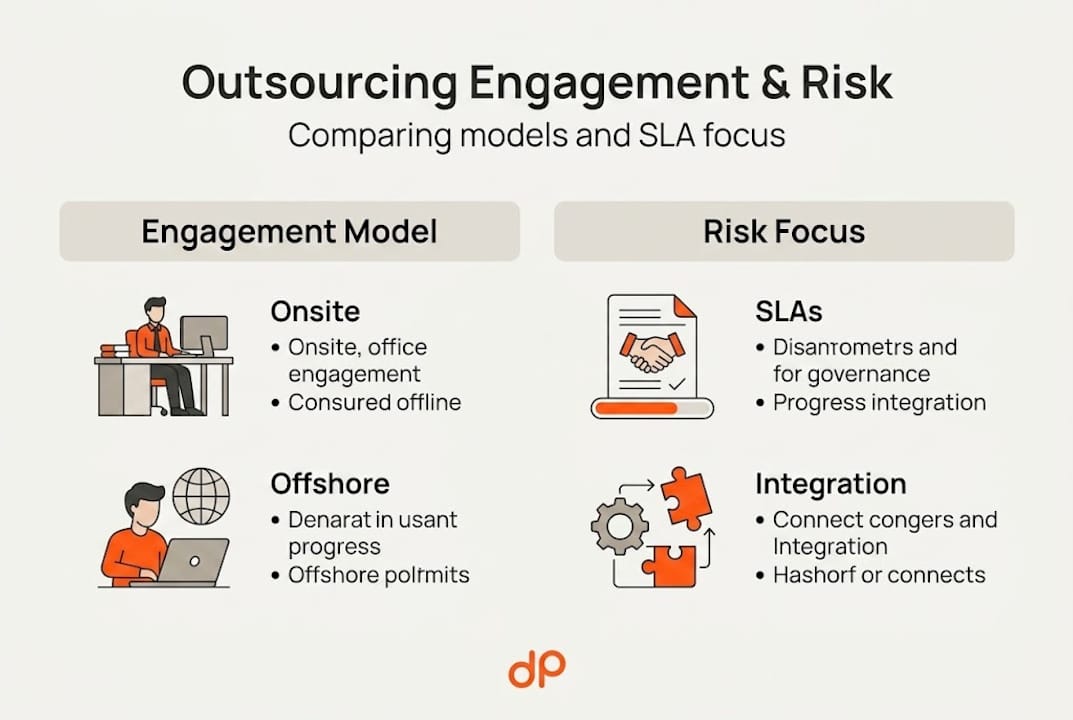
Engagement model selection also carries significant risk implications. Onsite consultants offer deep contextual integration but at higher cost. Offshore models reduce cost but introduce time zone and cultural coordination challenges. Nearshore models, particularly in Latin America for U.S. companies, offer a strong middle ground with overlapping business hours and reduced cultural friction. Hybrid models combine the cost advantages of offshore with the collaboration benefits of nearshore, and they represent an increasingly common structure for enterprise-scale engagements.
When (and when not) to engage IT outsourcing consultants
Understanding risk is key. Equally crucial is knowing when the value of consultants peaks and when internal solutions are the better fit.
There are specific scenarios where bringing in an IT outsourcing consultant creates clear, measurable value. Recognizing these triggers early allows you to move decisively and avoid the delays that compound costs.
Strong triggers for engagement:
- You face an urgent expertise gap that your internal team cannot fill within your project timeline.
- You are launching a digital transformation initiative that spans multiple systems, teams, or vendors.
- You are undergoing a major system overhaul, such as an ERP migration, cloud re-architecture, or data platform consolidation.
- Your organization is navigating a merger or acquisition with significant technology integration complexity.
- A critical project is failing and needs an objective external assessment and recovery plan.
Tech lead best practices consistently show that early consultant involvement in these scenarios reduces total project cost and improves delivery confidence significantly.
When internal resources are the better choice:
- Routine IT support and maintenance that your in-house team handles competently today
- Organizations with mature internal expertise in the specific technology domain at hand
- Situations where continuity and institutional knowledge outweigh the benefits of external perspective
- Long-term steady-state operations that do not require episodic strategic input
One important structural consideration involves virtual CIO services. A vCIO model can work effectively for small to mid-sized organizations, but vCIO services are not suitable for companies with over 500 employees due to coordination bottlenecks that emerge at scale. Larger enterprises need dedicated, embedded leadership rather than a fractional model. Recognizing this limitation prevents organizations from underinvesting in leadership capacity during critical growth phases.
Remote IT teams can complement consultant-led engagements effectively, especially when consultants define the governance structure and the remote team executes within it. The key is never confusing the advisory function with the delivery function. Consultants set the strategy; your delivery partners and internal teams execute it.
To evaluate whether your situation warrants engagement, use this quick decision checklist:
- Is the required expertise unavailable internally within your timeline? Yes or no.
- Does the initiative span more than two systems or vendor relationships? Yes or no.
- Are there compliance, security, or contractual stakes that require independent review? Yes or no.
- Is the project recovery scenario, M&A related, or a first-time technology category for your organization? Yes or no.
Three or more “yes” answers indicate a strong case for consultant engagement. Fewer than two suggests your internal team may be better positioned to lead.
The overlooked secret: Consultants maximize speed and innovation only if you master executive integration
With the decision process clarified, it’s time to examine what actually drives success and the hard lessons not found in glossy consulting brochures.
Here is the uncomfortable reality we see repeatedly across enterprise engagements: the quality of the consulting firm matters far less than the quality of executive integration on the client side. Organizations that treat consultants as external problem-solvers who will fix things independently almost always underperform. Organizations that treat consultants as force multipliers for their own strategic clarity consistently outperform.
Micro-managing kills consultant output just as effectively as full abdication does. When executives demand approval on every tactical decision, consultants lose the autonomy needed to apply their expertise. When executives step back entirely, assuming the consultant will self-direct, the engagement loses strategic alignment and business context.
The sweet spot is structured empowerment. Define the outcome with precision. Give the consultant access to the stakeholders, systems, and data they need. Then hold them accountable to measurable milestones, not activity metrics. This model turns digital transformation success from a possibility into a repeatable outcome.
Clear executive sponsorship is the single most consistent predictor of consulting engagement value. One named internal leader with decision-making authority, a defined escalation path, and a personal stake in the outcome creates the conditions for consultants to operate at their highest level. Without that, even the most capable consultant will eventually be slowed by organizational friction.
How DevPulse can empower your IT outsourcing journey
Ready to move from clarity to results? Here is how DevPulse can partner with your team for outsized strategic outcomes.
At DevPulse, we work with enterprise clients, SaaS companies, and fast-scaling startups to translate strategic technology decisions into executed, production-grade solutions. Whether you need to modernize a legacy platform, evaluate your engineering infrastructure, or integrate AI into your existing workflows, our team brings the technical depth and business fluency your leadership team deserves. Explore our software engineering capabilities, review real-world case studies from clients across healthcare, legal tech, and cybersecurity, and see how our data and AI expertise can accelerate your roadmap. Schedule a strategy conversation with our team today.
Frequently asked questions
What are the main benefits of using IT outsourcing consultants?
The main benefits are access to specialized expertise, faster project delivery, risk mitigation, and the ability to align technology with business goals. The market’s rapid growth to $9.87 billion reflects the strategic weight organizations are placing on these engagements.
How long do typical IT outsourcing consulting engagements last?
Most consulting projects are episodic and last less than one year, with engagement costs averaging around 3% of payroll, making them a contained investment with potentially significant strategic returns.
What is a common reason IT outsourcing projects fail?
Vague service level agreements are the leading cause, contributing to 14% project failure rates across outsourcing engagements, a risk that experienced consultants are specifically trained to eliminate.
Are virtual CIO (vCIO) services suitable for large enterprises?
No, vCIO models do not scale well for companies with more than 500 employees due to coordination bottlenecks that fractional leadership structures cannot overcome at enterprise scale.
How do consultants handle offshore collaboration risks?
They use asynchronous communication tools and hybrid nearshore-offshore models to reduce time zone and cultural risks while preserving the cost advantages that offshore engagements provide.