














TL;DR:
- Vendor management maximizes value across quality, reliability, innovation, and risk reduction.
- Effective programs rely on strategic segmentation, automated monitoring, and senior leadership support.
- Organizational commitment and leadership culture are critical for success beyond just process and tools.
Vendor management is widely misunderstood. Most organizations treat it as a back-office function focused on contract renewals and invoice approvals, when in reality it is one of the most powerful levers available for improving operational efficiency, reducing risk, and driving measurable business value. Companies that limit their approach to basic contract oversight leave significant performance gains on the table. This guide clarifies what vendor management actually involves, why it deserves a seat at the strategic table, and how you can build or refine a program that strengthens supplier relationships and delivers consistent results across your operations.
Table of Contents
- Defining vendor management: What it is and why it matters
- Core components: The vendor management framework
- Best practices: Strategic selection, value over price, and technology integration
- Implementing vendor management in your organization: Practical steps
- The uncomfortable truth about vendor management most guides miss
- Connecting vendor management to business growth
- Frequently asked questions
Key Takeaways
| Point | Details |
|---|---|
| Value over price | The best vendor management focuses on maximizing value, not just cutting costs. |
| Segment for results | Segment suppliers by importance and adjust oversight to get better outcomes with less effort. |
| Automate for efficiency | Integrating technology and automation boosts efficiency and reveals actionable supplier insights. |
| Start small, scale up | Begin with high-impact vendors and build your process for broader application as you learn. |
| Custom-fit your approach | Tailoring vendor management to your unique business context beats a one-size-fits-all model. |
Defining vendor management: What it is and why it matters
Vendor management is the set of processes and strategies an organization uses to select, onboard, monitor, and develop its suppliers so they consistently meet business goals. That definition sounds straightforward, but the practice is far more nuanced than most procurement teams acknowledge. It is not simply about controlling costs or enforcing contract terms. Done well, vendor management maximizes total value across four critical dimensions: quality, reliability, innovation, and risk reduction.
Think about what that means in practice. A technology vendor that delivers on time but never proactively flags integration risks is costing you money in ways that never appear on an invoice. A supplier who consistently meets quality benchmarks but refuses to collaborate on process improvements is limiting your competitive agility. Vendor management gives you the tools and structure to address both scenarios systematically.
The core activities that define a mature vendor management program include:
- Vendor segmentation: Categorizing suppliers by strategic importance so you can allocate oversight resources appropriately.
- Quarterly Business Reviews (QBRs): Structured meetings with top-tier suppliers to review performance data, address issues, and align on future priorities.
- Automated scorecards: Standardized performance tracking tools that make supplier evaluation consistent and objective.
- Consequence management: Clear policies for what happens when a vendor underperforms, including corrective action plans and, if necessary, transition strategies.
“Vendor management methodologies emphasize strategic segmentation, regular QBRs for Tier 1 suppliers, automated scorecards, and consequence management for underperformance.” — J.P. Morgan
The strategic impact of getting this right is substantial. Organizations that invest in structured vendor management report stronger supplier relationships, lower operational risk, and measurably better efficiency. Understanding the types of tech partnerships available to your business is a natural starting point for building a segmentation model that reflects your actual supplier landscape.
Core components: The vendor management framework
With the “why” in place, it is essential to understand the “how.” A robust vendor management system is built on a small number of foundational components that, when combined, create a repeatable and scalable process.
Vendor segmentation is the cornerstone. Not every supplier deserves the same level of attention, and treating them all identically is one of the most common and costly mistakes procurement teams make. A well-designed segmentation model typically uses three tiers:
| Tier | Label | Characteristics | Management approach |
|---|---|---|---|
| Tier 1 | Strategic | High spend, high risk, core to operations | Quarterly QBRs, dedicated relationship manager, joint roadmaps |
| Tier 2 | Preferred | Moderate spend, recurring engagement | Semi-annual reviews, scorecard monitoring, periodic check-ins |
| Tier 3 | Transactional | Low spend, easily replaceable | Automated monitoring, minimal direct engagement |
This model lets you concentrate your team’s time and energy where it produces the greatest return. Tier 1 vendors shape your operational outcomes in ways that Tier 3 suppliers simply do not.
Once segmentation is in place, the process follows a clear sequence:
- Selection and onboarding: Evaluate vendors against defined criteria including financial stability, technical capability, compliance posture, and cultural fit. Establish clear expectations from day one.
- Performance monitoring: Deploy scorecards that track agreed KPIs on a consistent schedule. Automate data collection wherever possible to reduce manual effort and bias.
- Quarterly Business Reviews: Conduct formal reviews with Tier 1 vendors to assess performance trends, discuss challenges, and align on the next quarter’s priorities.
- Corrective action and consequence management: When performance falls short, activate a documented corrective action process. If improvement does not follow, enforce consequences as defined in the contract.
For a detailed look at how to evaluate vendors before they enter your program, the technology partner evaluation guide offers a practical framework. And if you are managing outsourced development relationships specifically, outsourcing success best practices covers the nuances that apply to that context.
Pro Tip: Automating scorecard data collection is not just a convenience. Research indicates that technology-driven vendor management can close efficiency gaps of nearly 9% compared to manual processes. Even a basic automation layer on your monitoring workflow pays dividends quickly.
Best practices: Strategic selection, value over price, and technology integration
Having covered what makes up vendor management, let’s dig into actionable strategies that set leaders apart from organizations running average programs.
Shift from lowest price to total value. This is the single most impactful mindset change you can make. Price is visible and easy to compare. Total value is harder to quantify but far more consequential. When evaluating vendors, factor in service quality, innovation capacity, risk profile, and the cost of managing the relationship itself. A cheaper vendor who requires constant oversight, delivers inconsistent quality, or cannot scale with your business is almost always more expensive in aggregate.
Prioritizing total value over price in selection, combined with tiered management to allocate resources efficiently, is what separates high-performing procurement functions from reactive ones.
Use technology to drive continuous improvement. Data analytics tools can surface performance trends that would take weeks to identify manually. Automated alerts can flag contract milestones, compliance deadlines, or performance threshold breaches in real time. When you integrate these capabilities into your vendor management workflow, you shift from reactive problem-solving to proactive relationship management.
Common mistakes that undermine vendor management programs include:
- Relying too heavily on price as the primary selection criterion, which drives short-term savings but long-term risk.
- Failing to tailor oversight to vendor importance, which wastes resources on low-risk suppliers and under-invests in strategic ones.
- Skipping onboarding rigor, which leads to misaligned expectations and early performance problems.
- Treating QBRs as formalities rather than genuine performance conversations, which erodes their value over time.
- Neglecting consequence management, which signals to vendors that underperformance carries no real cost.
Pro Tip: Not every supplier needs a QBR. Tiered management ensures you invest relationship-building energy where it generates the most return. Reserve formal review meetings for Tier 1 vendors and use automated monitoring for the rest. This approach keeps your team focused without sacrificing visibility.
For teams managing engineering vendors or outsourced development partners specifically, outsourcing for tech executives provides targeted guidance on how to apply these principles in a technical context. And if you are refining your selection process, the evaluate technology partners resource covers the specific criteria that matter most in software and technology procurement.
Implementing vendor management in your organization: Practical steps
Knowing best practices is only useful if they are implemented. Here is how you can bring structured vendor management into your regular operations, whether you are starting from scratch or refining an existing program.

Step 1: Conduct a vendor assessment. Start by cataloging every active vendor relationship. For each one, document spend level, business criticality, current performance, and contract status. This baseline tells you where you stand and what needs immediate attention.
Step 2: Apply your segmentation model. Using the three-tier framework described earlier, classify each vendor. Be honest about which relationships are truly strategic versus which ones feel important but are actually replaceable.
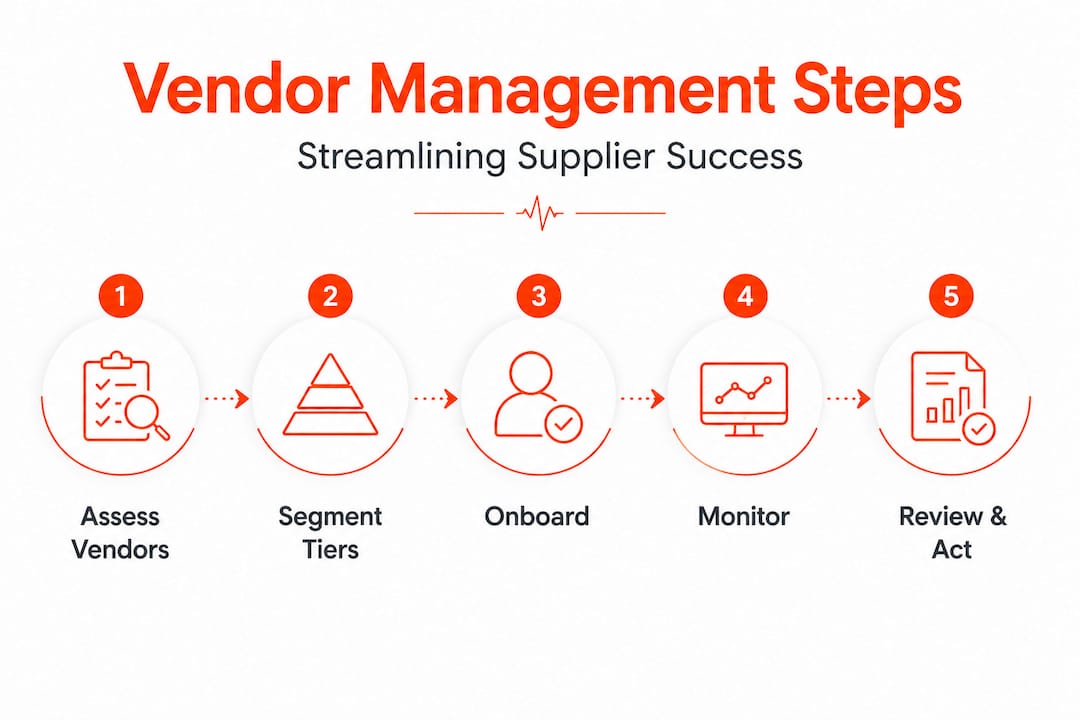
Step 3: Standardize onboarding. Create a consistent onboarding process for new vendors that includes expectation-setting, KPI agreement, compliance verification, and system integration. A structured onboarding process, similar to what is described in IT team onboarding best practices, reduces early-stage friction and sets the relationship up for success.
Step 4: Deploy monitoring tools. Implement scorecards for all active vendors, with automation handling data collection for Tier 2 and Tier 3 suppliers. Reserve manual review time for Tier 1 relationships where nuance matters.
Step 5: Schedule and conduct QBRs. For Tier 1 vendors, quarterly QBRs are non-negotiable. Prepare an agenda in advance, share performance data before the meeting, and document action items with clear owners and deadlines.
Step 6: Act on performance data. When scorecards reveal underperformance, activate your corrective action process promptly. Delayed responses signal tolerance for poor performance and make future enforcement harder.
The table below illustrates the practical difference between manual and automated vendor management approaches:
| Process | Manual approach | Automated approach |
|---|---|---|
| Performance data collection | Spreadsheets, email follow-ups | Integrated dashboards, real-time feeds |
| Scorecard updates | Monthly or quarterly, error-prone | Continuous, consistent, auditable |
| Contract milestone alerts | Calendar reminders, easy to miss | Automated notifications with escalation |
| QBR preparation | Hours of manual data compilation | Pre-built reports generated automatically |
| Compliance tracking | Manual document review | Automated expiration and renewal alerts |
Pro Tip: Do not try to overhaul your entire vendor portfolio at once. Start with your top five to ten strategic vendors, build your process around those relationships, and then scale the system outward. Early wins with high-visibility suppliers build internal support for the broader program.
The uncomfortable truth about vendor management most guides miss
Most articles on vendor management present it as a process problem. Build the right framework, deploy the right tools, and results will follow. That framing is incomplete, and in some cases it actively misleads organizations into investing heavily in structure while ignoring the factors that actually determine success.
The real constraint in most vendor management programs is not process maturity. It is organizational will. Specifically, it is whether senior leadership treats vendor relationships as a strategic priority or as a procurement function to be managed at arm’s length. We have seen organizations with sophisticated vendor management software and detailed scorecard systems that still produce poor supplier outcomes, because no one at the executive level is willing to have a difficult conversation with a strategic vendor who is underperforming.
Honest assessment is harder than process design. It requires acknowledging that a long-standing vendor relationship may no longer be serving your business. It requires being willing to enforce consequences even when the vendor is a known quantity and switching feels risky. It requires admitting that your internal processes may be contributing to a supplier’s performance problems, not just their own shortcomings.
Automation is a genuine enabler, but it is not a substitute for judgment. A well-designed engineering management workflow can surface the right data at the right time, but a human still has to decide what to do with it. Organizations that over-invest in tooling while under-investing in the skills and authority of their vendor management team tend to produce dashboards that no one acts on.
The most effective vendor management programs we have observed share three characteristics. First, they have visible senior sponsorship. Second, they are willing to adjust oversight intensity as circumstances change rather than applying a rigid framework regardless of context. Third, they treat vendor relationships as genuinely two-way, recognizing that the best suppliers will choose to invest more in partners who treat them with transparency and respect. Process matters. But culture and leadership matter more.
Connecting vendor management to business growth
As you look to put these practices into action, expert support can accelerate your progress and help you avoid the implementation pitfalls that slow most programs down.

At DevPulse, we help businesses build the digital infrastructure that makes vendor management more effective. Whether that means developing custom software engineering solutions to automate supplier monitoring, or deploying Data and AI solutions that turn raw vendor performance data into actionable insights, our team brings both technical depth and business context to every engagement. We understand that vendor management is not just a procurement challenge. It is an operational and strategic one. Explore our real-world software case studies to see how we have helped organizations in healthcare, legal tech, and enterprise software build systems that scale. If you are ready to modernize how you manage supplier relationships, we would welcome the conversation.
Frequently asked questions
What are the main benefits of vendor management?
Effective vendor management improves supplier performance, reduces operational risk, and drives efficiency gains across your supply chain. Structured vendor management methods cut risk and improve performance in ways that contract oversight alone cannot achieve.
How do you segment vendors?
Segment vendors by their strategic importance to your business, separating key partners who affect core operations from routine suppliers who are easily replaceable. Strategic segmentation into strategic, preferred, and transactional tiers allows you to tailor oversight intensity to actual business impact.
Is technology integration necessary for vendor management?
Technology is not strictly required, but automating monitoring workflows and scorecard data collection can close efficiency gaps of 8.9% compared to manual processes, making your program more consistent and scalable.
What are QBRs and why are they important?
QBRs, or Quarterly Business Reviews, are structured meetings held with top-tier vendors to assess performance data and align on strategic priorities. Quarterly QBRs for Tier 1 suppliers create a formal cadence for accountability and relationship development that ad hoc communication cannot replicate.
What’s the biggest mistake companies make in vendor management?
Treating all vendors with the same level of oversight drains team resources and reduces overall program effectiveness. Tiered management allocates resources efficiently by concentrating attention on the supplier relationships that carry the most strategic weight.
Recommended
- Unlock the Strategic Value of IT Outsourcing Consultants
- Optimize IT staffing workflow for project success
- Top advantages of managed services for IT executives in 2026
- Master agile in IT outsourcing for 25% better delivery
- Best Practices Vendor Management for Secure Operations
- Implement Vendor Management Programs for Optimal Risk Control