













TL;DR:
- Technology outsourcing is a strategic capability aimed at achieving specific business outcomes, not just cost savings.
- Different models and geographies of outsourcing should align with an organization’s regulatory, talent, and collaboration needs.
- Success depends on clear objectives, disciplined governance, and treating vendors as strategic partners, not merely cost cutters.
Many executives walk into technology outsourcing decisions carrying the same misconception: that outsourcing is simply about moving jobs overseas or cutting payroll costs. In reality, technology outsourcing is a deliberate strategic practice that reshapes how organizations access capability, scale operations, and accelerate delivery. For healthcare and SaaS leaders specifically, the difference between treating outsourcing as a cost-cutting lever versus a strategic capability driver can determine whether a digital initiative succeeds or stalls. This guide breaks down the core definitions, delivery models, and strategic drivers you need to make informed, confident decisions.
Table of Contents
- What is technology outsourcing?
- Types and models of technology outsourcing
- Why organizations outsource technology: Key benefits and drivers
- Key nuances: Outsourcing vs offshoring and choosing the right approach
- The real secret to successful technology outsourcing
- Explore your next step with DevPulse
- Frequently asked questions
Key Takeaways
| Point | Details |
|---|---|
| Clear definition | Technology outsourcing means using outside providers for IT services to get specific business results. |
| Multiple models | Outsourcing ranges from single projects to full IT functions using different delivery structures. |
| Not just offshoring | Outsourcing focuses on external responsibility, not solely on overseas or low-cost locations. |
| Strategic drivers | Cost savings, agility, expertise, and business focus are key reasons organizations outsource technology. |
| Executive alignment | Success depends on aligning outsourcing decisions with strategy, oversight, and ongoing optimization. |
What is technology outsourcing?
Technology outsourcing is a precise concept, and the distinction between it and general outsourcing matters more than most executives realize. General outsourcing is hiring a third party to perform tasks or provide services, with the provider arranging the workers and delivery, whether onsite or at external locations. It covers everything from HR administration to facility management.
Technology outsourcing narrows that scope considerably. According to Gartner, IT outsourcing is the use of external service providers to deliver IT-enabled business process, application, and infrastructure solutions for business outcomes. The key phrase here is “business outcomes.” This is not transactional task execution. It is outcome-oriented delivery of technology capability.
Technology outsourcing is not a procurement decision. It is a capability strategy that, when executed well, creates durable competitive advantage by extending your engineering and operational reach without expanding your fixed cost base.
What makes IT outsourcing distinct is the breadth of what falls under its umbrella. Organizations can outsource virtually any layer of their technology stack or operational support function. Common categories include:
- Infrastructure management: Servers, networks, storage, data centers, and cloud platform operations
- Application development and maintenance: Custom software, SaaS product development, modernization of legacy systems
- Cybersecurity services: Threat monitoring, penetration testing, and compliance management, which is especially critical in healthcare
- Data and analytics platforms: Business intelligence pipelines, AI model development, and data engineering
- End-user support: Help desks, IT service management, and device management
- Process-specific IT: Revenue cycle management systems in healthcare, billing engines in SaaS, and DevOps pipelines across both sectors
Understanding cloud outsourcing explained can help you map how cloud-enabled services fit within this broader definition, particularly as infrastructure decisions increasingly intersect with vendor and delivery model choices.
Pro Tip: Outsourcing is not just for lowering costs. Organizations that extract the most value from outsourcing use it to accelerate product development cycles, access niche technical talent, and scale without proportional headcount growth. Reframe the objective before you sign the first contract. And if you want deeper context on what drives those decisions at scale, why businesses outsource technology offers a strategic breakdown worth reviewing.
Types and models of technology outsourcing
With an understanding of the definition, let’s examine the different types and models used in technology outsourcing. According to CIO, tech outsourcing engagements typically fall along two mechanics dimensions: scope, ranging from discrete services to entire IT functions, and delivery model, spanning infrastructure versus application outsourcing plus related subsets.
These two dimensions create a matrix of options. Here is how the principal models break down in practice:
-
Infrastructure outsourcing: A vendor manages your physical or cloud infrastructure, including networks, servers, and storage. This is common in healthcare organizations that need high availability and compliance without building internal data center expertise. The tradeoff is less direct control over underlying systems.
-
Application outsourcing: An external team handles development, maintenance, and support for specific applications. For SaaS companies, this often means augmenting a core product team with specialized engineers for a feature sprint or building an entirely new module. It is highly flexible and scales with your roadmap.
-
Full IT outsourcing: Sometimes called total outsourcing, this model hands off most or all IT functions to a single provider. It offers maximum cost predictability and operational simplicity but introduces significant vendor dependency and governance risk. Best suited for organizations that view IT as a non-core function.
-
Specialized or selective outsourcing: Organizations carve out specific domains, such as cybersecurity, AI development, or cloud architecture, and engage specialized vendors. This is the model most SaaS and healthcare companies are gravitating toward in 2026, because it lets them own strategic capabilities internally while leveraging external expertise where depth matters most.
| Delivery model | Best fit for | Key advantage | Primary risk |
|---|---|---|---|
| Onsite outsourcing | Complex integrations, regulated environments | Deep collaboration, fast feedback | Higher cost, coordination overhead |
| Offsite domestic | Sensitive data, compliance-heavy work | Full regulatory alignment, similar time zones | Limited talent pool in niche areas |
| Nearshore | SaaS product teams needing daily sync | Strong overlap, cost savings, cultural alignment | Smaller vendor markets |
| Offshore | High-volume development, cost optimization | Significant cost reduction, broad talent availability | Time zone gaps, governance complexity |
| Cloud-enabled | Scalable infrastructure, SaaS platforms | Elastic capacity, pay-as-you-go models | Lock-in risk, security configuration |
For executives evaluating which model fits, agile IT outsourcing approaches can help you align delivery cadence with product development velocity. And for organizations weighing governance structures, outsourcing strategy insights provides a detailed look at how strategic advisors can structure vendor relationships effectively. If you are leading an engineering-heavy organization, reviewing engineering outsourcing models will help you map technical team structures to your delivery goals.
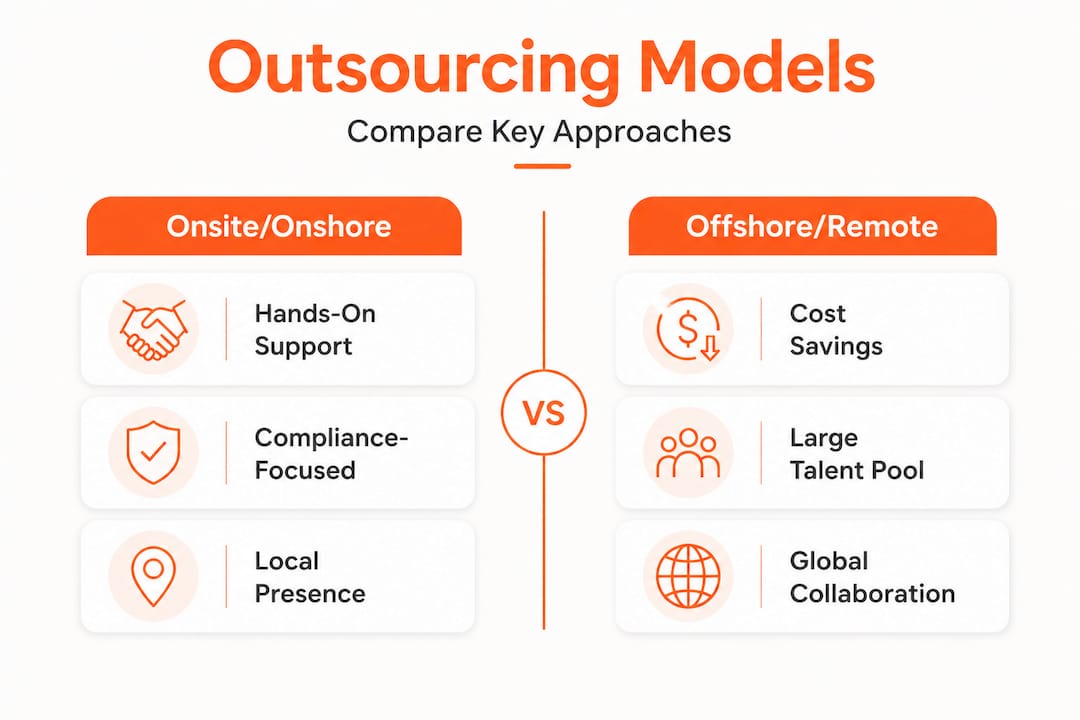
Pro Tip: Match the outsourcing model to your regulatory, governance, and business agility needs, not just your budget. A healthcare company under HIPAA or HITRUST obligations has materially different governance requirements than a SaaS startup. Optimizing purely for cost often creates compliance and operational risk that costs far more to remediate than the original savings.
Why organizations outsource technology: Key benefits and drivers
After exploring the models, it is crucial to understand why so many healthcare and SaaS organizations elect to outsource technology in the first place. As Gartner notes, IT outsourcing can enable cost reduction and faster time to market. But those two outcomes are just the beginning of the value case.
The principal benefits that drive executive outsourcing decisions include:
- Cost efficiency: Converting fixed engineering costs into variable operating expenses. Organizations eliminate overhead tied to full-time salaries, benefits, training, and tooling by paying for outcomes instead.
- Access to specialized expertise: The global talent shortage in areas like AI engineering, cloud architecture, and healthcare data systems is acute. Outsourcing gives you access to specialists who would be difficult or expensive to recruit and retain internally.
- Scalability: Product teams in SaaS need to scale engineering capacity rapidly around major releases or market opportunities. Outsourcing provides elastic capacity without the long hiring cycles.
- Faster time to market: External teams with established processes, tooling, and domain knowledge can accelerate delivery timelines significantly. For a SaaS company launching a new feature to stay competitive, weeks matter.
- Focus on core competencies: When internal teams are freed from maintaining legacy infrastructure or building ancillary systems, they can concentrate on the product differentiation that drives revenue and customer retention.
- Risk distribution: Technology vendors assume operational risk for the functions they manage, including uptime, security patching, and compliance updates within their scope.
For healthcare organizations, the calculus often includes reducing the operational burden of maintaining EHR integrations, clinical data pipelines, and secure patient communication systems, all of which require deep technical specialization that is costly to maintain in-house. For SaaS companies, the driver is usually velocity. The market will not wait for you to hire a senior ML engineer.

Explore how digital transformation outsourcing connects these benefits to broader organizational change initiatives. And to ensure you are capturing these benefits in practice, reviewing outsourcing best practices provides a structured approach to managing vendors and measuring outcomes.
Pro Tip: The best outsourcing results come when the driver is not simply reducing headcount, but solving a business-critical challenge. Organizations that outsource with a clear problem statement, such as “we need to reduce time-to-release for our core product by 40%” or “we need HIPAA-compliant data infrastructure running within 90 days,” consistently outperform those that outsource with vague cost targets.
Key nuances: Outsourcing vs offshoring and choosing the right approach
With benefits in mind, it is equally important to avoid the common trap of conflating outsourcing with offshoring. These are two separate dimensions of the same decision. Outsourcing answers the question of who does the work. Offshoring answers the question of where they do it. You can outsource to a domestic firm down the street, or you can keep work in-house while operating a captive center abroad. Neither decision dictates the other.
As TechTarget and Gartner note, geography and operating model are separate design choices. Sourcing can be offshore, nearshore, onshore, or hybrid depending on collaboration needs and governance requirements. This is a critical planning insight that many organizations overlook in the rush to evaluate vendor proposals.
Geography is a variable in your operating model, not a defining characteristic of outsourcing itself. The best model is not the cheapest one, it is the one that fits your compliance requirements, communication cadence, and talent needs simultaneously.
Your location strategy should be driven by concrete factors:
- Regulatory compliance: HIPAA, SOC 2, GDPR, and sector-specific regulations may constrain where data can be stored or processed. Healthcare organizations often have hard requirements that eliminate purely offshore options.
- Communication and collaboration: Teams that need daily standups, real-time pair programming, or rapid iteration cycles benefit from nearshore or onshore arrangements. Offshore teams work well for well-defined, documentation-heavy projects.
- Cost targets: Offshore engagements in Eastern Europe, Latin America, or Southeast Asia offer significant savings, but factor in governance, legal, and communication overhead.
- Talent availability: If you need highly specialized AI engineers or niche healthcare IT expertise, the talent pool may be genuinely global, making offshore a strategic rather than purely financial choice.
- Speed of engagement: Onshore vendors typically mobilize faster due to shared legal frameworks and business norms.
| Operating model | Typical use case | Healthcare fit | SaaS fit |
|---|---|---|---|
| Onshore outsourcing | Compliance-critical systems, EHR integrations | High | Medium |
| Nearshore outsourcing | Agile product development, daily collaboration | Medium | High |
| Offshore outsourcing | High-volume dev work, QA automation | Medium (with controls) | High |
| Hybrid | Complex programs needing both speed and compliance | Very high | Very high |
For organizations managing vendor relationships across multiple functions, outsourcing support strategies outlines how to structure ongoing operational partnerships. And if you are negotiating contracts, understanding SLAs in outsourcing is essential to building in accountability and performance protection from day one.
The real secret to successful technology outsourcing
Having navigated definitions, models, and strategic drivers, it is time to offer a perspective that most standard guides skip entirely.
The organizations that consistently extract long-term value from technology outsourcing are not the ones with the most sophisticated vendor selection matrices. They are the ones with clear executive intent and honest internal assessments of their own capabilities. Picking the right model matters far less than knowing exactly what problem you are solving and why your internal team cannot solve it alone. Most outsourcing failures we have observed trace back to executives who approved a vendor relationship without articulating a specific business outcome. The vendor delivers exactly what was contracted. Nobody is satisfied because the contract described activities, not results.
Governance is the other underrated variable. Outsourced teams need active management, not passive oversight. A partner who reports green on a weekly dashboard but has quietly accumulated technical debt in your codebase is not delivering value. Regular architecture reviews, shared KPIs tied to business metrics, and quarterly strategic alignment sessions are not overhead. They are the mechanisms through which outsourcing actually works.
The uncomfortable truth is that most organizations need to get better at buying technology services before they can get better at outsourcing. That means building internal capability in vendor management, contract structure, and performance measurement, even if the delivery work itself is external. The executives and tech leads who do this consistently outperform peers who treat outsourcing as a pure cost decision. What tech leaders do differently is not magic. It is disciplined governance paired with genuine partnership orientation.
One more point worth stating directly: geography and vendor prestige are proxies for quality, not guarantees of it. We have seen offshore teams outperform boutique domestic firms on complex SaaS projects because the offshore team had better processes, clearer communication norms, and a more aligned understanding of the business problem. That alignment came from the client’s investment in onboarding, documentation, and relationship management, not from the vendor’s location or credentials. Successful digital transformation wins share one common element: an internal champion who treated the outsourcing relationship as a strategic partnership from day one.
Explore your next step with DevPulse
If you are evaluating technology outsourcing for your organization, here is how DevPulse can help you take the next step.
DevPulse works with healthcare and SaaS executives who need more than a vendor. They need a capable, accountable engineering partner who understands the compliance, scalability, and speed pressures that define both sectors. Our software engineering outsourcing practice covers everything from full product development to targeted capability augmentation, built around your business outcomes, not just a statement of work.
We also bring deep capabilities in AI and data solutions, helping organizations build the intelligent infrastructure that modern healthcare platforms and SaaS products require. If you want to see how this translates in practice, our outsourcing success stories provide concrete examples of how we have helped clients accelerate delivery, modernize systems, and scale securely. Reach out to schedule a consultation and explore what a well-structured outsourcing engagement could achieve for your organization.
Frequently asked questions
What is the primary difference between technology outsourcing and general outsourcing?
Technology outsourcing focuses specifically on IT services, applications, and infrastructure, while general outsourcing applies to any business function a third party can perform, including HR, facilities, and logistics.
Does outsourcing always mean offshoring work overseas?
No. As Gartner confirms, geography and operating model are separate decisions. Outsourcing simply means a third party performs the work, regardless of whether that party is located domestically, nearshore, or offshore.
What types of IT services are most commonly outsourced?
The most frequently outsourced IT services span infrastructure and application domains, including cloud infrastructure management, custom application development, cybersecurity monitoring, and end-user support.
How does technology outsourcing help cut costs?
Outsourcing shifts fixed technology costs to variable operating expenses and gives organizations access to provider scale and specialization. Gartner confirms that IT outsourcing enables cost reduction and faster time to market by leveraging providers with established processes and global talent pools.