














TL;DR:
- Distributed teams can achieve round-the-clock productivity without sharing an office.
- They provide significant cost savings, access to global talent, and faster scaling opportunities.
- Diversity, transparency, and structured communication are key to their success.
Most executives assume that high-performing teams need to share the same office. The data says otherwise. Distributed teams, groups working across multiple locations and time zones, are proving that physical proximity is not a prerequisite for speed, quality, or innovation. Follow-the-sun workflows enable round-the-clock productivity that colocated teams simply cannot match. Beyond the operational edge, distributed models deliver measurable cost savings, access to global talent, and a structural advantage for scaling. This article breaks down exactly how distributed teams work, where they create the most value, and how to avoid the pitfalls that trip up most organizations.
Table of Contents
- How distributed teams enable continuous productivity
- Cost efficiency: The financial benefits of distributed teams
- Diversity and innovation: Unlocking global potential
- Challenges and solutions: Making distributed teams work
- A fresh perspective: What most guides miss about distributed teams
- Implement distributed teams with expert support
- Frequently asked questions
Key Takeaways
| Point | Details |
|---|---|
| Continuous productivity | Distributed teams deliver non-stop workflows using time zone coverage and async tools. |
| Cost savings | Organizations lower office, salary, and facilities expenses by adopting distributed teams. |
| Diversity boosts innovation | Global perspectives across the team drive creative solutions and outperform competitors. |
| Success needs structure | Proactive training, onboarding, and strong documentation overcome distributed team challenges. |
How distributed teams enable continuous productivity
A distributed team is a group of professionals collaborating across different cities, countries, or time zones using digital tools as their primary communication layer. Unlike a remote team where everyone works from home in the same city, distributed teams span geography intentionally. That geographic spread is not a limitation. It is a strategic asset.
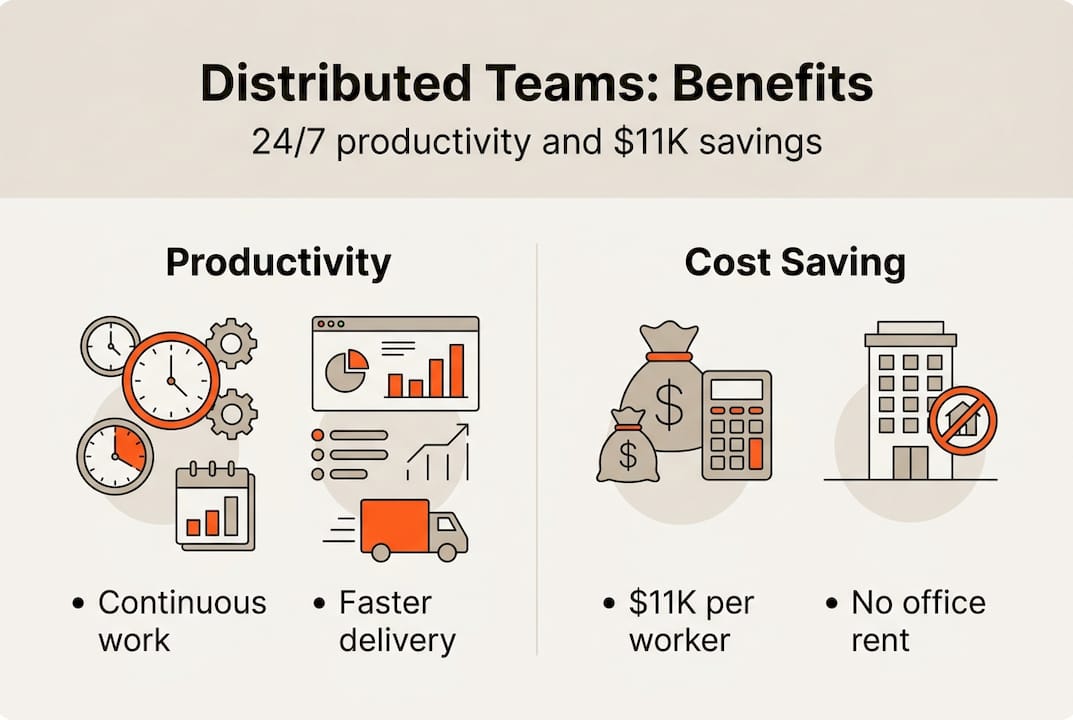
The most powerful operational benefit is the follow-the-sun model. When your engineering team in Warsaw finishes their day, your team in Kyiv or Lisbon picks up the thread. When they sign off, your team in Latin America continues. Work never stops. 24/7 productivity shortens project timelines in ways that single-timezone teams cannot replicate, regardless of how many hours they log.
This matters enormously for software delivery. Consider a product team building a SaaS platform with distributed engineers across three time zones. A critical bug found at 6 PM in one region gets handed off with full context to a team just starting their morning. Resolution happens before the first region’s next business day begins. That is not a theoretical scenario. It is a repeatable workflow that accelerates release cycles.
The numbers support this. Feature delivery improves by 15% once distributed teams stabilize their async workflows and handoff processes. The key word is “stabilize.” Early-stage distributed teams often see friction, but teams that invest in clear documentation and structured handoffs unlock compounding velocity gains.
| Workflow model | Active work hours per day | Typical release cycle |
|---|---|---|
| Single timezone team | 8 hours | 2 to 3 weeks |
| Distributed (2 time zones) | 14 to 16 hours | 10 to 14 days |
| Distributed (3+ time zones) | 20 to 24 hours | 7 to 10 days |
Understanding the types of remote teams available to your organization helps you choose the right structure before committing to a model.
“The competitive advantage of distributed teams is not just talent access. It is time. Every hour your competitors are not working, you can be.”
Key enablers for continuous productivity:
- Async-first documentation: Every decision, update, and blocker recorded in writing
- Structured handoff protocols: End-of-day summaries with clear next steps
- Overlap windows: At least 2 to 3 hours of shared availability between adjacent time zones
- Unified project management tools: Single source of truth for task status and priorities
Pro Tip: Invest in a team management workflow that treats async documentation as a first-class deliverable, not an afterthought. Teams that do this consistently outperform those relying on verbal handoffs.
Cost efficiency: The financial benefits of distributed teams
Distributed teams do not just save money on office rent. They restructure your entire cost model in ways that create lasting financial flexibility. The savings are significant and well-documented.
Companies save up to $11,000 per remote worker annually when they eliminate office overhead, facilities management, and on-site utilities. For a team of 20 engineers, that is $220,000 per year redirected toward R&D, product development, or competitive salaries.

| Cost category | Colocated team (20 engineers) | Distributed team (20 engineers) |
|---|---|---|
| Office space and utilities | $180,000 to $240,000/yr | $0 to $20,000/yr |
| Equipment and facilities | $40,000 to $60,000/yr | $10,000 to $20,000/yr |
| Regional salary premiums | High (single market) | Optimized (global talent pool) |
| Total estimated savings | Baseline | $180,000 to $220,000+/yr |
Beyond real estate, distributed hiring lets you access talent in markets where compensation expectations differ significantly from major tech hubs. A senior engineer in Eastern Europe or Latin America often commands 40 to 60 percent lower salaries than equivalent talent in San Francisco or London, with no compromise on technical quality.
These savings are not just a line item. Forward-thinking organizations reinvest them strategically:
- Accelerated R&D: Redirect savings into new product features or AI integrations
- Stronger benefits packages: Attract top talent globally with competitive perks
- Crisis resilience: Maintain a lean cost structure that withstands market downturns
- Faster scaling: Hire across multiple markets simultaneously without capital constraints
Financial flexibility also means operational resilience. When a single-office company faces a facilities disruption or a regional economic shock, operations stall. A distributed team absorbs those shocks naturally because no single location is a single point of failure.
For organizations focused on scaling engineering teams efficiently, the distributed model provides both the talent pipeline and the cost structure to grow without the overhead penalties of traditional expansion. Pairing financial discipline with smart engineering team management strategies ensures those savings translate directly into performance.
Diversity and innovation: Unlocking global potential
Cost and productivity are compelling. But the innovation argument for distributed teams may be the most strategically significant of all.
Diverse teams are 35% more likely to outperform their peers, according to McKinsey research. This is not about optics. It is about cognitive diversity, the range of problem-solving approaches, cultural contexts, and market knowledge that globally distributed teams bring to every product decision.
When your team includes engineers and designers from different countries, they naturally surface insights that a homogenous team misses. A team member in Southeast Asia spots a UX pattern that resonates with local users. A developer in Germany flags a compliance requirement that would have caused a costly rework later. These are not hypothetical benefits. They are real competitive advantages that show up in product quality and market fit.
“Innovation is not a solo act. It is what happens when different experiences collide around a shared problem.”
Building a genuinely innovative distributed team requires deliberate steps:
- Establish psychological safety: Create norms where every team member feels safe raising concerns or proposing ideas, regardless of seniority or location
- Rotate leadership roles: Assign project leads from different regions to surface a wider range of decision-making styles and ideas
- Document and share knowledge openly: Use wikis, recorded meetings, and async channels so insights from every region are accessible to all
- Schedule cross-regional collaboration sessions: Bring together team members who rarely interact to spark unexpected connections
- Celebrate diverse wins publicly: Recognize contributions from every region to reinforce that all voices matter
Psychological safety deserves special attention in distributed settings. Without it, quieter team members in different time zones disengage, and the innovation potential of the team shrinks. Structured check-ins, clear contribution norms, and visible recognition go a long way.
Pro Tip: Rotating sprint leadership across regions is one of the highest-ROI practices for distributed teams. It builds leadership capacity, surfaces hidden talent, and prevents the “headquarters bias” that stifles innovation in global teams. Learn more about structuring dedicated teams for project success to maximize these benefits.
Challenges and solutions: Making distributed teams work
Distributed teams are not without friction. Recognizing the real challenges, and having a plan to address them, separates organizations that thrive from those that struggle.
Research shows that proximity boosts junior feedback by 23.9% and measurably improves code quality. Junior engineers in distributed settings miss the informal mentorship that happens naturally in shared offices. This is one of the most underestimated costs of going fully distributed without a plan.
Additionally, without deliberate structure, productivity may match colocated teams but innovation and belonging can suffer. The solution is not to abandon distributed work. It is to engineer the conditions that make it work.
| Challenge | Root cause | Practical fix |
|---|---|---|
| Weak junior mentorship | Lack of proximity and informal feedback | Pair programming sessions, dedicated mentorship hours |
| Communication delays | Time zone gaps and async misalignment | Structured handoffs, overlap windows, clear SOPs |
| Belonging and cohesion issues | Isolation, lack of shared culture | Virtual socials, in-person kickoffs, recognition programs |
| Knowledge silos | Information hoarding or poor documentation | Shared wikis, recorded decisions, open channels |
Key practices for making distributed teams work:
- Structured onboarding: New hires need more context in distributed settings. Build onboarding programs that cover culture, tools, and workflows explicitly. Explore effective IT team onboarding practices that reduce ramp-up time.
- In-person kickoffs: For new projects or new hires, a short in-person session builds trust and shared context faster than months of video calls
- Clear standard operating procedures (SOPs): Document how decisions are made, how work gets reviewed, and how escalations happen
- Scheduled cross-time-zone huddles: Weekly touchpoints that include all regions prevent the “out of sight, out of mind” dynamic
Pro Tip: Blend digital feedback tools with face-to-face training whenever possible. Even one annual in-person gathering significantly improves cohesion and trust for the rest of the year. Pair this with strong IT workforce strategies to build a resilient, scalable team structure.
A fresh perspective: What most guides miss about distributed teams
Most playbooks focus on tools: which project management software to use, which video call platform to standardize on. Tools matter, but they are not what makes distributed teams succeed or fail. Culture and radical transparency are.
The organizations we see struggle most with distributed teams are not the ones with the wrong tools. They are the ones where leadership communicates differently to different regions, where decisions get made in private Slack channels before the broader team hears about them, and where “documentation” means a Confluence page nobody updates.
Real distributed team success requires a shared reality. Every team member, regardless of location, needs to operate from the same information. That means engineering outsourcing decisions, product pivots, and strategic shifts get communicated transparently and simultaneously across all regions.
Async documentation is the most underinvested capability in distributed organizations. When done well, it eliminates the “I missed that meeting” problem entirely and creates an institutional memory that survives team turnover. Pair that with outstaffing scalability practices, and you have a model that grows without losing coherence. The teams that treat documentation as a core engineering discipline, not an administrative burden, consistently outperform those that do not.
Implement distributed teams with expert support
Building a high-performing distributed team requires more than good intentions. It requires the right architecture, tooling, and operational expertise to make it sustainable.

At DevPulse, we help businesses design and scale distributed engineering teams that deliver real results. Whether you need custom software development capabilities across time zones or want to integrate data and AI services into your distributed workflows, our team brings the technical depth and operational experience to make it work. We combine proven async practices, structured onboarding, and engineering discipline to help your distributed team reach full velocity faster. Schedule a consultation with our team to explore how we can support your next phase of growth.
Frequently asked questions
What is a distributed team?
A distributed team is a group of employees working across multiple locations and time zones, collaborating primarily via digital tools rather than in a single office.
How do distributed teams increase productivity?
They enable continuous 24/7 workflows by leveraging different time zones, accelerating project delivery and providing round-the-clock development and support coverage.
Do distributed teams actually save money?
Yes. Companies save up to $11,000 per worker annually through lower real estate, facilities, and regional labor costs.
How can companies address the challenges of distributed teams?
Successful companies use structured onboarding, clear documentation, and blend virtual and in-person training to overcome communication and cohesion barriers that distributed settings create.
Are distributed teams more innovative?
Globally distributed teams are 35% more likely to outperform by tapping diverse perspectives, cultural contexts, and problem-solving approaches that homogenous teams lack.