














TL;DR:
- The success of outsourced SaaS projects largely depends on the quality of the tech lead.
- Effective tech leads manage technical direction, process quality, team alignment, and stakeholder communication.
- Poor leadership can lead to technical debt, missed estimates, team churn, and costly project failures.
Outsourcing a software project doesn’t automatically reduce your risk. In fact, the single variable that most consistently predicts whether a distributed SaaS build succeeds or collapses isn’t the vendor you choose. It’s the tech lead running the work. Poor tech leads are a leading cause of technical debt, failed estimations, and high team turnover, sometimes costing companies hundreds of thousands of dollars. Engineering and product leaders who understand this shift their attention from contract terms to leadership quality. This article breaks down what tech leads actually control in outsourced projects, what failure and success look like in practice, and what you can do right now to protect your investment.
Table of Contents
- What makes tech leads pivotal in outsourcing?
- How tech leads impact project outcomes: best- vs worst-case scenarios
- Key responsibilities and must-have skills for tech leads in outsourced teams
- Best practices to ensure tech leads succeed in your outsourced projects
- A hard-won truth about tech leads and outsourcing no one tells you
- Ready to strengthen your outsourced projects with expert tech leadership?
- Frequently asked questions
Key Takeaways
| Point | Details |
|---|---|
| Tech leads determine project fate | An effective tech lead is the single biggest factor in successful or failed outsourcing initiatives. |
| Key risks with poor leadership | Incompetent tech leads create technical debt, drive team turnover, and result in costly failures. |
| Best practices for success | Set KPIs, hold regular audits, and empower tech leads to mitigate outsourcing risks. |
| Invest in leadership, not just vendor | Strong tech leads are more important than supplier reputation when it comes to outsourced project outcomes. |
What makes tech leads pivotal in outsourcing?
A tech lead is not a project manager. They’re not a software architect operating in isolation either. The role sits at the intersection of technical authority and team coordination, and that intersection is exactly where outsourced projects either gain traction or fall apart.
In a distributed SaaS environment, the tech lead owns four critical functions: setting technical direction, managing process quality, aligning the team around shared goals, and communicating progress to stakeholders. Each of these functions becomes harder to execute when your team spans time zones, cultures, and organizational boundaries. That’s the outsourcing multiplier. Weak leadership gets amplified fast.
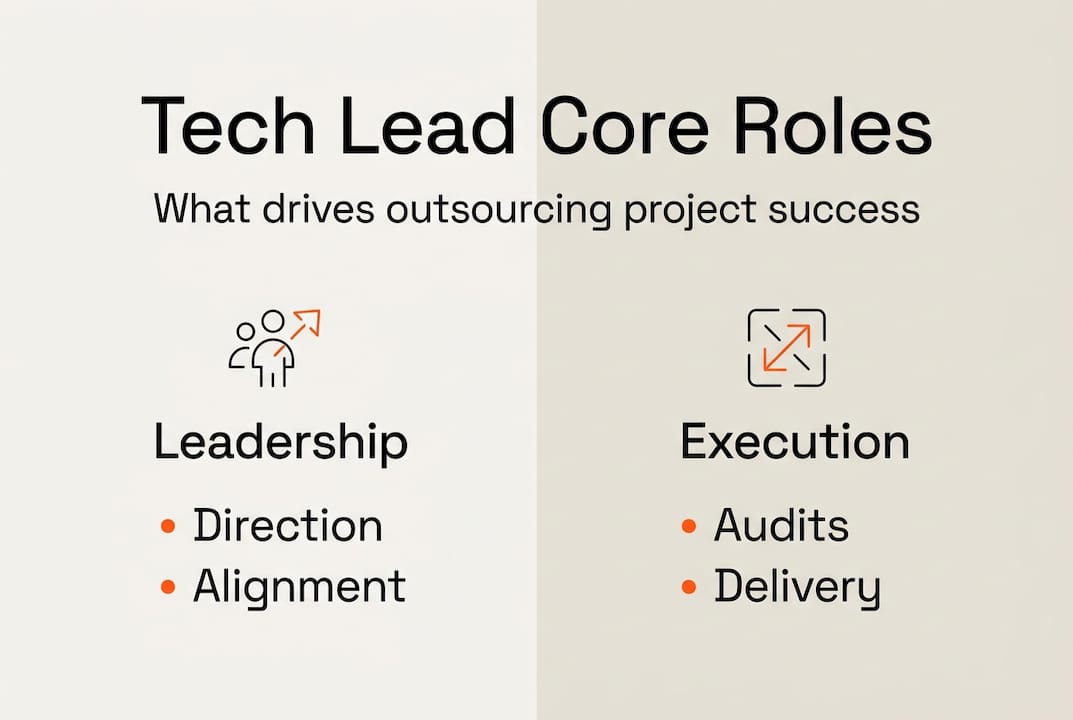
What separates strong tech leads in outsourced contexts is their ability to “localize” their leadership style. They don’t assume that the practices working in a co-located team will transfer automatically to a remote partner. They invest time in establishing shared standards, explicit documentation, and communication rhythms that work across distributed setups. This is why tech leads bridge business needs with technical execution, and why poor leadership leads to costly failures in outsourced projects.
Review your strategic outsourcing guide to understand how leadership structure fits into the broader vendor selection process. Understanding the advantages of remote IT teams also helps you frame what a tech lead needs to enable.
Here are responsibilities that only an effective tech lead can handle in outsourced projects:
- Defining and enforcing coding standards across geographically distributed contributors
- Running architecture reviews to catch design decisions before they become expensive technical debt
- Owning estimation accuracy by grounding timelines in technical reality, not stakeholder pressure
- Translating business requirements into precise engineering tasks that remote teams can execute without constant clarification
- Monitoring code quality through pull request reviews, automated testing standards, and regular refactoring cycles
- Maintaining team alignment by creating feedback loops that surface blockers before they compound
- Managing stakeholder communication so that business-side expectations stay calibrated to actual engineering progress
No project manager or architect alone can cover all of these. The tech lead is the connective tissue holding the outsourced engagement together.
How tech leads impact project outcomes: best- vs worst-case scenarios
The stakes here are not abstract. One company wasted $200,000+ in resources over eight months because of an inept tech lead. That’s the cost of a senior engineer’s annual salary, gone. And the damage wasn’t just financial. The team churned, the architecture regressed, and the product had to be partially rebuilt.

Strong tech leads produce the opposite effect. Velocity stays predictable. Code quality remains high enough to support future feature development without constant rework. Stakeholders receive accurate, timely updates. The outsourced team feels ownership over their work rather than confusion about shifting priorities.
| Outcome area | Effective tech lead | Ineffective tech lead |
|---|---|---|
| Estimation accuracy | Consistent, grounded in data | Optimistic, frequently missed |
| Code quality | Maintained through reviews | Degraded by shortcuts and debt |
| Team retention | High, with clear growth paths | Low, driven by frustration |
| Architecture stability | Evolves intentionally | Regresses under pressure |
| Stakeholder trust | Built through transparency | Eroded by surprises |
| Project cost | Predictable and controlled | Inflated by rework and churn |
Incompetent leads amplify risks in outsourcing. Mitigate with audits, clear KPIs, and hybrid in-house/outsource models for core IP.
The specific failure patterns are worth naming. Technical debt accumulates silently when no one is enforcing standards. Architecture regressions happen when decisions get made under deadline pressure without a lead who pushes back. Team churn follows when engineers feel directionless. Missed estimates become chronic when the lead lacks the experience to scope work accurately.
Review outsourcing tips for tech execs to see how these risks map to real engagement structures. Understanding outsourcing for digital transformation also reveals how leadership quality shapes long-term product outcomes.
Pro Tip: Schedule quarterly technical audits with defined KPIs for code quality, estimation variance, and team velocity. These audits give you an early warning system that doesn’t rely on the tech lead self-reporting problems.
Key responsibilities and must-have skills for tech leads in outsourced teams
Effective tech leads in outsourced environments carry a specific set of responsibilities that go beyond what most job descriptions capture. Here’s what the role actually requires:
- Conducting architecture and design reviews before development begins, not after problems surface
- Setting and enforcing code quality standards through documented guidelines and consistent pull request feedback
- Owning estimation processes by involving the full team in scoping and accounting for distributed-team overhead
- Maintaining alignment documentation so that context isn’t lost when team members rotate or time zones create gaps
- Facilitating stakeholder communication by translating technical progress into business-relevant updates
- Identifying and resolving blockers before they cascade into schedule delays or architectural compromises
- Supporting team growth by mentoring engineers rather than solving every problem personally
The skill set that supports these responsibilities is equally specific. Strong communication is non-negotiable. A tech lead who cannot clearly articulate technical tradeoffs to a non-technical stakeholder will create misalignment that compounds over time. Context sharing matters just as much. Remote teams need explicit context because they can’t absorb it passively through hallway conversations.
Scaling mindset is another differentiator. A tech lead who designs for the current team size without considering future growth creates systems that break at the worst possible moment. Explore remote team types for productivity to understand how team structure affects what your lead needs to manage.
The common pitfalls worth avoiding include letting business priorities override sound technical decisions, ignoring scalability in favor of short-term delivery, and producing poor documentation that leaves the team dependent on individual knowledge. Review agile IT outsourcing best practices to see how these principles apply in sprint-based delivery models.
Pro Tip: Involve the entire engineering team in design sessions, not just the tech lead. Distributed contributors often spot edge-case risks that a single decision-maker misses, and shared ownership improves buy-in across time zones.
Best practices to ensure tech leads succeed in your outsourced projects
Even the best tech lead will underperform without the right organizational support. Your job as an engineering or product leader is to create the conditions where strong leadership can produce results.
Start with a clear KPI framework. Ambiguity is the enemy of accountability in distributed teams. Define what success looks like across estimation accuracy, code review turnaround, defect rates, and deployment frequency. Then review those metrics regularly, not just at milestones.
| Practice | What it addresses | Recommended frequency |
|---|---|---|
| Technical audits | Architecture drift, code quality | Quarterly |
| KPI reviews | Velocity, estimation variance | Bi-weekly |
| Stakeholder alignment sessions | Expectation gaps, scope creep | Monthly |
| Team retrospectives | Process friction, morale | Every sprint |
| Documentation reviews | Knowledge gaps, onboarding risk | Quarterly |
Mitigate lead risk with audits, clear KPIs, and hybrid in-house/outsource models for core IP. This isn’t a theoretical recommendation. It’s a structural safeguard that separates organizations that scale outsourcing successfully from those that repeat expensive mistakes.
Here’s what tech leads need from management to perform at their best:
- Clarity on scope and priorities so they can make technical decisions without constant escalation
- Autonomy to enforce standards without being overridden by business-side pressure on deadlines
- Regular feedback channels that surface concerns before they become crises
- Access to the right tools for code review, documentation, and asynchronous communication
- Support for team growth including budget for training and time for mentorship
For teams scaling quickly, review scaling tech teams quickly to understand how staffing models affect tech lead workload. Consider outsourcing support strategies for ongoing engagement structures. And don’t overlook cybersecurity in outsourcing, since tech leads often own security standards in distributed environments.
A hard-won truth about tech leads and outsourcing no one tells you
Most organizations spend months evaluating vendors. They review portfolios, check references, negotiate contracts, and run technical assessments. Then they assign a tech lead to the engagement without applying anywhere near the same rigor. That’s the gap where seven-figure mistakes live.
Vendor quality cannot compensate for tech lead incompetency. A strong vendor with a weak lead will still produce architectural drift, estimation failures, and team churn. The vendor’s engineers need direction. Without it, they default to whatever feels fastest, not whatever is right for your product.
Incompetent tech leads dramatically raise risks. Hybrid models and proactive audits offer practical risk reduction, but they only work if the lead has the competency to act on what those audits surface.
The structural change we’d recommend: treat tech lead selection with the same discipline you apply to vendor selection. Define the competencies you need. Assess candidates against them. Then invest in IT staff augmentation benefits to fill gaps where your internal leadership bench is thin. Outsourcing works. But it works because of the people leading it, not in spite of them.
Ready to strengthen your outsourced projects with expert tech leadership?
At DevPulse, we’ve built and scaled distributed engineering teams across SaaS, healthcare, legal tech, and enterprise platforms. We know what strong technical leadership looks like in practice because we’ve embedded it into every engagement we run.

If you’re planning a new outsourced build or trying to stabilize an existing one, our software enhancement services and proven delivery frameworks are designed to reduce exactly the risks this article covers. Explore our real-world case studies to see how we’ve helped SaaS and enterprise clients navigate complex distributed projects. When you’re ready to talk specifics, the DevPulse team is here to help you build with confidence.
Frequently asked questions
What is the primary responsibility of a tech lead in outsourced projects?
The tech lead ensures technical alignment, code quality, and effective communication between stakeholders and the remote team. As the role bridges business needs to technical outcomes, they are the single most accountable person for whether the distributed project delivers on its goals.
What are common failures caused by poor tech leads in outsourcing?
Poor tech leads can cause technical debt, missed deadlines, architecture downgrades, and costly resource waste. In documented cases, a poor tech lead led to $200K lost in eight months through failed project estimation and team management failures.
How do I mitigate risks with tech leads in outsourcing?
Set clear KPIs, conduct regular technical audits, and ensure the lead has the authority to enforce decisions without business-side interference. Clear KPIs and audits combined with hybrid in-house/outsource models are proven to reduce engagement risk significantly.
What skills distinguish a great tech lead for outsourced teams?
A great tech lead demonstrates technical expertise, strong communication, the ability to empower teams, and strategic oversight across distributed contributors. Empowering growth over hero-solving and maintaining thorough documentation are the critical distinctions that separate strong leads from costly ones.