












TL;DR:
- Building and maintaining a proactive tech talent pool accelerates hiring and reduces costs.
- Talent pools differ from pipelines by being broad, ongoing, and qualification-focused.
- Leveraging AI and global networks enhances reach, matching, and diversity in tech talent sourcing.
Despite fierce competition for tech talent, most companies still rely on reactive hiring — posting a job, sifting through applications, and hoping the right candidate shows up in time. That approach leaves serious money, speed, and market opportunity on the table. A tech talent pool is a database of pre-qualified candidates with tech skills, including past applicants, referrals, and passive candidates who may not be actively job hunting. For technology executives scaling digital products, this distinction is not academic. It is the difference between launching a feature on schedule and stalling for months while your recruitment team scrambles.
Table of Contents
- What is a tech talent pool?
- Talent pool vs. talent pipeline: What’s the difference?
- Why tech talent pools matter for scaling US tech teams
- Designing and nurturing an effective tech talent pool
- Leveraging AI and global networks to expand your talent pool
- Why building a future-proof tech talent pool requires more than software
- Accelerate your tech hiring with DevPulse solutions
- Frequently asked questions
Key Takeaways
| Point | Details |
|---|---|
| Tech talent pool defined | A tech talent pool is a curated database of qualified candidates for future hiring needs. |
| Key pool vs pipeline difference | Talent pools are broad and preemptive, while pipelines focus on filling current vacancies. |
| Speeds up tech hiring | Leveraging talent pools can reduce time-to-hire and costs for tech teams. |
| Nurturing prevents staleness | Regular updates and engagement keep your pool active and relevant. |
| AI expands, doesn’t replace | AI boosts sourcing scale but still requires oversight to ensure quality hires. |
What is a tech talent pool?
A tech talent pool is a curated, continuously updated database of pre-screened candidates who are a potential fit for your technology roles, now or in the future. Unlike a static resume folder or an unorganized applicant tracking system (ATS) inbox, a true talent pool is actively managed. It includes candidates at various readiness stages: those ready to hire immediately, those who need a few months of nurturing, and those who are passively open to the right opportunity.
The people in your pool typically come from multiple sources:
- Past applicants who were strong but not selected for a previous role
- Employee referrals from your existing engineering and product teams
- LinkedIn and GitHub profiles identified through proactive sourcing
- Previous contract or freelance staff who delivered strong results
- Attendees from developer conferences, hackathons, or community events
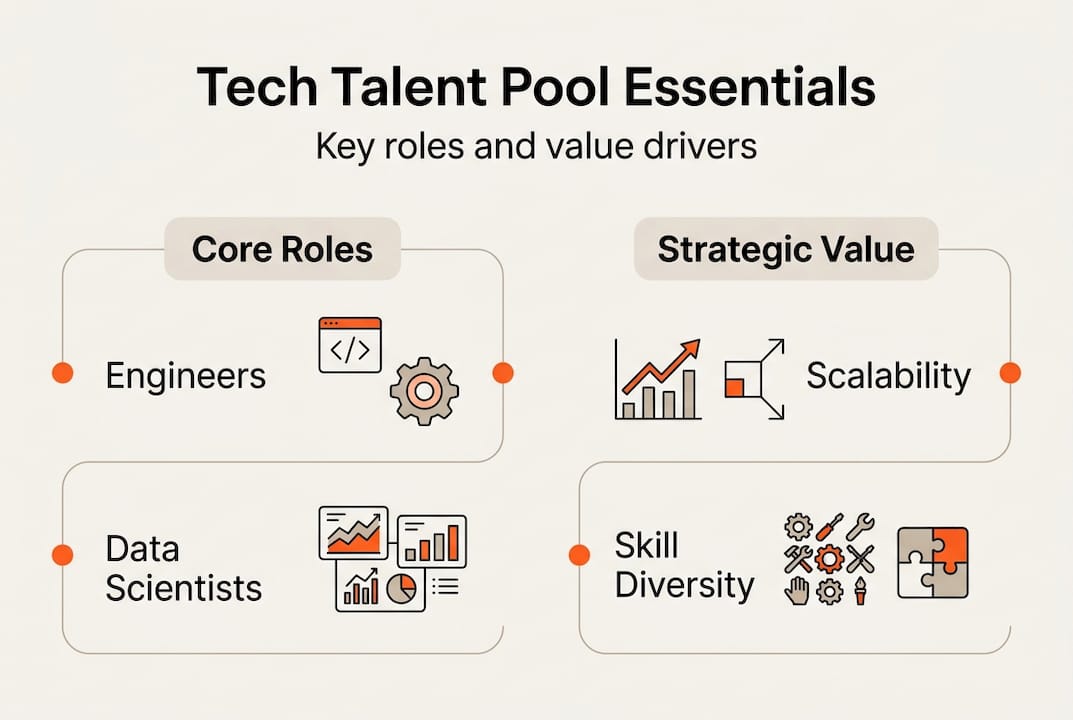
Common profiles inside a tech talent pool include software engineers, data scientists, AI/ML specialists, DevOps engineers, and cybersecurity analysts. The key differentiator from a simple candidate list is intentionality. As talent pools work across industries show, the value comes from qualifying and segmenting candidates before a vacancy opens, not after.

Building a pool also supports your workforce scalability strategies by creating a ready bench of talent aligned to both current needs and future digital initiatives. The payoff is measurable. Industry data places the average time-to-hire at 41 days, but companies with active talent pools consistently outperform that benchmark by a significant margin.
| Pool component | Example | Value delivered |
|---|---|---|
| Past applicants | Strong engineers who missed prior offer | Ready to re-engage fast |
| Passive candidates | Senior ML engineers on LinkedIn | Access to unavailable talent |
| Contract alumni | Freelancers with proven delivery | Reduced onboarding time |
| Referrals | Recommendations from internal team | Higher cultural alignment |
Talent pool vs. talent pipeline: What’s the difference?
Understanding the talent pool’s foundation leads naturally to the next strategic question — how does it differ from the closely related concept of the talent pipeline?
These two terms are often used interchangeably, but they are not the same thing, and confusing them leads to strategic mistakes. A talent pool vs pipeline comparison makes the distinction clear: pools are broad databases of diverse, pre-qualified candidates; pipelines are narrow, role-specific sequences activated by an open vacancy.
| Dimension | Talent pool | Talent pipeline |
|---|---|---|
| Scope | Broad, multi-role | Narrow, role-specific |
| Trigger | Proactive, ongoing | Reactive, vacancy-driven |
| Nurturing | Continuous engagement | Accelerated for open role |
| Risk | Stale data if neglected | Market mismatch if outdated |
Think of the pool as your bench strength and the pipeline as the active play. When a vacancy opens, you draw from the pool to build a targeted pipeline. Here is how to make that conversion effective:
- Segment your pool by role type, skill level, and time-to-readiness
- Identify top matches against the specific job requirements using ATS filtering
- Warm up candidates with a personalized outreach message referencing past interactions
- Move qualified leads into a structured interview sequence with defined timelines
- Document outcomes to refine your pool data for the next vacancy
A critical risk to address: pools that are not actively maintained become stale. Candidates move on, skills evolve, and contact details go out of date. That is why your staffing workflow optimization process must include scheduled pool audits at least twice a year.
Pro Tip: Schedule quarterly check-ins with high-priority pool candidates, even a brief email update about your company’s product roadmap keeps you top of mind and dramatically improves activation rates when you are ready to hire.
Why tech talent pools matter for scaling US tech teams
With distinctions clear, it’s time to focus on why building a tech talent pool is no longer optional for US-based startups and mid-sized firms.
The US tech labor market is under structural pressure. Time-to-hire averages 41 days, and talent gaps in AI/ML (68%) and cybersecurity (65%) are acute. For a startup racing to ship a product, or a mid-sized SaaS company scaling its engineering org, those delays translate directly into missed revenue.
Talent pools address this head-on. Talent pools enable up to 40% faster market launches, especially for hard-to-fill roles where sourcing from scratch is simply too slow. The practical benefits stack up quickly:
- Reduced time-to-hire by engaging pre-vetted candidates instead of starting cold
- Lower recruiting costs by minimizing agency fees and job board spend
- Higher offer acceptance rates because candidates already know your brand and culture
- Better upskilling pathways by tracking where pool candidates need development
- Stronger diversity by sourcing proactively from underrepresented communities and global networks
For the hardest-to-fill roles in AI/ML and cybersecurity, domestic sourcing alone is often insufficient. This is where remote IT teams and global or nearshore talent pools become a strategic asset. Teams in Latin America, Eastern Europe, and Southeast Asia offer strong technical depth, compatible time zones with US clients, and significantly faster sourcing timelines.
Stat to know: Companies with structured talent pools report up to 40% faster product launches compared to those relying solely on reactive hiring, according to additional evidence on value.
Beyond speed, the best talent pools also shift evaluation criteria. Leading teams are moving from narrow skill-only filters toward culture-add assessments, rewarding candidates who bring diverse perspectives and problem-solving approaches that their current team lacks.
Designing and nurturing an effective tech talent pool
Leaders now recognize the value; next, see exactly how to design and maintain a tech talent pool that consistently delivers results.
Building a pool is not a one-time project. It is an ongoing operational discipline. Neglecting engagement leads to stale pools, and the key success metrics include activation rate, time-to-fill reduction, and hire quality. Here is a practical step-by-step approach:
- Forecast talent needs by aligning with your product and engineering roadmaps for the next 12 to 18 months
- Source from multiple channels to build breadth and reduce dependency on any single pipeline
- Screen and segment candidates by role family, seniority, availability, and readiness timeline
- Engage consistently with tailored content: job market insights, company updates, technical resources
- Measure and refine using activation rate, source quality, and offer acceptance data
The best sourcing channels for tech talent pools include:
- GitHub and Stack Overflow for identifying active, skilled contributors
- LinkedIn Recruiter for passive candidate outreach at scale
- Developer meetups and hackathons for early relationship building
- University partnerships and bootcamp networks for emerging talent
- Internal referral programs for higher-trust, higher-fit candidates
Pro Tip: Integrate your talent pool strategy directly with your product roadmap. If you know you are launching a new AI-powered feature in Q3, start sourcing ML engineers six months in advance so they are warm and ready when you need them.
The most common pitfall is treating the pool as an archive rather than a living system. Assign clear ownership, set review cycles, and use your ATS to flag candidates who have not been contacted in more than 90 days.
Leveraging AI and global networks to expand your talent pool
Once the foundation is built, scaling reach and effectiveness requires leveraging new technologies and global talent options.
AI expands the workforce by 21% net, but it requires oversight to avoid bias. AI-driven tools are most effective when used in the right contexts:
- Automated sourcing across job boards, GitHub, and LinkedIn to surface candidates at scale
- Skill-matching algorithms that rank pool candidates against open role requirements
- Engagement automation for scheduling regular touchpoints without manual effort
- Bias-reduction features that anonymize early screening criteria to promote objective evaluation
- Predictive analytics to flag which pool candidates are most likely to convert based on behavioral signals
That said, AI is a tool, not a strategy. Over-reliance on automation creates real risks. Algorithmic screening can miss candidates who bring unconventional backgrounds but high culture-add potential. Agentic AI tools are advancing rapidly, but the highest-performing teams embed human-in-the-loop checks at every key decision point.
For data and AI strategies to work in talent management, they must be aligned with your business forecasts, not just your current vacancies. Global and nearshore recruitment is equally important here. Following best practices for tech talent recruiting across borders allows you to tap markets where AI/ML and cybersecurity talent is more accessible and equally high quality.
Why building a future-proof tech talent pool requires more than software
Here is something the industry rarely acknowledges openly: most organizations that invest in ATS platforms and AI sourcing tools still struggle with talent pool effectiveness. The software is not the problem. The process and discipline around it are.
We have seen companies deploy sophisticated talent intelligence platforms and still end up with pools full of candidates who stopped responding 18 months ago. Why? Because no one owned the relationship. Executives over-index on technology features and under-invest in the human systems that keep pools active and relevant.
The real competitive edge in talent pooling comes from three things: intentional forecasting tied to your business roadmap, consistent and genuine candidate engagement, and a clear-eyed view of culture add, not just skill match. These are not software features. They are leadership decisions.
At DevPulse, we believe scalable IT workforce insights only convert into results when there is process discipline behind them. The organizations winning the talent game in 2026 are not the ones with the most advanced tools. They are the ones who treat their talent pool as a strategic asset that needs as much attention as their product roadmap.
Accelerate your tech hiring with DevPulse solutions
Having clarified what tech talent pools are and how to build them strategically, the next step is putting these insights into practice. DevPulse helps startups and mid-sized tech companies design scalable hiring foundations and build the engineering capacity to deliver on their product vision. Our engineering solutions are built to support rapid team scaling, and our AI-powered recruitment tools help surface and engage the right candidates faster.
Whether you need to modernize your talent acquisition approach, build nearshore teams, or explore what a high-performance engineering partnership looks like, our real-world case studies show exactly how we have helped companies like yours scale with confidence. Reach out to DevPulse to start building a talent pool that matches the pace of your ambitions.
Frequently asked questions
What roles are typically included in a tech talent pool?
A tech talent pool usually features a range of tech-skilled roles, including software engineers, data scientists, cybersecurity experts, AI/ML specialists, and IT support professionals, depending on your product roadmap and organizational needs.
How can small companies compete with Big Tech for top talent?
Small firms can win by building engaged, proactive talent pools and tapping global or nearshore resources to offset US shortages, while differentiating through culture, mission clarity, and faster career growth opportunities.
How is a talent pool kept ‘fresh’ and effective?
Regular engagement, data updates, and consistent relationship nurturing prevent stale candidate lists and low activation rates, and quarterly audits with defined ownership are the simplest safeguard.
Is AI effective for building and maintaining a tech talent pool?
AI can rapidly expand sourcing capacity and improve skill matching, but AI expands workforce effectiveness only when paired with human oversight to prevent bias and ensure candidates are evaluated for culture alignment, not just technical credentials.