










Software development services give your company the people, processes, and platforms to design, build, deploy, and operate custom software products. Before you evaluate a single vendor, schedule a short discovery call or send a scoped RFP to align on requirements, risk, and total cost of ownership.
Core service types to look for in any capable vendor:
- Custom web and mobile application development — purpose-built products for your users and workflows
- Legacy system modernization — replatforming or refactoring systems that limit your speed or scale
- QA, DevOps, and cloud engineering — the delivery infrastructure that keeps software reliable in production
- AI/ML and agentic AI integration — intelligent features and automated workflows embedded in your product
Pro Tip: Before you brief any vendor, write a one-page problem statement: what the software must do, who uses it, and what “done” looks like. Vendors who respond to that document with clarifying questions are worth shortlisting; vendors who respond with a price are not.
Key Takeaways
Custom software development services require outcome-owned vendor partnerships, full IP assignment, and a structured discovery phase to control scope, cost, and delivery risk.
| Point | Details |
|---|---|
| Start with discovery | A two-week paid discovery sprint produces a scoped SOW and prevents the most expensive form of scope creep. |
| Require team continuity | Name the technical lead in the contract; vendors who stay from sprint zero through production reduce handoff risk and post-launch refactor costs. |
| Budget for TCO, not just build cost | Include first-year maintenance and a refactor reserve; MVP timelines run 8–12 weeks, full platforms 6+ months. |
| Verify IP ownership before signing | All source code, design assets, and documentation must transfer to you at delivery under a written assignment clause. |
| Devpulse for outcome-owned delivery | Devpulse covers discovery through production and post-launch support for startups, SaaS companies, and enterprise clients. |
What software development services actually cover
Software development services span the full lifecycle of a software product: discovery and requirements, UX design, engineering, quality assurance, deployment, and ongoing operations. The term covers both the work and the team delivering it, which is why it differs fundamentally from buying a SaaS subscription.
When you buy SaaS, you get a fixed product built for a broad market. When you engage software development services, you commission a product built around your specific processes, data, and users. That distinction shapes every procurement decision that follows.
Custom development and SaaS differ in practical ways
- Fit: Custom software matches your exact workflow; SaaS requires your workflow to match its feature set.
- Control: You own the codebase, the data model, and the roadmap; SaaS vendors control all three.
- Cost structure: SaaS has predictable per-seat fees; custom development has higher upfront investment and lower marginal cost at scale.
Signals that your company needs custom software development services rather than SaaS:
- Your core process requires integrations, data models, or compliance controls that no off-the-shelf product supports
- A legacy system is blocking product-market fit, regulatory compliance, or team velocity
- You are building a differentiated product that is itself the business (a platform, a marketplace, a clinical tool)
- You need to own your IP and data pipeline for competitive or regulatory reasons
Core service types to expect from a competent vendor
A vendor’s service menu tells you whether they can own the full lifecycle or only a slice of it. The taxonomy of software development service types typically includes the following:
- Product strategy and discovery — requirements workshops, technical feasibility, architecture scoping, and risk mapping before a line of code is written
- Custom web application development — full-stack web products, portals, and SaaS platforms built to your specifications
- Mobile application development services — native iOS and Android apps, or cross-platform builds using React Native or Flutter, covering the full mobile software development lifecycle
- Cross-platform desktop applications — Electron, Tauri, or WASM-based apps that run consistently across Windows, macOS, and Linux
- Cloud engineering and replatforming — AWS, Azure, or GCP architecture, containerization, migration from on-premise, and cloud-native redesign
- AI/ML and agentic AI — model integration, generative AI features, intelligent automation, and AI-assisted workflows embedded in your product
- Integrations and APIs — connecting your product to third-party systems, payment processors, EHRs, ERPs, and data pipelines
- QA and testing — automated test suites, regression testing, performance testing, and security scanning
- DevOps and SRE — CI/CD pipelines, infrastructure-as-code, monitoring, and incident response
- Maintenance and support — post-launch bug resolution, dependency updates, performance tuning, and feature iteration
A vendor who covers all of these in-house reduces the coordination overhead you carry. One who subcontracts QA or DevOps introduces handoff risk at exactly the points where projects most often break.
How vendors structure engagements, and which model fits your situation
Engagement models determine who owns risk, how costs are controlled, and how fast you can move. Each model fits a different situation, and choosing the wrong one is one of the most expensive mistakes a technology leader can make. For a deeper comparison of model trade-offs, the IT outsourcing vs. staff leasing guide covers the decision criteria in detail.
| Engagement model | Best for | Accountability | Cost predictability | Flexibility |
|---|---|---|---|---|
| Project-based (fixed scope) | Well-defined deliverables, limited budget variance | Vendor owns delivery | High | Low |
| Dedicated team / pod | Ongoing product development, scaling a product org | Shared | Medium | High |
| Staff augmentation | Filling specific skill gaps in your existing team | Client owns delivery | Medium | High |
| Managed services / retainer | Post-launch operations, maintenance, SRE | Vendor owns SLA | High | Medium |
Contract items to verify before signing, regardless of model:
- IP ownership: All code, data models, and documentation must transfer to you at delivery, not on final payment.
- SLAs: Response time, uptime commitments, and escalation paths must be written, not verbal.
- Team continuity: Name the leads. Contracts that allow unlimited team rotation without notice are a red flag.
- Exit plan: You need access to repositories, credentials, and documentation on day one, not after a dispute.
For teams evaluating whether to outstaff engineers or run a full outsourced engagement, the outstaffing considerations guide walks through the practical trade-offs.
What the delivery process looks like, phase by phase
A well-run software delivery follows a structured SDLC from discovery through to production operations. The phases below reflect how high-performing vendors structure work, and where the most common failures occur.
- Discovery (2–4 weeks): Requirements gathering, technical architecture, risk assessment, and a scoped statement of work. This phase is where scope creep is prevented, not managed.
- UX design and prototyping (2–4 weeks): Wireframes, user flows, and interactive prototypes validated with real users before engineering begins.
- Sprint zero (1–2 weeks): Development environment setup, CI/CD pipeline, repository structure, and coding standards. Skipping this phase costs weeks later.
- Iterative development (ongoing sprints): Two-week sprint cycles with working software demonstrated at each sprint review. Stakeholders should see running code, not status reports.
- QA and security validation (parallel to development): Automated testing, manual exploratory testing, and security scanning run continuously, not as a final gate.
- Deployment and launch: Staged rollout with rollback capability, monitoring dashboards live before go-live.
- Run and maintenance: Post-launch support, performance monitoring, dependency management, and planned feature iteration.
The most common failure point is the handoff gap: a vendor who delivers at launch and then rotates the team leaves the next sprint without institutional knowledge. High-performing vendors stay from sprint zero through production and into run, preserving the context that makes post-launch iteration fast and safe.
Pro Tip: Require that the same technical lead who ran sprint zero signs off on the production deployment. If the vendor cannot commit to that, ask specifically who owns continuity and get it in writing.
Modern delivery teams are also embedding AI-enabled, agentic workflows across the SDLC to accelerate documentation, automate test generation, and run continuous security validation. These tools add measurable speed when properly governed, but they require a vendor with the engineering maturity to use them without introducing new risk. The same pattern of AI-driven productivity gains is visible in adjacent fields: agentic content workflows have cut research time by 60% in comparable knowledge-work contexts, and software engineering is seeing analogous gains in test coverage and documentation quality.

For practical guidance on keeping sprints on track across an outsourced team, the tech leads’ outsourcing best practices guide covers the specific decisions that determine delivery continuity.
Which technology stacks and industry specializations matter
Technology stack choices shape your product’s speed, security, and long-term maintainability. A vendor’s stack fluency tells you whether they can build what you need and whether they can maintain it after launch.
Stack categories and what they signal about vendor capability:
- Backend (Node.js, Python, Go, Java, .NET): Signals API design maturity, data modeling depth, and performance engineering experience.
- Frontend (React, Vue, Angular, Next.js): Signals UI complexity they can handle and whether they build for performance and accessibility.
- Cloud (AWS, Azure, GCP): Signals infrastructure ownership. Ask which certifications the team holds, not just which logos appear on the website.
- Data and AI (PyTorch, TensorFlow, LangChain, vector databases): Signals whether AI features are genuine engineering work or thin API wrappers.
- DevOps and infrastructure (Terraform, Kubernetes, GitHub Actions, Datadog): Signals whether they can own production reliability, not just deliver code.
Industry specialization matters more than most buyers expect. A vendor who has built HIPAA-compliant systems before knows the data architecture, audit logging, and BAA requirements before you brief them. One who has not will learn on your project. The same applies to fintech (PCI DSS, SOC 2), legal tech (data residency, chain-of-custody), and edtech (FERPA, accessibility standards). Vertical experience compresses the time from requirements to compliant architecture.
Software development is a growing, well-paying field with strong demand across specializations, which means the talent market is competitive. Vendors who retain senior engineers rather than cycling through contractors carry a real advantage in institutional knowledge and delivery consistency.
Security and compliance: what to ask for, not just what to accept:
- SOC 2 Type II certification (or active audit in progress with a target date)
- HIPAA capability documentation for any healthcare-adjacent project
- Encryption standards: data at rest and in transit, key management practices
- Penetration testing cadence and most recent report summary
- Secure code review process and dependency vulnerability scanning
How to evaluate and choose a software development provider
Vendor selection is a procurement process, not a gut-feel exercise. A scored framework prevents the most common mistake: choosing the vendor with the best sales presentation rather than the best delivery record. Agency directories like DesignRush let you cross-reference specialties, portfolios, and client reviews before you invest time in a formal RFP.
Scored evaluation checklist:
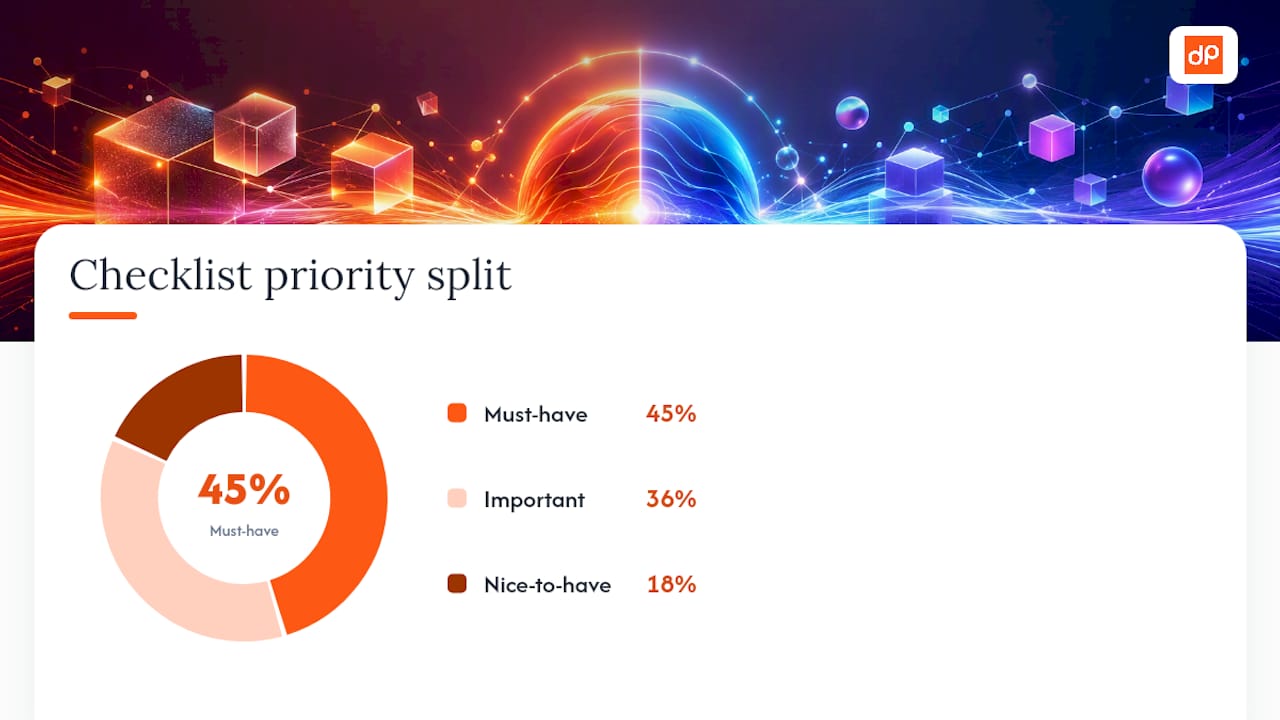
- Must-have: Full-lifecycle capability (discovery through run), not just development
- Must-have: Named team leads committed for the project duration
- Must-have: IP ownership transferred to client at delivery
- Must-have: SOC 2 or equivalent security posture documented
- Must-have: Published case studies with named clients and measurable outcomes
- Important: Vertical experience in your industry (healthcare, fintech, legal tech, etc.)
- Important: Agile delivery with sprint reviews and working software demonstrated bi-weekly
- Important: Post-launch support model with defined SLAs
- Important: References from clients with similar project scope and complexity
- Nice-to-have: AI-augmented workflows for testing, documentation, and security validation
- Nice-to-have: Onshore or nearshore team for timezone-aligned collaboration
Interview questions worth asking technical leads, PMs, and account teams:
- “Walk me through a project where requirements changed significantly mid-delivery. What happened?”
- “Who specifically will be the technical lead on our project, and what is their current workload?”
- “How do you handle a sprint where the team misses velocity? What does the client see?”
- “What does your post-launch support model look like for the first 90 days?”
- “Can you show us the test coverage reports from a recent project?”
Red flags that should end the conversation:
- SLAs described verbally but not written into the contract
- Team composition described as “we’ll assign the right people” without naming anyone
- No post-launch retention plan or maintenance model
- Case studies with no named clients, no outcomes, and no technical detail
- Pricing delivered before requirements are understood
For a full executive-level checklist, the engineering outsourcing guide for tech executives covers the scoring criteria in depth.
What drives cost and how to estimate realistic timelines
Price in software development is a function of scope, complexity, compliance requirements, and team composition.
Primary cost drivers:
- Scope and complexity: Number of user roles, integrations, data models, and edge cases
- Compliance requirements: HIPAA, SOC 2, PCI DSS, and similar frameworks add architecture, audit, and documentation overhead
- UX complexity: Custom design systems, accessibility requirements, and multi-device support
- AI and data work: Model training, fine-tuning, vector database architecture, and inference infrastructure
- Team location and seniority: Senior engineers with vertical experience cost more per hour and deliver faster, with fewer costly rework cycles
- Integration depth: EHR, ERP, payment processor, and third-party API integrations add significant scoping and testing overhead
Typical timeline ranges (based on industry benchmarks from application development practice):
- MVP: 8–12 weeks for a focused, well-scoped product with limited integrations
- Full platform: 6+ months for a production-grade system with multiple user roles, integrations, and compliance requirements
These ranges assume a completed discovery phase. A vendor who quotes a timeline before discovery is guessing. Require a two-week paid discovery before any fixed-price or time-and-materials contract is signed.
Budgeting for total cost of ownership:
Structure your budget in three layers: initial build, first-year maintenance and support, and a refactor reserve for the technical debt that accumulates in any fast-moving product. Vendors who stay post-launch and retain domain knowledge lower the refactor risk significantly, because they know where the debt lives and why decisions were made. That institutional continuity is one of the most underweighted factors in vendor selection.
How Devpulse works with clients, from discovery to production
Devpulse is a software engineering company that works with startups, SaaS companies, and enterprise organizations across healthcare, cybersecurity, legal tech, edtech, and professional software. The core service offering covers the full lifecycle: product strategy and discovery, custom web and mobile development, cross-platform desktop applications, cloud engineering, AI-powered and generative AI solutions, DevOps, QA, and ongoing maintenance and support.
Representative project examples:
- AI-powered job discovery platform: A client needed a job aggregation product that could adapt to constantly changing source site structures. Devpulse built an AI-powered platform with adaptive web scraping that maintained data freshness without manual intervention as source sites changed.
- Cross-platform desktop application delivery: An enterprise client required a high-performance desktop product that ran consistently across Windows and macOS without maintaining two separate codebases. Devpulse delivered a cross-platform desktop application that cut infrastructure overhead significantly.
- Unified cloud file management platform: A client managing distributed file operations across cloud storage providers needed a single control layer. Devpulse built a unified cloud file management platform that consolidated access, permissions, and audit logging into one interface.
Engagement options:
- Discovery sprint (2 weeks): Scoped requirements, architecture proposal, risk register, and a fixed-price SOW
- Outcome-owned SOW: Devpulse owns delivery from sprint zero through production deployment
- Dedicated engineering pod: A named team embedded in your product org for ongoing development
- Maintenance retainer: Post-launch support, monitoring, and planned iteration with defined SLAs
Pro Tip: Review Devpulse’s full case study portfolio before your first call. Identifying two or three projects similar to yours gives the discovery conversation a concrete starting point and compresses scoping time.
For clients evaluating the outsourcing strategy question before committing to a vendor, Devpulse’s insights library covers the decision framework in detail.
Who owns the code? Intellectual property rights in software contracts
IP ownership is the single contract clause that most buyers underread and most regret. The default legal position in a work-for-hire arrangement under U.S. copyright law is that the party who creates the work owns it, unless the contract explicitly assigns ownership to the client. That means a vendor who delivers your product without a clear IP assignment clause may legally own the codebase they built for you.
What your contract must specify:
- Full IP assignment: All source code, documentation, design assets, and data models transfer to the client upon delivery or upon final payment, whichever comes first.
- Third-party components: The vendor must disclose all open-source libraries and third-party components used, along with their licenses. GPL-licensed components, for example, carry obligations that affect how you can distribute your product.
- Pre-existing IP: Vendors sometimes incorporate proprietary frameworks or tools they built before your engagement. These must be licensed to you explicitly, not assumed to transfer.
- Work product during the engagement: Any code written during the project belongs to you, not the vendor, from the moment it is committed. Contracts that tie IP transfer to final payment create leverage risk if a dispute arises mid-project.
- Employee and contractor agreements: Confirm that the vendor’s own engineers have signed IP assignment agreements with the vendor. A gap there creates a chain-of-title problem that surfaces during due diligence or acquisition.
Raise IP ownership in the first commercial conversation, not after the statement of work is drafted. Vendors who push back on full IP assignment without a specific, legitimate reason are telling you something important about how they intend to manage the relationship.
The case for outcome-owned engineering partnerships
The conventional advice in vendor selection is to evaluate capabilities, check references, and negotiate price. That framework is not wrong, but it misses the variable that most consistently determines whether a software project delivers value: whether the vendor is accountable for outcomes or only for outputs.
An output-accountable vendor delivers code that passes acceptance criteria. An outcome-accountable vendor stays engaged until the product works in production, users adopt it, and the metrics it was built to move actually move. The difference shows up most clearly in the 90 days after launch, when the gap between what was specified and what users actually need becomes visible.
Most project failures are not engineering failures. They are continuity failures: the team that understood the domain rotated off, the institutional knowledge left with them, and the next team spent the first two months reconstructing decisions the previous team made. Requiring named team continuity from sprint zero through the first production quarter is not a nice-to-have. It is the single highest-leverage contract term a technology leader can negotiate.
The TCO argument is equally clear. A vendor who stays post-launch and retains domain knowledge prevents the expensive refactor cycles that accumulate when a new team inherits undocumented decisions. That continuity compounds over time: each sprint builds on real knowledge of the system, rather than on assumptions about it.
Devpulse delivers outcome-owned software engineering
Devpulse’s engineering services are built around a single principle: the team that scopes your project is the team that ships it and supports it. For technology leaders who have experienced the handoff gap firsthand, that continuity is the concrete differentiator.
From a two-week discovery sprint through production deployment and a post-launch maintenance retainer, Devpulse owns the full delivery arc. The same engineers who mapped your architecture in sprint zero are the ones resolving production incidents at month six. For organizations building in healthcare, fintech, legal tech, or enterprise SaaS, Devpulse brings vertical experience that compresses the time from requirements to compliant, production-grade software. If your project involves AI-powered features, Devpulse’s agentic AI capabilities cover model integration, generative AI development, and intelligent workflow automation built into your product from day one.
Schedule a discovery call with Devpulse to get a scoped architecture proposal, risk register, and fixed-price SOW within two weeks.
Sources
The sources below provide authoritative context on software development services, workforce trends, and SDLC practices:
- Application Development for Business Growth | Insight Global
- Is Software Development a Good Career? (WGU Blog)
- Designrush