














TL;DR:
- Compliance should be integrated into every phase of IT outsourcing, from vendor selection to ongoing monitoring.
- Clear evidence of certifications like SOC 2 Type II or ISO 27001 must be verified upfront, and contracts should include specific compliance clauses.
Compliance must shape every stage of IT outsourcing, from vendor shortlisting through contract execution and ongoing delivery. You retain full regulatory accountability regardless of what your vendor does, so the practical question is never whether to address compliance but how early and how specifically. Start here:
- Require SOC 2 Type II or ISO 27001 certification evidence with the issuing body, audit date, and scope before shortlisting any vendor.
- Add a compliance-impact assessment as a named Discovery deliverable in your Statement of Work.
- Assign an internal compliance owner who sits at the intersection of legal, engineering, and procurement.
- Include audit rights, breach notification timelines, and a regulatory-change mechanism in every Master Services Agreement.
- Request the last penetration-test report and any open remediation tickets during due diligence.
- Map subcontractors and cloud providers in the vendor’s supply chain before contract signature.
Pro Tip: Build a short evidence checklist into your RFP. Ask vendors to attach the certification name, issuing body, last audit date, scope statement, and one remediation example. Vendors who cannot complete that checklist in the RFP stage rarely improve after contract award.
Table of Contents
- Why compliance defines the outcome of outsourced engineering
- Which U.S. regulations apply to your outsourced IT work
- What your contracts must actually say
- Technical controls and verifiable evidence you should require
- How to run a compliance-focused vendor due diligence process
- Managing compliance across the full vendor lifecycle
- What compliance requirements actually cost and how to negotiate them
- Red flags that should stop or escalate a vendor deal
- Devpulse builds compliance into engineering from day one
- Key Takeaways
- The case for treating compliance as an engineering constraint
- Authoritative U.S. sources for further reading
Why compliance defines the outcome of outsourced engineering
Compliance failures in outsourced software projects do not stay contained. They force re-architecture, delay releases, and leave legal liability squarely with your organization, not your vendor. Regulatory accountability cannot be outsourced — your compliance officer and your board remain the responsible parties in every enforcement scenario.
The business impacts are concrete:
- Regulatory fines and consent decrees with multi-year monitoring obligations
- Injunctions that halt product deployments mid-launch
- Remediation costs that dwarf the original development budget when compliance is discovered late
- Customer attrition and reputational damage following a breach or enforcement action
- Lost contracts in regulated sectors where certification is a procurement prerequisite
Compliance also shapes technical architecture. Access-control models, encryption key management, audit logging, and CI/CD pipeline security are not afterthoughts — they are design constraints. When outsourced teams build without those constraints defined upfront, late-stage compliance discovery forces expensive re-architecture. U.S. banking regulators, for example, hold institutions accountable for third-party failures and can impose audits directly on vendors performing regulated functions.
Which U.S. regulations apply to your outsourced IT work
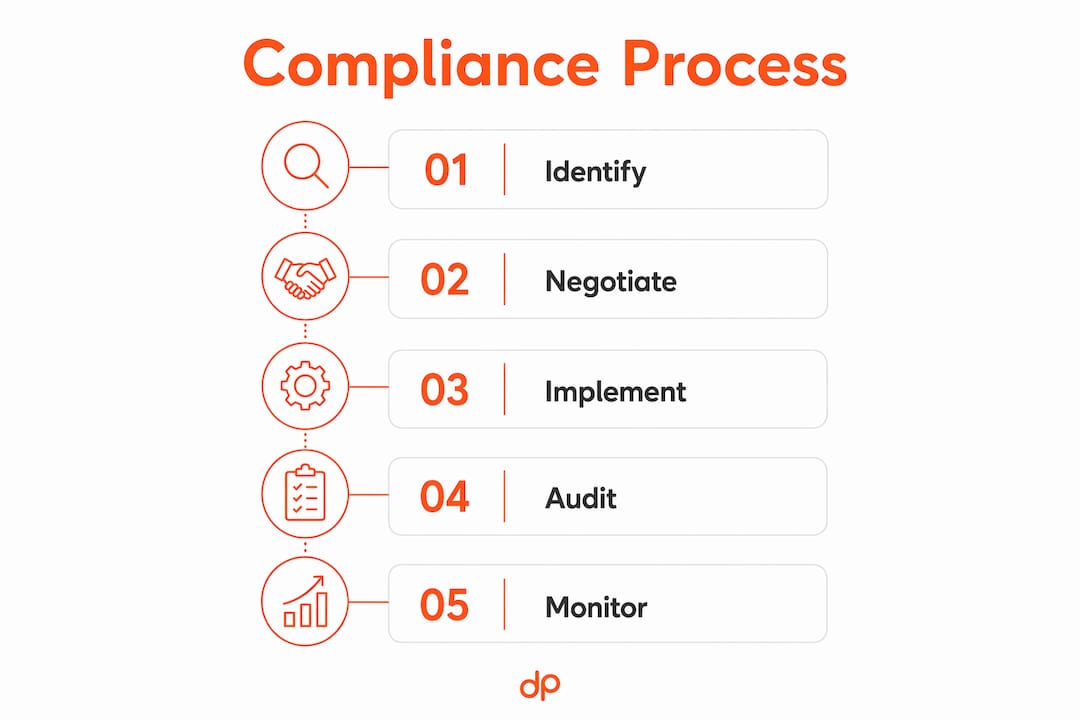
U.S. federal law does not prohibit IT outsourcing, but sector-specific regimes attach the moment your outsourced work touches regulated data or functions. Knowing the trigger for each regime tells you which contract clauses and certifications to require.

| Regulatory Regime | Trigger | Typical Contractual Requirement |
|---|---|---|
| HIPAA / HITECH | Vendor accesses protected health information (PHI) | Business Associate Agreement, breach notification within 48 hours, audit rights |
| GLBA / FFIEC / OCC guidance | Outsourced functions support banking or financial services | Third-party oversight program, annual audits, incident reporting |
| EAR (Export Administration Regulations) | Software, technology, or source code crosses borders or reaches foreign nationals | Export license review, nationality screening, technology-control plan |
| ITAR (International Traffic in Arms Regulations) | Defense-related software or technical data involved | ITAR compliance plan, restricted-party screening, subcontractor flow-downs |
| OFAC sanctions | Vendor or subcontractor located in or owned by sanctioned jurisdictions | Sanctions screening of all sub-tier vendors, contractual representations |
| Uyghur Forced Labor Prevention Act | Supply chain includes goods or services with potential Xinjiang nexus | Supply-chain mapping, rebuttable-presumption documentation |
| CCPA / CPRA | California residents’ personal data processed | Data processing agreement, deletion rights, opt-out mechanisms |
Healthcare outsourcing that touches PHI requires due diligence and ongoing oversight as a matter of federal law, not just good practice. Export controls and OFAC sanctions apply regardless of vendor location — a domestic vendor with offshore subcontractors can still trigger EAR or ITAR obligations. Sub-tier supply-chain visibility is therefore mandatory, not optional.
What your contracts must actually say
Contracts must allocate responsibilities precisely and include enforceable mechanisms for audits, breach response, and regulatory change. Generic security warranties are not sufficient.
Essential clauses for every MSA and SOW:
- Data Processing Agreement: defines data categories, processing purposes, retention limits, and deletion obligations.
- Security obligations: specifies encryption standards, access-control requirements, logging retention, and secure SDLC practices by name.
- Audit rights: grants you the right to conduct or commission audits annually and after any material incident, with vendor cooperation required.
- Breach notification: sets a contractual timeline shorter than the regulatory deadline (e.g., 48 hours to you, giving you time to meet a 72-hour regulatory clock).
- Subcontractor disclosure: requires written approval before adding subcontractors and mandates flow-down of all security and compliance obligations.
- Indemnity tied to regulatory fines: allocates liability for fines arising from vendor-caused compliance failures.
- Regulatory-change mechanism: names triggers, timetables, and cost-sharing for new compliance obligations so neither party is blindsided by a mid-contract regulatory shift.
Pro Tip: Include termination rights tied to material compliance failures and require a documented transition plan covering IP handover, data deletion, and access revocation. Without it, a compliance-driven exit becomes a negotiation under pressure.
Plain-language formulation to request: “Vendor shall notify Client of any actual or suspected security incident within 48 hours of discovery, and shall provide a written incident report within 5 business days.” That specificity is what makes breach-notification clauses enforceable.
Technical controls and verifiable evidence you should require
Require verifiable evidence, not vendor assurances. Regulators and auditors expect evidence-based compliance — named certifications with scope statements, not marketing claims about security posture.
| Control | Evidence Type | Verification Step |
|---|---|---|
| Encryption in transit and at rest | TLS configuration + KMS policy documentation | Review key management procedures and test logs |
| Access control and least privilege | SOC 2 Type II report | Confirm scope covers the relevant environment |
| Audit logging and retention | Log management policy + sample log exports | Verify retention period meets regulatory minimum |
| Secure SDLC | CI/CD pipeline security policy + SAST/DAST tool evidence | Review pipeline configuration and scan reports |
| Incident response | IR plan + tabletop exercise records | Confirm last exercise date and documented outcomes |
| Penetration testing | Third-party pen-test report + remediation evidence | Check report date, scope, and open findings |
| ISO 27001 certification | Certificate + Statement of Applicability | Confirm issuing body and expiry date |
The NIST Cybersecurity Framework positions these controls as engineering-first requirements, meaning they belong in architecture decisions during Discovery, not in a post-launch audit. For cybersecurity controls in outsourced environments, the verification step matters as much as the control itself.
Pro Tip: Always ask for the scope of a SOC 2 or ISO 27001 certification. A certificate that excludes the specific environment or service you are procuring provides no assurance for your use case.
How to run a compliance-focused vendor due diligence process
Use a consistent, documented due-diligence process that checks regulatory experience, certifications, sub-tier visibility, and process maturity before award. Ad hoc diligence produces inconsistent results and creates audit gaps.
- RFP evidence requirements: Include the evidence checklist from the opening section. Require vendors to submit certification documents, last audit date, and a subcontractor list with the RFP response.
- Technical verification: Review submitted evidence against your control requirements. Engage your security team or an external assessor to evaluate CI/CD security policies and pen-test reports.
- Reference checks: Ask references specifically about compliance incidents, how the vendor responded, and whether remediation was timely and documented.
- Sub-tier mapping: Request a full list of subcontractors and cloud providers. Map each against NIST SP 800-161 supply-chain risk categories and check for OFAC or export-control exposure.
- Contract negotiation triggers: Escalate to legal and compliance if the vendor declines audit rights, cannot produce recent certification evidence, or proposes vague subcontracting language.
Sample RFP questions that surface compliance maturity:
- “Provide your current SOC 2 Type II report, including the issuing auditor, report date, and scope statement.”
- “List all subcontractors and cloud providers used to deliver this service. Describe how compliance obligations flow down to each.”
- “Describe your process for notifying clients of a security incident. What is your contractual commitment on notification timelines?”
- “When did you last conduct a penetration test? Provide the executive summary and remediation status.”
A compliance-focused diligence phase typically adds two to four weeks to procurement. Budget that time explicitly rather than compressing it. The common IT outsourcing risks that surface post-award are almost always visible during diligence if you look.
Managing compliance across the full vendor lifecycle
Ongoing monitoring and a documented regulatory-change process prevent surprises and control remediation costs. Due diligence at contract award is necessary but not sufficient.
Recurring activities to schedule:
- Quarterly evidence refresh: Collect updated certification status, any new audit findings, and incident logs.
- Annual audit or attestation: Commission or review a full audit of the vendor’s control environment covering the services you procure.
- Continuous monitoring tooling: Use platforms that automate evidence collection, track certification expiry, and flag control gaps without manual follow-up.
- Governance cadence: Hold a monthly or quarterly steering committee that includes compliance representation from both sides.
- Escalation path: Define in writing who triggers a compliance escalation, what the response timeline is, and when termination rights activate.
Regulatory-change process: when a new rule is finalized, the sequence is notification (vendor informs you within 30 days), impact assessment (joint review of affected controls and architecture), remediation plan (agreed scope, timeline, and cost allocation), and closure (documented evidence of compliance with the new requirement).
Pro Tip: Integrated compliance dashboards that pull evidence directly from your vendor’s systems reduce manual audit overhead and create a continuous audit trail. That trail is what examiners request first in an enforcement review.
What compliance requirements actually cost and how to negotiate them
Tighter compliance requirements increase cost and extend timelines, but they reduce downstream risk. The question is who bears which cost and when.
Common cost drivers:
- SOC 2 Type II audit fees (vendor-side, but often passed through in pricing)
- Third-party penetration testing, typically required annually
- Specialized security engineering for encryption key management, zero-trust access, and audit logging
- Extended Discovery phase to produce a compliance-impact assessment
- Continuous monitoring tooling and evidence-management platforms
Negotiation tactics:
- Phase compliance work into Discovery with a fixed-price deliverable (compliance-impact assessment) so costs are visible before full development begins.
- Use conditional milestones: tie payment tranches to certification evidence submission, not just feature delivery.
- Agree shared-cost triggers for unexpected regulatory changes — specify a threshold (e.g., changes requiring more than 40 engineering hours) above which costs are renegotiated rather than absorbed by either party unilaterally.
- Require the vendor to maintain existing certifications as a contract condition, with renewal costs included in their base pricing.
Budget planning note: include a compliance contingency of 10–15% on top of your engineering estimate for projects in regulated sectors. That buffer covers remediation, re-testing, and regulatory-change response without requiring a contract amendment.
Red flags that should stop or escalate a vendor deal
Immediate deal-stoppers include refusal to provide recent audits, vague subcontracting policies, or attempts to shift regulatory responsibility entirely to you. Walk away or escalate when you see:
- No SOC 2 or ISO 27001 evidence, or certificates that expired more than 12 months ago
- Declining your contractual audit rights or proposing audit rights “by mutual agreement only”
- Inability or unwillingness to list subcontractors and cloud providers
- Breach-notification timelines longer than 72 hours, or no timeline specified at all
- Liability caps that exclude regulatory fines entirely
- No documented incident response plan or no record of a tabletop exercise in the past 12 months
- Subcontracting language that allows unrestricted substitution without client notification
- Missing or vague remediation commitments following prior audit findings
- Cyber liability insurance limits that do not cover the value of data they will process
Decision rule: if a vendor cannot produce verifiable evidence for three or more of the controls in your requirements list, treat that as a systemic process gap, not a documentation lag. Escalate to legal and compliance before proceeding.
Devpulse builds compliance into engineering from day one
Compliance-aware engineering requires a partner who treats it as a design input, not a post-build review. Devpulse integrates compliance requirements during Discovery, producing a compliance-impact assessment that maps controls to architecture, CI/CD pipelines, and operational processes before a line of production code is written.
That means your team gets audit-ready documentation, defined security controls, and a transition plan from the start of the engagement, not after a regulator asks for them. Devpulse works with clients in healthcare, cybersecurity, legal tech, and enterprise software where HIPAA, SOC 2, and export-control requirements are standard procurement conditions. Evidence packages covering certifications, pen-test reports, and remediation records are available on request.
If you are evaluating vendors for a compliance-sensitive modernization or custom development project, explore Devpulse’s engineering services or review client case studies to see how compliance has been handled in comparable engagements. Schedule a compliance-focused Discovery conversation to get a scoped assessment of your requirements before committing to a full build.
Key Takeaways
Compliance must be treated as a Discovery-phase engineering requirement, not a post-launch audit, because late discovery forces re-architecture and leaves legal liability with the client organization.
| Point | Details |
|---|---|
| Retain accountability always | Regulatory responsibility stays with your organization regardless of what your vendor does or agrees to contractually. |
| Require verifiable evidence | Demand SOC 2 Type II or ISO 27001 with issuing body, audit date, and scope — not marketing claims about security. |
| Bake compliance into contracts | Every MSA needs audit rights, breach notification timelines, subcontractor disclosure, and a regulatory-change cost-sharing mechanism. |
| Map the full supply chain | Subcontractors and cloud providers can trigger EAR, ITAR, or OFAC obligations even when your primary vendor is domestic. |
| Devpulse as your partner | Devpulse delivers a compliance-impact assessment during Discovery and provides audit-ready documentation and evidence packages on request. |
The case for treating compliance as an engineering constraint
Most organizations approach compliance as a legal review that happens after the architecture is set. That sequence is exactly backwards. By the time your legal team flags a HIPAA gap in a data model or your auditor finds that your CI/CD pipeline lacks audit logging, you are looking at weeks of rework and a delayed launch.
The more useful frame is to treat compliance the same way you treat performance requirements: define it at the start, build to it, and verify it continuously. That means your vendor’s first deliverable in Discovery should include a compliance-impact assessment, not just a technical specification. It means your contract should name the specific controls required, not just reference “applicable law.” And it means your governance cadence should include compliance evidence review, not just sprint velocity.
The vendors who resist that approach — who cannot produce recent audit reports, who push back on subcontractor disclosure, who want to handle compliance “after we get the MVP out” — are telling you something important about how they will behave when a real incident occurs. The evidence checklist in your RFP is not bureaucracy. It is your first test of whether a vendor can actually operate in a regulated environment.
Authoritative U.S. sources for further reading
Use these primary sources when defining contract triggers, scoping compliance requirements, and validating vendor claims:
- Federal Reserve SR 23-04: Supervisory guidance on third-party relationships for banking institutions; covers oversight expectations, audit rights, and accountability principles.
- NIST Cybersecurity Framework and CSRC: The authoritative source for security control frameworks, including the NIST CSF and SP 800-series publications used in SOC 2 and FedRAMP contexts.
- NIST SP 800-161 Rev.1: Supply-chain risk management practices; essential for mapping sub-tier vendor obligations and flow-down requirements.
- Bureau of Industry and Security (BIS): Administers the Export Administration Regulations (EAR); use for export-control classification, license requirements, and compliance program guidance.
- OFAC (U.S. Treasury): Sanctions lists, compliance frameworks, and enforcement actions; required reading before engaging any vendor with offshore subcontractors.
- HHS Office for Civil Rights — HIPAA: Primary source for HIPAA Privacy and Security Rules, Business Associate Agreement requirements, and enforcement guidance.
- FFIEC IT Examination Handbook: Covers third-party risk management expectations for financial institutions; directly relevant to GLBA and OCC-supervised entities.
- CBP — Uyghur Forced Labor Prevention Act guidance: Official guidance on the rebuttable-presumption standard and supply-chain documentation requirements.