














TL;DR:
- Vendor performance management is an ongoing discipline focused on measuring, evaluating, and improving software vendor delivery against contractual obligations and business goals.
- Effective VPM involves tiering vendors, defining SLAs, tracking key KPIs, and conducting regular evidence-based reviews to mitigate risks and inform decision-making.
Vendor performance management (VPM) is a continuous operating discipline that tracks, evaluates, and improves what your software vendors deliver against their contractual obligations and business goals. It is not a quarterly procurement review. The single best action you can take before the end of this week: tier your vendors by business criticality and assign one measurable SLA to your highest-risk engagement.
TL;DR:
- VPM runs a repeating loop: set expectations, measure against evidence, review on cadence, remediate issues, and feed learnings back into contracts and sourcing decisions.
- Assign a vendor tier today, write one SLA with a numeric target, and name the internal owner responsible for tracking it.
Table of Contents
- Why VPM matters for high-stakes software projects
- How the continuous VPM lifecycle works
- What KPIs should you track for software vendors?
- How to build a weighted scorecard for vendor evaluation
- Governance, escalation, and meeting cadence
- What tooling and data sources should you integrate?
- Common pitfalls that make VPM programs fail
- Your 30–60–90 day implementation plan
- Legal and compliance considerations in vendor agreements
- Key Takeaways
- The case for keeping VPM simple and decision-focused
- Devpulse brings VPM discipline to every engineering engagement
Why VPM matters for high-stakes software projects
Budget overruns and missed releases rarely announce themselves. They accumulate quietly in untracked sprint slippage, unresolved defects, and scope creep that nobody flagged at the right moment. A disciplined VPM program surfaces those signals early, before they become emergency escalations or contract disputes.
The business risks VPM directly controls include:
- Delivery delays from unmonitored sprint commitment drift
- Hidden cost variance when change orders and out-of-scope work go unreviewed
- Data-access and security exposure when vendor certifications lapse without notice
- Renewal decisions made on impressions rather than evidence
The concrete payoff is lower cost variance, fewer emergency fixes, and a defensible record when you decide to expand, renegotiate, or exit a vendor relationship. For engineering leaders running modernization programs, that record is also your audit trail if a board or investor asks why a project ran over.
How the continuous VPM lifecycle works
Vendor performance management connects vendor data, delivery evidence, stakeholder feedback, and corrective actions into a loop that never fully closes. Each stage feeds the next.
The five stages:
- Set expectations: Define scope, SLAs, escalation paths, and the baseline metrics before work begins.
- Measure: Collect evidence continuously from CI/CD pipelines, issue trackers, and accepted deliverables.
- Review: Score vendors against evidence on a cadence proportional to their risk tier.
- Remediate: Convert every issue into a tracked ticket with an owner, due date, and verification step.
- Improve: Feed review outcomes back into contract language, onboarding checklists, and sourcing criteria.
Cadence by vendor risk tier
| Vendor tier | Risk profile | Review cadence |
|---|---|---|
| Mission-critical | High spend, data access, or delivery dependency | Monthly |
| Standard | Moderate spend, defined scope | Quarterly |
| Low-risk / commodity | Minimal dependency, replaceable | At renewal or after incidents |
RACI summary: The business sponsor approves the program and owns renewal decisions. The procurement or operations owner runs evidence collection and scorecard updates. The engineering owner validates delivery quality and signs off on sprint data. Finance reviews cost variance. Legal and security review compliance artifacts at each renewal cycle.
What KPIs should you track for software vendors?
Focus on a small set of KPIs tied to decisions, not a large dashboard nobody reads. For software delivery and modernization engagements, five metrics cover the critical ground.

| KPI | Definition | Target range |
|---|---|---|
| Deployment success rate | Percentage of releases that deploy without rollback | maintained at above 95% success rate |
| Mean time to resolution (MTTR) | Average hours to close a confirmed bug or incident | within targeted reduced time frames for critical and high issues |
| Sprint commitment adherence | Percentage of committed story points delivered per sprint | consistently hitting 85% or above |
| Defect rate | Defect rate | maintained at below 1% |
| Incident response time | Time from alert to vendor acknowledgment | within a prompt timeframe for critical issues |
Industry benchmarks for supplier performance set targets such as above 95% on-time delivery and below 1% defect rate. In a sprint-based software model, “on-time delivery” translates directly to sprint commitment adherence: a vendor consistently hitting 85% or above is performing; one trending below 75% for two consecutive sprints needs a corrective conversation, not a wait-and-see.
Pro Tip: Lead with leading indicators. Incident response time and confirmation accuracy predict delivery failures earlier than milestone slippage does. If a vendor takes 48 hours to acknowledge a critical bug, the sprint is already at risk before the burndown chart shows it.
How to build a weighted scorecard for vendor evaluation
A weighted scoring matrix converts subjective demos and qualitative assessments into objective, comparable data. Assign weights to criteria based on business priority, then score each vendor 1–5 per criterion. The weighted total drives the sourcing or renewal decision.
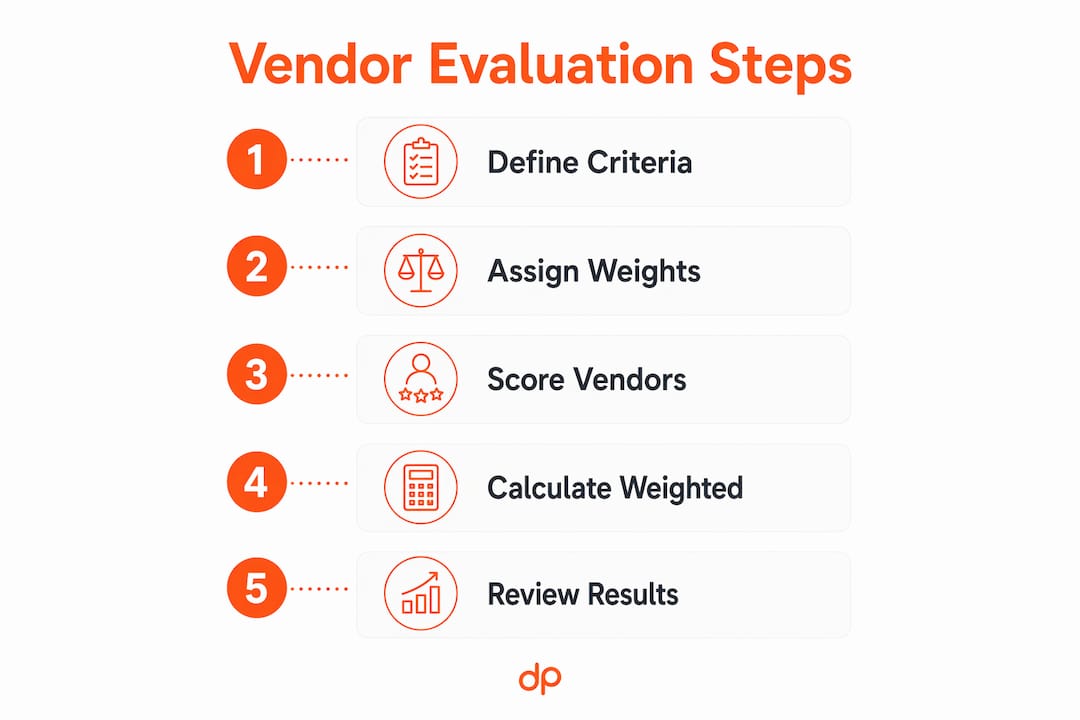
Sample weighted scoring matrix
| Criterion | Weight | Vendor A score | Vendor A weighted | Vendor B score | Vendor B weighted |
|---|---|---|---|---|---|
| Technical fit | 30% | 4 | — | 3 | — |
| Security and compliance | — | 5 | — | 4 | — |
| Delivery reliability | — | 3 | — | 5 | — |
| Cost and TCO | 10% | 4 | — | 3 | — |
| Support and response | 10% | 3 | — | 4 | — |
In this example, Vendor A scores higher on security and technical fit, but Vendor B’s delivery reliability advantage nearly closes the gap. Without weighting, a reviewer anchoring on the security score would pick Vendor A without seeing how close the overall result actually is. That is exactly the bias a weighted matrix prevents.
For R&D engagements, raise the technical fit weight to 40% and reduce cost to 5%. For maintenance contracts, shift 10% from technical fit to support and response. Store the completed matrix in your contract repository and reference it at every renewal review. You can adapt this template in a spreadsheet or a dedicated technology partner evaluation tool.
Governance, escalation, and meeting cadence
Governance should be lightweight, role-based, and decision-oriented. A program that requires three approval layers to log a corrective action will not survive past the first quarter.
Meeting artifacts for every performance review:
- Current scorecard with evidence citations (not impressions)
- Open issue log with owner, severity, and due date for each item
- Agreed actions from the prior review and their verification status
- Contract or SLA reference for any disputed metric
Escalation ladder:
- Level 1 (Operational): Engineering owner raises the issue in the sprint review; vendor has one sprint to remediate.
- Level 2 (Management): Issue persists or severity is high; procurement owner and vendor account manager meet within five business days.
- Level 3 (Executive): Two consecutive failed remediations or a critical security finding; business sponsor and vendor executive meet within 48 hours.
- Level 4 (Contractual): Formal notice of breach per SLA terms; legal reviews options including cure period, credit, or termination.
Every issue logged in a review must become a trackable ticket with an owner, a due date, and a verification artifact. Meetings that produce only discussion notes do not improve performance. For practical leadership behaviors that reinforce this discipline, see how tech leads drive outsourcing success.
What tooling and data sources should you integrate?
Pick tool categories that capture accepted deliverables, issue logs, CI/CD results, and invoices, then consolidate them into one performance record. Fragmented data across email threads and spreadsheets is the single biggest reason scorecards become stale.
Recommended tool categories:
- Project tracking (Jira, Azure Boards): sprint velocity, story point completion, open defect counts
- CI/CD dashboards (GitHub Actions, Jenkins): deployment success rate, build failure frequency
- Incident and issue trackers: MTTR, severity distribution, response time logs
- Contract repository: SLA terms, renewal dates, amendment history
- Invoice and payment systems: cost variance, change order frequency
- Security certification registry: SOC 2, ISO 27001, HIPAA status and expiration dates; see vendor security posture evaluation for a structured assessment framework
- Stakeholder feedback channels: structured post-sprint surveys, not open-ended email threads
Pro Tip: Use webhooks from your CI/CD and issue tracker to push key signals directly into a shared scorecard. A scheduled weekly export from Jira into a Google Sheet or Notion database is enough to start. Automate the data flow before you automate the analysis.
Common pitfalls that make VPM programs fail
The most common failure is building a scorecard nobody uses. It happens when the KPI set is too large, the review cadence is too infrequent, or no one owns the outcome.
- Tracking vanity metrics: Story points completed per sprint sounds meaningful but tells you nothing about quality or business impact. Replace it with defect rate and deployment success rate.
- One-size-fits-all scorecards: A mission-critical AI platform vendor and a commodity QA contractor should not share the same scorecard template. Tier vendors and customize accordingly.
- Reviews with no action items: If the meeting ends without a tracked ticket, nothing will change before the next review. Require at least one assignable action per open issue.
- Disconnected stakeholder records: Engineering, finance, and legal each holding separate vendor notes means no one has the full picture at renewal. Centralize evidence in one repository.
- Ignoring leading indicators: Waiting for a missed milestone to trigger a conversation is too late. Monitor response times and confirmation accuracy weekly.
Your 30–60–90 day implementation plan
Prioritize vendor tiering, KPI selection, and one pilot vendor in the first 30 days. Everything else builds on that foundation.
30 days:
- Inventory all active vendors and assign a risk tier (mission-critical, standard, low-risk).
- Select your pilot vendor: the highest-spend or highest-risk active engagement.
- Define five or fewer KPIs for the pilot and write the baseline SLA targets.
- Assign internal owners (engineering, procurement, finance) and schedule the first review.
60 days:
- Run the first scored review for the pilot vendor using evidence from your existing tools.
- Log all open issues as tracked tickets with owners and due dates.
- Begin integrating CI/CD and issue tracker data into a shared scorecard.
- Draft the weighted scoring matrix for any upcoming vendor selection or renewal.
90 days:
- Complete the first full review cycle and present results to the business sponsor.
- Tie pilot outcomes to a concrete decision: renew, renegotiate, or expand scope.
- Roll the framework out to standard-tier vendors with a quarterly cadence.
- Document lessons learned and update the scorecard template for future pilots.
Effort estimates by task
| Task | Effort level | Recommended owner |
|---|---|---|
| Vendor tiering and KPI selection | Low (4 hrs) | Engineering lead + procurement |
| Scorecard template setup | Low (2–4 hrs) | Procurement or ops owner |
| Tooling integration (webhooks, exports) | Medium (over 8 hrs) | Engineering or DevOps |
| Stakeholder alignment and RACI | Low (2–4 hrs) | Business sponsor |
| First pilot review cycle | Medium (4 hrs) | All RACI owners |
Piloting on one mission-critical vendor validates the scorecard and the cadence while keeping political friction low. At 90 days, success looks like one completed review cycle, at least one corrective action resolved, and a documented renewal recommendation backed by scored evidence.
Legal and compliance considerations in vendor agreements
Every vendor performance program needs a contractual backbone. SLAs should specify the exact metrics, measurement methods, review frequency, and remedies for non-performance, including cure periods, service credits, and termination rights. Vague language like “reasonable efforts” or “best endeavors” is unenforceable when a dispute arises.
For software vendors handling sensitive data, the agreement must address data access controls, breach notification timelines (typically 72 hours under many state laws and GDPR-aligned frameworks), and the right to audit security certifications. Cloud-hosted vendors introduce additional exposure; cloud computing security risks such as misconfigured access controls and shared-infrastructure vulnerabilities should be explicitly addressed in the vendor’s security addendum.
Compliance requirements vary by industry. Healthcare engagements require HIPAA Business Associate Agreements. Legal tech and fintech vendors may need SOC 2 Type II reports and specific data residency commitments. Build a certification expiration calendar into your contract repository and flag renewals 90 days in advance. This is general guidance; confirm current regulatory requirements with qualified legal counsel for your specific situation.
Key Takeaways
Effective vendor performance management requires continuous measurement, evidence-based scoring, and governance that converts every review into a tracked decision, not just a report.
| Point | Details |
|---|---|
| Tier vendors first | Assign mission-critical, standard, and low-risk tiers before setting any KPI or cadence. |
| Track five KPIs or fewer | Focus on deployment success rate, MTTR, sprint adherence, defect rate, and response time. |
| Score with evidence, not impressions | Every scorecard entry must cite an artifact: a log, a report, or an accepted deliverable. |
| Escalation must produce tickets | Every review issue needs an owner, a due date, and a verification step to drive real change. |
| Devpulse as delivery partner | Devpulse operationalizes VPM within engineering engagements, tying delivery evidence to renewal and scope decisions across custom software and modernization projects. |
The case for keeping VPM simple and decision-focused
Most VPM programs fail not because the metrics are wrong, but because the process becomes a reporting exercise disconnected from real decisions. The organizations that get the most value from supplier performance tracking are the ones that treat every review as a decision gate, not a status update.
The conventional wisdom is to build comprehensive scorecards covering every possible dimension of vendor performance. The practical reality is that a five-KPI scorecard reviewed monthly drives better outcomes than a twenty-KPI dashboard reviewed annually. Reports do not improve performance. Simple, triggerable metrics that cause a conversation do.
There is also a relationship dimension that most guides underweight. VPM is as much about aligning vendor technical output to your product roadmap as it is about grading delivery. The best vendor relationships are ones where the vendor understands your business goals well enough to flag risks before you do. That kind of alignment comes from consistent, structured communication, not from a scorecard sent by email once a quarter.
For engineering leaders managing vendor management strategies across multiple concurrent engagements, the governance overhead is real. The answer is not a lighter process; it is a tiered one. Spend your governance energy where the business risk is highest, and let low-risk vendors run on minimal oversight until something changes.
Devpulse brings VPM discipline to every engineering engagement
When you hire a custom software development partner, you should not have to build a vendor performance program from scratch on top of the engagement. Devpulse embeds delivery governance directly into its engineering contracts: sprint commitment tracking, defect rate reporting, and structured monthly reviews are standard, not optional add-ons. For CEOs and engineering leaders running modernization programs or building new digital products, that means you get a partner who arrives with the scorecard already defined.
Whether you need a full-cycle development partner, a technical audit before a renewal decision, or a modernization team with built-in accountability, Devpulse’s custom software development services are structured to give you the evidence you need to make confident sourcing and expansion decisions. Request a pilot engagement or vendor performance audit today and see what a delivery-accountable engineering partner looks like in practice.