














TL;DR:
- Outstaffing allows engineering leaders to extend team capacity without increasing payroll headcount. It embeds external engineers into existing teams while ensuring full management control and ownership of the codebase. Success relies on strong leadership, effective integration, and choosing a reliable, transparent partner.
How outstaffing functions as a capacity extension for engineering leadership
Outstaffing gives a VP of Engineering a direct way to extend team capacity without adding headcount to the payroll. External engineers join your existing team, attend your standups, commit to your repositories, follow your coding standards, and report to your technical leads. The outstaffing partner handles employment contracts, payroll, benefits, and compliance behind the scenes. You retain full ownership of the codebase, the architecture decisions, and the daily direction of the work.
This model differs fundamentally from outsourcing, where a vendor owns the delivery and a project manager sits between you and the engineers. With outstaffing, there is no handoff. You direct the work exactly as you would with a direct hire.
Key characteristics of the outstaffing model:
- External engineers are embedded full-time into your team under your management and processes
- The partner handles all administrative functions: payroll, HR, equipment, and legal compliance
- You retain technical ownership, IP rights from day one, and full control over architecture
- The model supports ongoing product development, not bounded one-off deliverables
- Engineering capacity planning becomes more reliable when headcount timelines are predictable
Table of Contents
- Key advantages of outstaffing for VP engineering
- Leadership and management considerations that determine success
- What to look for when choosing an outstaffing partner
- Expert insights from Devpulse on scaling product engineering through outstaffing
- How outstaffing affects team culture and retention
- KPIs that help you manage outstaffed engineers effectively
- Cost considerations and budgeting for outstaffing in engineering
- Key Takeaways
- Devpulse gives you an embedded engineering team without the hiring overhead
Key advantages of outstaffing for VP engineering
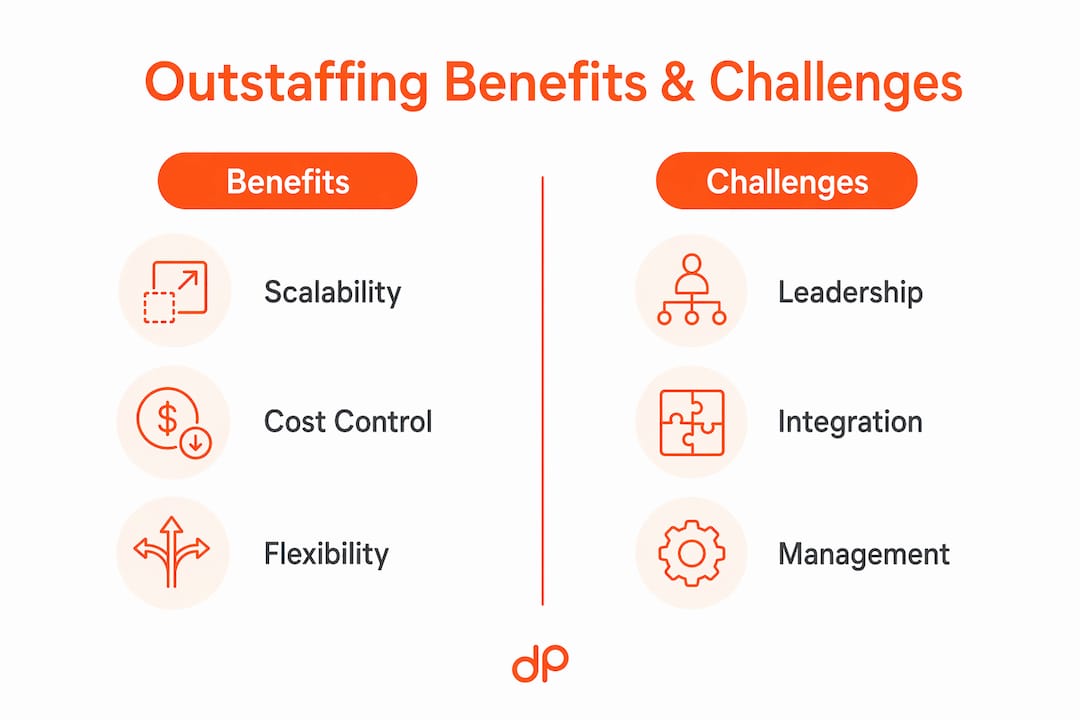
The strategic benefits go well beyond cost reduction. Here is what engineering leaders consistently report after running the model well:
- Hiring predictability. Experienced outstaffing providers meet headcount timelines over 90% of the time, letting you commit to roadmap milestones with confidence rather than guarded optimism.
- Operational flexibility. Teams can scale up or down monthly without severance complexity or legal overhead, which matters when product priorities shift mid-quarter.
- Cost transparency. You pay a clear per-engineer monthly rate. The savings come from avoiding loaded US employment costs: benefits, payroll taxes, and recruiting fees, not just salary differences.
- Domain knowledge retention. Engineers who stay on your team for months accumulate deep product context. That knowledge compounds in a way short-term contracts never replicate.
- Full process control. Unlike outsourcing, you set the sprint cadence, own the code reviews, and drive every architecture decision.
Pro Tip: Read Devpulse’s breakdown of why outstaff engineers to see how scalability and process integration work together in practice.
Leadership and management considerations that determine success
The outstaffing model does not run itself. Its success depends almost entirely on the quality of in-house technical leadership. A VP of Engineering, a senior tech lead, or a strong architect must be present and actively directing the work. Without that, outstaffed engineers lack focus, and the model underperforms traditional outsourcing.

Mismanaging outstaffed engineers as vendors rather than teammates consistently produces worse outcomes than simply outsourcing the work. Integration is the prerequisite, not a nice addition.
Critical leadership practices:
- Treat outstaffed engineers as full team members: same Slack channels, same sprint planning, same code review process
- Assign a dedicated tech lead to own architectural decisions, unblock developers, and maintain code quality standards
- Avoid middlemen who filter communication between you and the engineers doing the work
- Conduct structured onboarding during the first two weeks, walking through architecture, not just tickets
- Keep internal leadership focused on product strategy; if a VP spends significant time answering implementation questions from the outstaffed team, a dedicated tech lead is missing
Pro Tip: When a CTO or VP of Engineering handles day-to-day technical questions from an outstaffed team, the company is already paying for the absence of a tech lead through senior leadership time.
What to look for when choosing an outstaffing partner
Not every provider delivers the same quality of integration. The right partner handles administrative complexity without inserting layers that slow communication. Here is what to evaluate:
- Administrative coverage without obstruction. The partner manages payroll, HR, compliance, and equipment. They do not insert project managers between you and the engineers.
- Reliable candidate pipelines. Look for providers who can present vetted candidates within two to three weeks and replace engineers quickly when a mismatch occurs. Rapid replacement within roughly a week reduces the cost and disruption of a technical mismatch far more than a lengthy full-time termination process would.
- Cultural and technical fit screening. Technical ability without cultural alignment creates friction. A good partner evaluates communication style and soft skills alongside hard skills.
- Long-term orientation. Providers built for short-term contracts are the wrong fit for core product development. Look for average partnership lengths measured in years, not months.
- Transparent cost models. You should know exactly what you pay per engineer, with no hidden management markups buried in project pricing.
For IT leaders managing distributed teams, the digital workplace guide for IT managers offers useful context on structuring remote collaboration effectively.
Expert insights from Devpulse on scaling product engineering through outstaffing
Outstaffing is a talent architecture decision, not a shortcut around a difficult hiring market. Devpulse’s experience across long-term engineering engagements points to a consistent pattern: the teams that perform best treat outstaffed engineers as permanent members of the organization from day one.
Devpulse maintains a 98% retention rate across outstaffed teams with an average partnership of five years. That figure reflects genuine integration, not just contract length. Engineers who stay embedded in one product accumulate architectural knowledge that accelerates feature delivery and raises code quality over time.
The administrative burden that typically consumes VP bandwidth, including legal entity setup, multi-country payroll, and foreign labor compliance, is handled entirely by Devpulse. That frees engineering leadership to focus on architecture, roadmap execution, and team development. The outstaffing scalability model Devpulse uses allows teams to grow from a few engineers to a full product squad without disrupting existing delivery cycles.
How outstaffing affects team culture and retention
Outstaffing done well does not dilute team culture. It extends it. When outstaffed engineers participate in sprint planning, contribute to architecture discussions, and communicate through the same channels as in-house staff, the distinction between “internal” and “extended” team fades in daily practice.
The risk runs in the opposite direction. If outstaffed engineers are treated as external vendors, given isolated tickets, and excluded from product context, they disengage. Turnover follows, and the domain knowledge they built walks out with them. The same integration practices that protect culture also protect retention.
Internal teams benefit too. When outstaffed engineers absorb execution capacity, in-house engineers can focus on higher-leverage work: system design, mentoring, and product strategy. That shift tends to improve satisfaction and reduce burnout among your core staff.
KPIs that help you manage outstaffed engineers effectively
Tracking the right metrics keeps outstaffed teams aligned with your engineering goals. Focus on output and integration quality, not just activity.
- Sprint velocity and delivery consistency against planned story points
- Code review cycle time as a measure of collaboration quality and codebase familiarity
- Defect rates and rework frequency to assess code quality over time
- Onboarding time to first meaningful contribution for new outstaffed engineers
- Retention rate across the outstaffed team, tracked quarterly
- Time-to-fill for open outstaffed roles, benchmarked against your partner’s stated timelines
These KPIs work best when reviewed in the same engineering retrospectives used for in-house staff. Separate reporting creates a two-tier dynamic that undermines integration.
Cost considerations and budgeting for outstaffing in engineering
Outstaffing costs are predictable by design. You pay a monthly per-engineer rate, and the partner absorbs all employment overhead. For senior developers, the loaded cost savings compared to a comparable US full-time hire typically run 50–80%, driven by cost-of-living differences in the engineer’s home market plus the elimination of benefits, payroll taxes, and recruiting fees.
For ongoing product development, outstaffing is generally less expensive than outsourcing a comparable scope, due to a transparent per-engineer rate with no hidden vendor margin, because you pay a transparent per-engineer rate with no hidden vendor margin. Budget planning is straightforward: headcount times monthly rate, with no severance exposure when you scale down.
The hidden cost to watch is internal leadership time. If your VP or senior architects spend hours each week managing coordination overhead from the outstaffed team, that time has a real cost. Structuring the team with a dedicated tech lead eliminates most of that overhead and protects the ROI of the engagement.
Key Takeaways
Outstaffing extends engineering capacity with embedded external talent under VP leadership, and its success depends on direct management, strong internal technical ownership, and the right partner.
| Point | Details |
|---|---|
| Predictable hiring timelines | Experienced providers meet headcount timelines over 90% of the time, enabling confident roadmap planning. |
| Integration over vendor management | Treating outstaffed engineers as teammates, not vendors, is the single factor that separates successful engagements from costly ones. |
| Tech lead coverage is required | Without a dedicated tech lead, VPs absorb coordination overhead that erodes the ROI of the entire engagement. |
| Cost structure is transparent | Outstaffing runs 50–80% below the loaded cost of a US full-time hire and 20–35% below comparable outsourcing for ongoing work. |
| Devpulse delivers stable, long-term teams | Devpulse maintains a 98% retention rate across outstaffed teams with an average partnership of five years. |
Devpulse gives you an embedded engineering team without the hiring overhead
When your roadmap is outpacing your recruiting pipeline, the answer is not to wait. Devpulse provides embedded engineering teams that work directly under your technical leadership, following your processes, committing to your repositories, and contributing to your product from week one.

Devpulse handles every administrative layer: payroll, compliance, HR, and equipment, so your VP of Engineering stays focused on architecture and delivery, not paperwork. With a 98% retention rate across long-term partnerships, the engineers you invest in training stay with your team. Every engagement is built around your technical standards, not a generic delivery model.
If you are ready to extend your engineering capacity with a team that integrates as naturally as a direct hire, explore Devpulse’s engineering services or review the case studies to see how similar teams have scaled. Schedule a consultation to discuss your roadmap and headcount needs directly.