














TL;DR:
- Choosing between outsourcing and staff leasing depends on your project’s control needs and internal technical maturity.
- Outsourcing suits well-defined, outcome-focused projects, while staff leasing works best for core products with strong internal leadership.
When you need full delivery accountability with minimal management overhead, outsource. When you must retain technical control, IP continuity, and direct influence over your product’s architecture, choose staff leasing (also called outstaffing). That distinction drives most of the decisions in this guide.
For the majority of custom software projects, the right answer depends on two factors: how much technical risk you can transfer, and how mature your internal engineering leadership is.
- Choose IT outsourcing when the scope is well-defined, your team lacks capacity to manage specialists day-to-day, and delivery accountability matters more than hands-on control.
- Choose staff leasing when you have a strong technical lead in-house, need to preserve product culture and architecture decisions, and want specialists who integrate directly with your team.
- Not sure yet? Run the checklist in Section 3, then brief a provider with the vendor questions that follow.
Table of Contents
- IT Outsourcing vs Staff Leasing: Core Differences at a Glance
- How to Choose the Right Model for Your Project
- Pricing Models and How to Estimate True Cost
- Legal, IP, and Security Considerations for U.S. Buyers
- Onboarding, Ramp-Up, and Exit Planning
- Devpulse Supports Both Models for Custom Software Projects
- Key Takeaways
- What Most Executives Get Wrong About This Choice
- Useful Sources and Further Reading
IT Outsourcing vs Staff Leasing: Core Differences at a Glance
The fundamental divide is outcomes versus people. IT outsourcing means buying a deliverable: the vendor owns staffing, management, and delivery against agreed SLAs. Staff leasing means renting capacity: you direct the work, and the vendor handles payroll, benefits, and local compliance.
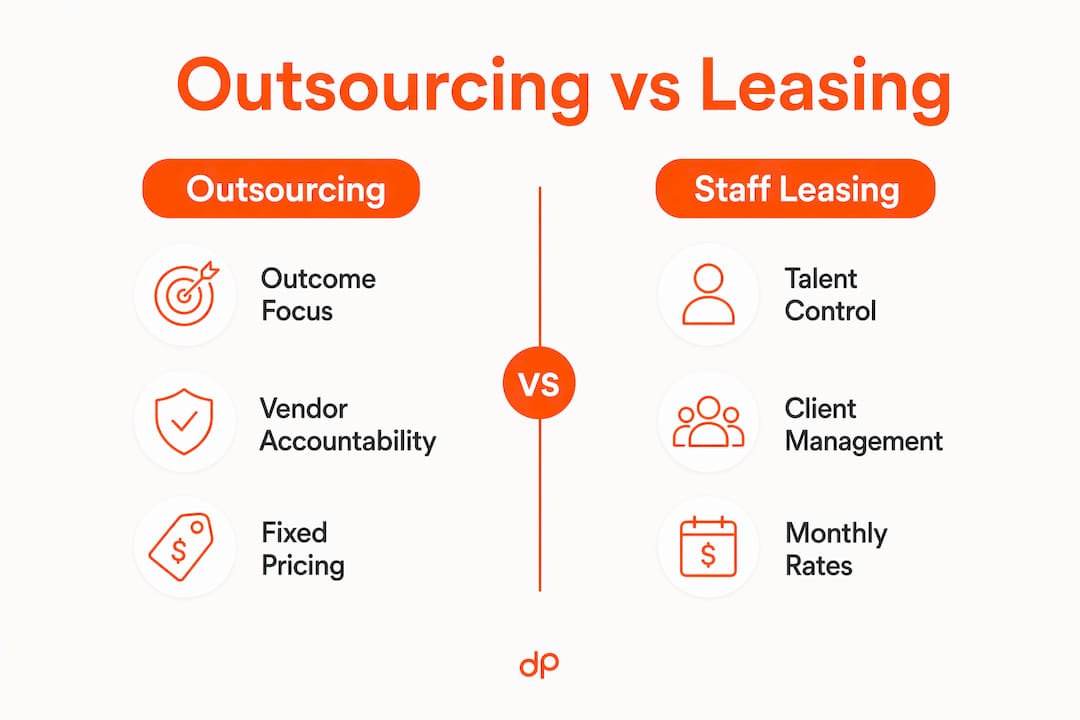
| Dimension | IT Outsourcing | Staff Leasing / Outstaffing |
|---|---|---|
| Control over technical direction | Vendor-led; client sets requirements | Client-led; client directs daily work |
| Accountability for delivery | Vendor contractually accountable for outcomes | Client accountable; vendor supplies the people |
| Cost predictability | Fixed-price or capped T&M; more predictable | Monthly seat rates; variable with headcount changes |
| Speed to start | Slower (discovery, SOW alignment); faster delivery once scoped | Faster to hire individual specialists |
| Scalability | Vendor scales team internally; client approves scope changes | Client scales by adding or removing seats |
| IP & deliverables ownership | Must be explicitly assigned in contract | Typically cleaner; client directs work product |
| Management overhead | Low for client; vendor manages execution | Higher; client manages tasking and performance |
| Best for | Well-scoped modules, regulated deliverables, low internal capacity | Mission-critical core product, long-term dedicated roles, strong internal tech lead |
Practical implications for executives:
- Outsourcing vendors are contractually accountable for the final product within scope. Your involvement is strategic, not operational.
- In staff leasing, specialists integrate with your team and work within your processes. You own the technical risk and direction.
- Outsourcing scenario: A SaaS company needs a new billing module built to spec. The vendor delivers against a fixed SOW. The internal team reviews and accepts.
- Staff leasing scenario: A healthcare startup needs two senior backend engineers embedded in its core product squad for 18 months. The CTO directs their work daily.
How to Choose the Right Model for Your Project
Work through these criteria in order. Each one narrows the decision.
- Project criticality. Is this your core product or a peripheral feature? Core product architecture belongs under your direct control. Peripheral, well-scoped modules are good outsourcing candidates.
- Scope confidence. Can you write a complete SOW today? High confidence favors fixed-price outsourcing. Low confidence (exploratory, evolving requirements) favors staff leasing where you can redirect daily.
- Internal leadership maturity. Do you have a technical lead who can manage specialists? If yes, staff leasing preserves quality and culture better. If no, outsourcing transfers that management burden to the vendor.
- IP continuity need. Will this codebase live with your team for years? Staff leasing keeps institutional knowledge in-house. Outsourcing requires deliberate knowledge-transfer clauses to avoid lock-in.
- Speed-to-market pressure. Staff leasing gets individual specialists productive faster. Outsourcing has a longer discovery phase but accelerates once the SOW is fixed.
Vendor questions to ask during RFP:
- Who is accountable if delivery misses the agreed milestone? Name the person and the remedy.
- What is your knowledge-transfer process at project close or team transition?
- How do you handle staff turnover on a dedicated engagement? What is your replacement SLA?
- What security credentials do you hold? (SOC 2, HIPAA controls, secure SDLC documentation)
- How do you handle scope changes? Fixed-price change-control or T&M overflow?
Red flags to watch:
- An outsourcing vendor that cannot name a single accountable delivery lead.
- A staff leasing provider with no documented replacement guarantee or notice period.
- Any vendor that resists audit rights or knowledge-transfer obligations in the contract.
- A proposal with no acceptance criteria or definition of done.
Pro Tip: The most common accountability failure is attempting to outsource while still managing developers day-to-day. When the client micromanages vendor engineers, neither side owns quality. Decide before signing: are you buying an outcome or renting capacity? Then govern accordingly.

Pricing Models and How to Estimate True Cost
Headline rates rarely reflect total cost of ownership. Here is how each model’s pricing works and where hidden costs accumulate.
Fixed-price (outsourcing): The vendor quotes a lump sum against a defined SOW. Predictable for the client, but change requests carry a premium. Hidden costs: scope creep penalties, rework cycles if acceptance criteria are vague, and vendor margin for risk.
Time and materials (T&M): Billed by hours or days worked. Flexible for evolving requirements, but cost control requires active client oversight. Hidden costs: client-side management overhead and the time your product owner spends reviewing timesheets and directing work.
Monthly dedicated seats (staff leasing): A flat monthly rate per specialist. Predictable at the seat level, variable at the team level. Hidden costs: onboarding time (typically 2–4 weeks before full productivity), turnover replacement gaps, and the internal product leadership hours required to direct the team effectively.
Managed services: Outcome-based with SLAs. Higher unit cost than leasing, but the vendor absorbs operational risk. Best for ongoing support, DevOps, or maintenance workloads where uptime and response time matter more than feature velocity.
To build a comparable 12–24 month TCO:
- Start with the vendor’s quoted rate (fixed fee, T&M estimate, or monthly seats × headcount).
- Add your internal product owner and tech lead hours at their fully loaded cost.
- Add onboarding and offboarding costs (documentation, access provisioning, knowledge transfer sprints).
- Add estimated change-request or scope-overflow costs based on historical project variance.
- Factor in turnover risk: one replacement cycle on a leased specialist typically costs 4–8 weeks of lost productivity.
Checklist items to include in every proposal for comparability:
- SOW with explicit acceptance criteria and definition of done.
- SLA terms: response time, defect remediation windows, uptime targets.
- Change-control process and pricing for out-of-scope requests.
- Payment milestones tied to deliverable acceptance, not calendar dates.
- Offboarding and knowledge-transfer obligations with timelines.
For a deeper breakdown of IT outsourcing cost savings, reviewing the financial drivers behind each model is worthwhile before you finalize a vendor budget.
Legal, IP, and Security Considerations for U.S. Buyers
IP ownership is the clause most executives underestimate until it is too late. In both models, the default legal position in the U.S. is that the vendor or contractor may retain rights to work product unless the contract explicitly assigns them to you.
Key contract clauses to include:
- IP assignment: All work product, inventions, and code created under the engagement must be assigned to the client upon payment. Do not accept “perpetual license” language as a substitute for full transfer.
- Work-for-hire language: For employees of a leasing vendor, confirm the vendor’s own employment agreements include work-for-hire provisions that flow through to you.
- NDA and confidentiality: Cover source code, architecture, business logic, and any data the vendor accesses. Include post-termination obligations.
- Warranty and indemnity: Vendor warrants deliverables are original and do not infringe third-party IP. Indemnity covers you against claims arising from vendor-supplied code.
Compliance evidence to request:
- SOC 2 Type II report (for any vendor handling sensitive data or operating in your cloud environment).
- HIPAA controls documentation if the project touches protected health information.
- Secure development lifecycle (SDLC) policy and vulnerability remediation SLAs.
- Vendor security credentials should be current, not self-attested.
Employment and labor risk: In staff leasing, the vendor is typically the employer of record. They cover payroll, benefits, and local compliance; you direct the work. This matters for U.S. co-employment risk: if you control work conditions too closely, the IRS and state labor boards may classify leased workers as your employees. Keep task direction within the engagement scope and avoid controlling hours, location, or personal conduct.
Practical mitigation steps: Use source code escrow for mission-critical outsourced projects. Build staged acceptance gates into the SOW. Require mandatory knowledge-transfer sprints before final payment. Include audit rights for security and compliance reviews.
Onboarding, Ramp-Up, and Exit Planning
Transitions fail when they are planned last. Build exit obligations into the contract before you sign.
| Phase | IT Outsourcing | Staff Leasing |
|---|---|---|
| Days 1–30 | Discovery, SOW finalization, environment access | Specialist onboarding, codebase walkthrough, tooling setup |
| — | First sprint delivery, alignment on definition of done | Full integration into team cadence, first independent deliverables |
| — | Milestone review, scope confirmation, first acceptance gate | Performance baseline established, feedback loop active |
| Exit notice period | Typically 30–60 days per contract | Typically 30 days per seat |
| Handover deliverables | Full codebase, documentation, test suites, runbooks | Knowledge transfer sessions, documentation of in-progress work |
Onboarding checklist for both models:
- Codebase access and repository permissions granted on Day 1.
- Development environment setup and CI/CD pipeline documentation shared.
- Definition of done, coding standards, and QA process documented and reviewed.
- Communication cadence established (standups, sprint reviews, escalation path).
- Security onboarding: access controls, NDA signed, data handling policy reviewed.
For integrating external staff with agile teams, the first sprint is the highest-risk period. Assign an internal technical lead as the primary point of contact for the first 30 days regardless of model.
Exit planning: Require a minimum 4-week overlap window where outgoing and incoming engineers work in parallel. Document replacement guarantees for leased staff. For outsourced projects, tie final payment to a knowledge-transfer acceptance gate, not a calendar date.
Devpulse Supports Both Models for Custom Software Projects
Devpulse works with startups, SaaS companies, and enterprise clients across healthcare, cybersecurity, legal tech, and edtech. Whether you need a vendor to own delivery end-to-end or dedicated engineers who embed in your team, Devpulse structures engagements to match your governance model.
On the outsourcing side, Devpulse has delivered AI-powered platforms, cloud-based systems, and legacy modernization projects under outcome-based contracts with defined SOWs, acceptance gates, and SLAs. One example: an AI-powered job discovery platform built with adaptive web scraping, delivered as a complete product with ongoing support. On the staff leasing side, Devpulse provides dedicated engineering squads that integrate directly into client teams, with the client retaining full technical direction.
Governance across both models includes documented SLAs, sprint-level reporting, IP assignment in every contract, and SOC 2-aligned security practices. You get a named delivery lead, not a rotating contact.
Ready to brief a provider? Review Devpulse’s engineering services or browse the case studies portfolio to see outcomes across both delivery models, then schedule a scoping call.
Key Takeaways
Staff leasing gives you control and talent; outsourcing gives you accountability and lower management overhead. The right choice depends on your internal technical leadership and how well you can define scope before signing.
| Point | Details |
|---|---|
| Outcomes vs. people | Outsourcing buys a deliverable with vendor accountability; staff leasing rents capacity with client-held technical direction. |
| Internal maturity decides | Strong technical leadership favors staff leasing; limited internal capacity favors outsourcing where the vendor manages execution. |
| TCO includes hidden costs | Factor in product owner hours, onboarding time, turnover gaps, and change-request premiums before comparing headline rates. |
| IP must be explicit | Always include IP assignment and work-for-hire clauses; a perpetual license is not the same as ownership. |
| Devpulse fits both models | Devpulse structures outcome-based and dedicated-seat engagements with named delivery leads, SLAs, and IP assignment in every contract. |
What Most Executives Get Wrong About This Choice
The conventional wisdom frames IT outsourcing vs staff leasing as a cost decision. It is not. It is a risk-allocation decision. Cost follows from where you place accountability.
The clients who regret outsourcing almost always made the same mistake: they hired a vendor for outcomes but kept managing the engineers directly. That hybrid creates the worst of both models. The vendor stops feeling accountable because the client is in the weeds. The client stops feeling in control because the vendor still owns the process. Quality falls through the gap between them.
The clients who regret staff leasing made a different mistake: they hired specialists without a technical lead capable of directing them. Leased engineers are only as productive as the direction they receive. Without a strong internal product owner or CTO driving priorities, a leased team drifts.
The fix in both cases is the same: decide which model you are running before you sign, then govern it consistently. If you choose outsourcing, stay at the strategic layer and enforce it through acceptance gates. If you choose staff leasing, invest in the internal leadership that makes the model work.
Useful Sources and Further Reading
External sources:
- IT Outsourcing vs Staff Augmentation vs Body Leasing — Relout: definitions, use cases, and model comparisons.
- Four Reasons for the Rise of the Staff Leasing Model in IT Outsourcing — iTWire: market drivers behind staff leasing growth.
- EOR vs Managed Services vs Leasing: Total Cost Comparison — Kimon Services: TCO analysis and compliance considerations.
- How to Choose the Right Delivery Model — Outsource Accelerator: staff leasing, EOR, and managed BPO compared.
- IT Outsourcing and Managed Services — ASTIA: managed IT services and outsourcing from a partner perspective.
Devpulse resources:
- Top IT Outsourcing Risks and How to Safeguard Your Business
- Why Outstaff Engineers: Scalability and Efficiency
- IT Staff Augmentation Benefits for Scaling Tech Teams
- Vendor Management Strategies
- Devpulse Engineering Services