














You’re probably living in the middle of it already. A dispatcher has one screen on the TMS, another on the WMS, a carrier portal open in a third tab, and a spreadsheet for detention, accessorials, or proof of delivery. By 6 a.m., the operation is moving, but the data is still split across tools that were never designed to agree with each other.
That’s where custom software development for logistics earns its keep. The market for logistics software was valued at about US$14.5 billion in 2023 and is projected to reach roughly US$26.7 billion by 2032, which lines up with the continued push to connect transportation, warehousing, fulfillment, and driver workflows in one environment Adevs. The story isn’t the market size, though, it’s the operational limit that appears when point tools, spreadsheets, and manual handoffs can’t keep pace with exceptions.
The Problem Custom Logistics Software Is Built to Solve
At 6 a.m., the dispatcher is not thinking about architecture. They’re trying to answer a simple question, where is the load, what’s changed, and who needs to know. The problem is that the answer lives in different systems, and each system only knows part of the story.
Fragmentation is the real bottleneck
A TMS might know the planned route, a WMS might know pallet status, a carrier portal might know the last update, and a spreadsheet might be the only place detention fees are tracked. That’s not a feature gap, it’s a coordination gap. Custom logistics software exists because highly digitized operations still run into the same wall when data handoffs are slow, exception handling is manual, and no off-the-shelf workflow models the complexity of a live network Adevs.
Practical rule: if your team spends more time reconciling systems than moving freight, the core issue is usually the operating model, not the user interface.
The strongest use cases show up in regional carriers, 3PLs, and shipper-ops teams that have layered new tools on top of older ones until the stack becomes fragile. Generic software handles the happy path well enough. It usually falls apart when a driver misses a stop, a customer disputes an accessorial, or a warehouse needs to update status while a carrier feed is lagging.
Exceptions drive the design
That’s why the essential question is not whether the software has more buttons. It’s whether it can unify TMS, WMS, driver apps, and customer systems into one operational view so exceptions, not idealized workflows, shape the design. In logistics, the exception is often the business event that matters most, because it affects billing, service, compliance, and customer trust at the same time.
A useful way to think about the problem is simple. If a generic platform can’t model your detention logic, accessorial rules, proof-of-delivery states, or partner-specific data flow without brittle workarounds, the operation has outgrown a generic workflow. That doesn’t always mean a new build is needed, but it does mean the issue sits deeper than feature comparison.
What Custom Software Development for Logistics Actually Means
A custom logistics platform is like a made-to-measure uniform, not a one-size-fits-all jacket with the sleeves pinned back. It’s built around a company’s own carrier relationships, warehouse layout, billing logic, and data environment instead of asking the operation to adapt to a vendor’s roadmap. That difference matters because logistics is full of small rules that become big operational problems when they’re forced into generic templates.
Custom, configured, and hybrid are not the same thing
A heavily configured SaaS TMS or WMS can work well when the workflows are stable and the integration load is light. A true custom build becomes more relevant when the operation needs to own the workflow model itself, not just tweak screens and dropdowns. The middle ground is often the best place to start, a hybrid approach where the core logic is custom, but commodity services like maps, telematics, document AI, or billing components are bought and integrated.
One useful distinction is whether the team is buying software, or buying a roadmap. If the vendor decides when new capabilities arrive, that’s a vendor-driven platform. If the business owns the workflow logic and can change it without waiting for a product committee, that’s closer to a custom core.
For a practical companion view on planning a modern supply chain stack, 2026 supply chain optimization tools is a useful outside reference because it frames tooling around operational fit, not just feature lists.
What custom usually includes
Custom doesn’t mean hand-building every subsystem from scratch. It usually means the orchestration layer, data model, business rules, and integration logic are customized. The team can still plug in mapping APIs, rate engines, OCR, ELD feeds, and document services where buying is smarter than building.
The cleanest projects I’ve seen start with a custom operating core and attach best-in-class components only where they reduce risk or speed up delivery.
That’s why the decision isn’t custom versus off-the-shelf in the abstract. It’s whether the business needs control over the workflows that make the operation unique, or whether standardization is enough. The more exception-heavy the business becomes, the more expensive it is to fake fit inside a generic system.
The Business Case and ROI Drivers Behind Custom Builds
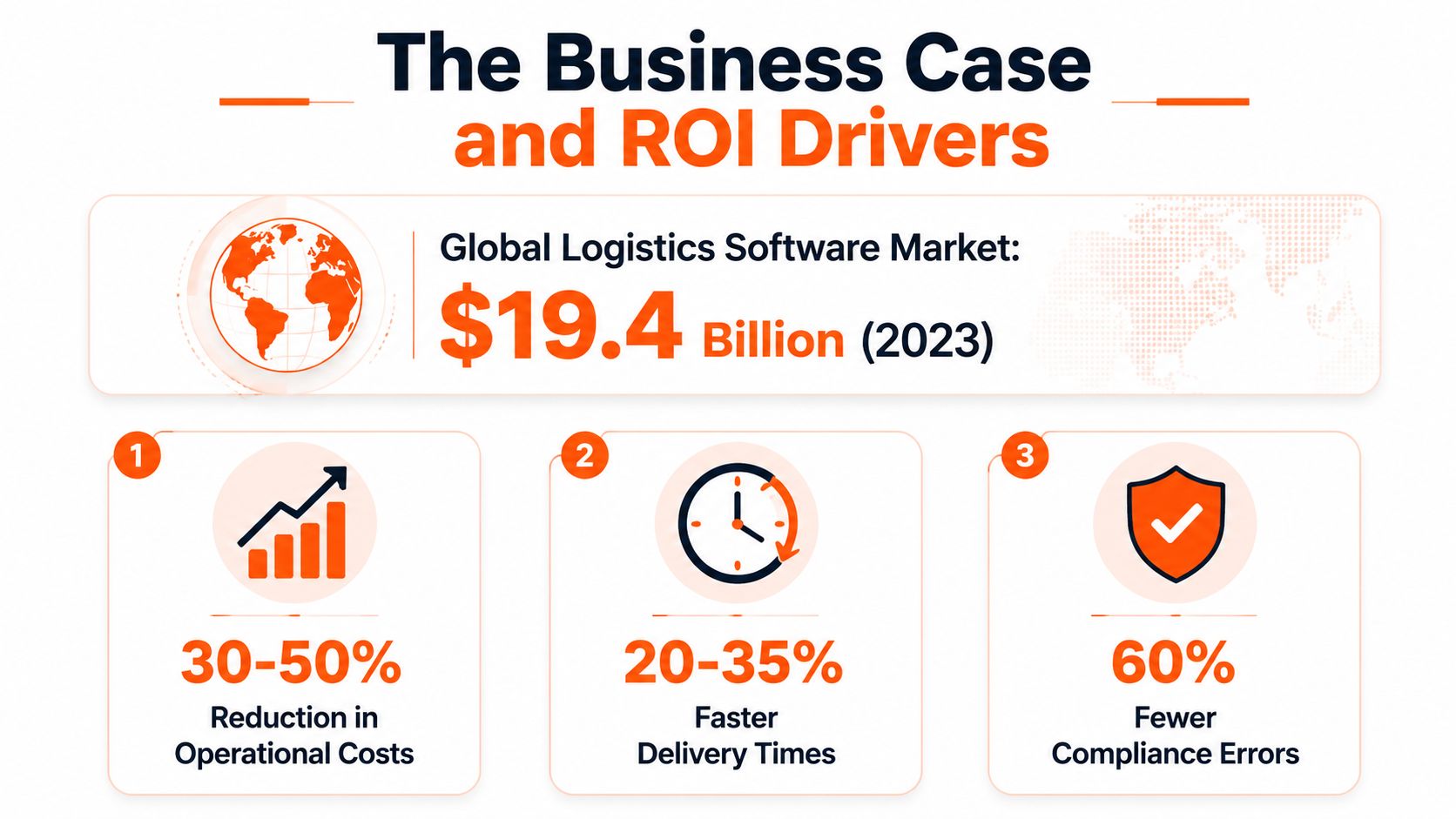
The business case for custom logistics software usually lands in the same place, fewer handoffs, fewer mistakes, and less time spent correcting what systems didn’t agree on. In industry guidance, route optimization can cut fuel costs by 10% to 25%, automation and better data integration can reduce manual work by as much as 70%, and efficiency can improve by 30% to 40% Adevs. Those are meaningful levers because fuel, labor, and exception handling are the cost centers that logistics teams feel every day.
The value is spread across the workflow
A custom build rarely wins because of one killer feature. It wins when dispatch, warehouse activity, billing, and customer visibility stop behaving like separate mini-systems. The payback comes from removing bottlenecks across the chain, not from polishing a single screen.
The same source notes that many organizations see measurable ROI within 18 to 36 months, with the fastest returns coming from route optimization and automated billing Adevs. That timeframe makes sense when the workflow is dense enough that every avoided manual touch, rerouted load, or corrected invoice compounds across the network.
Market pressure is part of the signal
The broader market data matters because it shows continued investment in custom platforms. The global logistics software market, valued at about US$14.5 billion in 2023, is projected to reach roughly US$26.7 billion by 2032 Adevs. That doesn’t prove every custom project is right, but it does show where operators are placing their bets when their stack has to connect transportation, warehousing, fulfillment, and visibility in one environment.
| Cost center | Why custom helps |
|---|---|
| Fuel | Route logic can be tuned to actual lanes, service windows, and fleet behavior |
| Labor | Automation reduces repetitive dispatch, billing, and reconciliation work |
| Exceptions | Shared data and workflow rules make disputes easier to resolve |
A smart executive team doesn't ask whether custom is elegant. It asks whether the current operating cost is already being paid in rework, delays, and disconnected decisions. If the answer is yes, the business case starts getting real fast.
Decision point: if your team already relies on manual reconciliation to keep service running, the software spend is probably being paid somewhere else in headcount and error recovery.
For teams evaluating whether to keep building in-house or shift work to a partner, this strategic guide to outsourcing software development is a useful lens on delivery ownership and risk.
Integration Architecture and Data Flows That Actually Scale
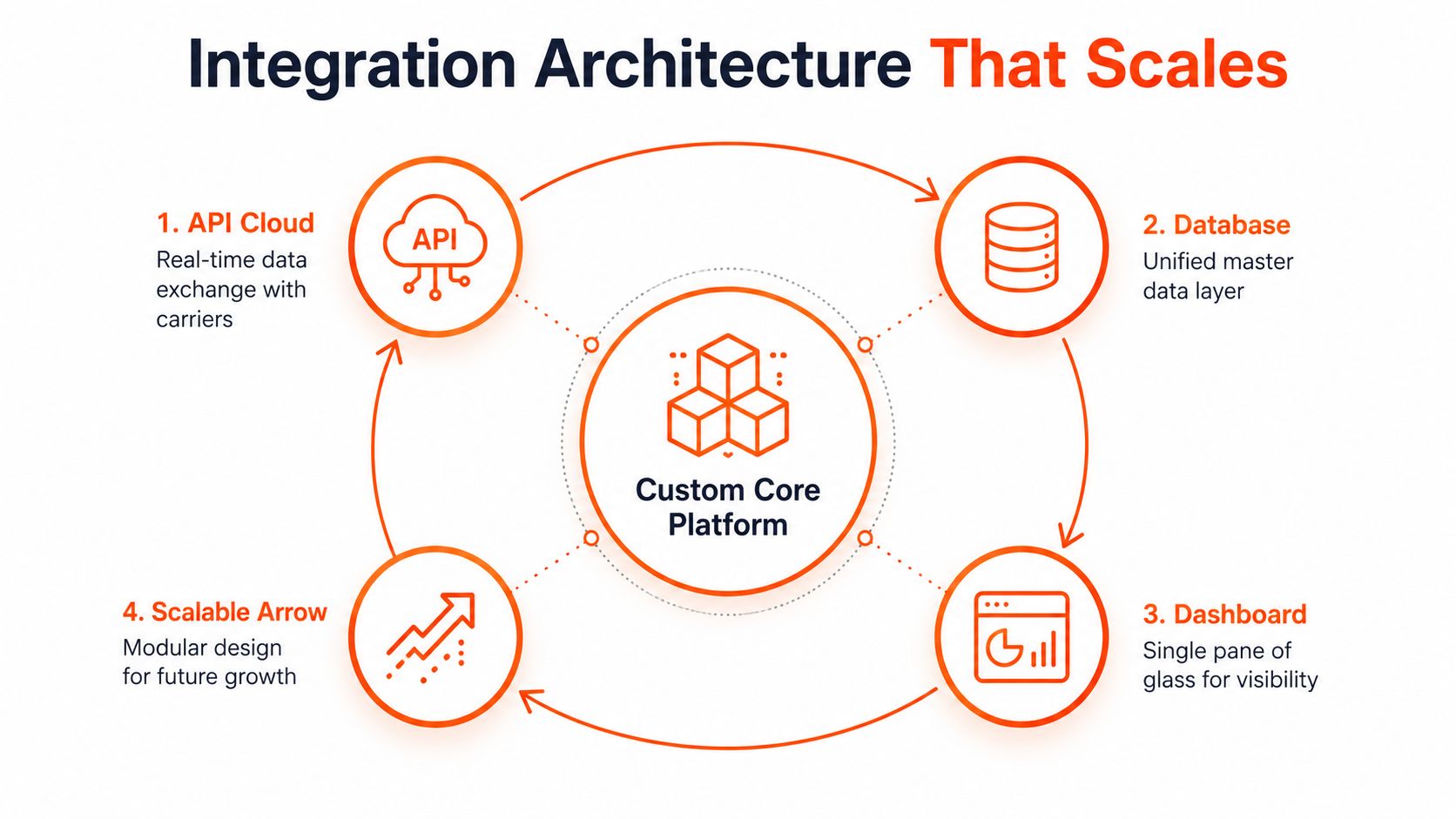
Integration usually eats the budget before anyone notices. In logistics, guidance puts integration work at 30% to 50% of custom development budgets, because platforms have to connect TMS, WMS, ERP, telematics, ELDs, carrier portals, and customer systems without creating new silos WeAreArch. That's not overhead, it's the system.
Build the integration layer first, not last
The strongest architecture starts with an API-first core, containerized microservices, and clearly defined event contracts. That combination lets teams isolate changes, avoid tight coupling, and keep one broken partner feed from dragging the rest of the platform down. If you skip the contract layer and wire everything together opportunistically, rework arrives later with interest.
The practical rule is straightforward. Define every integration point, every event contract, and every schema expectation before the implementation spreads across teams. That's the only way to avoid the classic logistics trap where each carrier, warehouse, or customer feed needs a separate patch every time the business changes.
Real-time visibility needs different plumbing
Fleet and asset visibility are not batch-report problems. Expert guidance recommends edge computing to reduce dependence on centralized networks and lightweight protocols like MQTT for efficient device messaging, while fleet tracking APIs may need location updates every few seconds and write-heavy, horizontally scalable databases to absorb sensor volume as fleets grow iTransition. That mix matters because a high-volume fleet can't wait on nightly syncs when service issues happen in real time.
Engineering rule: if a device or truck event is late, the dashboard is already behind, so the telemetry path has to be designed for low latency, not just reliable storage.
A sane stack usually separates operational data from presentation. The dashboard should read from a unified data layer, not become the data layer itself. That keeps carrier updates, warehouse events, and customer notifications aligned without forcing each screen to do its own reconciliation.
For teams that want a deeper view of this pattern, the event-driven architecture overview is a solid reference point for thinking about decoupled services and event contracts.
Five technical pillars that keep the platform alive
- Integration discipline: connect once, govern the contract, and reuse the flow.
- Event-driven data: push meaningful changes as events, not endless refreshes.
- Scalability: choose storage and service patterns that can absorb more locations, more vehicles, and more transactions.
- Security: treat partner access, role boundaries, and audit logs as part of the architecture, not a later hardening pass.
- AI readiness: don't automate until the event data, exceptions, and master records are trustworthy.
The point isn't to make the system complex. It's to keep the complexity where it belongs, in the business rules, not in brittle point-to-point integrations.
Real-World Use Cases Where Custom Logistics Software Wins
A regional carrier usually discovers the limits of generic software through billing disputes. A cross-border 3PL feels the pain through compliance and data ownership. Both are common, and both are good candidates for a custom core when the workflow is too exception-heavy for standard modules.
Regional carrier with exception-heavy billing
The first pattern is a carrier with detention, accessorials, multi-stop proof of delivery, and customer-specific rules that don't fit a vanilla TMS cleanly. Dispatch needs one view, billing needs another, and customer service needs enough detail to answer disputes without digging through five systems. A custom platform helps because the logic for those exceptions lives in one place instead of being scattered across spreadsheets, emails, and tribal knowledge.
That matters most when the same shipment can change value several times during the life of the move. A missed arrival window might trigger detention. A special stop might trigger an accessorial. A proof-of-delivery delay might block invoicing. If the system can't model those transitions cleanly, the back office ends up doing manual arbitration all day.
Cross-border 3PL with compliance pressure
The second pattern is a cross-border 3PL that has to unify warehouse, ERP, TMS, and customer systems while owning the data model for auditability and service control. Here the issue is not just visibility. It's governance. The operation needs a single operational view that can survive partner changes, regional rules, and customer-specific reporting without breaking every quarter.
A custom build helps because the business can choose what data is canonical, which events are authoritative, and how exceptions flow between systems. That's the piece most off-the-shelf platforms handle poorly, especially when the warehouse, billing, and customer layers all need different slices of the same transaction.
- Detention logic: easier to manage when timestamps, milestones, and charge rules sit in one event model.
- Accessorial handling: cleaner when billing rules are connected to shipment state, not manually copied from emails.
- Proof of delivery: more reliable when mobile capture, timestamps, and invoice triggers are part of the same workflow.
The best custom logistics projects I've seen don't start with features. They start with the exceptions that keep causing disputes, delays, or compliance headaches.
For organizations comparing partner-led delivery options, devPulse is one example of a consultancy that covers custom software development, platform integration, and workflow automation for enterprise systems. In logistics terms, that means the conversation can start with the operating model instead of a generic feature checklist.
Delivery Timeline, Phases, and Implementation Risk
Custom logistics platforms usually fail long before launch. They fail when the team underestimates discovery, skips integration scoping, or lets the data model drift while the build is already underway. A realistic plan starts with the front of the project, not the demo.
The front end of the project matters most
Experienced delivery guidance puts discovery, integration scoping, and architecture at 3 to 6 weeks, followed by data foundation and core architecture for another 2 to 5 weeks WorkflowUnity. That early work is where the project gets saved or lost, because the team defines every integration point, event contract, carrier or EDI schema, and data flow before code starts hardening into assumptions.
The same source gives practical delivery horizons: 8 to 14 weeks for a focused MVP, 4 to 8 months for a scalable single-category platform, and 8 to 14 months for an integrated or AI-enabled platform WorkflowUnity. Those ranges line up with what happens when logistics logic starts crossing multiple systems instead of living in a single app.
| Project Scope | Discovery & Architecture | Data Foundation & Core | End-to-End Timeline |
|---|---|---|---|
| Focused MVP | 3 to 6 weeks | 2 to 5 weeks | 8 to 14 weeks |
| Single-category platform | 3 to 6 weeks | 2 to 5 weeks | 4 to 8 months |
| Integrated or AI-enabled platform | 3 to 6 weeks | 2 to 5 weeks | 8 to 14 months |
Requirements work is not a tax
One logistics guide recommends spending 10% to 15% of timeline and budget on requirements gathering and process documentation before custom IT tools are built Attract Group. That advice sounds slow until you compare it with the rework that shows up when dispatch, billing, and customer-service teams discover they each define an exception differently. The same source notes that process documentation before custom tools can reduce deployment rework by 31% Attract Group.
Implementation rule: if the team can't describe the exception flow on paper, it's too early to code the system.
The cleanest programs don't try to sprint through uncertainty. They lock the integration contract, confirm the data owner for each object, and only then scale implementation. That's how a custom platform gets to value without turning into a long rework cycle.
Compliance, AI Readiness, and the Build-vs-Buy Decision
The worst build-vs-buy decision is the one made from habit. Too many logistics teams default to buying a bigger TMS when the core issue is workflow exceptions and data governance. Others jump straight to AI before their event data can even survive a customer dispute.
Buy software when the process is stable
If the operation is standard, the integrations are light, and the workflow mostly follows the vendor template, buying can be the right answer. The trouble starts when the business has unique rules that keep breaking standard flows. At that point, the question isn't whether a custom platform sounds attractive. It's whether the operation can function without owning its data model and exception logic.
The same logic applies to compliance. For regulated or cross-border operations, secure-by-design workflows, auditability, and domain expertise matter because the software has to preserve a reliable record of what happened and when. A generic tool can store data. A custom system can preserve the operational meaning of that data.
For a deeper perspective on controls, governance, and operating discipline, this AI governance framework guide is a useful companion.
AI only helps when the data is mature
AI in logistics is often sold as an overlay. In practice, it's a systems-design problem. If event quality is poor, exception handling is inconsistent, or the underlying data model is fragmented, AI can automate confusion faster than humans can clean it up. That's especially risky in regulated environments, where audit trails and change control matter as much as speed.
A practical decision checklist looks like this.
- Exception complexity: are your special cases frequent enough that standard workflows keep breaking?
- Integration debt: are teams manually reconciling data across TMS, WMS, ERP, and carrier feeds?
- Data ownership: is there one authoritative source for shipment, billing, and status events?
- Compliance burden: do auditability, privacy, or cross-border rules require tighter control than a generic platform offers?
- AI roadmap: can the operation support AI without first fixing event quality and process governance?
If the answers point to high exception complexity, high integration debt, and unclear data ownership, a custom core is usually the stronger play. If the process is mostly standard and the pain is localized, a better integration layer or tighter standardization may be enough.
devPulse designs, builds, and maintains custom digital systems for enterprise operations, including integration-heavy platforms and AI-enabled workflows. If your logistics stack is stuck between generic software and a brittle tangle of workarounds, visit devPulse to talk through the workflow, the data model, and whether a custom build pays back in your environment.
Drafted with the Outrank app