









Your portal RFP is approved, the legacy systems are real, and the compliance team has already asked for audit trails, role-based access, and a launch date you’re not sure anyone believes. That’s the moment most buyers realize they’re not hiring a website shop, they’re choosing the partner that will shape how the portal behaves under load, change requests, and governance pressure for years.
The mistake is treating a web portal development company like a commodity vendor. Portals are not brochure sites with a login form bolted on, they’re operational systems with users, integrations, permissions, reporting, and support obligations that keep showing up after go-live.
Why Choosing the Right Partner Matters
A procurement team can approve the budget, a product manager can define the user stories, and a security lead can set the controls, but the wrong vendor still drags the whole program into delay. I’ve seen portals stall because the chosen team could build screens but not manage workflow complexity, or because they priced the launch but assumed the client would handle every integration and post-launch fix.
The hidden cost of a bad fit
The first sign of trouble is rarely a failed build. It’s a stream of small compromises, like brittle integration choices, unclear ownership for maintenance, and release schedules that slip every time a dependency changes. Those issues are expensive because portal work is usually a long-running operating model, not a one-off website project.
Practical rule: if a vendor can’t explain how they’ll support the portal after launch, they’re not quoting the full job.
A good partner reduces ambiguity early. A poor one leaves your team discovering risks during user acceptance testing, when changing direction costs more and internal trust is already fading. That is why this decision belongs closer to enterprise sourcing than marketing procurement.
Why the stakes keep rising
Portal programs sit in the middle of business process, security, and service delivery. They touch users who expect self-service, teams who need internal efficiency, and leaders who want cleaner operations without adding another disconnected tool. For a useful supporting perspective on service design around self-service patterns, the SupportGPT modern support guide is a solid adjacent reference.
The partner choice also affects design quality. If UX is weak, adoption suffers. If backend planning is weak, the portal becomes hard to extend. If governance is weak, the portal becomes harder to defend in regulated environments.
For teams comparing delivery partners, the key question is simple: can this vendor carry the full lifecycle without turning every new requirement into a new project?
What a Web Portal Development Company Delivers
A genuine web portal development company does much more than assemble pages and forms. It handles the full path from discovery to ongoing support, which is why the work looks closer to building a city than opening a kiosk. A kiosk is static, easy to replace, and narrowly scoped. A city needs roads, utilities, traffic rules, maintenance crews, and a plan for growth.

From requirements to operations
The delivery scope typically starts with requirement analysis and architecture planning, then moves through development, third-party integrations, deployment, and post-launch maintenance, as described in portal lifecycle guidance. That sequence matters because the portal’s function, security model, and technology stack all need to align with business processes before anyone starts coding.
The strongest vendors are also comfortable with scalable backends, efficient database design, and integration-ready APIs, which is exactly what portal architecture needs when many users and heavy workloads are part of the brief. A brochure-site agency often optimizes for visual polish. A portal team has to optimize for uptime, access control, and data flow.
You should also expect the design side to be integrated, not siloed. The interface needs to support real tasks, not just look modern. For teams comparing design maturity, a useful reference point is this UI/UX design services overview, because portal UX is often about reducing friction in workflows rather than decorating screens.
What separates portal delivery from website delivery
- Process Alignment: The vendor should map user roles to actual business steps, not generic personas.
- Integration Planning: The team needs to design around systems that already exist, not assume a clean slate.
- Operational Support: The job continues after deployment, because fixes, upgrades, and enhancements don’t stop at launch.
- Security by Design: Access rules and governance belong in the architecture, not as a last-stage add-on.
A portal partner should make hard dependencies visible early. If the roadmap hides integration complexity, the budget will absorb it later.
That lifecycle mindset is also why portal partners should talk about evolution, not just delivery. A portal that can’t adapt to new workflows, new roles, or new controls is already aging on day one.
Market Realities Shaping Portal Buying
The market signals are clear, portal work is enterprise work. The global web development services market was valued at USD 80.6 billion in 2025 and is projected to reach USD 134.17 billion by 2031, with a CAGR of 8.87% from 2026 to 2031, according to Mordor Intelligence’s market view of web development services. In the same market, large enterprises accounted for 62.40% of demand in 2025 and cloud-based solutions held 69.20% of deployment share, which tells you where the budget and complexity live.
What the market mix says about buyers
Those numbers matter because they show who is buying portals. Enterprise buyers dominate demand, and cloud-first deployment dominates delivery. That combination usually means more stakeholders, more systems, and more governance pressure than a small-project agency model is built to handle.
| Market signal | What it means for portal buying |
|---|---|
| Large enterprise demand led the market in 2025 | Vendors need enterprise governance and delivery maturity |
| Cloud-based deployment led the market in 2025 | Buyers should expect cloud-native planning and operations |
| Market value projected to grow through 2031 | Portal programs sit in a growing, not shrinking, category |
The chart below helps visualize the growth path.
| Year | Market size |
|---|---|
| 2025 | USD 80.6 billion |
| 2031 | USD 134.17 billion |
That trajectory doesn't say every portal is complicated. It does show that the category is being driven by organizations that need repeatable delivery, not one-off experiments.
The architecture trend behind the demand
Portal architecture is also moving toward composable and integration-heavy patterns. In one portal development market view, React-based front-ends held 32.50% share in 2025 and headless CMS tools are growing at 15.45% CAGR through 2031, based on portal development market research. Those figures point to a practical reality, buyers want front ends that can move quickly while content, permissions, and services stay decoupled enough to evolve.
That's the backdrop for procurement. If the market is enterprise-scale and cloud-first, then the vendor shortlist should reflect that. A team that mainly ships small marketing websites probably won't be the right fit for a portal that has to survive multi-system integration, governance reviews, and support cycles.
The takeaway is straightforward. Before you compare creative style or hourly rate, check whether the vendor's operating model matches the market reality your portal will have to live in.
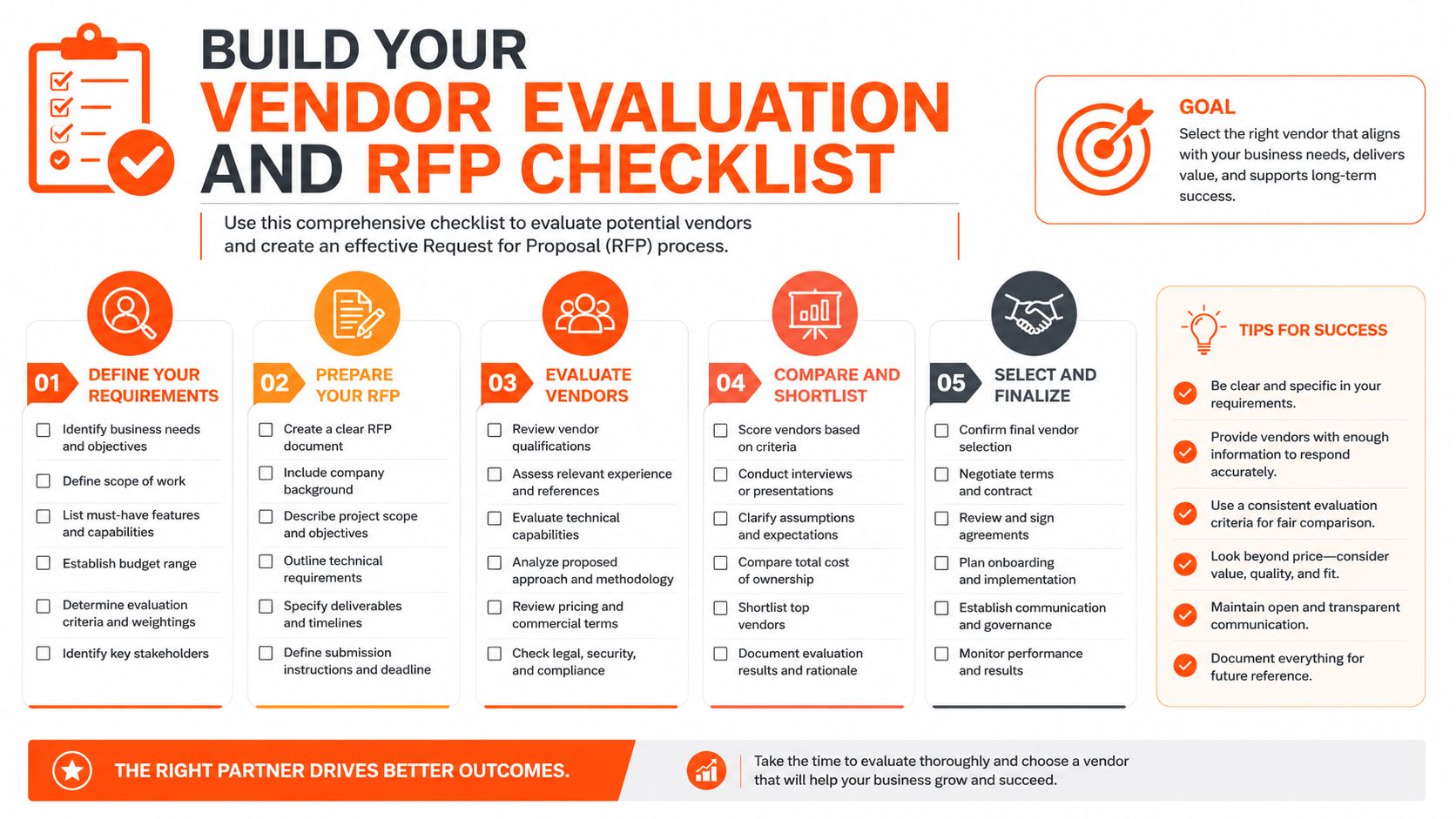
Build Your Vendor Evaluation and RFP Checklist
A strong RFP doesn't start with feature lists, it starts with architecture fit. Independent guidance on portal buying points out that the biggest cost drivers are third-party integrations, security audit requirements, and the number of distinct user roles, while portal budgets can range from roughly $20,000 to $400,000 depending on complexity, based on web portal vendor evaluation guidance. If your RFP ignores those variables, the cheapest bid is usually just the one that left them out.
Start with the complexity questions
Ask how many systems the portal must connect, how many roles need distinct permissions, and what support burden the client team is prepared to carry after launch. Those questions reveal whether a vendor is estimating the actual effort or just pricing the visible screens.
Your RFP should force answers in plain language:
- Integration count: Which systems are in scope, and which ones are excluded?
- Role complexity: How many user types need different permissions, approvals, or journeys?
- Support model: Who handles bugs, enhancements, and monitoring after go-live?
- Compliance scope: Which audits, logs, retention rules, or policy gates are expected?
- Scalability assumptions: What traffic and data patterns shaped the proposed architecture?
Useful filter: a vendor who can't estimate complexity in terms of systems, roles, and support usually can't control it either.
That checklist matters because many vendor pages offer pricing bands but skip the decision model that would tell you when portal development beats stitching together SaaS tools. If you want a sharper partner-evaluation process, the technology partner evaluation guide is a practical complement to your internal scoring sheet.
Turn the checklist into scoring criteria
A good scoring model gives weight to evidence, not marketing language. Review actual portal work in regulated or integration-heavy environments, ask for architecture samples, and verify whether the team has handled continuous support rather than only launch projects.
Use the checklist to separate capability from confidence:
- Discovery work should show how the team uncovers hidden workflow and data dependencies.
- Technical capability should show how the portal stays maintainable as integrations grow.
- Delivery history should show whether the vendor has operated systems after launch, not just handed them off.
- Commercial clarity should show whether the pricing covers maintenance, support, and change management.
If a response sounds polished but vague, assume the gap will appear in delivery. RFPs are most useful when they make vendors prove fit before the contract is signed.
Integration and Security Considerations
Security and integration shape day-to-day portal ownership. They are operating conditions, not launch-day extras. In regulated or content-heavy environments, the portal team has to manage permissions, traceability, and data handling while the system keeps changing, and that is where vendor quality becomes visible fast.
What Modern Resilience Requires
Buyer questions should go beyond SSO and API support. Ask how the team handles permissioning, observability, auditability, and structured content pipelines, because those controls determine whether the portal stays usable over time. For regulated sectors such as healthcare and legal tech, that discipline matters more than a feature checklist.
AI raises the bar again. The harder question is whether a portal can govern AI-assisted search, keep content structured, and stop sensitive data from drifting into the wrong workflow. Recent portal thinking also points to the pressure on model governance and data minimization, which is where many generic buyer guides go thin, a topic covered in more detail in this guide to cybersecurity in IT outsourcing.
Ask Vendors How They Handle AI Risk
Governance has to be part of the build conversation from the start. The Netguru portal development discussion notes that Gartner expects more than 80% of enterprises to have used generative AI APIs or deployed GenAI-enabled applications by 2026, while only 30% of GenAI projects are expected to survive to production. Those figures matter for portal buyers because adoption alone does not prove operational readiness.
The practical test is simple. Ask what controls exist, who owns them, and how they hold up after launch.
- Permissioning discipline: How does the portal enforce role-based access when data is reused across workflows?
- Observability: What logs, alerts, and monitoring are built into the operating model?
- AI governance: How are prompts, outputs, and knowledge sources reviewed and controlled?
- Data handling: Which data is minimized, masked, or excluded from AI-assisted features?
- Upgrade path: How does the team retrofit legacy portals without breaking current operations?
One practical option in this space is devPulse, which focuses on enterprise portal engineering, secure AI integration, structured content pipelines, and long-term support. That scope matters because portals often fail at the edges, where integration, governance, and ongoing change collide.
A vendor that only talks about launch speed is leaving out the hard part. A portal that cannot be audited, observed, and evolved safely becomes a liability even if the first release looks polished.
Sample Engagement Models and Cost Realities
Commercial model and portal complexity need to match. A fixed-price deal can work for a tightly scoped build, but it gets brittle when integration count, approvals, and compliance requirements keep expanding. A dedicated team makes more sense when the portal is expected to evolve continuously. Time and materials can fit discovery-heavy work, but only if governance is strong and scope is actively managed.
Budget tiers and maintenance
One cost guide places a basic portal at USD 15,000–30,000, while advanced enterprise or e-commerce portals can reach USD 50,000–150,000+. It also says annual maintenance often equals 20%–25% of initial development cost, which turns portal ownership into a recurring operating expense, based on web portal development cost guidance.
| Portal Scope Tier | Cost Range (USD) | Annual Maintenance |
|---|---|---|
| Basic portal | USD 15,000–30,000 | Often 20%–25% of initial development cost |
| Advanced enterprise or e-commerce portal | USD 50,000–150,000+ | Often 20%–25% of initial development cost |
The maintenance ratio is the detail buyers miss most often. A cheap build that needs constant patches, integration fixes, and support escalations can become more expensive than a cleaner build with better architecture and stronger operational ownership.
Which engagement model fits which tier
A fixed-price model fits best when requirements are stable and integration surfaces are limited. A dedicated-team model fits better when the portal has to absorb ongoing change, new roles, or iterative AI and compliance work. Time and materials can be appropriate for discovery or uncertain scope, but it only works if the client has the internal discipline to review scope continuously.
If your portal will keep changing after launch, budget for the change path, not just the first release.
Use commercial terms to test vendor maturity. Ask who owns deployment support, how enhancement requests are handled, and what happens when one integration exposes another dependency. Those answers tell you whether the vendor is selling software delivery or assuming operational responsibility.
The right contract doesn't eliminate risk. It makes the risk visible enough to manage.
Making the Final Selection with Confidence
The best selection criterion is not the lowest bid. It's the partner who can keep the portal healthy after the first release, because that's where real cost, risk, and value show up. If a vendor has no credible answer for support, architecture evolution, and compliance upkeep, the proposal is incomplete.
Choose for lifecycle strength
Review the shortlist against three questions. Can the team handle the integration load without improvising? Can it support the portal after launch without forcing every change into a new commercial event? Can it defend the system under governance and compliance pressure?
Those questions are more useful than generic promises about agility. They force buyers to evaluate the whole operating life of the portal, not just the demo.
Use the RFP as a gate, not a formality
The RFP should do more than compare features. It should expose whether a web portal development company can think like an operating partner, one that understands process, support, and evolution. If the answers are vague, the delivery will be vague too.
A confident shortlist usually looks boring in a good way. The vendors explain trade-offs clearly, show relevant enterprise work, and describe what maintenance will involve. That's the signal to trust.
Treat the decision as a lifecycle investment, not a one-time purchase. The portal will keep changing, and the partner you choose needs to change with it.
If you need a portal partner that can handle discovery, architecture, secure AI integration, structured content, and long-term support, devPulse works with enterprises that want the full lifecycle covered rather than patched together. Visit devPulse to discuss a portal program, compare delivery models, and see whether your current RFP is measuring the right things.
Refined using Outrank tool