











Enterprise custom software isn't a niche decision, it sits at the center of the market. Grand View Research estimates the global custom software development market at USD 43.16 billion in 2024 and expects it to reach USD 146.18 billion by 2030, with a 22.6% CAGR from 2025 to 2030, while the enterprise software segment accounted for over 60.0% of the market in 2024 (Grand View Research market report). That scale matters because it shows why large organizations keep choosing custom systems when off-the-shelf tools can't absorb messy integrations, approvals, compliance, and operating-model differences.
For enterprise leaders, the question isn't whether custom software is powerful. It's whether the organization has enough hidden operating friction to justify the cost, discipline, and governance that enterprise-grade delivery demands.
Table of Contents
- Why Enterprises Dominate Custom Software Demand
- The Enterprise Delivery Lifecycle and Governance Patterns
- Architecture Decisions That Compound Over Time
- Modernize, Integrate, or Replace Legacy Systems
- Building AI-Ready Enterprise Software
- Security and Compliance in Regulated Environments
- Long-Term Support Models and Operational Excellence
Why Enterprises Dominate Custom Software Demand
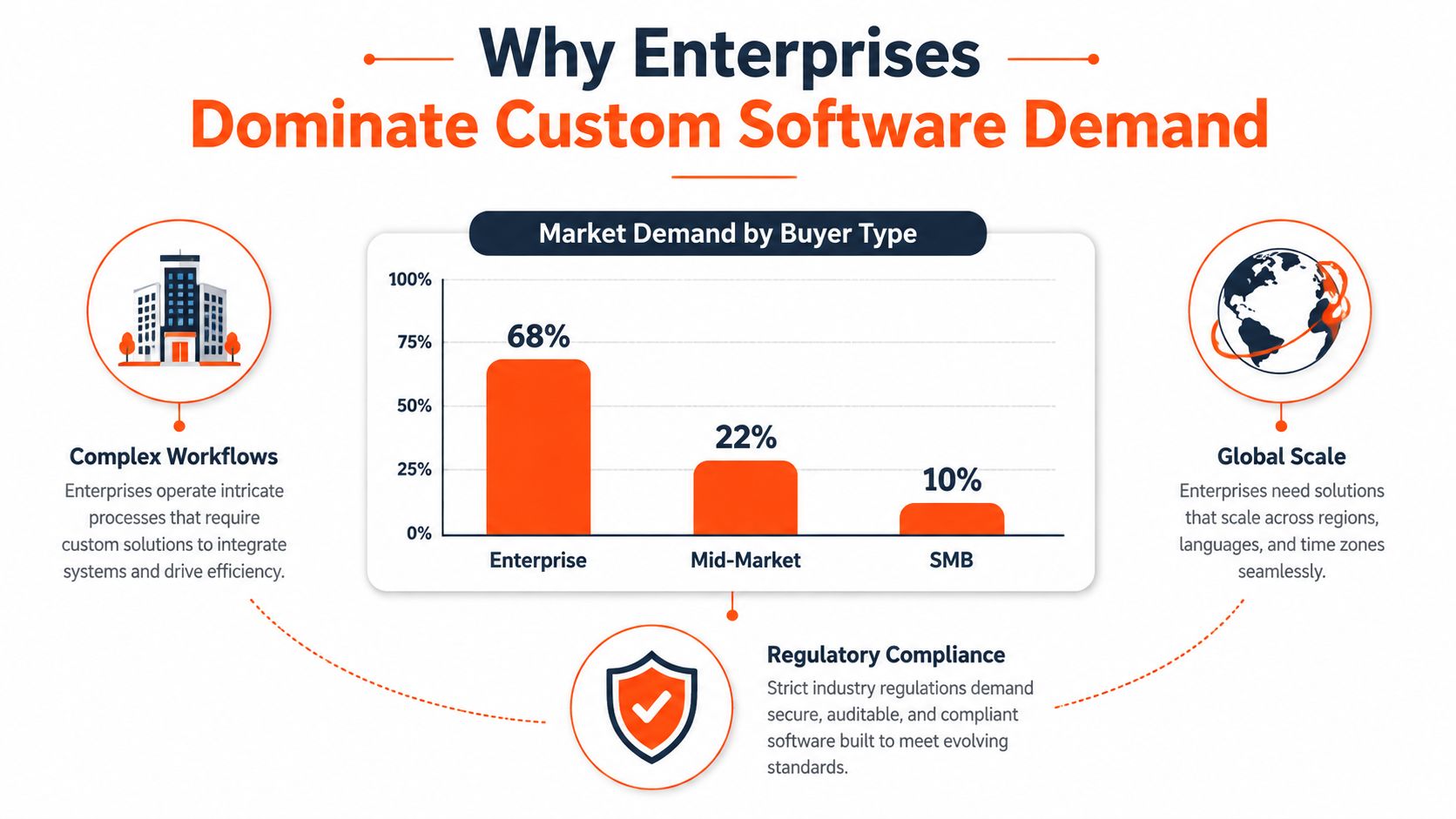
Enterprise buyers dominate custom software because their systems have to survive more than a single workflow. They have to handle layered approvals, identity controls, integrations across old and new platforms, and the operating cost of one broken handoff when revenue, operations, or compliance is on the line. Grand View Research's market view, which places a large share of demand in the enterprise segment, matches what delivery teams see in practice. Large organizations hold the hardest software problems because they carry the most interdependence, the most exception handling, and the most governance friction (Grand View Research market report).
Complex operating models need tailored systems
Off-the-shelf software usually assumes a cleaner process than most enterprises run. Teams deal with exceptions, regional variants, role-based approvals, and legacy data that does not fit standard templates. That is why custom software development for enterprise keeps winning budgets in modernization programs, platform engineering, and integration-heavy transformation work.
Practical rule: if a workflow needs three departments to agree before a customer-facing action is allowed, generic software usually becomes a compromise, not a solution.
The economic signal is simple. Enterprises are not buying custom systems because they want novelty. They buy because the cost of forcing standardized tools into non-standard operations shows up in rework, manual reconciliation, and delayed decisions. A custom system can centralize controls, preserve local variations, and make the workflow auditable without turning the business into a spreadsheet relay. It also gives teams a place to design for AI-readiness up front, which matters because data shape, access control, and event quality are set before the first model is ever considered.
The pre-build stage is where money is lost or saved. If teams delay decisions about master data, identity boundaries, integration ownership, or whether a legacy system should stay in the path, they move the cost downstream and pay for it later in rework, brittle glue code, and slower releases. A direct look at sourcing and delivery choices can help teams avoid that delay, including why outsourcing software development can be a strategic choice, but only if governance and architecture are defined before build starts.
Scale changes the buying logic
Large organizations also think differently about risk. Mordor Intelligence reports that enterprise software held a meaningful share of revenue in 2025, large enterprises accounted for the majority of market share, and cloud-hosted solutions made up a major portion of the market in the same year (Mordor Intelligence market report). Those figures line up with a practical reality enterprise software decisions are increasingly cloud-centered, architecture-heavy, and tied to how the business runs.
For a consultancy like devPulse, the strategic fit is obvious. Work that spans modernization, platform engineering, secure integrations, and cloud deployment sits closest to where enterprise demand concentrates. That does not make every custom build worthwhile, but it does mean the strongest use cases are usually the ones where systems must be secure, scalable, and adapted to complex operating models. It also explains why the decision point often happens before development begins, when leaders decide whether to replace a legacy constraint, isolate it, or keep paying the operational tax it creates.
The Enterprise Delivery Lifecycle and Governance Patterns
Enterprise delivery fails most often when teams confuse motion with control. GoodFirms research shows an average development time of 4.5 months for custom software, 61.6% of firms say their standard delivery window is 4 to 6 months, and only 7.7% can deliver a typical basic-feature product in less than 2 months (GoodFirms research). The same dataset shows project price ranges spanning $3,000 to $120,000, which makes the point clearly, scope variance drives delivery reality as much as coding effort does.
Discovery has to surface risk, not just requirements
Discovery is not a PowerPoint phase. It is the point where teams decide whether they understand the problem well enough to spend money on it. The strongest enterprise programs use discovery to map stakeholder disagreement, integration dependencies, data quality issues, and change-management friction before a build starts.
Practical rule: if discovery ends with a neat feature list but no visible risk register, the project is probably under-scoped.
The most useful artifacts are not long documents, but decisions. What must be true for the system to succeed, which dependencies are brittle, and which assumptions need proof before engineering starts? Early spikes matter at that stage. A short proof-of-concept can show that a promising design breaks under real identity, data, or throughput conditions, and that information is cheaper than a failed launch.
Governance keeps scope from drifting
The reason so many programs slide is not that teams lack effort, it is that no one owns change control. Independent industry guidance links scope creep to schedule slippage, budget overruns, and rework, which is why formal approval gates and documented trade-offs matter so much in enterprise work (ApexioSoft guidance).
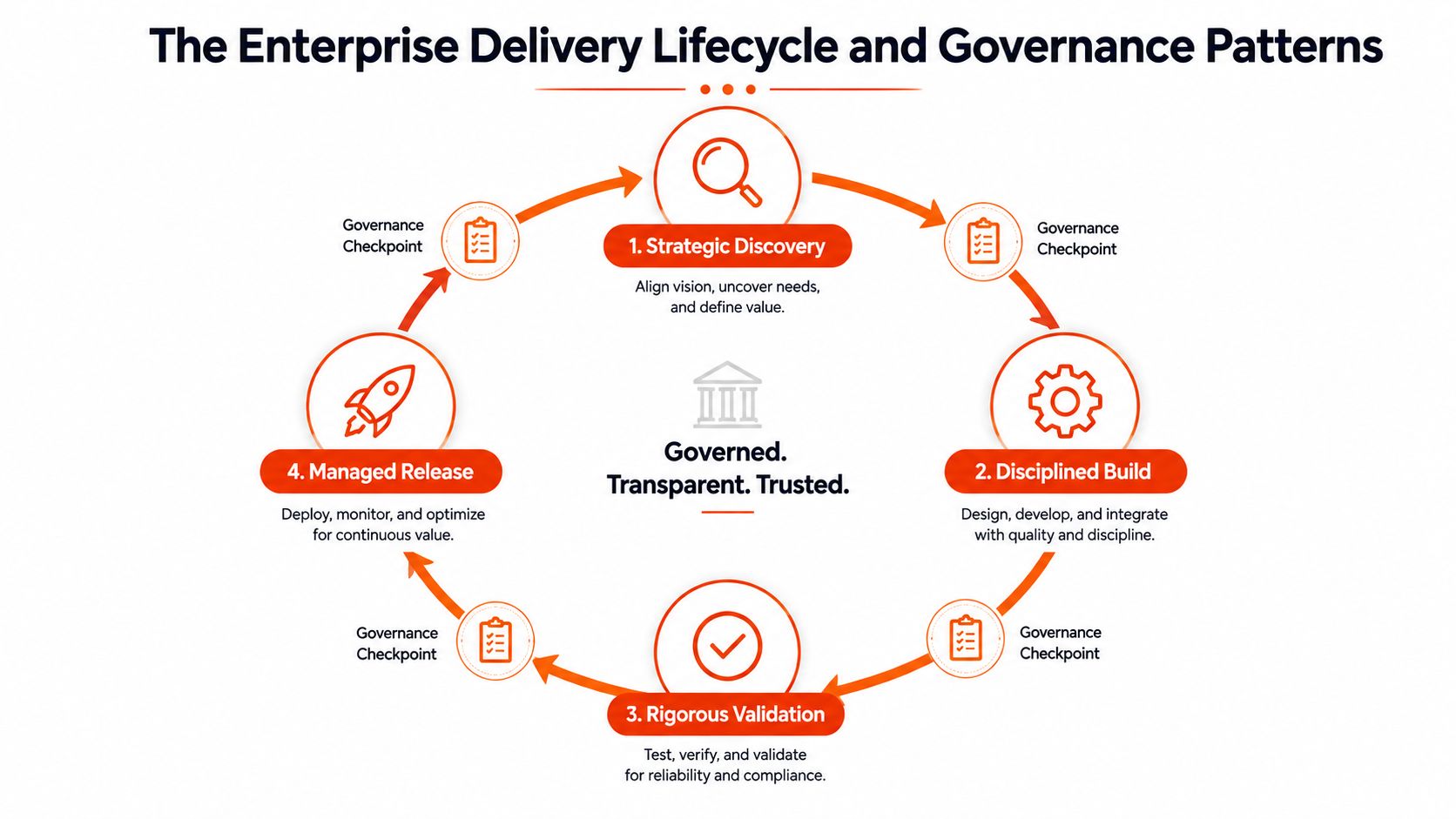
A practical lifecycle usually looks like this:
- Strategic discovery, define the business problem, the constraints, and the essentials.
- Disciplined build, keep the backlog tied to approved scope and visible acceptance criteria.
- Rigorous validation, test integrations, performance, and business workflows before release.
- Managed release, stage rollout, monitor behavior, and keep rollback options clear.
Governance also has to cover delivery mechanics. A release process only stays predictable when engineering, product, security, and operations agree on who approves changes, who owns exceptions, and how incidents get escalated. That is where a clear DevOps operating model helps, and the practical mechanics are worth spelling out in a DevOps implementation guide.
The point is not ceremony. The point is keeping decisions traceable when requirements change midstream, which they almost always do in enterprise environments. The teams that stay predictable are the ones that treat governance as an engineering tool, not a bureaucratic tax.
Architecture Decisions That Compound Over Time
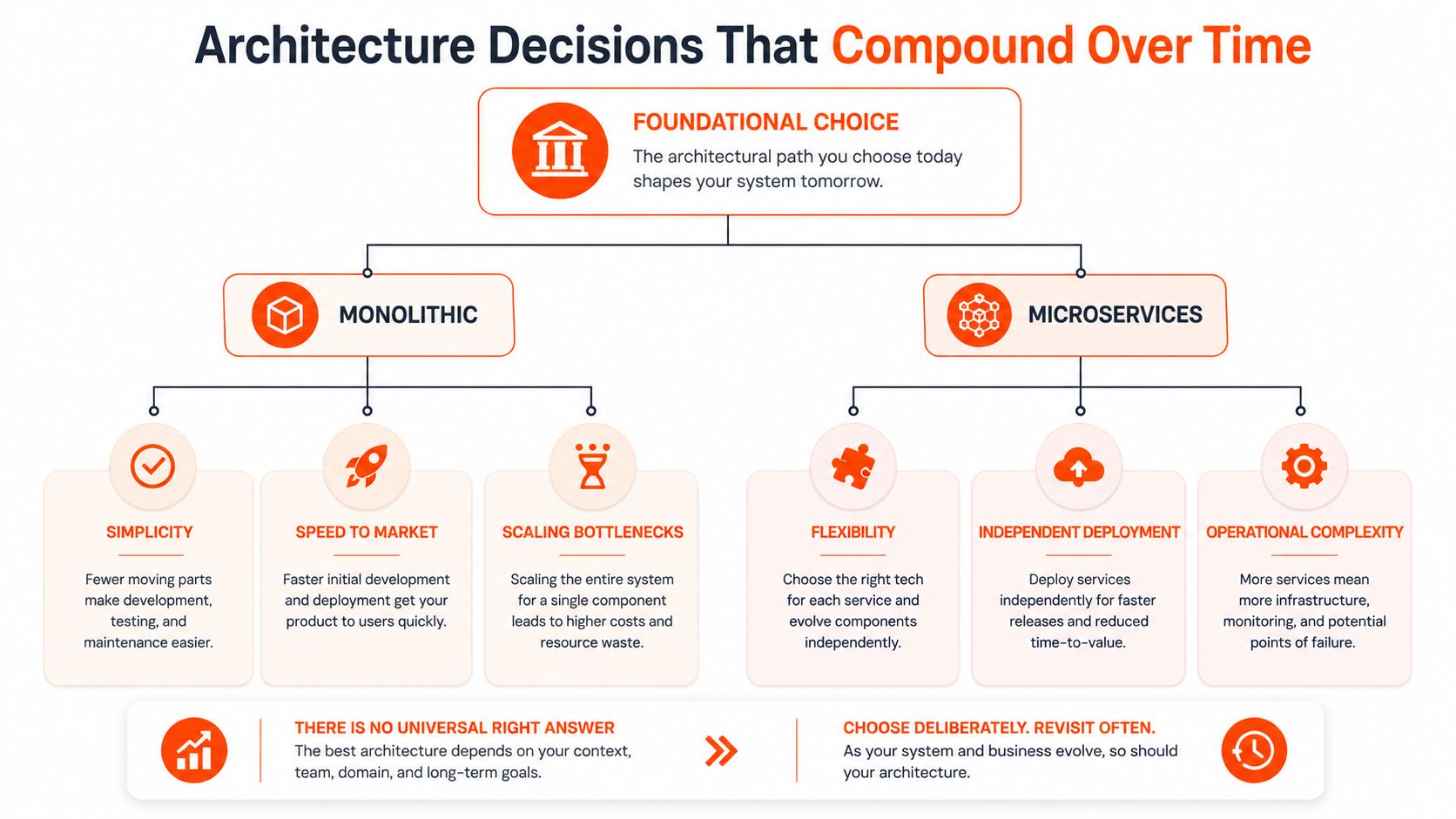
Architecture is where enterprise programs either buy optionality or lock in friction. The biggest mistake is treating early design as temporary, because the first deployment shape tends to become the long-term operating model. In enterprise custom software, that choice affects release cadence, incident response, security exposure, and how much effort it takes to change anything later.
Integration layers carry the real risk
Enterprise systems usually break at the integration layer before they fail in core feature logic. Legacy platforms, SaaS APIs, and multi-cloud event streams create brittle coordination points, and those seams are where security gaps and performance bottlenecks usually appear first (Devsinc article). That's why middleware, gradual migration, and early load testing matter so much in large programs.
The right pattern depends on the system's gravity. If the platform has to coordinate many external services, event streams, and user roles, loose coupling helps, but loose coupling without governance just spreads complexity around. If the data model is stable and the domain is tight, a simpler core can outperform a distributed one because the team spends less time managing service chatter.
Cloud-hosted deployment shapes the design
Mordor Intelligence's 61.40% cloud-hosted share in 2025 is more than a market note, it reflects the direction of enterprise delivery itself (Mordor Intelligence market report). Cloud deployment patterns reward design decisions that support observability, scaling, and controlled rollout. They also punish sloppy interface design, because once services are distributed, bad contracts become expensive quickly.
Good architecture doesn't try to make every future option cheap. It makes the likely future changes survivable.
A monolith can be the right move when the team needs cohesion, speed, and a single transaction boundary. Microservices can be the right move when independent deployment and domain separation outweigh the cost of operational overhead. The wrong move is starting with the architecture diagram before understanding the integration load, the data lifecycle, and the release model the business can support.
Modernize, Integrate, or Replace Legacy Systems
The most expensive enterprise mistake is often starting with a build decision before the organization has answered a simpler question, what's broken? Many programs fail in the pre-build stage because the pain is hidden operating friction, not an obvious feature gap. Teams live with workarounds, fragmented approvals, and workflow knowledge trapped in a few senior staff members until the delay itself becomes the liability.
Decide based on friction, not fashion
McKinsey found that large IT projects commonly run 45% over budget, 7% over schedule, and 56% over value, which is why “should we build at all?” is a more useful question than “what is custom software?” (Softlabs article citing McKinsey). That doesn't mean new builds are wrong. It means leaders should look first at whether the current system needs selective modernization, a new integration layer, or full replacement.
The decision often comes down to where the operational drag sits:
- Modernize when the core process still works, but the platform is dated, fragile, or expensive to maintain.
- Integrate when the business wants to preserve existing systems while removing manual handoffs and duplicate entry.
- Replace when the old platform blocks scale, security, or change so thoroughly that patching it only delays the inevitable.
Delay has a real cost
The hidden cost of waiting is rarely obvious in one quarter. It shows up as more manual exceptions, slower response times, and growing dependence on a few people who understand the old system well enough to keep it running. Once that knowledge is concentrated, the organization starts paying for continuity in human labor instead of software design.
A useful rule is to count the number of workarounds before counting the number of features. If the business is still paying people to reconcile systems by hand, the issue is probably not UI polish. It's operating friction, and that friction usually gets worse, not better, the longer the legacy stack stays untouched.
That's where a deliberate option analysis helps. A modernization plan can reduce risk without forcing a big-bang cutover. An integration layer can buy time while core systems stay in place. Full replacement makes sense when the business needs a structural reset, not another patch on top of the same constraints.
Building AI-Ready Enterprise Software
Enterprise teams are no longer just asking for digital workflows. They're asking whether those workflows can safely support governed AI search, RAG, and agentic actions on sensitive data. Gartner projected that 40% of enterprise applications would include task-specific AI agents by 2026, and McKinsey reported that 72% of organizations had adopted AI in at least one business function in 2024, up from 50% in 2022 (Keyhole Software article). That shift changes the architecture conversation fast.
AI readiness starts with data control
If a custom platform is going to support intelligent automation, the first requirement is not a model. It's a data structure that knows what can be read, what can be exposed, and what must stay inside a policy boundary. Provenance matters because enterprise users need to know where a response came from, not just whether the answer sounds plausible.
Access control becomes more than login logic. The system has to respect role-based visibility, retention policy, and data sensitivity across search, retrieval, and action layers. Human review also matters more in regulated environments, because AI-generated recommendations can't be allowed to bypass business judgment when the output affects customers, records, or approvals.
Build for governed workflows, not novelty
A practical AI-ready platform usually has four properties:
- Structured master data, so entities stay consistent across systems and the AI layer isn't guessing at definitions. A useful reference on that problem is master data management for AI from FalkorDB, Inc.
- Retrieval boundaries, so search and RAG pull from approved sources instead of the whole data swamp.
- Auditability, so every AI-assisted decision leaves a trace that operations or compliance can review.
- Human-in-the-loop controls, so agents assist work without taking ownership of regulated decisions.
The mistake many teams make is bolting AI onto a messy platform and hoping intelligence will compensate for fragmented data. It won't. AI readiness is really an operating model question, because the architecture has to support trust, provenance, and policy enforcement before it supports automation.
Security and Compliance in Regulated Environments
A healthcare rollout I've seen succeed started with the security review, not the feature backlog. The team mapped what data could be stored, what had to be masked, who could approve exceptions, and which services needed tighter logging before the first sprint hit production. That sequence felt slow at first, but it prevented the kind of late-stage rewrite that usually appears when privacy and architecture are treated as separate conversations.
Controls belong in the design, not after launch
In regulated sectors, security-first delivery only works when controls are embedded from day one. That includes threat modeling, data classification, least-privilege access, and audit logging that compliance teams can use. For teams working through policy-heavy requirements, regulations and technical controls are most useful when they're treated as engineering constraints, not policy afterthoughts.
DevOps also changes the security story. Zipdo reports that 89% of custom software projects in 2023 included DevOps and CI/CD practices, up from 67% in 2020, which shows how quickly release automation has become part of the delivery baseline (Zipdo industry statistics). In regulated environments, that kind of pipeline discipline helps teams maintain speed without losing traceability.
Compliance is a delivery habit
Security failures in enterprise software rarely come from one dramatic mistake. They come from small oversights, missing logs, weak data segregation, unreviewed access paths, or a release process that skips validation because deadlines got tight. The better pattern is to make security reviews routine, keep evidence close to the code, and let compliance teams inspect the same artifacts engineering uses to ship.
If a team can't explain who can access sensitive records, where those records move, and how changes are audited, the system isn't ready for regulated production.
That's why enterprise programs in legal tech, financial services, healthcare, and other regulated domains need a shared model for governance. When security is built into delivery mechanics, teams spend less time arguing about exceptions and more time shipping systems that can stand up to scrutiny.
Long-Term Support Models and Operational Excellence
Enterprise software doesn't end at go-live. If anything, the hardest work starts there, because production introduces real users, real load, and real failure modes. The investment mix proves it. Zipdo reports that custom software cost allocation often breaks down as 40% development, 30% maintenance, 20% training, and 10% testing, which means the build is only part of the lifecycle cost (Zipdo industry statistics).
Support has to be designed up front
Teams that treat support as an afterthought usually end up with fragmented ownership. The application gets handed to operations, operations calls engineering for every exception, and no one has a clean view of incident patterns, costs, or root causes. A better model uses tiered support, observability, and defined escalation paths so the platform can stay stable without depending on heroic effort.
SRE practices fit enterprise software well because they force the organization to think in service levels, not just feature delivery. Incident management, monitoring, rollback readiness, capacity planning, and dependency tracking all belong in the same operating picture. That's how teams keep systems resilient under load and avoid turning every issue into an emergency.
Maintenance is strategy, not cleanup
The same logic applies to maintenance. New frameworks appear, API contracts shift, infrastructure changes, and compliance rules evolve. If nobody owns that drift, the platform slowly becomes harder to run and more expensive to change. Strong support agreements make those realities explicit, with responsibilities for fixes, security updates, performance tuning, and continuous improvement.
devPulse builds and maintains systems with discovery, architecture, development, AI integration, and long-term support in the same delivery model. For enterprise teams comparing modernization, integration, or replacement paths, that matters because the operating model has to survive after launch, not just look good in a roadmap.
If your enterprise is weighing modernization, integration, replacement, or AI-readiness, devPulse can help map operating friction before code starts. Visit devPulse to discuss discovery, architecture, delivery, and long-term support for a system that has to work in production, not just on paper.