














Many teams reach for event-driven architecture because they’ve been told it’s the modern answer to scale, decoupling, and speed. That advice is often backwards. If your system is mostly a straight request-response workflow, adding a broker, consumers, replay rules, and distributed failure modes can create more architecture than business value.
EDA is already mainstream, yet maturity is shallow in many organizations. A 2021 survey cited by Solace found 72% of global businesses were already using EDA, but only 13% had reached the “gold standard” of maturity, where it was applied across the organization for most use cases. The same survey said 71% felt the benefits outweighed or matched the costs, but 75% said lack of adequate technology was a barrier and 59% hadn’t identified the right tools and vendors, which is exactly why so many teams end up with partial implementations that look modern and behave fragilely. For a practical companion to the pattern itself, this guide to scalable architecture for dev teams is a useful reference point.
The core question isn’t how to adopt EDA. It’s whether your system needs asynchronous fan-out, independent consumers, and eventual consistency, or whether you’re reaching for a hammer because the market keeps calling everything a nail.
Why Many Engineering Teams Adopt Event-Driven Architecture for the Wrong Reasons
The common mistake is adopting software architecture event driven because it sounds advanced. Teams say they want loose coupling, but what they often have is a CRUD workflow with a few integration requests attached to it. That gap matters because the model adds real operational obligations, and those obligations do not disappear just because a diagram looks cleaner.
Adoption is common, maturity is not
The Solace survey numbers tell the story plainly. 72% usage says EDA is no longer niche, but 13% gold-standard maturity says many organizations are still running partial versions of it, not durable enterprise-grade platforms. That is the uncomfortable middle ground where teams get the worst of both worlds, more moving parts than a monolith, less clarity than a clean synchronous design.
Practical rule: if your first argument for EDA is “everyone else is using it,” you are already too shallow in the decision.
That does not mean EDA is overhyped in every case. It means the market has normalized the pattern faster than many teams have learned to operate it well. Financial services, telecoms, and media and technology adopted under stronger pressure, but pressure alone does not make a design correct.
The wrong reasons sound plausible
Loose coupling is beneficial, but only when there are multiple independent consumers. Scalability is advantageous, but only if the bottleneck is the coordination cost of synchronous calls, not the domain shape itself. And “real time” is not a design requirement, it is often a vague aspiration with no tolerance bound attached.
For a broader architectural perspective on where EDA fits inside modern platforms, the discussion of modern tech stack choices is useful because it forces teams to compare the pattern against the rest of the system, not in isolation.
A team should be skeptical when EDA is proposed before the event contract is defined, before consumer ownership is clear, and before the failure model is written down. That is usually the sign the architecture is following fashion, not demand. For a practical companion to the pattern itself, this guide to scalable architecture for dev teams is a useful reference point.
The Core Mental Model of Event-Driven Systems
The cleanest mental model starts with a simple chain. A producer detects a state change, emits an event, and passes it to an event broker or bus. One or more consumers then react independently, each on its own timeline. That’s the core shape, and once you see it, a lot of the jargon around EDA gets easier to ignore.
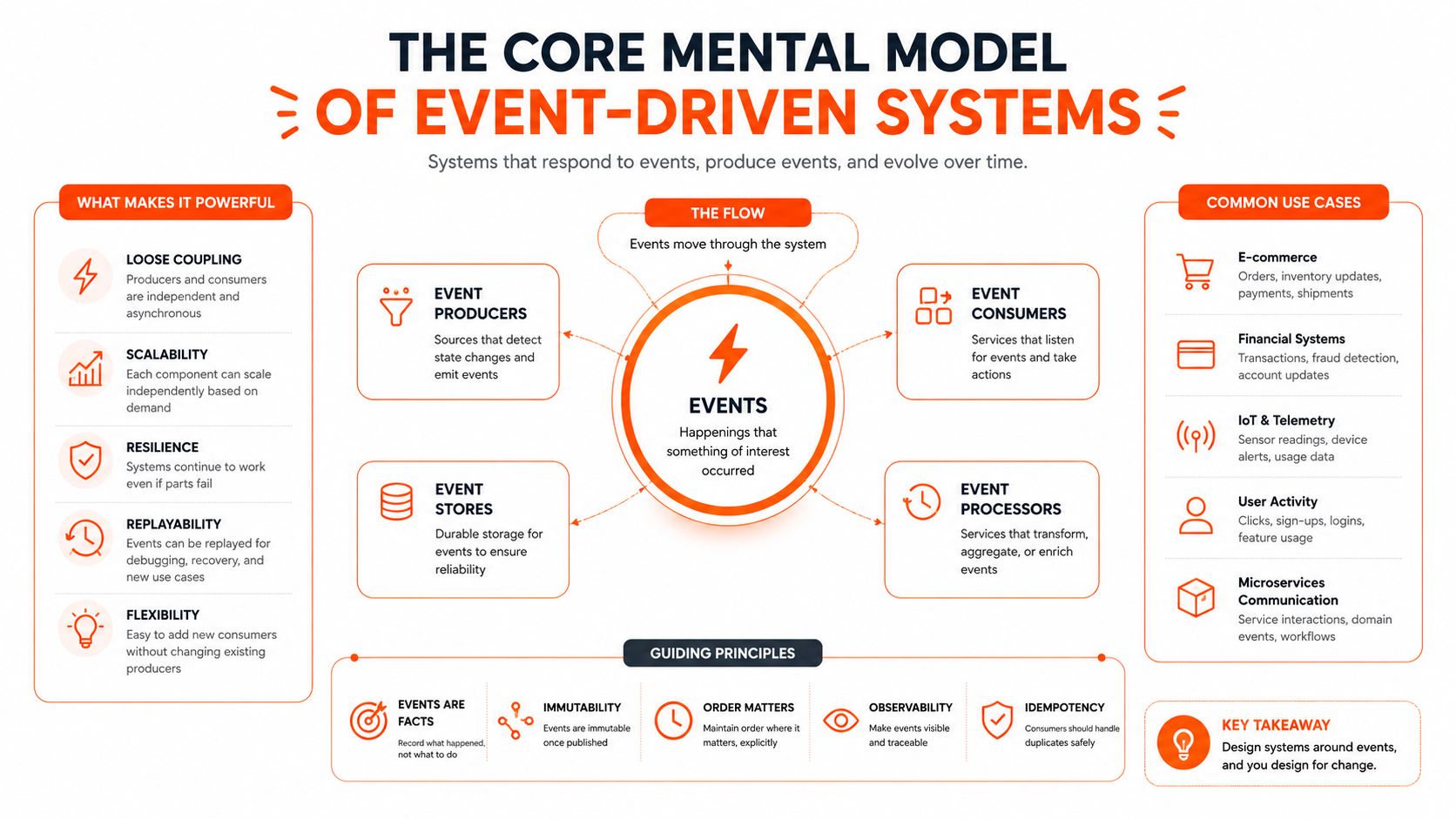
Producers, brokers, and consumers
The producer does not need to know who consumes the event. That is the point. The broker or bus becomes the handoff point, and each consumer can scale, fail, deploy, or recover without forcing the producer into a direct dependency chain. In practice, that is why EDA works so well for large platforms with multiple teams and multiple downstream reactions.
A system stops being tightly coupled when one component no longer has to wait for the rest of the system to line up before it can move.
AWS describes EDA as using events to trigger and communicate between decoupled services, and Google Cloud describes production and consumption of events with state changes such as an order being placed, a file upload, or a record update. That framing is helpful because it keeps the focus on the change itself, not on the transport mechanism.
Commands are not events
The Open Group draws a line that teams still blur in reviews. A command is an intention to change state. An event is a fact about the domain from the past. That matters because commands ask for work, while events report that work already happened. The design consequences are enormous, because commands usually have a clear handler, while events may have zero, one, or many consumers.
If you’re mapping this to the rest of your platform, the event-driven diagrams sit naturally beside a broader systems view like the one in this architecture and modernization guide, because both are really about coupling, ownership, and boundaries.
IBM’s definition also aligns with that model, describing EDA around publication, capture, processing, and storage of events. Microsoft’s Azure guidance similarly frames it through producers, consumers, and event channels. Those are not just vendor definitions, they reflect the canonical architecture enterprises settled on after request-response systems stopped being enough.
Pub/Sub, Event Sourcing, and CQRS Compared
Teams often say “event-driven” when they mean three different things. That confusion causes bad designs, because pub/sub, event sourcing, and CQRS solve different problems even though they share the same event vocabulary. Treat them as siblings, not synonyms.
The patterns side by side
| Pattern | Core Idea | Best Fit | Watch Out For |
|---|---|---|---|
| Pub/Sub | One event fans out to many consumers | Notifications, integrations, independent downstream reactions | Consumers drifting into hidden business logic |
| Event Sourcing | The event log is the source of truth | Auditability, history-heavy domains, state reconstruction | Replay complexity, schema discipline, and operational overhead |
| CQRS | Separate write and read models | Different performance needs for commands and queries | Overengineering when reads and writes are already simple |
Pub/sub is the lightest of the three. It works well when one fact needs to trigger several independent actions, such as notifications, enrichment, or integration updates. The producer emits the fact once, and the rest of the platform reacts without a fan-in of direct calls.
Where event sourcing earns its keep
Event sourcing goes further. Instead of storing only the current state, the system records the sequence of events and derives state from that history. That is powerful when history itself matters, but it's wasteful when the domain is just a mutable record with no meaningful lifecycle.
CQRS separates the write side from the read side so each can be optimized differently. That can be a great fit when queries are shaped very differently from commands, especially in systems where read performance and write integrity pull in different directions. It is not a default choice, though, because it adds projection logic and more places for inconsistency to show up.
For teams working through the boundary between APIs, services, and event flows, mastering APIs and microservices is a useful companion reference because it keeps the distinction between transport, contract, and domain model sharp.
The blunt guidance is simple. Use pub/sub for fan-out, event sourcing for durable history, and CQRS only when the read and write models are sufficiently different to justify the complexity.
Two Enterprise Scenarios That Show the Patterns at Work
A pattern becomes believable when it survives a real operating environment. Financial services and healthcare are good stress tests because they punish vague contracts, loose auditing, and hand-wavy recovery plans. The systems that work there usually have to be explicit about ownership, ordering, and error handling from the start.

Financial services with traceability built in
A trade platform is a classic place where event sourcing and CQRS earn their keep. Every trade, cancellation, correction, and status transition matters, because auditability and reconstruction are part of the business, not a side effect. The write path records the facts, and the read side builds fast operational views for desks, risk, and reporting.
The friction shows up quickly. A schema change that looks harmless in a development branch can poison a downstream consumer if versioning isn't controlled. That's why dead-letter handling and contract ownership are not optional decorations, they're the recovery plan.
If your team wants a broader systems lens on how these service boundaries behave in practice, the case study on building real-time collaboration across five platforms without compromising speed or consistency is a good reminder that coordination costs don't disappear, they just move.
Healthcare with fan-out and bounded reaction
A healthcare platform that updates patient records across clinics is a better pub/sub fit. One record change can drive billing updates, analytics, notifications, and internal workflows without making the source system know who cares. That decoupling matters when downstream consumers are owned by different teams and not all of them should block the core clinical flow.
The hard part is not the publish step. The hard part is making sure consumers are idempotent, because retries happen and duplicate delivery is a normal reality in distributed systems. A notification system that sends twice or a billing consumer that charges twice is a design failure, not a broker failure.
The contrast is useful. In financial services, history and reconstruction dominate. In healthcare, fan-out and responsibility separation are usually more valuable than turning every state change into a permanent event log. The domain should choose the pattern, not the other way around.
The Scalability Numbers That Actually Hold Up
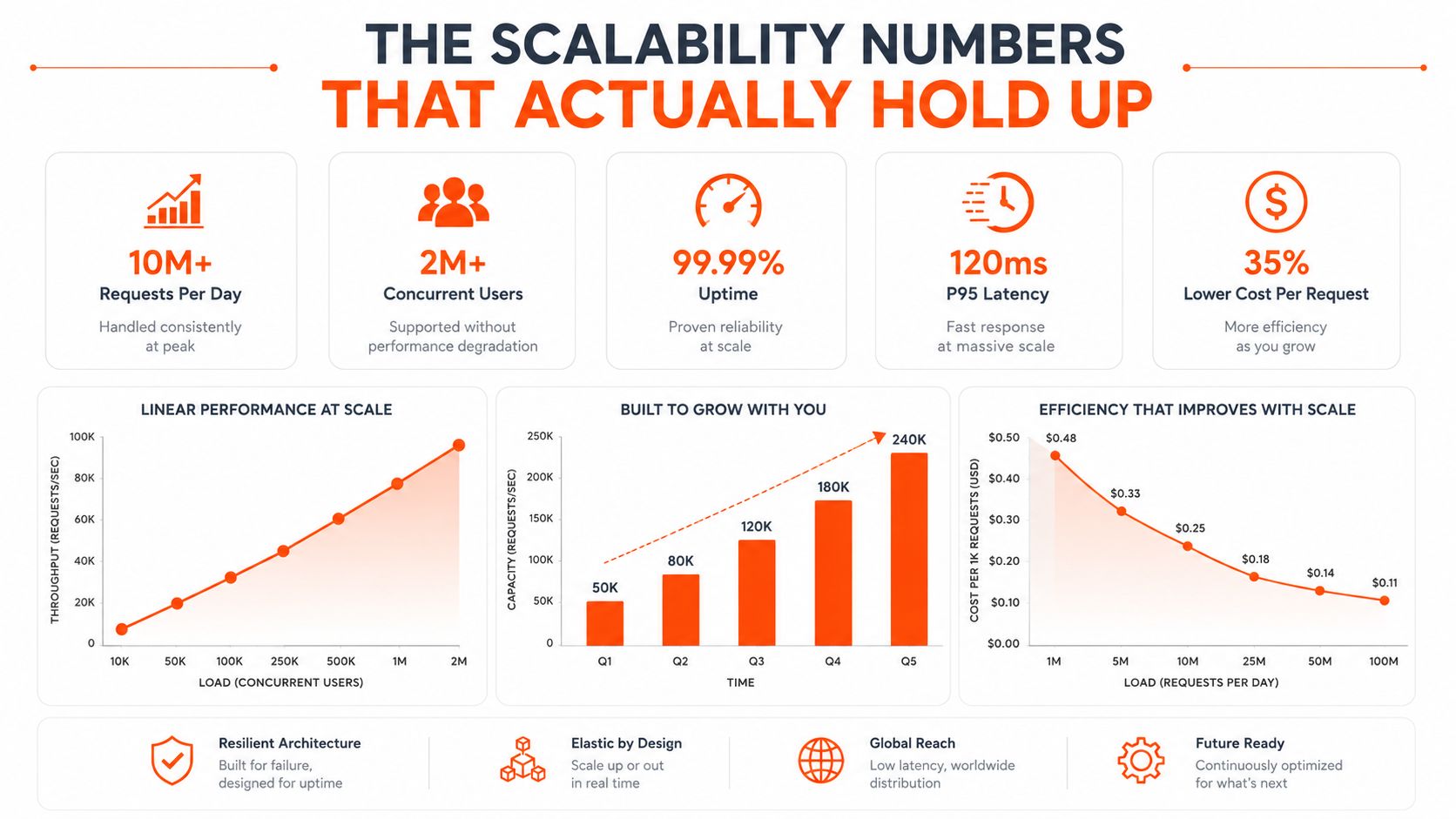
EDA's scalability case is strongest when you stop treating it like a slogan and look at the mechanics. A 2025 academic survey of implementations reported 12,500 peak transactions per second for event-driven architecture versus 3,200 for synchronous architecture, 80 ms response time versus 700 ms, and feature implementation in 6.3 days versus 14.7 days for tightly coupled systems. Those are not magic numbers, but they do show why the model keeps winning in large systems. The IBM event-driven architecture overview frames the same pattern around publication, capture, processing, and storage, which is the mechanism behind those gains.
Why the numbers improve
Asynchronous decoupling removes head-of-line blocking. One slow consumer doesn't have to stall the producer, and the producer doesn't have to wait for the entire call chain to unwind. That lets teams scale consumers horizontally and deploy them independently, which reduces coordination overhead and shortens delivery cycles.
Practical rule: if the bottleneck is human coordination between services, EDA often helps. If the bottleneck is a single hot record, a bad index, or a slow database transaction, EDA won't rescue you.
Where the gains break down
The numbers only hold when consumers are designed properly. If a consumer isn't idempotent, retries become duplication. If schemas drift without versioning, fan-out becomes a breaking change factory. If teams assume ordering that the architecture can't guarantee, the system will look fast right up until it returns the wrong answer.
The benefit is not just throughput. It's that teams can ship and isolate change with less cross-team choreography than synchronous chains usually require. That is why the pattern scales better operationally when the system has many moving parts and a genuine need for decoupled reactions.
When Event-Driven Architecture Is the Wrong Choice
This is the part most vendor decks skip. EDA is not free, and there are clear thresholds where simpler designs are better. If a path is latency-critical and cannot tolerate broker round-trips, synchronous handling usually wins. If the team is small and still learning how to debug distributed flows, EDA adds more surface area than it removes. And if the workflow is tightly transactional, the overhead of eventual consistency can be worse than the coupling you were trying to avoid.
Three hard stop signals
A team should pause when the following is true:
- Latency budget is unforgiving. If the request must complete immediately and every extra hop matters, a broker can be the wrong middle layer.
- Operational maturity is low. If nobody owns tracing, retries, dead-letter queues, or replay drills, distributed async debugging turns into guesswork.
- Consistency must be immediate. If the business process depends on one atomic view of state, eventual consistency can create user-visible confusion and reconciliation work.
The research gap matters here too. A recent agenda paper says the field still lacks empirical evidence on EDA's effects on performance, stability, software monitoring, and adoption challenges, and it calls out a scarcity of literature on those topics. That means teams shouldn't pretend vendor benchmarks answer the decision question for their own domain.
For organizations in the middle of cloud transition work, cloud migration engineering is often where these architecture choices get exposed, because moving platforms changes latency, ownership, and failure modes all at once.
The rule that actually helps
Use EDA when multiple consumers need to react independently to the same fact. Don't use it when the system is just a synchronous workflow in disguise. The size of the company doesn't decide that, the shape of the business process does.
Enterprise Design Checklist Most Teams Skip
Commonly observed patterns in enterprise EDA implementations show that the failures usually are not about pub/sub, event sourcing, or CQRS itself. They come from the boring pieces teams postpone, then act surprised when the platform is hard to recover, hard to observe, and hard to change. This checklist sets the minimum bar I would want before production traffic hits the system.
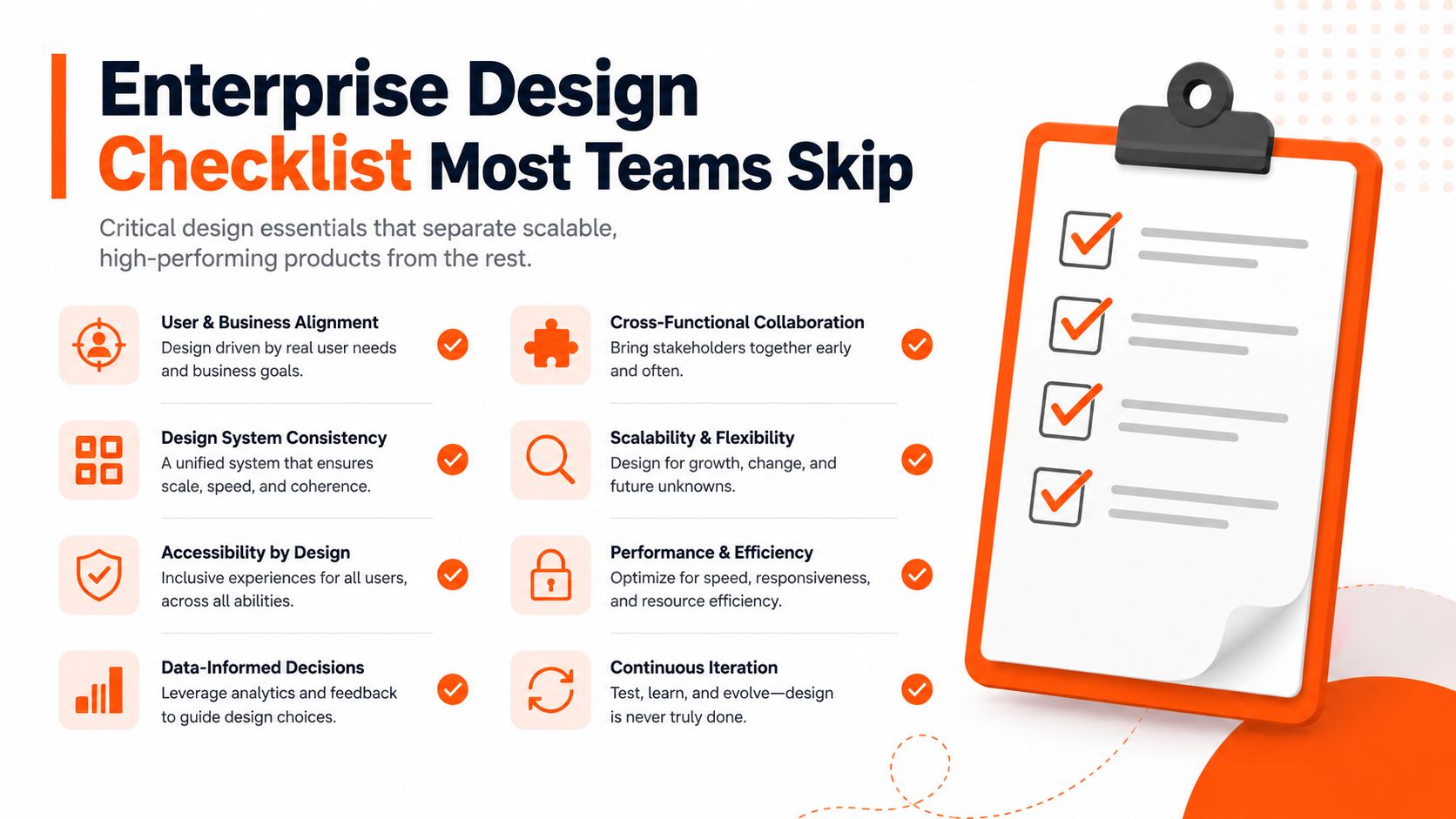
The items that prevent expensive mistakes
- Schema ownership: Define who owns each event contract, and make versioning explicit before consumers rely on it. If ownership is vague, every downstream change turns into a coordination problem.
- Idempotent consumers: Assume retries will happen, and make duplicate processing safe by design. Without this, a healthy broker can still produce duplicate business actions.
- Dead-letter queues: Quarantine bad messages so one malformed event does not stall the stream. Teams that skip this end up debugging by exception, not by design.
- Replay strategy: Decide what can be replayed, for how long, and who can trigger it. Replay is useful only when the team has already decided which events are safe to reprocess.
- Retention windows: Keep enough event history to support recovery and reconstruction, then document the boundary. Too little history breaks audits and rebuilds, too much creates storage and governance noise.
- Distributed tracing: Trace the event path from producer to broker to consumer so incidents do not turn into archaeology. If you cannot follow a single event across services, operational ownership is already too thin.
- Legacy integration boundaries: Treat old systems as deliberate interfaces, not accidental side effects. Legacy platforms need containment, or they leak complexity into every consumer.
- Ownership model: Put a human name or team on every consumer, contract, and failure path. If nobody owns a retry loop, a dead-letter queue, or a schema change, the system will drift.
If a team cannot answer who owns retries and schema changes, it does not have an architecture yet. It has an assumption.
The Salesforce event bus description of a time-ordered event log is relevant here because replay and retention only help when the log is managed with intent. Google Cloud's routed fan-out model makes the operational consequence clear too, because one event can reach many consumers, and each consumer needs the same level of discipline.
These items are boring on purpose. They separate a platform that can absorb change from one that accumulates risk under a clean-looking diagram.
A Decision Frame You Can Use Tomorrow
Start with the consumers. If one change needs to fan out to several independent reactions, EDA is on the table. Then choose the pattern shape, pub/sub for notifications, event sourcing for history, CQRS when reads and writes need separate models. Only after that should you accept the operational cost, because the cost is real and it belongs in the decision, not as an afterthought.
This week, pick one live flow and draw the event contract on a whiteboard. Trace who produces it, who consumes it, and what breaks if the event arrives twice or late. If the coupling you want to break is real, the architecture will show it. If it isn't, you'll save the team from building a distributed problem they didn't need.
If you want help pressure-testing whether software architecture event driven is the right fit for your platform, devPulse can map the trade-offs against your actual systems, not a generic reference diagram. Visit devPulse to talk through modernization, integration, and the operational reality behind event-driven change.
Prepared with Outrank