













TL;DR:
- A structured technical hiring pipeline emphasizes role clarity, multi-channel sourcing, and fast, fair assessments. Using asymmetric tasks combined with follow-up discussions improves screening efficiency and candidate quality. A consistent process with clear decision points and timely offers enhances delivery outcomes and attracts top engineering talent.
The most reliable technical hiring pipeline runs in this sequence: define the role with measurable outcomes → source across active and passive channels → send an async role-relevant assessment → run a brief technical screen → conduct a 60-minute system design round for senior hires → close with a structured final loop → extend the offer fast and execute a 30/60/90 onboarding plan. The single highest-leverage practice within that sequence is pairing a role-calibrated async task with a follow-up discussion rather than relying on live whiteboard puzzles, which are a poor proxy for on-the-job performance. Done right, async assessments let you screen far more candidates without increasing senior engineer load.
Table of Contents
- What does a step-by-step technical hiring pipeline look like?
- How to write a role spec that predicts on-the-job performance
- Where should you source technical candidates?
- How to design async assessments that are fair and predictive
- What should a technical phone screen cover?
- How do you run a system design interview that actually predicts impact?
- How to structure behavioral interviews that measure collaboration
- How do you run the final loop and make a defensible hiring decision?
- Why candidate experience determines whether top engineers accept your offer
- What does a strong 30/60/90 onboarding plan include?
- Which KPIs tell you whether your hiring process is working?
- Plug-and-play templates your team can use immediately
- Key Takeaways
- Why this pipeline matters for delivery, not just headcount
- Useful sources and Devpulse resources
What does a step-by-step technical hiring pipeline look like?
A compact roadmap with time budgets keeps stakeholders aligned and prevents the process from drifting into a six-week marathon.
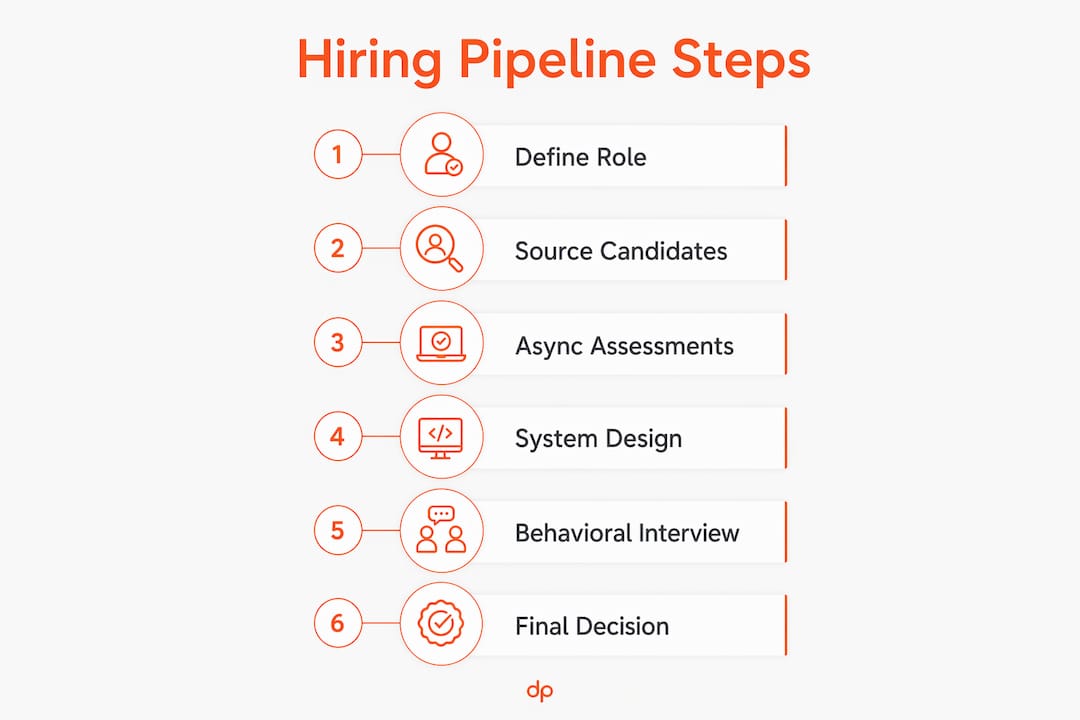
| Stage | Typical time budget | Primary owner |
|---|---|---|
| Role spec + scorecard | 3–5 days | Hiring manager + HR |
| Resume / portfolio filter | 1–2 days | Recruiter |
| Async skills assessment | 3–5 days (candidate window) | Recruiter + senior engineer |
| Technical phone screen | 30–45 min per candidate | Senior engineer |
| System design interview | 60 min (senior roles) | Staff engineer |
| Final structured loop | 3–4 interviews, 1 day | Full panel |
| Reference checks | 2–3 days | Recruiter |
| Offer and negotiation | 24–48 hours post-decision | Hiring manager + HR |
| Onboarding kickoff | Day 1 | Engineering lead |
Every stage needs a defined decision output and a communication SLA. Candidates should receive a status update within two business days of completing any stage. Letting candidates go dark for several days is one of the fastest ways to lose them to a competitor who moves faster.
How to write a role spec that predicts on-the-job performance
Start with the decision the hire must make and the systems they will own, not a list of technologies. Build 3–5 non-negotiable skills linked to real outcomes, and attach a 30/60/90 success framework before you post the role.
A strong job spec includes these fields:
- Problem statement: What specific gap or opportunity does this hire address?
- Core responsibilities: Day-to-day tasks and systems owned, not a generic duty list.
- Must-haves vs. nice-to-haves: Separate them explicitly. Screen only on must-haves.
- 30/60/90 success metrics: What does “good” look like at each milestone? (e.g., “Shipped first production PR by day 30, owns one service by day 60, leads a cross-team initiative by day 90.”)
- Compensation band: Publishing the range upfront reduces wasted cycles on both sides.
Drop arbitrary “years of experience” filters. Research on experience metrics shows they correlate poorly with performance, and they exclude strong candidates with nontraditional backgrounds. Share the finalized spec with every interviewer before screening begins, along with the scorecard, so the panel evaluates the same criteria.
Pro Tip: Attach the scorecard to the job spec in your ATS so interviewers cannot advance a candidate without completing it. This single habit eliminates the “gut feel” debrief.

Where should you source technical candidates?
Most qualified engineers are not actively searching. Reaching them requires a multi-channel approach that combines inbound visibility with direct outreach.
- Employee referrals: High ROI and lower cost-per-hire compared with agency fees; structure a referral bonus and track conversion by source.
- Direct outreach: Personalized messages to open-source contributors, GitHub profile owners, and conference speakers convert better than generic InMail blasts.
- Tech communities: Slack groups, Discord servers, and forums like Hacker News “Who’s Hiring” threads surface candidates who are engaged but not actively applying.
- Job aggregators: LinkedIn, Indeed, and Stack Overflow Jobs drive volume; use them for inbound while referrals and direct outreach handle quality.
| Channel | Volume | Quality | Cost |
|---|---|---|---|
| Employee referrals | Low–medium | High | Low |
| Direct outreach | Low | High | Medium (time) |
| Tech communities | Medium | Medium–high | Low |
| Job aggregators | High | Variable | Low–medium |
For passive candidates, a brief personalized message works best when it names a specific project or contribution the candidate made, states the problem your team is solving, and asks a single low-friction question. Keep the warm pipeline active by re-engaging promising candidates every 60–90 days. Devpulse’s guide on building a tech talent pool covers the mechanics of maintaining that pipeline at scale.
How to design async assessments that are fair and predictive
The best async tasks mirror work the candidate will do on day 30, run under two hours, and include clear acceptance criteria so scoring is objective. Structured async assessments let you evaluate far more candidates without pulling senior engineers into every early-stage conversation.
A take-home task template should include:
- Context: One paragraph describing the system and the problem.
- Inputs: Sample data, a failing test, or a stub codebase.
- Acceptance criteria: Explicit pass/fail conditions (e.g., “all provided tests pass,” “API response under 200ms”).
- Deliverable format: PR, zip, or shared repo link.
- Estimated time: State it explicitly; cap at 90–120 minutes.
- Allowed aids: Specify whether documentation, Stack Overflow, or AI tools are permitted.
Score submissions on a 1–4 scale across four dimensions:
| Dimension | 1 (Below bar) | 2 (Meets bar) | 3 (Exceeds) | 4 (Exceptional) |
|---|---|---|---|---|
| Correctness | Fails core criteria | Passes core tests | Passes all tests | Edge cases handled |
| Code readability | Hard to follow | Readable | Well-structured | Self-documenting |
| Test coverage | None | Partial | Core paths covered | Full coverage |
| Design choices | No explanation | Brief notes | Clear rationale | Trade-offs discussed |
On the ethics side: state clearly in the task brief that the work is for evaluation only and will not be used in production. Avoid timed proctoring for senior roles; it adds anxiety without improving signal. For accessibility, allow candidates to request alternative formats.
What should a technical phone screen cover?
The phone screen’s job is to verify what the async assessment surfaced and filter out candidates who cannot explain their own work. Keep it to 30–45 minutes with a tight agenda.
- Minutes 0–10: Background and motivation. Confirm role alignment, ask one question about a recent project, and listen for ownership language vs. passive participation.
- Minutes 10–30: Focused technical probe. Walk through the async submission together, or review a short PR. Ask the candidate to explain a specific design decision and probe the trade-offs.
- Minutes 30–45: Candidate questions and logistics. Answer honestly about team structure, tech stack, and process. Vague answers here hurt conversion.
Decision rules to apply after the screen:
- Advance: Candidate explained their async work clearly, identified at least one trade-off, and asked substantive questions.
- Hold for discussion: Strong async score but communication was unclear; flag for a second opinion before advancing.
- Do not advance: Could not explain their own submission, gave memorized answers unconnected to the task, or showed a significant mismatch with the role’s must-haves.
How do you run a system design interview that actually predicts impact?
Pick a problem class that matches your stack and scale. Avoid abstract “design Twitter” prompts unless your team actually operates at that scale. A realistic prompt for a mid-size SaaS team might be: “Design the notification delivery system for our platform, which sends 500K events per day.”
Structure the 60 minutes this way:
- Minutes 0–10: Context and constraints. The candidate asks clarifying questions; you provide scope, scale, and non-functional requirements.
- Minutes 10–45: Solution work. Candidate diagrams the architecture, talks through data flow, estimates rough load, and discusses trade-offs between options.
- Minutes 45–60: Debrief. You probe gaps, introduce a failure scenario, and ask how they would monitor the system in production.
Evaluate on five dimensions: quality of clarifying questions, architecture clarity, scaling reasoning, failure-mode thinking, and communication. Allow diagrams in Miro or Google Slides rather than forcing live whiteboard drawing. Combining async tasks with follow-up discussion consistently produces better signal than whiteboarding alone.
How to structure behavioral interviews that measure collaboration
Replace “culture fit” with “culture add.” The goal is evidence of constructive dissent, cross-functional influence, and growth, not confirmation that someone thinks like the existing team. Structured behavioral interviews with STAR prompts reduce bias and surface stronger collaboration signals than open-ended conversation.
Effective STAR prompts for engineering roles:
- “Tell me about a time you disagreed with a technical decision. What did you do, and what was the outcome?”
- “Describe a situation where you had to deliver difficult feedback to a peer. How did you approach it?”
- “Give me an example of a production incident you owned. Walk me through your response.”
- “Tell me about a time you mentored someone less experienced. What changed for them?”
Score each answer on a 1–4 scale with behavioral anchors: 1 = no specific example, 2 = example present but vague, 3 = clear STAR structure with outcome, 4 = outcome quantified and learning articulated. Run a calibration session with all interviewers before the first candidate enters the loop. Blind scoring before the group debrief prevents anchoring on the first strong opinion in the room.
How do you run the final loop and make a defensible hiring decision?
The final loop should cover four focused areas: coding depth, system thinking, behavioral/collaboration, and an optional domain case study for specialized roles. Three to four interviewers is the right size; more than four creates coordination overhead without improving signal.
Score aggregation example:
| Interviewer | Coding | System design | Behavioral | Domain |
|---|---|---|---|---|
| Engineer A | 3 | 3 | — | — |
| Engineer B | — | 4 | 3 | — |
| EM | — | — | 4 | 3 |
| Domain lead | — | — | — | 4 |
| Average | 3.0 | 3.5 | 3.5 | 3.5 |
Decision rules: advance candidates who score 3.0 or above on all must-have dimensions. A single 1 on any must-have dimension is a veto. For close calls between a 2 and a 3, the hiring manager makes the call with documented rationale in the ATS, not in Slack.
Reference checks should use behavior-focused questions: “Can you describe a time this person had to navigate a difficult technical disagreement?” and “What would you say is the area where they grew the most while working with you?” These reveal blind spots that structured interviews often miss.
Offer best practices: approve the compensation band before the loop begins, extend the offer within 24–48 hours of the decision, and present a transparent package that includes base, equity, benefits, and the 30/60/90 plan. Speed signals seriousness.
Why candidate experience determines whether top engineers accept your offer
Hiring is a two-sided process. Many of the strongest candidates are fielding multiple conversations simultaneously, and the quality of your process is itself a signal about your engineering culture. Around 70% of today’s workforce is not actively looking for new roles, which means your outreach and experience design carry real weight.
Practical commitments that improve conversion:
- Send a process overview email within 24 hours of first contact, covering stages, timelines, and who the candidate will meet.
- Provide written feedback within five business days of any rejection, even at the screen stage.
- Prepare interviewers with the candidate’s async submission and resume before every call.
- Sell the role’s impact honestly: what problem does the team solve, what is the engineering challenge, and what does growth look like?
For remote hiring specifics, Devpulse’s guide on hiring remote developers covers time-zone considerations and distributed candidate experience in detail.
What does a strong 30/60/90 onboarding plan include?
Onboarding is where hiring ROI is either captured or lost. Tie the plan directly to the success metrics defined in the role spec.
- Day 1–30: Complete environment setup, access provisioning, and codebase orientation. Pair with a mentor. Ship a first PR, even a small one, by day 14.
- Day 31–60: Own a defined service or feature area. Participate in sprint planning and retrospectives. Complete first bug fix or minor feature independently.
- Day 61–90: Lead a cross-team initiative or own a roadmap item. Deliver a technical design doc for review.
Measure early delivery signals: first PR merged, first bug resolved, first feature shipped. These are leading indicators of long-term retention and performance. Devpulse’s IT team onboarding guide provides a detailed checklist you can adapt directly.
Which KPIs tell you whether your hiring process is working?
Track these five metrics and review them quarterly:
- Time-to-hire: Days from role open to offer accepted. Benchmark against your previous quarter, not industry averages.
- Offer acceptance rate: Below 80% signals a compensation, experience, or speed problem.
- Quality-of-hire: 90-day retention rate and manager performance rating at the 90-day mark.
- Source ROI: Hires per channel divided by cost and time invested.
- Candidate NPS: A single post-process survey question reveals experience gaps faster than internal retros.
Run a hiring retrospective after every three hires. Ask: which stage produced the most false positives? Where did candidates drop off? Which assessment questions correlated with strong 90-day performance? Use those answers to run lightweight A/B tests on assessment formats, such as take-home versus paired coding, and update your templates quarterly.
Plug-and-play templates your team can use immediately
These templates give your team a repeatable foundation without building from scratch.
- Job spec template: Problem statement, responsibilities, must-haves, nice-to-haves, 30/60/90 metrics, compensation band. Store in your ATS as a role-type template.
- Async task template: Context, inputs, acceptance criteria, deliverable format, time estimate, allowed aids. Version-control it in your engineering wiki.
- Scoring rubric: 1–4 scale across correctness, readability, test coverage, and design choices. Attach to every assessment in the ATS.
- Phone-screen agenda: Three-block structure (background, technical probe, candidate questions) with a pass/hold/no-advance decision field.
- System design prompt: Problem class, scale parameters, non-functional requirements, and a failure scenario for the debrief block.
- Behavioral interview pack: Four STAR prompts per competency (conflict, feedback, ownership, mentorship) with scoring anchors.
- Candidate email templates: Process overview, assessment instructions, stage-advance confirmation, and rejection with feedback.
For async interview best practices and candidate-facing guidance, the asynchronous interview resource from Filmijob covers the candidate experience side in detail. Devpulse’s IT skills assessment guide provides rubric frameworks you can adapt for specific engineering disciplines.
Legal and DEI note: Under U.S. employment law, all screening criteria must be job-related and consistently applied across candidates. Remove demographic signals from resume review, use structured interviews with identical questions for every candidate at the same level, and document all decisions in your ATS. Structured scorecards are among the highest-leverage tools for reducing bias. Actively source from underrepresented communities, HBCUs, coding bootcamps, and open-source projects to build a more balanced pipeline. Consult qualified legal counsel to confirm your process meets current EEOC guidelines for your specific roles and jurisdictions.
Key Takeaways
A repeatable technical hiring pipeline requires role-calibrated assessments, structured scoring, and fast offer execution to convert qualified candidates before competitors do.
| Point | Details |
|---|---|
| Define before you source | Write the role spec with 30/60/90 metrics and a scorecard before posting the role. |
| Async assessment at stage 2 | Place the skills screen before any synchronous interview to filter on real performance data. |
| Score with anchored rubrics | Use a 1–4 scale with behavioral anchors across all interview dimensions to reduce bias. |
| Offer within 24–48 hours | Extend the offer within 24–48 hours of the decision; delays signal disorganization and lose candidates. |
| Track quality-of-hire | Measure 90-day retention and performance rating as the primary indicator of pipeline effectiveness. |
Why this pipeline matters for delivery, not just headcount
The conventional view treats hiring as an HR function that ends at the offer letter. That framing is wrong, and it costs engineering teams months of lost productivity.
Every stage of this pipeline is designed to answer one question: will this person ship reliable software in your specific context? The role spec defines what “reliable” means. The async task tests it under realistic conditions. The system design round probes whether they can reason about scale and failure before those problems hit production. The 30/60/90 plan ensures the answer to that question becomes visible within the first quarter, not the first year.
At Devpulse, we apply this pipeline because it connects hiring decisions directly to delivery outcomes. When onboarding milestones are tied to the same success criteria used during the interview, new engineers reach their first meaningful contribution faster, and retention at the 12-month mark improves. Teams that skip the structured loop and rely on gut feel tend to discover the mismatch at the worst possible moment: mid-sprint, mid-release, or mid-client engagement.
If your team is building or scaling a technical function and wants a partner who understands both the hiring side and the delivery side, Devpulse’s engineering services are built for exactly that context. We work with startups, SaaS companies, and enterprise teams to staff, build, and ship.
Useful sources and Devpulse resources
- How to Hire Developers: The Complete Guide for Engineering Leaders — pipeline structure, async assessment rationale, and stage-level timing.
- Technical Hiring Pipeline: 7-Step Structure Guide — ATS configuration, skills-screen sequencing, and offer documentation.
- The 7-Step Framework for Technical Hiring That Actually Works — scoring rubrics, calibration sessions, and decision frameworks.
- The Manager’s Guide to Technical Hiring — job description frameworks and compensation-range guidance.
- Engineering Hiring Process for Startups — shorter funnel design for small teams and early-stage filtering.
- Tech Talent Statistics and a Hiring Guide — passive candidate data and sourcing strategy context.
- Cost-per-hire by industry — referral ROI benchmarks and channel cost comparisons.
- How to Assess IT Team Skills for Project Success — Devpulse rubric frameworks for skills evaluation.
- Effective IT Team Onboarding Steps for Software Companies — Devpulse 30/60/90 onboarding checklists.
- What Is a Tech Talent Pool? — Devpulse guide to building and maintaining warm candidate pipelines.