












TL;DR:
- SLAs are legally binding contracts that define service scope, performance standards, and accountability.
- Effective SLAs include clear metrics, remedies, reporting, escalation, and review processes.
- Proper SLA governance requires active monitoring, regular reviews, and alignment with business impacts.
Most executives sign off on IT outsourcing contracts believing the service-level agreement is simply a technical safeguard, something that tracks uptime percentages and response times. That assumption is expensive. When SLAs are treated as operational checklists rather than strategic accountability tools, enterprises absorb avoidable risk, lose leverage in disputes, and watch outsourcing relationships drift away from business goals. This guide breaks down what SLAs truly are, where they routinely fail, and how C-suite leaders can structure and enforce them to protect enterprise value. Getting this right separates companies that extract maximum ROI from outsourcing from those that absorb painful surprises.
Table of Contents
- What SLAs in IT outsourcing really are—and why they matter
- The anatomy of an effective SLA: Key components for C-suite scrutiny
- Pitfalls and limitations: The real-world gaps in IT outsourcing SLAs
- How to negotiate SLAs that align with your business
- The uncomfortable truth: SLAs alone rarely deliver business value—here’s what works
- Take the next step with outsourcing expertise and proven SLAs
- Frequently asked questions
Key Takeaways
| Point | Details |
|---|---|
| SLAs as risk tools | Treat SLAs as business risk management frameworks, not just technical contracts. |
| Avoid common SLA pitfalls | Watch for vague KPIs, remedy caps, and exclusions that weaken your position. |
| Align SLAs with outcomes | Design SLAs to reflect real business impact, with measurable, enforceable metrics. |
| Negotiate for value | C-suite leaders must negotiate SLA terms that safeguard critical processes, not just uptime. |
| Regular reviews are essential | Make SLAs living documents that evolve with your IT outsourcing partnership and risk landscape. |
What SLAs in IT outsourcing really are—and why they matter
A service-level agreement (SLA) is far more than a promise about server uptime. At its core, an SLA is a legally binding contract that specifies service scope, performance standards, measurement methods, responsibilities, and what happens when commitments are not met. The service level agreement guide from DevPulse details how these documents function as the operational and legal backbone of any outsourcing relationship.
Too many organizations treat SLAs as a formality, something their legal team reviews once and files away. That approach leaves decision-makers flying blind. When a critical system goes down or a vendor consistently underdelivers, the SLA is the only instrument that determines accountability, remedies, and escalation paths. If the document is vague or narrowly written, your recourse is limited regardless of the real business damage incurred.
As CIO.com defines it, “SLAs serve as the contractual instrument that defines measurable service commitments, including response times, availability, quality/KPIs, and operational governance for performance measurement.”
That definition is worth internalizing. Notice it covers governance and operational measurement, not just technical availability. A well-structured SLA governs the entire relationship, from how issues are reported and escalated to how performance data is shared and reviewed.
Strategically, SLAs also function as risk management tools. They force vendors to commit to specifics, which filters out providers who cannot back up their claims. For enterprises pursuing agile IT outsourcing, SLAs must also accommodate iterative delivery cycles, sprint-based reporting, and flexible capacity models—not just static monthly availability windows.
Here are the core components every SLA in IT outsourcing should contain:
- Service description: Precisely what is being delivered, including scope boundaries and exclusions
- Performance metrics: Quantified targets for uptime, response time, resolution time, and quality thresholds
- Measurement methods: How, when, and by whom performance is tracked and validated
- Remedies: Specific credits, penalties, or other recourse triggered by underperformance
- Reporting obligations: Frequency, format, and content of performance reports provided by the vendor
- Review cycles: Scheduled intervals for reassessing metrics and renegotiating terms
Understanding this structure is the starting point. Learning to evaluate whether your current SLA actually contains these elements in enforceable form is where real protection begins. A scalable outsourcing guide reinforces that scalability requires SLAs that grow and adapt alongside your operational demands.
The anatomy of an effective SLA: Key components for C-suite scrutiny
Knowing what belongs in an SLA is necessary, but evaluating whether those components are actually effective requires a more critical eye. Here is a structured approach for assessing SLA completeness before you sign:
- Verify service definitions are unambiguous. Every service element should be described in language that leaves no room for interpretation. If a vendor can dispute whether a task falls within scope, the definition is too loose.
- Confirm KPIs are quantified and measurable. “High availability” is not a KPI. “99.9% uptime measured monthly, excluding scheduled maintenance windows” is. Require specific numbers.
- Assess the reporting and monitoring framework. Who measures performance? How often are reports delivered? Does the enterprise retain audit rights?
- Map out escalation paths. What happens when a metric is breached? Who is notified, in what timeframe, and what actions are required?
- Scrutinize remedies for enforceability. Are service credits or penalties clearly defined? Are they proportional to the business impact of a breach, or are they symbolic?
- Confirm review cycles are built in. Static SLAs become outdated quickly. Regular review clauses ensure terms stay aligned with evolving business priorities.
For outsourcing support strategies that involve customer-facing services, the stakes of weak SLA language are especially high. Vague remedies and undefined escalation paths translate directly to degraded end-user experiences.
The following comparison shows the difference between effective SLA elements and their common weak counterparts:
| SLA element | Effective version | Common pitfall |
|---|---|---|
| Uptime target | 99.95% monthly, excluding pre-approved windows | “Best effort availability” |
| Response time | P1 issues acknowledged in 15 minutes, 24/7 | “Prompt response during business hours” |
| Remedy | 10% monthly credit per 0.1% below target | “Credits at vendor discretion” |
| Escalation | Named contacts, tiered response, legal trigger | “Contact support team” |
| Reporting | Weekly dashboard plus monthly executive summary | “Reports available upon request” |
| Review cycle | Quarterly formal review with amendment rights | No review clause |
Pro Tip: Always align SLA metrics and remedies with what actually impacts end-user experience and business continuity. A metric that looks good on paper but does not reflect your actual operational risk profile creates a false sense of security. Work with your engineering outsourcing guide to map technical KPIs directly to business outcomes before negotiations begin.
The help desk outsourcing sector illustrates this well. A provider hitting 95% ticket resolution within SLA windows may still be failing if the 5% of missed tickets are all high-priority, customer-impacting issues. Granular metric design matters as much as the metrics themselves.

SLAs should define service standards, performance metrics, remedies including service credits and penalties, and escalation processes as foundational elements, not optional additions.
Pitfalls and limitations: The real-world gaps in IT outsourcing SLAs
Even well-intentioned SLAs can leave enterprises exposed. The legal mechanics embedded in standard SLA templates often favor the vendor, and executives who do not scrutinize these clauses absorb disproportionate risk.
One of the most significant issues involves availability SLA limitations: “Availability SLAs may provide limited customer recovery due to mechanics such as credit caps, sole and exclusive remedy clauses, and restrictive measurement definitions.” This matters because credit caps mean your compensation is capped even if the business damage far exceeds that ceiling. Sole remedy clauses mean service credits are your only recourse, blocking other legal claims.
Here is how these structures typically look in practice:
| Remedy clause type | Typical language | Impact on recourse |
|---|---|---|
| Credit cap | Credits not to exceed 30 days of fees | Major outages yield minimal compensation |
| Sole remedy | Credits are customer’s exclusive remedy | Bars additional legal or financial claims |
| Measurement exclusion | Excludes third-party outages, force majeure | Significantly narrows what counts as downtime |
| Claim window | Must claim within 30 days of incident | Missed windows forfeit any remedy |
Many enterprises miss claim windows entirely because incident documentation processes are not aligned with SLA notice periods. This is an operational gap that legal and IT teams must close together.
The major pitfalls in IT outsourcing SLAs you should watch for:
- Unclear exclusions that remove common failure scenarios from coverage
- Unenforceable remedies written with enough ambiguity for vendors to dispute
- Narrow measurement windows that obscure chronic underperformance
- Sole remedy clauses that strip enterprises of legal recourse beyond credits
- Lack of business-hour alignment for support metrics that miss peak operational periods
For context on why outsource software development at scale, the due diligence required before signing any SLA is substantial. Reviewing outsourcing risks and best practices should be a mandatory step before finalizing vendor agreements. Cost-effective outsourcing strategies must account for these legal risks as part of the total cost calculation.
How to negotiate SLAs that align with your business
Negotiating an SLA that genuinely protects enterprise interests requires more than pushing back on standard terms. It requires a structured approach that connects every metric and remedy to actual business impact.
Here is a practical negotiation framework:
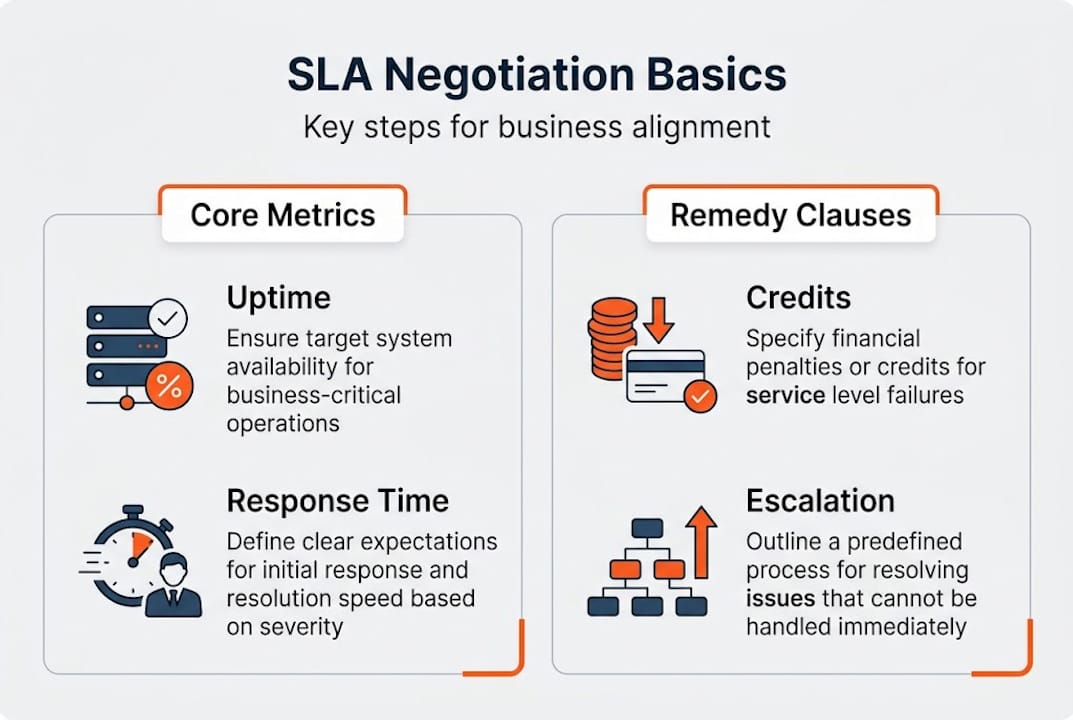
- Establish measurable KPIs grounded in business outcomes. Define what “good” looks like for your operations, not the vendor’s standard template.
- Define remedies proportional to business impact. A 10% credit cap is rarely adequate for a mission-critical outage. Push for tiered remedies that escalate with severity.
- Require transparent, automated reporting. Real-time dashboards and monthly executive summaries should be contractually required, not provided at the vendor’s discretion.
- Clarify all exclusions explicitly. Every exclusion narrows your coverage. Negotiate to remove exclusions that cover foreseeable failure scenarios.
- Include escalation procedures with named contacts and timelines. Vague escalation language protects vendors, not clients.
- Build in frequent review cycles. Quarterly reviews with documented amendment rights ensure SLAs evolve alongside your business.
SLAs must align KPI definitions, measurement windows, escalation paths, and enforceable remedies with business experience and critical timeframes. That principle should anchor every negotiation.
Pro Tip: Negotiate for remedies proportional to business impact, not just standard credits. If an outage costs your organization $500,000 in lost productivity, a $10,000 credit is not risk mitigation. It is theater.
Red flags to watch for in SLA drafts:
- Uptime measured annually instead of monthly, which masks monthly failures
- Support response times scoped only to business hours for 24/7 operations
- Credits requiring manual claims with short notice windows
- No formal escalation path beyond a generic support ticket
- No amendment clause or defined review schedule
For outsourcing arrangements involving outsourcing cybersecurity, SLA remedies must also account for breach notification timelines and regulatory obligations, not just service availability. Review managed services advantages to understand how the right provider structures SLAs from the start. Cross-departmental alignment across legal, IT, and operations is not optional. It is the only way to ensure SLA terms reflect real operational risk. Global outsourcing support relationships add additional complexity, including time zone coverage and jurisdictional considerations that must be explicitly addressed.
The uncomfortable truth: SLAs alone rarely deliver business value—here’s what works
Here is what most SLA guides will not tell you: having a well-written SLA does not, by itself, produce accountability. We have seen enterprises with technically solid agreements that were never actively enforced, monitored, or reviewed. The vendor quietly underperforms. The business absorbs the cost. Nobody invokes the SLA because nobody built a process to track it.
The real discipline is treating SLAs as dynamic systems, not static documents, with remedies and escalation paths that reflect business urgency. That means assigning internal ownership of SLA monitoring, scheduling quarterly reviews, and being willing to invoke remedies when they are earned.
The biggest gains come from teams that treat an SLA as the beginning of accountability, not the end. When vendors know metrics are actively tracked and remedies are enforced, performance improves—not because of the legal threat, but because the relationship becomes one of genuine mutual accountability. Explore outsourcing for digital transformation to see how active SLA governance supports broader strategic outcomes.
Take the next step with outsourcing expertise and proven SLAs
At DevPulse, we structure every outsourcing engagement around SLAs that are enforceable, business-aligned, and actively governed. Our clients do not get boilerplate templates. They get measurable commitments tied to their operational priorities and risk thresholds.
If you are evaluating outsourcing partners or renegotiating existing agreements, our product modernization experts can help you define the metrics and terms that actually protect your business. Browse our outsourcing case studies to see how we have structured accountable delivery relationships across enterprise clients. Visit DevPulse to schedule a consultation and put strategic SLA governance at the center of your next outsourcing decision.
Frequently asked questions
What is an SLA in IT outsourcing?
An SLA is a contract that defines measurable service commitments such as uptime, response times, and remedies between a business and its IT outsourcing provider. It serves as the legal and operational foundation for vendor accountability.
What are common pitfalls in IT outsourcing SLAs?
Typical pitfalls include vague KPIs, short claim windows, and sole remedy clauses that cap credits and block additional legal recourse, leaving enterprises with limited recovery options after major incidents.
How can C-suite leaders make SLAs more effective?
Ensure SLAs align measurements and remedies with real business impacts, require transparent reporting, include defined escalation paths, and schedule regular review cycles to keep terms current.
Are SLA service credits enough to protect my business?
Rarely. Credits are often capped and designated as the sole remedy, which means additional legal or financial safeguards must be negotiated separately to provide genuine risk mitigation for enterprise-scale operations.