













TL;DR:
- Outsourcing DevOps provides immediate access to senior expertise, reducing time-to-productivity and costs. It enhances scalability, compliance, and internal capacity, but requires strong governance and clear contractual responsibilities. Effective vendor management and knowledge transfer are crucial for maximizing benefits and minimizing risks.
Most business leaders assume that keeping DevOps in-house means better control. The reality is more complicated. Hiring a senior DevOps engineer takes an average of six months before they reach full productivity, and in-house senior DevOps salaries range from $120K to $180K annually before benefits. Meanwhile, your competitors are shipping faster. The question of why outsource DevOps is no longer just about cost. It is about access to expertise, scalability, security compliance, and freeing your internal teams to build what actually differentiates your product.
Table of Contents
- Key Takeaways
- Why outsource DevOps: the core business case
- Risks and trade-offs worth understanding
- Choosing the right outsourcing model
- How to select and manage a DevOps outsourcing partner
- My honest take on DevOps outsourcing
- Ready to build a smarter DevOps function?
- FAQ
Key Takeaways
| Point | Details |
|---|---|
| Cost model shifts significantly | Outsourcing replaces fixed senior DevOps salaries with flexible, service-based pricing tied to actual usage. |
| Expertise is available immediately | Outsourced teams bring certified AWS, Kubernetes, and CI/CD specialists without a lengthy hiring ramp. |
| Control requires governance | Outsourcing does not eliminate your compliance responsibility. Clear contracts and SLAs are non-negotiable. |
| Model selection matters | Choosing between consulting, staffing, and managed services determines how much risk and accountability you retain. |
| Internal oversight stays critical | Even with a vendor handling execution, your team must manage scope, priorities, and quality validation. |
Why outsource DevOps: the core business case
The benefits of outsourcing DevOps go well beyond cutting a payroll line. When done right, outsourcing gives you a structural operating advantage.
1. Immediate access to senior expertise
The typical six-month hiring ramp-up for a productive senior DevOps engineer is a competitive liability. An outsourced partner onboards with established practices and certified specialists already in place. You get Kubernetes administrators, cloud architects, and CI/CD pipeline engineers from day one, not month seven.
2. Predictable, reduced cost structure
Operational costs for an in-house DevOps function extend far beyond salaries. They include cloud resource licenses, tooling subscriptions, ongoing training, and the hidden cost of turnover. Enterprises outsource to mitigate these costs while accessing a talent depth they cannot justify hiring full-time. Outsourcing DevOps services converts a largely fixed cost into a variable one, which gives you financial flexibility as your needs change.

3. Reclaimed capacity for your internal teams
One SaaS company reclaimed 15 hours per week for its internal engineering team after outsourcing DevOps operations. That is not a rounding error. Those hours went directly into product development, which is the work that moves the business forward.
4. Scalability without the overhead
Business needs change. A product launch, an acquisition, or a cloud migration can spike your infrastructure demands overnight. Outsourced DevOps teams scale up or down without the friction of headcount approvals, severance planning, or training gaps. This scalability benefit is one of the most underappreciated DevOps outsourcing advantages for growing organizations.
5. Current best practices and compliance alignment
The DevOps tooling and security landscape moves fast. An experienced outsourcing partner maintains current certifications and keeps your pipelines, monitoring, and infrastructure aligned with modern standards. This is especially valuable for regulated industries where compliance with PCI-DSS, HIPAA, or GDPR is non-negotiable.
Pro Tip: When evaluating outsourcing DevOps services providers, ask specifically which certifications their engineers hold and when those certifications were last renewed. Generic claims about “expertise” are not the same as verifiable credentials.
Risks and trade-offs worth understanding
Outsourcing DevOps is a sound strategy for many organizations. It is not a risk-free one. Understanding where the real exposure lies helps you mitigate it before it costs you.
- Security and audit trail ownership. Compliance obligations do not transfer to your vendor when you outsource. You still own the responsibility. What changes is how controls are executed and evidenced. Incomplete audit trails, inconsistent patching, and fragmented evidence are common gaps when contracts fail to define telemetry access and evidence delivery schedules.
- Loss of direct control. When an external team runs your CI/CD pipelines and cloud infrastructure, your visibility depends entirely on the reporting and access they provide. Without well-designed governance protocols, this creates blind spots in your operational posture.
- Vendor dependency and knowledge transfer risk. If a vendor leaves or your contract ends, do your internal teams understand the architecture they built? Knowledge transfer planning is frequently overlooked and becomes costly when transitions happen under pressure.
- Hidden management overhead. Internal oversight remains significant even with outsourcing in place. Scope management, priority alignment, and quality validation consume real internal resources. Leaders who assume outsourcing eliminates management work are consistently disappointed.
- Integration complexity. Connecting an external DevOps team to your existing development workflow, security policies, and product roadmap requires deliberate design. Poor integration leads to coordination breakdowns that erode the efficiency gains you expected.
Pro Tip: Before signing any DevOps outsourcing contract, require a written description of how the vendor will handle audit artifact ownership, including which team is responsible for generating compliance evidence and at what cadence. This single requirement eliminates a large category of compliance risk.
For a deeper look at how outsourcing intersects with enterprise security obligations, the cybersecurity in IT outsourcing framework is worth reviewing as part of your vendor evaluation process.
Choosing the right outsourcing model
Not all DevOps outsourcing arrangements are the same. Different engagement models carry fundamentally different accountability structures, and choosing the wrong one is a primary driver of budget overruns and under-delivery.
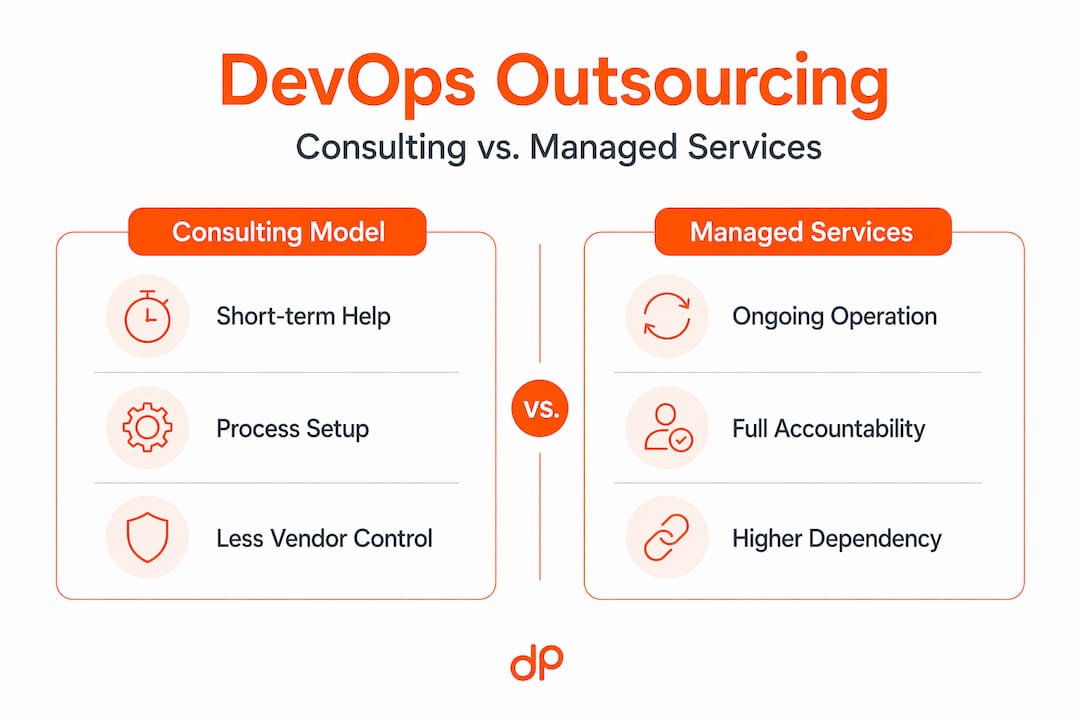
| Model | What the vendor owns | What you own | Best for |
|---|---|---|---|
| Consulting / Implementation | Design, architecture recommendations, project delivery | Execution, ongoing operations, maintenance | One-time transformations, pipeline builds, cloud migrations |
| Staff Augmentation | Individual engineer output | Direction, integration, management, quality | Teams with DevOps capability gaps needing specific skills |
| Managed Services | Ongoing operations, incident response, monitoring | Strategic direction, compliance sign-off, vendor oversight | Organizations wanting full operational handoff with defined SLAs |
The consulting model suits you if you need a structured intervention, such as building a new CI/CD pipeline or migrating to Kubernetes, and your internal team can own operations afterward. Staff augmentation works when you have DevOps knowledge internally but lack specific skills like AWS certification or Terraform expertise.
Managed services represent the highest degree of vendor accountability and the highest dependency risk. The vendor runs incident response, monitors your systems, and owns uptime. This model works well when your internal team lacks bandwidth for operational work entirely, but it demands the tightest contractual governance of the three. Vague scope and undefined delivery standards are leading causes of failure in this model specifically.
How to select and manage a DevOps outsourcing partner
Picking the right partner is the most consequential decision in the entire outsourcing process. Here is how to evaluate candidates with the rigor the decision deserves.
- Demand verifiable delivery track records. Ask for case studies, reference contacts, and measurable outcomes from past engagements. A partner who cannot point to specific, quantified improvements has not been held accountable for results.
- Define “done” before you sign. Unclear delivery definitions are the single most common source of outsourcing failure. Write down exactly what success looks like: deployment frequency targets, incident response times, infrastructure uptime thresholds.
- Require DORA metric reporting. Experienced DevOps partners measure outcomes using DORA metrics: deployment frequency, lead time for changes, mean time to recovery, and change failure rate. If a vendor resists this, that tells you something important about their confidence in their own work.
- Build a knowledge transfer plan into the contract. Specify what documentation the vendor will produce, where it will be stored, and what onboarding support they will provide if your engagement ends. This protects you from dependency and keeps your internal team informed.
- Establish governance cadences. Weekly status reviews, monthly performance reviews, and quarterly strategic alignment sessions are not bureaucratic overhead. They are the mechanism by which you maintain control without micromanaging execution.
Pro Tip: Use a pilot engagement before committing to a long-term contract. A well-scoped 60 to 90 day project gives you direct evidence of how the vendor communicates, handles scope changes, and performs under pressure. It is far cheaper than discovering a misalignment after a 12-month commitment.
For a broader perspective on technology outsourcing models and how they apply to modern engineering organizations, that resource covers the strategic framing in detail.
My honest take on DevOps outsourcing
I have worked with dozens of organizations navigating this decision, and the pattern I see most often is this: companies underestimate how much internal leadership their outsourced DevOps engagement actually requires.
In my experience, the teams that get the most from outsourcing treat their vendor as a high-performance contractor, not as someone who relieves them of thinking. They define outcomes clearly, review DORA metrics monthly, and treat knowledge transfer as a deliverable, not an afterthought. The teams that struggle assume outsourcing is a set-it-and-forget-it move.
What I have learned is that the cost savings are real but secondary. The bigger win is access to institutional knowledge: a vendor who has handled Kubernetes migrations across 30 companies brings pattern recognition your in-house team simply cannot develop at the same speed. That depth of experience shapes your delivery timelines and security posture in ways that are hard to quantify but easy to feel.
The uncomfortable truth about compliance in outsourced DevOps is that most audit failures I have seen were not the vendor’s fault technically. They were the client’s fault contractually. They failed to specify who owns the audit artifacts, who delivers evidence, and at what cadence. Every organization considering DevOps management outsourcing should get legal and compliance teams involved in vendor contracts from day one.
If I were advising a CTO today, I would say: outsource DevOps where you lack depth, retain internal ownership of strategy and architecture, and govern the engagement like it matters. Because it does.
— Vlad
Ready to build a smarter DevOps function?
At Devpulse, we work with SaaS companies, enterprise product teams, and scaling startups that need DevOps expertise without the long hiring cycles or operational overhead. Our engineers bring certified cloud and infrastructure skills, and we structure engagements around clear outcomes, not open-ended retainers.

Whether you need a managed DevOps partner, staff augmentation for a specific project, or an architectural review before your next cloud migration, our DevOps engineering services are built to deliver measurable results. We also make knowledge transfer a contractual commitment, not an optional add-on. Explore our client case studies to see how we have helped organizations reduce deployment times, pass compliance audits, and free their internal teams to build better products. If you are ready to explore whether outsourcing fits your current needs, contact Devpulse for a no-obligation consultation.
FAQ
Why do companies outsource DevOps?
Companies outsource DevOps primarily to access senior expertise faster, reduce operational costs, and scale infrastructure capacity without the delays of full-time hiring. Operational cost and talent scarcity are the two most consistently cited drivers.
Is DevOps outsourcing worth it for smaller companies?
Yes, particularly for startups and scaling SaaS companies that cannot justify a full in-house DevOps team. A managed services or staff augmentation model gives small teams access to senior infrastructure expertise at a fraction of the cost of full-time headcount.
What are the biggest risks of outsourcing DevOps?
The main risks are compliance gaps, vendor dependency, and loss of operational visibility. These are manageable with clear contracts that define audit artifact ownership, SLA terms, and knowledge transfer requirements.
How do I measure the success of a DevOps outsourcing engagement?
Use DORA metrics: deployment frequency, lead time for changes, mean time to recovery, and change failure rate. Experienced DevOps vendors track and report these metrics as standard practice.
What outsourcing model gives me the most control?
Staff augmentation gives you the highest degree of control since you direct the work and own all operational decisions. Managed services transfers the most operational responsibility to the vendor but requires tighter contractual governance to protect your compliance posture.