














TL;DR:
- The team extension model involves integrating external developers directly into existing in-house teams under your management, maintaining control over processes and tools. It differs from outsourcing by keeping scope flexible and ownership with the client, fostering continuity and deep collaboration. Effective management requires active leadership, clear onboarding, and fostering long-term engagement to maximize knowledge retention and ROI.
The team extension model is defined as an engagement structure where external developers or specialists integrate directly into your existing in-house team, working under your management, following your processes, and using your tools. Unlike outsourcing, where a vendor owns delivery, team extension keeps control with the client. The external professionals attend your standups, push code to your repositories, and operate as if they were on your payroll. This model sits at the intersection of workforce flexibility and operational control, making it the preferred approach for technology leaders who need to scale capacity without surrendering technical direction. Tools like Jira, GitHub, and Slack are the connective tissue that makes it work in practice.
What is the team extension model and how does it differ from outsourcing?

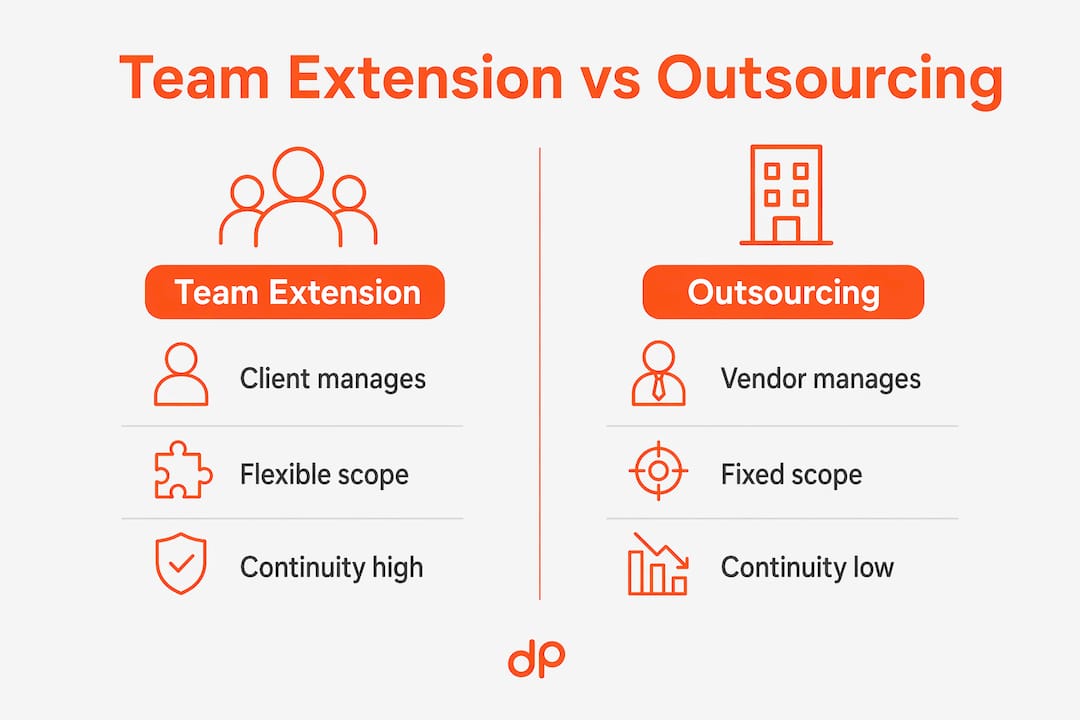
The team extension model is a form of IT staff augmentation where external talent augments your existing internal team rather than replacing it or operating independently. The critical distinction is ownership. In outsourcing, the vendor owns the outcome and manages the process. In team extension, you own both.
This matters more than most project managers initially realize. When a vendor owns delivery, they optimize for their margins and their processes. When your extended team operates under your technical lead, they optimize for your product. The difference shows up in code quality, architecture decisions, and how quickly the team responds to shifting priorities.
Companies like Multidots have documented this distinction clearly: outsourcing contracts lock in outcomes tightly bound to scope, while team extension contracts lock in resources but keep scope flexible. That contractual difference is not a technicality. It is the operational foundation that determines how much you can pivot, reprioritize, or expand work mid-engagement.
The model also differs from hiring freelancers. A freelancer is typically a solo contributor with limited accountability to your team’s standards or velocity. An extended team embeds a cohesive group long enough to build continuity and shared accountability, which is something a rotating cast of freelancers cannot replicate.
How does team extension work in practice?
In a functioning team extension engagement, external developers attend internal meetings, participate in sprint planning, contribute to code reviews, and follow your coding and testing standards from day one. The operational rhythm is identical to what you would expect from a full-time hire.
Here is what that looks like across a typical sprint cycle:
- Daily standups: Extended team members report blockers and progress alongside internal engineers, using the same Jira boards or Linear tickets.
- Sprint planning: Your product manager or tech lead assigns tasks directly. The extended team does not filter work through an account manager or vendor PM.
- Code reviews: External developers submit pull requests to your GitHub or GitLab repositories and receive feedback from your senior engineers, not from a vendor QA team.
- Architecture reviews: For longer engagements, deep integration means external developers participate in roadmap discussions and architecture decisions as genuine contributors.
- Communication: Slack channels, Confluence documentation, and Notion wikis are shared. There is no separate vendor communication layer.
The depth of integration is what separates a high-performing team extension from a mediocre one. A developer who joins your standup for six months builds context that a developer parachuted in for a two-week sprint never will.
Pro Tip: Aim for engagements of at least six months when knowledge retention is a priority. Short-term placements fill gaps; longer engagements build the institutional knowledge that actually accelerates your roadmap.
What are the differences between team extension, outsourcing, and staff augmentation?
These three models are frequently conflated, and the confusion costs project managers real money and time. Each model allocates control, responsibility, and risk differently.
Outsourcing suits tightly scoped milestone-driven projects where the client does not need or want day-to-day involvement. The vendor manages the team, the process, and the delivery. This works well for one-off builds with clear requirements. It works poorly for evolving products where priorities shift weekly.
Staff augmentation is the lightest-touch model. You bring in one or two individuals to plug specific skill gaps for a defined period. It is transactional by design. There is no expectation of continuity, and the individuals typically work across multiple clients simultaneously.
Team extension sits between these two. It offers the control of direct management without the overhead of permanent hiring, and it provides the continuity that staff augmentation cannot.
| Model | Who manages the team | Scope flexibility | Continuity | Best for |
|---|---|---|---|---|
| Outsourcing | Vendor | Low | Low | Fixed-scope, milestone projects |
| Staff augmentation | Client | High | Low | Short-term skill gaps |
| Team extension | Client | High | High | Evolving products, 6+ month engagements |
| Dedicated team | Shared | Medium | High | Multi-stack scaling with some autonomy |
The table above reflects a practical reality: dedicated teams offer autonomy between outsourcing and team extension, which makes them useful for scaling across multiple technology stacks when you want some vendor accountability without full outsourcing. For most SaaS companies and enterprise product teams, team extension delivers the best balance of control and flexibility. You can read more about the outsourcing side of this comparison in DevPulse’s breakdown of IT outsourcing for executives.
What are the common types of team extension engagements?
Team extension includes project-based and skill-based variations, and understanding which type fits your situation determines whether the engagement succeeds or stalls.
The main engagement patterns are:
- Project-based team extension: External engineers join for the duration of a specific initiative, such as a platform migration or a new product module. The team disbands or transitions once the project closes.
- Skill-based team extension: You identify a specific expertise gap, such as machine learning engineering or DevOps, and extend your team with specialists in that domain. This model is common in healthcare technology and cybersecurity, where niche certifications and domain knowledge are non-negotiable.
- Short-term vs. long-term engagements: Short-term extensions (under three months) address surge capacity. Long-term extensions (six months or more) are where the model delivers its strongest ROI through knowledge retention and reduced onboarding cycles.
- Offshore and nearshore remote team extension: What is remote team extension in practice? It is the same model executed across time zones, using asynchronous communication tools and overlapping working hours to maintain integration. Nearshore options, such as Eastern European or Latin American teams, minimize time-zone friction for North American companies.
- Agile pods: A cross-functional autonomous unit, typically including a developer, QA engineer, and designer, that embeds into your product team as a self-contained squad. This format works well for SaaS companies running parallel feature tracks.
The right variation depends on your current workflow maturity, the duration of the need, and whether the skill gap is narrow or broad. For non-technical founders scaling a product, the scalable product development guide from Hana Dkubat offers a useful framework for thinking through these decisions before you engage a provider.
What are the benefits and challenges of the team extension model?
The benefits of team extension are concrete and measurable when the model is applied correctly. Businesses fill talent shortages rapidly without the overhead of permanent hiring, and they avoid carrying idle headcount when project demand drops. That alone justifies the model for most technology organizations operating in uncertain markets.
Beyond cost flexibility, the model preserves something that outsourcing destroys: institutional knowledge. When your extended team works inside your codebase, attends your planning sessions, and follows your architecture standards, the knowledge they accumulate stays accessible to your internal team. Turnover in an extended team is far less damaging than turnover in an outsourced vendor, because your internal engineers have been present for every decision.
The challenges are real, though, and ignoring them is how engagements fail. Integration overhead and management bandwidth are the two most common friction points. Adding three external engineers to a team of five does not scale linearly. Your tech lead will spend more time in code reviews, your product manager will spend more time clarifying requirements, and your DevOps engineer will spend more time managing access and tooling.
Pro Tip: Before extending your team, audit your internal processes. If your sprint ceremonies are inconsistent or your documentation is sparse, fix those first. Extended teams amplify whatever processes you already have, good or bad.
Common triggers that make team extension the right choice include mature internal workflows, a need for niche skills that the local market cannot supply quickly, and a desire to maintain technical direction over a product that will evolve for years. The IT workforce scalability strategies guide from DevPulse covers the decision criteria in more depth for technology leaders planning 2026 capacity.
How to implement and manage a team extension engagement
Successful implementation follows a sequence that most companies skip in their eagerness to get engineers into seats. The steps below reflect what actually works in practice.
- Audit your toolchain and access controls. Before the first external developer joins a standup, confirm that your GitHub organization, Jira workspace, Slack channels, and cloud environments have role-based access configured. Security gaps discovered after onboarding create delays and erode trust.
- Define the integration scope in writing. Specify which ceremonies the extended team attends, who assigns tasks, how code reviews are conducted, and what the escalation path is for blockers. Ambiguity here is the leading cause of misaligned expectations.
- Run a structured onboarding week. Treat extended team members the same way you would treat a new full-time hire. Walk them through the codebase, introduce them to internal stakeholders, and assign a low-risk first task that builds familiarity before high-stakes work begins.
- Establish productivity metrics from day one. Cycle time, pull request throughput, and defect rates are measurable from the first sprint. Set baseline expectations early and review them in retrospect meetings, not just in quarterly vendor check-ins.
- Schedule regular calibration sessions. Monthly one-on-ones between your tech lead and the extended team’s senior developer catch misalignments before they compound. These sessions also surface knowledge gaps that formal documentation never captures.
- Plan the off-ramp before you need it. Decide in advance what knowledge transfer looks like when the engagement ends. Document architecture decisions, write runbooks, and record walkthroughs. The cost of this preparation is low; the cost of skipping it is high.
For SaaS companies specifically, the approach to scaling engineering teams requires additional consideration around feature velocity and technical debt management when extended teams are involved.
Key takeaways
The team extension model delivers maximum value when you maintain direct management control, invest in deep integration, and treat external engineers as genuine team members rather than temporary contractors.
| Point | Details |
|---|---|
| Control stays with the client | You assign tasks, manage output, and set standards. The vendor supplies talent, not direction. |
| Integration depth determines ROI | Engagements of six months or more build the continuity and knowledge retention that justify the model. |
| It is not outsourcing | Outsourcing locks in outcomes; team extension locks in resources and keeps scope flexible. |
| Process maturity is a prerequisite | Weak internal workflows amplify problems when extended teams join. Fix processes before scaling headcount. |
| Match the variation to the need | Project-based, skill-based, offshore, and agile pod formats each suit different business contexts. |
Why most companies underestimate the management cost
I have seen this pattern repeat across dozens of engagements. A business leader reads about the team extension model, gets excited about the flexibility and cost profile, and moves quickly to sign a contract. Three months later, the tech lead is burned out, the extended team is waiting on decisions, and the ROI calculation looks nothing like the original projection.
The model works. The problem is that most organizations underestimate how much active management it requires, especially in the first 90 days. You are not buying a service. You are expanding your team, and that expansion demands the same leadership attention you would give to any internal hire.
The companies I have seen get this right share one trait: they treat the extended team’s success as a leadership responsibility, not a vendor management task. They assign a named internal owner, they run retrospectives that include external members, and they invest in documentation as a first-class activity rather than an afterthought.
The future of workforce flexibility in technology is moving toward more of these embedded, long-term external relationships, not fewer. The organizations building the muscle to manage them well now will have a structural advantage in 2026 and beyond. The ones treating team extension as a procurement exercise will keep getting mediocre results from a model that genuinely works when applied with discipline.
— Vlad
How DevPulse supports your team extension strategy

DevPulse works with SaaS companies, enterprise product teams, and technology startups that need to extend their engineering capacity without losing control of their technical direction. Our engineers integrate directly into your workflows, follow your standards, and contribute to your codebase from day one. Whether you need a specialist in AI-powered systems, cloud architecture, or cross-platform desktop development, we match the right expertise to your specific roadmap. Explore our engineering services to see how we structure engagements, or review our client case studies to see the outcomes other product teams have achieved through structured team extension partnerships with DevPulse.
FAQ
What is the team extension model in simple terms?
The team extension model is a staffing approach where external developers join your existing team, work under your management, and follow your internal processes. It gives you the flexibility of external talent without surrendering control over technical direction or delivery.
How does team extension differ from outsourcing?
In outsourcing, the vendor manages the team and owns delivery. In team extension, the client manages the team directly and retains full control over scope, priorities, and output. The contractual structure also differs: team extension locks in resources while keeping scope flexible.
What are the main benefits of team extension?
The primary benefits include rapid access to niche skills, flexible scaling without permanent hiring costs, and preservation of institutional knowledge. Extended teams build continuity over time, which short-term staff augmentation cannot replicate.
When should a business choose team extension over staff augmentation?
Choose team extension when the engagement is expected to last six months or more and when knowledge retention matters. Staff augmentation is better suited to short-term, narrow skill gaps where continuity is not a priority.
What tools are typically used in a remote team extension?
Remote team extension engagements commonly rely on Jira or Linear for task management, GitHub or GitLab for version control, Slack for communication, and Confluence or Notion for documentation. These tools maintain integration depth across distributed teams.