












TL;DR:
- Hybrid IT outsourcing allows internal teams to control strategy while external providers handle operational functions, offering flexibility and specialized skills. Effective governance, including scope matrices, SLAs, and regular reviews, is crucial for success and often underappreciated by IT leaders. Organizations typically outsource infrastructure, cybersecurity, help desk, and cloud management, with costs around $100 to $150 per employee monthly for co-managed arrangements.
Hybrid IT outsourcing is defined as a model where a company retains ownership of its core IT strategy internally while contracting external providers to deliver specific IT functions such as infrastructure management, cybersecurity monitoring, help desk operations, and cloud services. The industry commonly refers to this as co-managed IT or a blended IT delivery model. Organizations adopting this approach gain access to specialized skills and 24/7 coverage without the cost of full internal headcount. Managed service providers (MSPs) like those operating under co-managed agreements handle defined operational functions, while your internal team focuses on architecture, vendor governance, and strategic roadmap. The result is a model that shapes your speed, security, and scalability without surrendering control.
What is hybrid IT outsourcing and how does it differ from other models?
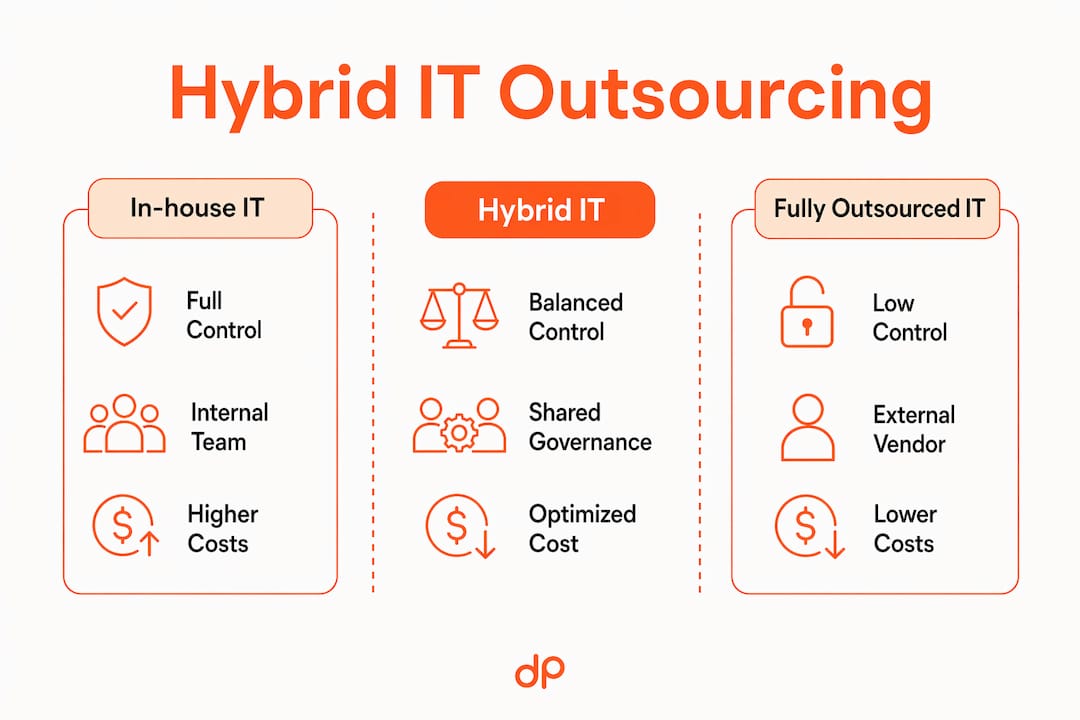
Hybrid IT outsourcing balances control and flexibility better than either fully outsourced or fully in-house IT setups. In a fully outsourced model, all IT functions are delegated externally, which reduces internal visibility and limits your ability to respond to strategic shifts quickly. A purely in-house model preserves control but requires significant investment in headcount, tooling, and 24/7 staffing capacity that most mid-market organizations cannot sustain.

The hybrid model sits between these two extremes. Your internal team owns IT strategy, architecture decisions, and vendor relationships. External providers execute defined operational tasks under agreed service levels. This division lets you scale specific capabilities up or down without restructuring your entire IT organization.
The table below contrasts the three models across the dimensions that matter most to IT decision-makers:
| Dimension | In-house IT | Fully outsourced IT | Hybrid IT outsourcing |
|---|---|---|---|
| Strategic control | Full | Low | High |
| Cost structure | Fixed, high | Variable, can escalate | Optimized, flexible |
| Scalability | Limited | High | High with governance |
| Specialized skills | Constrained | Broad | Targeted and on-demand |
| 24/7 coverage | Expensive | Included | Included via MSP scope |
| Accountability clarity | High | Moderate | Requires deliberate design |
The critical distinction is that hybrid models optimize control without sacrificing access to specialized talent. For IT leaders managing complex environments across cloud, on-premises, and edge infrastructure, this balance is a practical necessity rather than a preference.
How does governance determine whether hybrid IT outsourcing succeeds or fails?
Governance is the single factor that separates a high-performing hybrid IT model from one that creates more problems than it solves. Hybrid outsourcing spans multiple dimensions, including location, pricing structure, engagement type, and service delivery method. Treating it as a vague label rather than a deliberately designed operating model leads to unclear ownership, duplicated effort, and accountability gaps during incidents.
The governance framework for a hybrid IT engagement must define four things explicitly:
- Scope matrix: Which IT functions are owned internally, which are owned by the MSP, and which are shared. Every ticket category, system, and service must map to a clear owner.
- Ticket routing rules: Ambiguous routing causes duplicated effort and accountability gaps during incidents. Define escalation paths before go-live, not after the first outage.
- SLAs and KPIs: Service level agreements set response and resolution expectations. Key performance indicators track whether the MSP and internal team are meeting them. Both must be reviewed on a regular cadence, typically monthly.
- RACI matrices: SLAs, KPIs, and RACI matrices prevent overlapping tasks and clarify who is Responsible, Accountable, Consulted, and Informed for each process.
Operational overhead is frequently underestimated in hybrid models. Governance must explicitly address coordination complexity, contract management, reporting cadence, and vendor accountability. Organizations that skip this design work often find that their hybrid model costs more to manage than a simpler fully outsourced arrangement.
Pro Tip: Before signing any co-managed IT contract, build a one-page scope matrix that lists every IT function your organization owns and assign it to either internal, MSP, or shared. Review it with both teams before the engagement starts. This single document prevents the majority of governance disputes.
For a deeper look at how decision rights and operating models are structured in practice, the Devpulse guide on IT outsourcing governance covers the frameworks IT leaders use to maintain accountability across blended teams.
What IT functions are commonly outsourced and what do they cost?
The strategic rationale for hybrid IT is to keep core functions internal while outsourcing specialized or operational tasks to gain scalability and resilience. In practice, the functions most commonly handed to external providers fall into five categories:
- Infrastructure management: Server provisioning, patching, monitoring, and hardware lifecycle management. These are high-volume, low-differentiation tasks that MSPs handle efficiently at scale.
- Cybersecurity monitoring: Security operations center (SOC) services, threat detection, and incident response. Few mid-market organizations can staff a 24/7 SOC internally at a competitive cost.
- Help desk and end-user support: Tier 1 and Tier 2 support, device management, and onboarding. Outsourcing these frees internal engineers for higher-value work.
- Cloud operations: Cloud cost optimization, infrastructure-as-code management, and multi-cloud governance. This is particularly relevant as organizations migrate workloads to AWS, Azure, or Google Cloud.
- Specialized project services: Application modernization, compliance audits, and DevOps pipeline setup. These are scoped engagements rather than ongoing managed services.
On cost, co-managed IT for SMBs with 50 to 200 employees typically runs $100 to $150 per employee monthly when responsibility is shared between an MSP and an internal IT team with a defined scope. That figure provides specialized capabilities and 24/7 coverage at a fraction of the cost of hiring equivalent internal staff. For context, a single senior security engineer in the United States costs $150,000 or more annually in salary alone, before benefits and tooling.
The distinction between engagement types also affects cost. Fully managed services transfer all operational responsibility to the MSP. Co-managed services split responsibility based on a defined scope matrix. Project-based outsourcing covers discrete deliverables with a fixed timeline and budget. Hybrid IT models most commonly use co-managed or project-based arrangements, not full managed services. For a detailed breakdown of pricing structures, the Devpulse article on managed IT pricing covers what business leaders should expect at each tier.
What should IT leaders know about outsourcing cloud services within hybrid IT?
Cloud outsourcing within a hybrid IT framework carries regulatory and operational risks that infrastructure outsourcing does not. The European Central Bank’s 2025 Guide on cloud outsourcing sets supervisory expectations for risk-based, proportionate controls and continuity planning under the Digital Operational Resilience Act (DORA). While DORA applies directly to financial services firms, its principles represent the direction of travel for enterprise cloud governance across sectors.
The ECB’s guidance identifies several non-negotiable requirements for organizations outsourcing cloud services:
- Contingency planning: You must be able to operate critical functions if your cloud provider experiences an outage or terminates the contract.
- Provider termination planning: Contracts must include exit provisions that guarantee data access and migration support. Vendor lock-in is a regulatory risk, not just a commercial one.
- Segregated backups: Critical data must be backed up in environments that are logically or physically separate from the primary cloud provider.
- Proportionate controls: Risk controls must match the criticality of the function being outsourced. A non-critical analytics workload does not require the same controls as a core transaction processing system.
A multi-provider hybrid cloud architecture directly mitigates these risks. Distributing workloads across AWS, Azure, and a private cloud or colocation facility reduces single-provider dependency and supports continuity planning. Compliance requirements should be written into outsourcing contracts at the design stage, not retrofitted after the fact.
Pro Tip: When evaluating cloud providers for hybrid IT outsourcing, request their SOC 2 Type II report and ask specifically about their data portability guarantees. If a provider cannot clearly explain how you exit their platform with your data intact, that is a governance risk before it becomes a compliance one.
For organizations in regulated industries, the Devpulse resource on IT outsourcing risks covers compliance controls and continuity planning in detail. You can also review secure cloud hosting compliance considerations for additional context on risk-based cloud governance.
How do organizations implement hybrid IT outsourcing to maximize value?
Practical implementation of a hybrid IT model requires more than selecting an MSP and signing a contract. The organizations that extract the most value from hybrid outsourcing treat the engagement design as a product in itself.
- Write a detailed Statement of Work (SOW) with module ownership. Every service module, from patch management to incident response, should be explicitly assigned as outsourced, internal, or shared. Ambiguity in the SOW is the leading cause of scope disputes six months into an engagement.
- Schedule a structured overlap period. When transitioning functions to an MSP, plan a four to eight week overlap where both teams work in parallel. This transfers institutional knowledge and validates that ticket routing rules work before the internal team steps back.
- Share tooling and environments deliberately. CI/CD pipelines, monitoring dashboards, sandbox environments, and staging systems should be accessible to both internal and external teams under defined permissions. Siloed tooling creates information asymmetry and slows incident response.
- Combine staff augmentation with outsourcing strategically. Staff augmentation combined with outsourcing enables scale, speed, and control. CIOs handle mission-critical systems internally and outsource commoditized functions. This is not a binary choice; the ratio shifts as your organization’s needs evolve.
- Measure success through a governance cadence. Monthly KPI reviews, quarterly business reviews with your MSP, and annual scope reassessments keep the model aligned with your operational reality.
| Implementation phase | Key action | Success indicator |
|---|---|---|
| Design | Build scope matrix and SOW | Zero ambiguous ownership rows |
| Transition | Run parallel overlap period | Ticket routing validated in staging |
| Steady state | Monthly KPI and SLA reviews | SLA breach rate below threshold |
| Optimization | Annual scope reassessment | Cost per function trending down |
Pro Tip: Treat your MSP’s account manager as a member of your governance team, not a vendor contact. Monthly operational reviews should include your internal IT lead, the MSP account manager, and at least one business stakeholder. This prevents the model from drifting into a black-box arrangement where accountability erodes quietly.
Key takeaways
Hybrid IT outsourcing succeeds when internal teams own strategy and governance while external providers execute defined operational functions under explicit SLAs, scope matrices, and RACI frameworks.
| Point | Details |
|---|---|
| Core definition | Hybrid IT outsourcing retains internal IT strategy ownership while contracting external providers for specific functions. |
| Governance is non-negotiable | Scope matrices, ticket routing rules, and RACI matrices prevent accountability gaps and duplicated effort. |
| Cost benchmark | Co-managed IT for SMBs typically costs $100 to $150 per employee monthly with a defined MSP scope. |
| Cloud outsourcing carries extra risk | Regulatory frameworks like DORA require contingency planning, segregated backups, and exit provisions in cloud contracts. |
| Implementation requires deliberate design | Overlap periods, shared tooling, and monthly KPI reviews determine whether the model delivers ROI. |
Why governance is the part most IT leaders underestimate
Having worked with organizations across healthcare, cybersecurity, and enterprise software, the pattern I see most consistently is this: IT leaders spend significant time selecting the right MSP and almost no time designing the governance model that makes the relationship work. The MSP selection is treated as the hard part. It is not.
The hard part is writing a scope matrix that your internal team and the MSP both agree on before the contract is signed. The hard part is defining what happens when a P1 incident touches both an internally owned system and an MSP-managed one. The hard part is building a communication cadence that keeps both teams aligned without creating meeting overhead that slows everyone down.
Hybrid outsourcing as a composition layer requires deliberate governance over multiple dimensions, not a simple mix of offshore and onshore resources. The organizations I have seen extract real value from this model are the ones that treat governance design as a technical deliverable, not an administrative formality. They document decision rights. They review KPIs monthly. They reassess scope annually. The ones that struggle treat the contract as the governance model and wonder why accountability erodes six months in.
My practical advice: before you engage any external provider, spend two weeks mapping every IT function your organization owns and assigning a clear owner. That exercise alone will surface the ambiguities that would otherwise become disputes. It will also tell you which functions are genuinely ready to outsource and which ones need internal maturity work first.
— Vlad
How Devpulse supports your hybrid IT strategy
Devpulse works with SaaS companies, enterprise clients, and technology-driven organizations that need scalable engineering and IT delivery without the overhead of building every capability in-house. Whether you are modernizing legacy systems, building cloud-native platforms, or structuring a hybrid delivery model for your engineering organization, Devpulse brings the technical depth and governance experience to make it work. Our engineering services are designed for organizations that want to retain strategic control while accelerating delivery through expert external execution. You can also review our client case studies to see how we have structured hybrid engagements across healthcare, legal tech, and enterprise software. If you are evaluating your IT outsourcing model for 2026, we are ready to help you design it right from the start.
FAQ
What is hybrid IT outsourcing in simple terms?
Hybrid IT outsourcing is a model where your internal IT team owns strategy and architecture while an external provider handles specific operational functions like help desk, cybersecurity monitoring, or cloud management. It gives you the benefits of outsourcing without surrendering control over your core IT direction.
How is hybrid IT outsourcing different from fully managed IT services?
In a fully managed IT model, the external provider takes responsibility for all IT operations. In a hybrid model, responsibility is split: your internal team retains ownership of strategic and mission-critical functions while the MSP covers defined operational tasks under a co-managed agreement.
What does co-managed IT cost for a mid-size business?
Co-managed IT for organizations with 50 to 200 employees typically costs $100 to $150 per employee monthly, depending on the scope of services shared between the MSP and the internal IT team.
What are the biggest risks in hybrid IT outsourcing?
The primary risks are governance failures: unclear scope ownership, ambiguous ticket routing, and insufficient SLA oversight. Operational overhead is frequently underestimated when governance is not explicitly designed before the engagement begins.
Does hybrid IT outsourcing work for cloud services?
Yes, but cloud outsourcing within a hybrid model requires additional risk controls. Regulatory frameworks like DORA require organizations to plan for provider termination, maintain segregated backups, and guarantee data access continuity, requirements that must be written into contracts at the design stage.