













You’re staring at a release calendar that won’t move, a stack of stakeholder expectations, and a test strategy doc that still feels half-finished. The pressure usually isn’t about writing more, it’s about writing the right document fast enough to keep delivery moving without losing control of scope, risk, environments, or reporting. A strong test strategy template solves that problem by giving you a usable backbone, not a blank page.
In practice, the best templates don’t just help you “document testing.” They help you govern it. The stronger ones make room for risk management, entry and exit criteria, roles and responsibilities, defect workflow, and the evidence executives need when they ask why a release is safe to ship. That matters even more in large programs, where testing has to stand up to audit, traceability, and cross-team coordination.
This list stays practical and gets to the point. I’ve grouped the resources by how they behave in real projects, from Agile, to Enterprise, to Lean, so you can pick one that fits your delivery model instead of forcing a generic template into a regulated environment.
1. Experimentus, Test Strategy Template (Agile)
A programme with several squads, shared environments, and a release board needs a program-level spine, not another project worksheet. Experimentus fits that use case well because the template is built for multi-level strategy support, so it can sit above a programme, a project, or a test phase without forcing teams to duplicate the same sections in three different places. For enterprise delivery, that matters because governance stays visible while teams keep shipping in parallel.
The structure also reflects mature QA management. The template keeps test scenarios and test cases distinct, separates planned and ready execution, tracks preparation time and planned time, and records execution status through passed, failed, and blocked cases. It also supports bug tracking by test item and severity across runs, which gives a release board concrete evidence instead of a vague green checkmark. For teams comparing this style with lighter templates, the difference is clear. Experimentus asks for control and traceability up front, while lighter forms often leave those details for later cleanup.
Where it works best
Use this template when the work spans multiple teams, environments, or delivery stages. It already gives space to risk management, independence of testing, document control, approvals, and RACI, so it suits hybrid delivery models better than a lightweight form. The trade-off is practical. Because it ships as a PDF, many teams will copy it into Word or Confluence before they can use it in day-to-day delivery.
Practical rule: If your release governance depends on traceability, start with a template that assumes measurement from day one, not one you have to retrofit later.
The one caution is terminology. The template uses older ISO 9126 language, so teams that standardize on ISO 25010 need to map quality characteristics before sign-off. That is a small edit, but it matters in regulated or audit-heavy programs where wording consistency is part of the control model.
Website, Experimentus Agile Test Strategy PDF
2. DexForm, Test Strategy Template
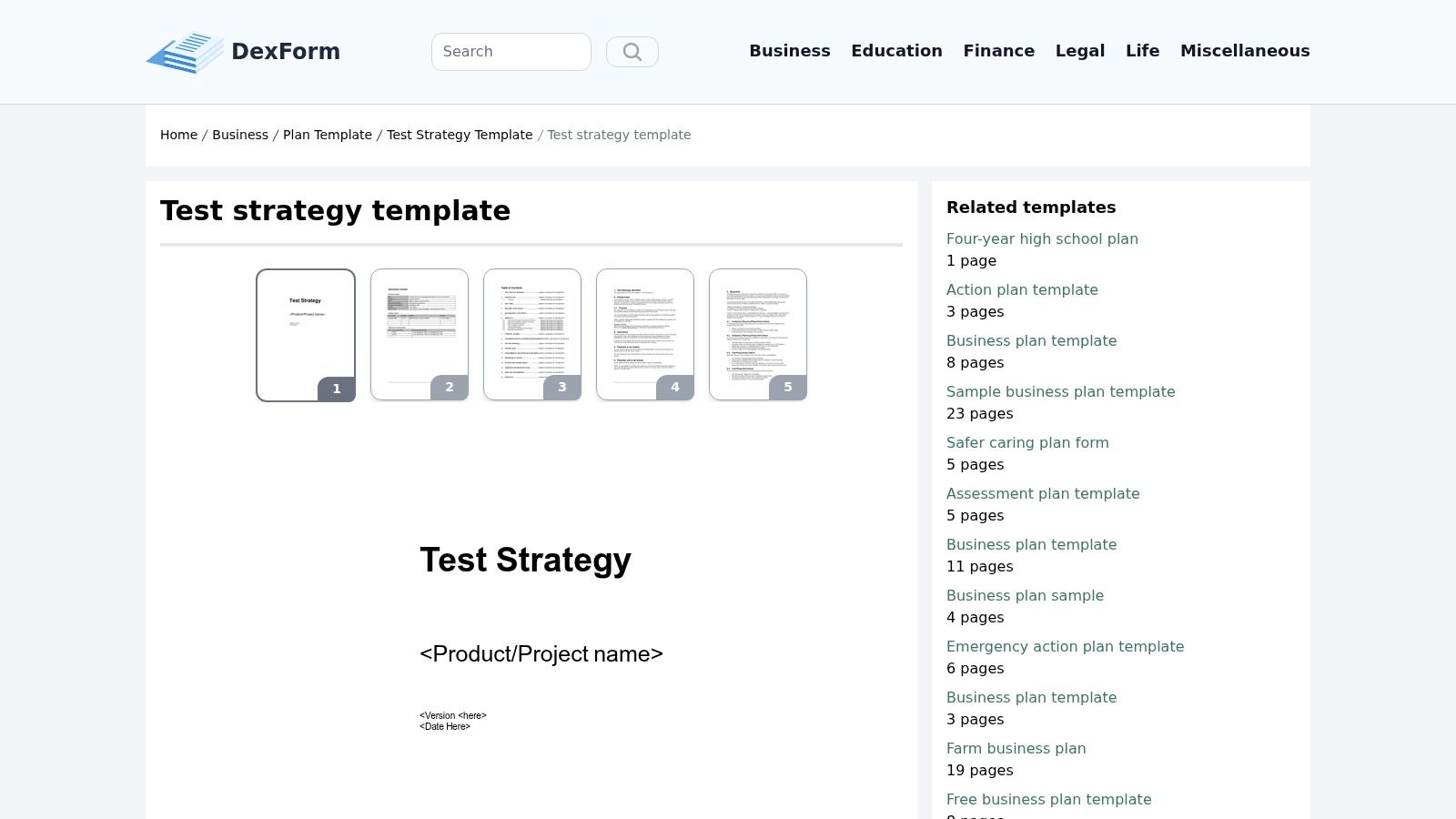
DexForm is the fastest path to a working draft when the problem is time, not theory. It’s an 11-page, fill-in-the-blanks template available in DOC and PDF, so a team can open it, replace placeholders, and get a readable strategy without building the document structure from scratch. For short-cycle engagements, that speed matters more than perfect elegance.
The format is intentionally light. You get pre-structured sections for scope, approach, and environments, which makes it a practical baseline for client-specific forks or addenda. If you’re standing up a strategy for a new project team, that’s enough to get everyone aligned on the first pass.
A clean thing about this template is that it doesn’t try to pretend it knows your context. That’s also its weakness. It won’t give you the depth needed for risk, compliance, or detailed tooling decisions, so regulated domains need to extend it with control sections, test data handling, and explicit approval flows.
Best use in real teams
For consulting work, I’d use this as the “first draft everybody can read” version. Then I’d layer in domain-specific annexes for security, privacy, or system integration. That keeps the core document short while still giving legal, architecture, and QA leads the evidence they need.
The lightweight templates are often the easiest to adopt, but they become dangerous when teams mistake “easy to edit” for “complete enough for governance.”
Website, DexForm test strategy download
3. MG Software, QA Test Strategy Template
MG Software is stronger than most web guides because it presents strategy as a living part of delivery, not a static document. It frames testing across test levels, automation, defect management, environments, and reporting, and it adds variants like Agile, risk-based, shift-left, and performance. That makes it useful for teams that need a shared language with product leaders, not just QA specialists.
The template also gives practical guidance on test data and CI/CD integration, which is where many generic strategy docs fall apart. In enterprise work, teams often define a test approach that sounds good on paper but never survives the first build pipeline issue or environment outage. MG Software’s framing helps prevent that by putting operational reality back into the strategy.
When this resource earns its keep
This one works best when you need to socialize testing with engineering leadership. The language is modern enough to discuss the test pyramid, flaky test handling, and continuous improvement without sounding like an academic artifact. That matters when the QA lead has to defend the strategy in front of product owners, architects, and release managers who care about throughput and risk.
What still needs extra work
It’s a good starting point, but enterprise teams will usually need more on compliance, segregation of duties, and reporting boundaries. If your organization has formal sign-off gates or regulated data handling requirements, treat this as the base narrative and then add controls as appendices.
Website, MG Software QA test strategy template
4. Testriq, Test Strategy Template ISO IEC IEEE 29119 aligned
Testriq does something many templates don’t, it separates strategy from plan in a way that avoids document bloat. That distinction matters because teams often mash both together and end up with a strategy that reads like a release checklist. Testriq keeps the strategic layer cleaner, while still including the fields teams need, like a risk register, entry and exit criteria, tooling stack, and RACI.
That structure is a real advantage for auditability. If you work with regulated clients, you need a doc that says what the testing approach is, who owns it, and what evidence shows the work is complete. A template aligned to ISO/IEC/IEEE 29119 gives you a better baseline for that conversation than a generic blog download.
Why practitioners keep it nearby
The practical value is that the sections are easy to copy into enterprise documentation systems. You can pull the fields into Word, Confluence, SharePoint, or a quality management repository without losing the original logic. It also includes checklists for coverage targets, automation ratios, and shift-left/right, which helps teams define boundaries instead of arguing about them during planning meetings.
Strong strategies separate policy from execution. If the document can’t tell you what belongs in the strategy and what belongs in the plan, it will get bloated fast.
The downside is that it isn’t packaged as a single polished DOC. You’ll be assembling the final artifact yourself, which is fine for experienced QA leads and a little annoying for teams that want a ready-made deliverable.
Website, Testriq test strategy template
5. Smartsheet, Agile Test Strategy Template
Smartsheet is a strong option for organizations that already live in Office-style delivery systems. The Agile testing collection includes a dedicated Agile Test Strategy plus companion artifacts in Word, Excel, PowerPoint, and Google formats, so it fits teams that need documents to travel through PMOs, steering groups, and client review cycles without conversion headaches.
The benefit is consistency. When a project manager wants a test summary, a test case workbook, and a strategy document that all look and feel related, Smartsheet gives you a coherent set instead of a single isolated template. That makes it easier to standardize across client programs where stakeholders expect familiar deliverables.
What it does well in enterprise settings
It’s especially handy for communication planning and role clarity. The template family supports iterative workflows, and the companion artifacts help keep reporting aligned with the strategy rather than bolted on afterward. For delivery organizations that need to show progress in a format executives already understand, that’s a practical win.
Where teams need to be careful
The Agile framing is broad, so it won’t go deep enough on security, performance, or data/privacy without extra sections. That’s not a failure, it’s a reminder that generic Agile templates rarely satisfy regulated environments on their own. If the project touches sensitive data or has strict release controls, treat Smartsheet as the coordination layer, not the full governance model.
Website, Smartsheet Agile testing templates
6. StrongQA, Test Strategy Templates Library
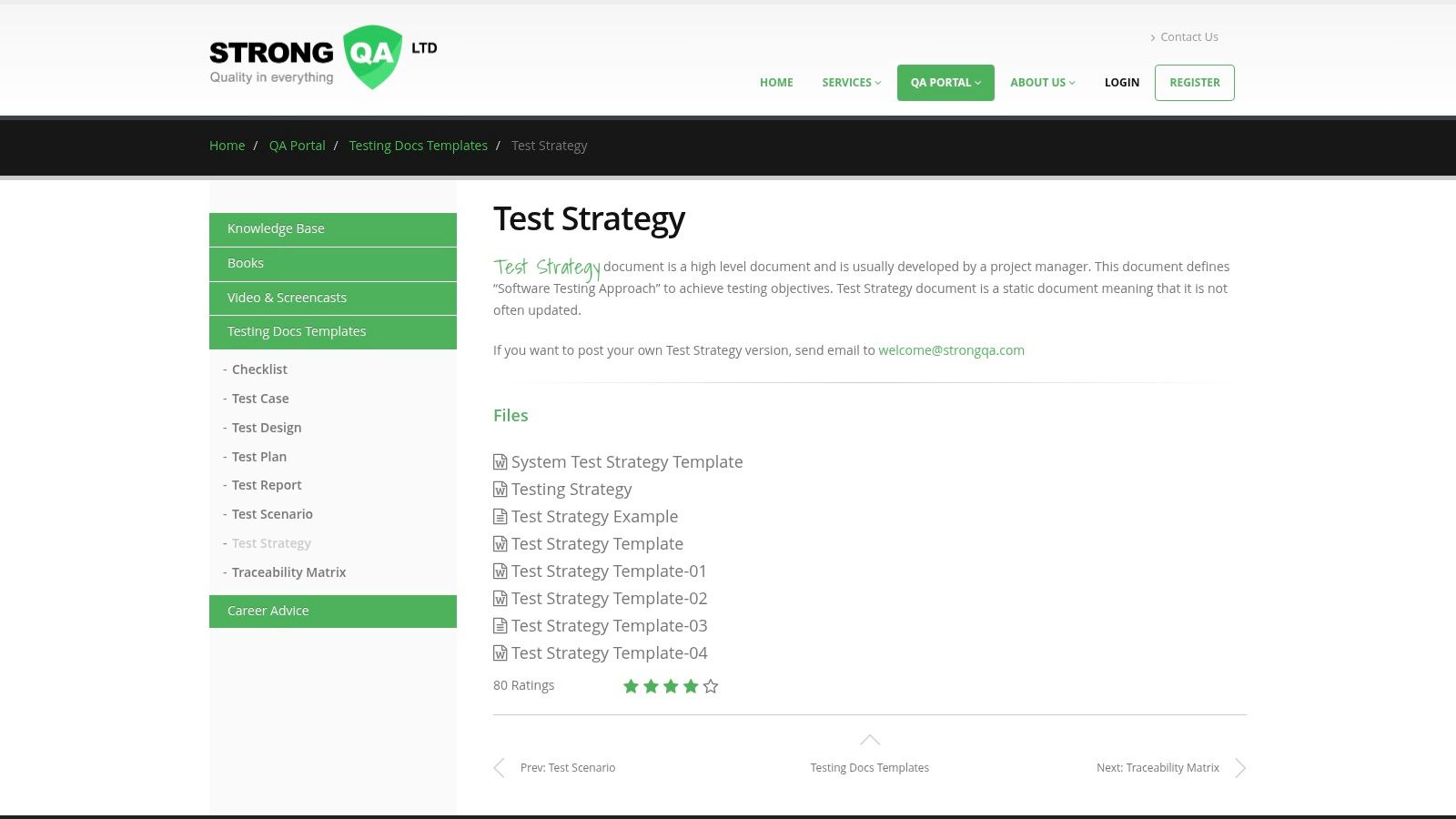
StrongQA works better as a library of references than as a single template download. That matters if you are setting a house standard for a client team, a delivery unit, or a shared QA practice, because you can compare formats before you choose one to adopt. I have found it especially useful in workshops, onboarding sessions, and template rationalization exercises, where the goal is to decide what should stay consistent and what should change for a specific program.
The strongest use case is as a comparison portal for different QA needs. Teams can review the variants side by side and sort them into Agile, Enterprise, and Lean patterns instead of treating every strategy as the same document. For complex, regulated work, that distinction saves time, because a lightweight release checklist, a delivery governance pack, and a formal program strategy should not carry the same level of detail or approval flow.
One practical way to view the library is as a concept map for strategy design. The sample structure helps teams see how planning, execution status, defect tracking, and reporting artifacts relate to each other, then decide which parts belong in the standard and which parts need to be customized. That is useful when a team is trying to reduce document sprawl without stripping out the controls a regulated environment still needs.
How to use it without creating chaos
Pick one base file, then treat the other variants as reference material, not as pieces to merge by default. Teams often overbuild a strategy by combining every section they find, which creates a document that is hard to own and harder to keep current. A better approach is to set one default structure for feature, product, or program work, then add only the sections that solve a real oversight, audit, or coordination problem.
The library also helps with onboarding. New QA staff can see how a strategy is organized, how supporting templates differ, and where a team’s house style starts to matter. That makes it easier to train people on the structure first, then the content quality that sits inside it.
The library is light enough to adopt quickly, which is a strength for busy teams. It also means you should review each file carefully before using it on a regulated project, because a template that works for internal alignment may still need extra controls for formal release governance.
Website, StrongQA test strategy templates library
7. TestLodge, Test Strategy Example plus Lean Test Plan Template
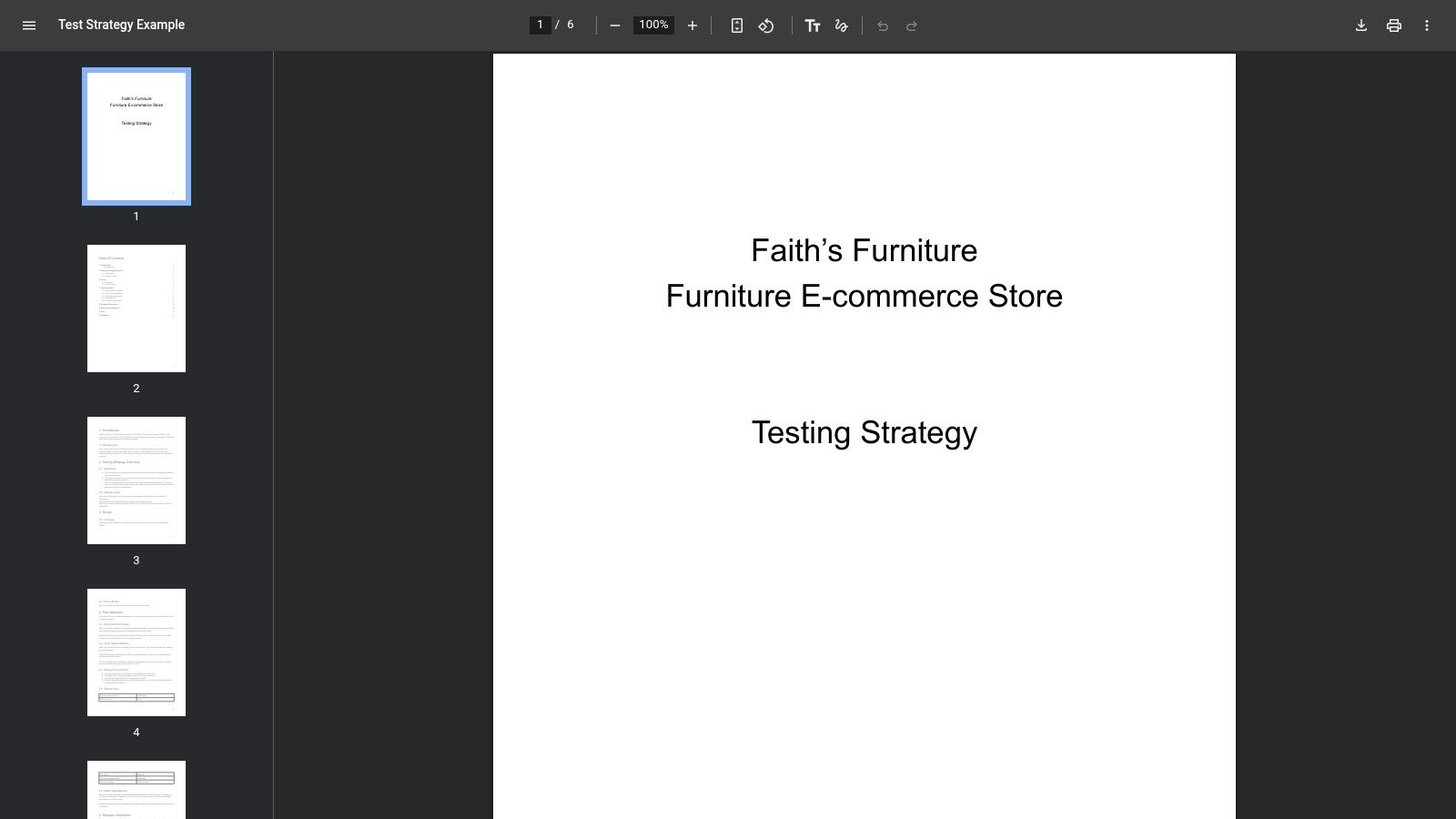
TestLodge is the cleanest example of a lean documentation mindset. The strategy PDF is short enough to show stakeholders how the sections connect, and the companion lean test plan template helps teams avoid the common trap of over-documenting simple releases. That makes it excellent for teaching, coaching, and keeping smaller teams from turning the strategy into a novel.
The sample strategy is realistic enough to include tooling and reporting sections, which helps junior QA staff see that a strategy is more than scope and roles. It also encourages documentation that stays maintainable, which is a useful corrective in organizations where every release seems to generate another document nobody updates.
Where lean works, and where it doesn’t
Lean documentation is great when the delivery risk is modest and the team is disciplined. It gets less comfortable in high-risk or heavily regulated contexts, where the strategy has to prove traceability, environment control, and evidence quality. In those cases, TestLodge can still help, but only as the readability layer on top of a stronger governance structure.
Use lean templates to remove waste, not to remove accountability.
That sentence matters because many teams confuse brevity with rigor. A short strategy can still be effective if it covers the right controls and is maintained with care.
Website, TestLodge test strategy example PDF
8. Satisfice DevelopSense, Heuristic Test Strategy Model HTSM
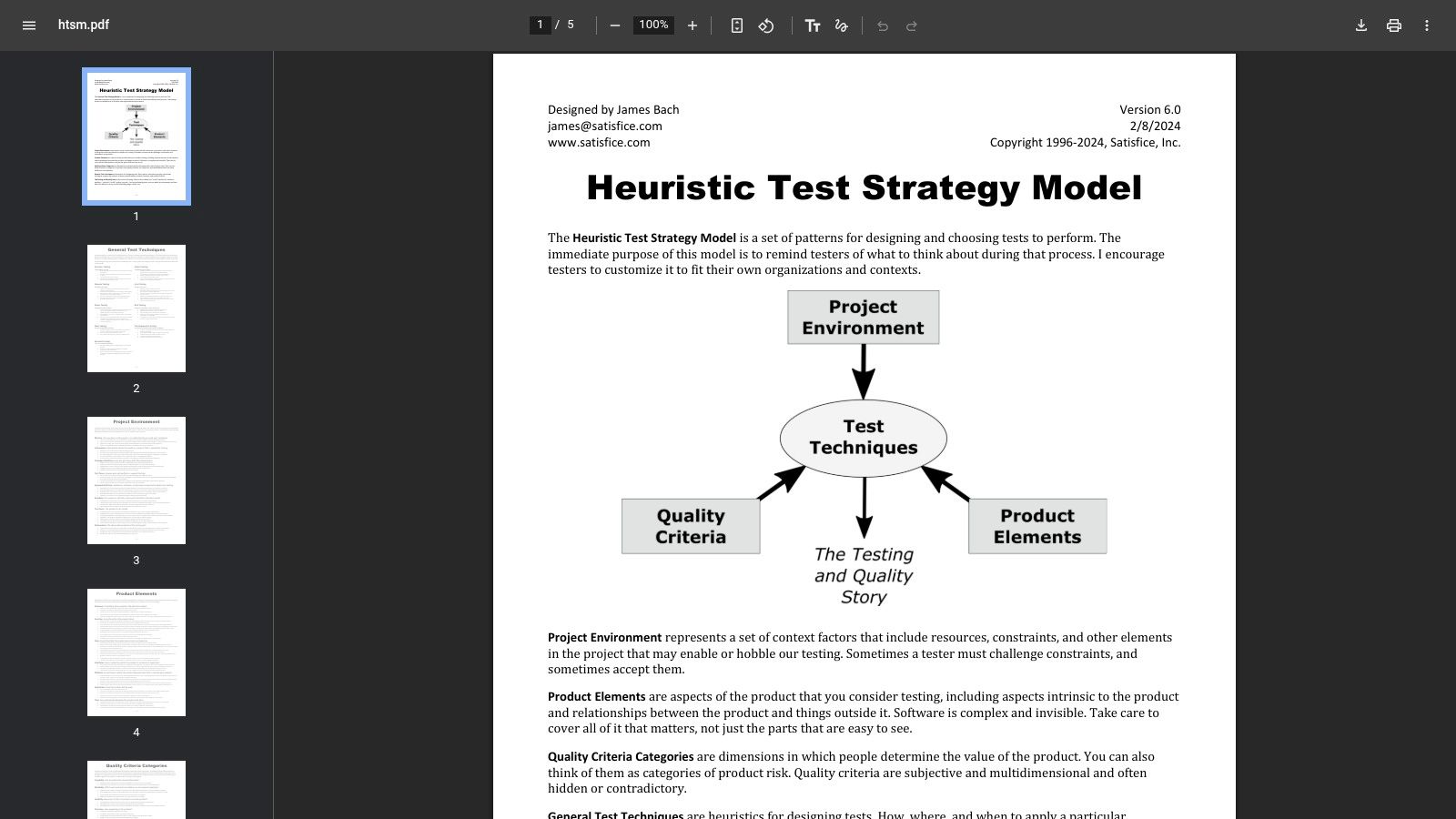
HTSM is not a fill-in-the-blanks template, and that’s exactly why strong QA leads keep it around. It works as a heuristic backbone, a compact mind-map that forces you to think through risk, oracles, flows, quality criteria, and test techniques before you sign off on the strategy. If the other templates give you structure, this one gives you coverage.
That makes it especially useful in exploratory and risk-based work. You can use it to audit your own draft and ask whether the document has blind spots around product elements, environments, or test ideas. For teams writing strategy docs for the first time, it’s a very good peer-review aid because it doesn’t let the document stay vague for long.
How experienced teams use it
I’ve seen this work best as a completeness checklist before stakeholder review. A team writes the formal strategy in Word or Confluence, then uses HTSM to challenge assumptions and find missing angles. That’s often where the value shows up, not in the template itself but in the quality of the conversation it triggers.
The downside is obvious. You still have to translate the heuristics into a formal governance artifact, and that takes judgment. But for seasoned practitioners, that’s the point.
Website, HTSM PDF
9. Department of the Navy, Master Test Strategy Template
The Department of the Navy Master Test Strategy template is the heavyweight option on this list. It’s built for traceability, governance, and program-level control, which means it reads more like a formal operating artifact than a marketing-friendly sample. If you need a strategy that can survive scrutiny in mission-critical or regulated work, this is one of the clearest reference points available.
A formal government template used for software and system programs says the document must give the program, developmental test agencies, operational test agencies, and other stakeholders the information needed to plan, resource, execute, and report testing. It also says the test process should support the Acquisition Strategy and program decision points, including release decisions, and that teams should estimate the number of Full Time Equivalents needed from each organization to support the schedule (government template). That level of operational clarity is rare in commercial templates, and it’s why defense-style structures are so often borrowed by enterprise PMOs.
Why enterprise teams study it
Even if your project isn’t in defense, the discipline is useful. The manual format reinforces schedule integration, explicit governance, and traceable decision-making. That makes it a valuable model for organizations that need audit-defensible appendices or formal sign-off chains.
The trade-off is weight. It’s detailed enough that commercial SaaS teams will usually need to trim it down hard. For mission-critical systems, though, that detail is a feature, not a bug.
Website, Department of the Navy test and evaluation manual
10. QA Zen, Test Plan plus Strategy Bundle
QA Zen is the practical “get moving today” option for teams that want editable Word files instead of theory. The bundle includes a combined Test Plan + Strategy DOCX, a Strategy Framework, and related QA artifacts such as metrics and UAT materials. That combination makes it a good fit when delivery teams need a complete baseline that they can extend quickly.
The appeal is obvious. The documents are immediately editable, the sections are pre-written, and the core downloads are free. For enterprise teams under time pressure, that can shave a lot of friction off the first drafting cycle, especially when a QA lead needs something the product manager can review without translation.
Where the bundle needs discipline
The biggest limitation is governance. Because strategy content sits inside a combined plan and strategy file, teams may need to separate those artifacts if the organization treats them as distinct approvals. That matters in formal environments where the strategy is stable and the plan changes release by release.
If you use QA Zen well, it becomes a good documentation seed rather than the final word. It gives you structure quickly, then leaves room to add architecture notes, compliance controls, and release-specific detail.
Website, QA Zen test plan template
Top 10 Test Strategy Templates Comparison
| Template / Source | Format & Editability | Best for (Target audience) | Compliance & Depth | Key strengths | Limitations |
|---|---|---|---|---|---|
| Experimentus – Test Strategy Template (Agile) | PDF (17pp); guidance + placeholders; copy to Word/Confluence to edit | Program-level governance; large enterprises; Agile/hybrid teams | Strong governance & risk focus; uses older ISO 9126 terms (needs mapping) | Practitioner "how-to" notes; multi-level strategy; program spine | PDF-only; editing friction; terminology update required |
| DexForm – Test Strategy Template | DOC & PDF (11pp); fill-in-the-blanks | Teams needing quick, operational template; small projects | Lightweight; minimal compliance detail | Fast to adopt; minimal onboarding | Generic content; needs deepening for regulated contexts |
| MG Software – QA Test Strategy Template | Web guide + downloadable file; modern terminology | Product, engineering leadership; CI/CD teams | Covers CI/CD, test data, metrics; may need enterprise annexes | Multiple variants (Agile/risk/shift-left); modern practices | Download link handling; adaptation for strict compliance |
| Testriq – Test Strategy Template (ISO/IEC/IEEE 29119 aligned) | Web template (structured eight sections); copy into doc system | Regulated clients; audit-focused programs | ISO/IEEE-aligned; risk register, entry/exit, RACI included | Audit-ready fields; clear Strategy vs Plan separation | Not packaged as DOC; requires tailoring to org templates |
| Smartsheet – Agile Test Strategy Template | Word/Excel/PPT/Google formats + companion assets | Office-centric teams; PMOs; iterative workflows | Generic Agile framing; limited depth for security/perf/privacy | Multiple Office formats; companion artifacts; easy standardization | Needs extra depth for high-risk or regulated projects |
| StrongQA – Test Strategy Templates Library | Portal with multiple downloadable templates (varied formats) | Workshops, training, composing house-style templates | Varies by file; some templates require expansion | Variety for merging best sections; quick samples | Mixed quality across files; review required before adoption |
| TestLodge – Test Strategy Example + Lean Test Plan | PDF example + Word/Excel lean templates | Teaching artifacts; teams favoring concise documentation | Illustrative; may lack depth for regulated/high-risk work | Promotes brevity and maintainability; immediate downloads | Example needs tailoring for real projects |
| Satisfice / DevelopSense – HTSM | PDF checklist / mind-map (heuristic model), not fill-in | Peer review; exploratory & risk-based strategy formation | Heuristic backbone for completeness; complements templates | Gold-standard heuristics; avoids blind spots | Not a ready template; requires interpretation and mapping |
| Department of the Navy – Master Test Strategy (MTS) Template | DoN manual PDF; highly structured program-level MTS | Mission-critical, defense, and heavily regulated programs | Very high, DoD T&E aligned; traceability & governance | Audit-defensible; rigorous program structure | Heavyweight; over-prescriptive for commercial SaaS |
| QA Zen – Test Plan + Strategy Bundle | Editable DOCX downloads; combined Plan+Strategy + QA artifacts | Enterprise teams needing editable Word baselines | Practical templates for enterprise; may need separation for governance | Immediately editable; cohesive document set; free core templates | Plan+Strategy combined (may need separation); some resources behind paywall |
Implement Your Strategy with Confidence
A template is only the starting point. The true value comes from adapting it to your delivery model, your risk profile, and your governance needs, especially when the work involves legacy systems, regulated data, multiple release trains, or AI-enabled features that need more than basic functional coverage. The strongest test strategy template is the one that helps your team prove readiness, not just describe intent.
For enterprise systems, that usually means building in compliance, security, test data management, environment strategy, and a clear defect workflow. It also means keeping the document alive after release 1, because a strategy that never changes quickly stops reflecting reality. The best QA leaders treat the strategy as a living governance artifact, version it carefully, and revisit it when the product, team, or operating model changes.
There's also a bigger historical shift happening here. Strategy documents have moved from narrative checklists to measurable control systems, and the templates that work best are the ones that make quality visible in a way leaders can act on. That's why the right template matters, it shapes how your team thinks about evidence, risk, and release confidence from the first draft onward.
If your organization needs help turning a generic template into a release-ready governance artifact, devPulse can help design the structure, tailor the controls, and align QA with architecture, compliance, and delivery reality. The team works across modernization, AI integration, and regulated enterprise systems, so it's a solid fit when your test strategy has to hold up under real operational pressure. Visit devPulse to see how they can help you build a strategy that's practical, auditable, and ready for the next release.