













Software companies typically deliver twelve core service categories: custom software development, web application development, mobile app development, cross-platform desktop apps, cloud and DevOps, AI/ML and generative AI, UI/UX and product design, QA and testing, integrations and APIs, data and analytics, security and compliance, dedicated teams and staff augmentation, legacy modernization, ongoing maintenance, and support. The global software market continues to expand, making the ability to distinguish between these categories a genuine competitive advantage for any business evaluating vendors.
The fastest way to validate a provider: request a written capability brief and at least one case study from your specific industry before any sales conversation begins.
- Custom software / product development: Purpose-built applications designed around your workflows, not generic off-the-shelf tools.
- Web application development: Browser-based platforms, portals, and SaaS products built for scale and performance.
- Mobile app development: Native iOS/Android or cross-platform apps (React Native, Flutter) for consumer or enterprise use.
- Cross-platform desktop apps: Applications that run on Windows, macOS, and Linux from a single codebase.
- Cloud and DevOps: Infrastructure design, CI/CD pipelines, containerization, and managed cloud operations.
- AI/ML and generative AI: Predictive models, recommendation engines, LLM-powered assistants, and agentic AI workflows.
- UI/UX and product design: Research-driven design systems, prototyping, and usability testing.
- QA and testing: Automated and manual testing, performance benchmarking, and release validation.
- Integrations and APIs: Connecting third-party platforms, ERPs, CRMs, and data sources into a unified system.
- Data and analytics: Data pipelines, warehousing, dashboards, and business intelligence layers.
- Security and compliance: Secure SDLC, penetration testing, SOC 2 readiness, and zero-trust architecture.
- Dedicated teams and staff augmentation: Embedded engineers who extend your in-house capacity under your direction.
- Legacy modernization: Migrating, refactoring, or rebuilding aging systems to reduce technical debt.
- Maintenance and support: Post-launch monitoring, bug resolution, performance tuning, and SLA-backed uptime management.
Pro Tip: Before your first vendor call, write a one-page discovery brief that names your target users, the core problem you are solving, your technology constraints, and one measurable success metric. Vendors who respond to that brief with specific questions rather than a generic proposal deck are worth shortlisting.
Key Takeaways
A software company’s value to your business depends on matching the right service category to your actual need, choosing an engagement model that fits your risk tolerance, and evaluating vendors on evidence rather than proposals.
| Point | Details |
|---|---|
| Map needs to service categories | Identify which of the twelve core service types your project requires before issuing any RFP or vendor brief. |
| Use NIST definitions for cloud claims | Classify vendor cloud offerings against IaaS/PaaS/SaaS definitions to avoid paying for hosted VMs marketed as cloud-native. |
| Run a paid discovery before committing | A two-to-four-week discovery phase reveals more about a vendor’s capability than any proposal document. |
| Audit before modernizing | Commission a technical audit covering incident frequency, feature cost, and dependency risk before choosing between modernization and rebuild. |
| Devpulse as a full-cycle option | Devpulse covers discovery through post-launch support across custom engineering, AI, cloud, desktop, and legacy modernization engagements. |
Three immediate action items
- Write a one-page discovery brief that names your target users, core problem, technology constraints, and one measurable success metric. Send it to every vendor you are evaluating and compare the quality of their clarifying questions.
- Request a relevant case study from each shortlisted vendor, specifically from your industry or a comparable technical domain. Ask the vendor to walk you through the outcome, the timeline, and one thing that did not go as planned.
- Run the three-step decision framework (non-negotiables screen, weighted differentiator scoring, paid discovery) before committing to any full-build contract.
Table of Contents
- What services does a software company actually cover?
- How do engagement models and costs compare?
- How do you evaluate and choose a software company?
- When should you modernize vs. rebuild a legacy system?
- Why Devpulse is worth evaluating as your software partner
- What decision-makers often get wrong about vendor selection
- Devpulse builds what your business actually needs
- Sources
What services does a software company actually cover?
The services of a software company rarely fit into a single bucket, and that breadth is precisely what makes vendor selection complex. Each category below carries a short definition and a buying signal so you can map your actual need to the right service type.
Custom software and product development
A software company builds applications from the ground up when no commercial product fits your workflows or competitive requirements. The output is source code you own, not a license you rent.
When to choose this: Your process is differentiated enough that off-the-shelf tools create workarounds rather than solutions.
Pro Tip: Confirm IP ownership in writing before a line of code is written. The contract should state that all work product, including interim builds and documentation, transfers to you upon payment.
Web application development
Web apps cover everything from internal portals and customer-facing SaaS platforms to e-commerce engines and data dashboards. A qualified vendor will specify the framework (React, Next.js, Django, Rails) and explain why it fits your scale and team’s future maintenance capacity.
When to choose this: You need a browser-accessible product that multiple user roles interact with simultaneously.
Pro Tip: Ask the vendor to show you a live performance audit (Lighthouse or WebPageTest scores) from a comparable project. Load time and Core Web Vitals directly affect conversion and SEO.
Mobile app development
Native development (Swift for iOS, Kotlin for Android) delivers the best device integration and performance. Cross-platform frameworks like React Native or Flutter reduce build time and cost when you need both platforms simultaneously and can accept minor performance trade-offs.
When to choose this: Your users are primarily on mobile, or your product requires device hardware access (camera, GPS, biometrics).
Desktop and cross-platform applications
Electron, Tauri, and .NET MAUI let teams ship a single codebase across operating systems. This matters most for professional software tools, creative applications, and enterprise utilities where users expect native-feeling performance on managed corporate hardware.
When to choose this: Your users work in regulated or air-gapped environments where browser-based delivery is impractical.
Cloud and DevOps
NIST Special Publication 800-145 defines the three cloud service models (IaaS, PaaS, SaaS) and five essential characteristics that distinguish genuine cloud delivery from a hosted virtual machine. Use those definitions when a vendor claims “cloud-native,” but cannot explain which service model they are building on.
When to choose this: You need elastic scaling, multi-region availability, or automated deployment pipelines.
Pro Tip: Ask vendors to classify their cloud architecture against NIST’s service model definitions. A vendor who cannot distinguish IaaS from PaaS is likely to over-provision and under-architect.
AI/ML and generative AI
This category spans predictive analytics, classification models, NLP pipelines, retrieval-augmented generation (RAG), and agentic AI systems that take autonomous action within defined guardrails. The distinction between a fine-tuned model and a prompt-engineered wrapper matters enormously for cost, latency, and maintainability.
When to choose this: You have a decision, classification, or content generation task that currently requires significant manual effort and has enough data to train or adapt a model.
UI/UX and product design
Design is not decoration. A structured UX process (user research, information architecture, wireframing, prototype testing) reduces rework in development by surfacing requirement gaps before they become expensive code changes.
When to choose this: You are building a consumer-facing product, or your current product has measurable drop-off at key user flows.
QA and testing
Quality engineering covers unit, integration, end-to-end, performance, and security testing. Automated test suites that run in CI/CD pipelines catch regressions before they reach production. A vendor with no documented QA process is a liability, not a cost saving.
When to choose this: Always. QA is not optional; the question is only whether it is embedded in the delivery process or bolted on at the end.
Integrations and APIs
Most enterprise products do not live in isolation. Connecting your application to Salesforce, SAP, Stripe, or a proprietary data source requires API design, authentication management, error handling, and versioning strategy. Poor integration architecture is one of the most common sources of production incidents.
When to choose this: Your product needs to exchange data with external systems, or you are consolidating multiple tools into a unified platform.
Data and analytics
Data engineering (pipelines, warehouses, lakes) feeds the analytics layer (BI dashboards, reporting, embedded analytics). AI/ML sits on top of a clean data foundation. Vendors who offer AI without addressing data quality are skipping the hardest part.
When to choose this: You need to turn operational data into decisions, or your current reporting relies on manual exports and spreadsheets.
Security and compliance
Forbes reporting on web security incidents has long underscored that unprotected applications are targets from day one. A mature vendor embeds security into the SDLC rather than treating it as a final-phase checklist. SOC 2 Type II certification, penetration testing, and zero-trust network design are the baseline expectations for enterprise software.

When to choose this: Any product handling sensitive data, regulated information (HIPAA, FERPA, SOC 2), or financial transactions.
Dedicated teams and staff augmentation
Staff augmentation places individual engineers under your management. A dedicated team model provides a self-managed squad (engineers, QA, PM, design) that operates as an extension of your organization. The distinction matters for IP control, management overhead, and knowledge retention.
When to choose this: You have a defined product roadmap but lack the internal headcount to execute it at the required pace.
Maintenance and support
Post-launch support covers bug resolution, dependency updates, performance monitoring, and SLA-backed incident response. A vendor who disappears after go-live creates compounding technical debt. Confirm SLA tiers (response time, uptime guarantees) and escalation paths before signing.
When to choose this: Every production system. The question is whether you handle it internally or contract it to the development partner.
How do engagement models and costs compare?
Choosing the right engagement model shapes your risk exposure, budget predictability, and ability to respond to changing requirements. Four models dominate the US market.
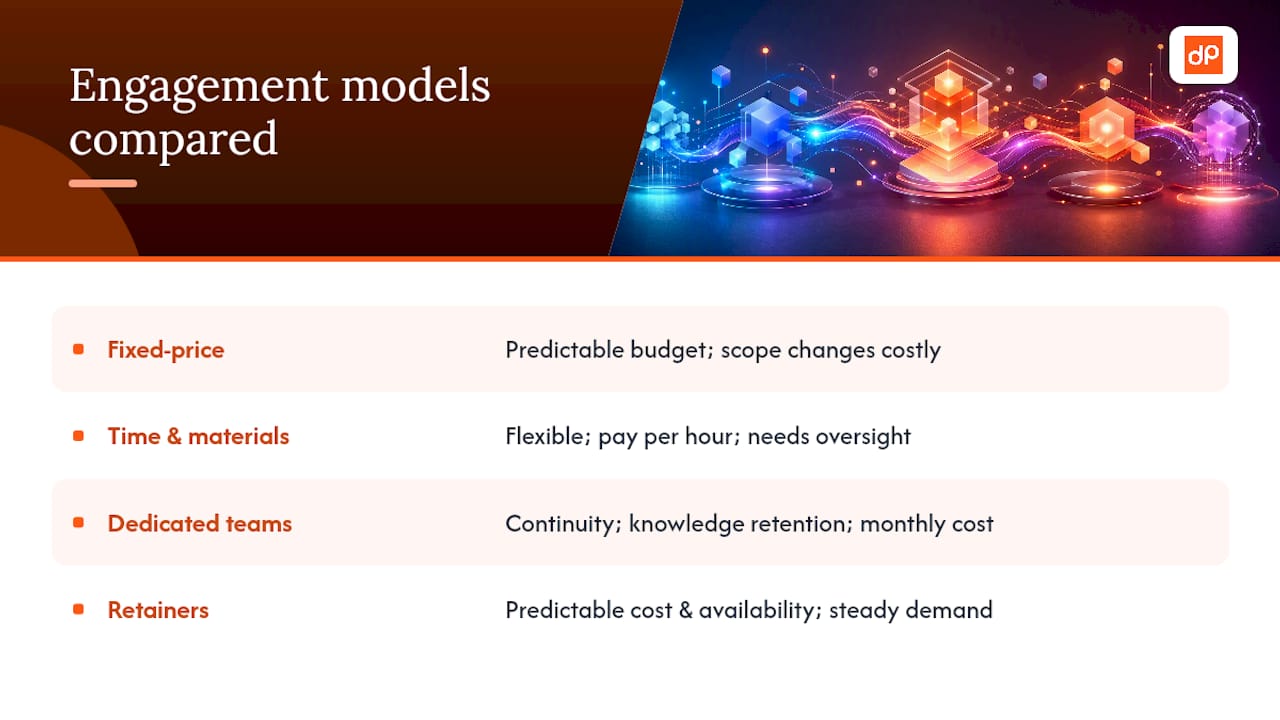
Fixed-price: The vendor delivers a defined scope for an agreed fee. Predictable for budget owners, but scope changes are expensive and slow. Best for well-defined, short-duration projects where requirements are stable.
Time and materials (T&M): You pay for hours worked at an agreed rate. Flexible for evolving requirements, but budget control requires active oversight. Best for discovery phases, R&D, and products where the roadmap is still forming.
Dedicated teams: A retained squad works exclusively on your product. You get continuity, institutional knowledge, and predictable monthly cost. Best for ongoing product development and SaaS companies scaling their engineering capacity.
Retainers: A fixed monthly fee for a defined service scope, typically maintenance, support, or advisory work. Predictable cost, predictable availability. Best for post-launch support and IT consulting services where demand is steady but not project-shaped.
Typical timeline and cost ranges
These ranges reflect US market rates for experienced engineering teams in 2025–2026 and vary significantly by team seniority, geography, and technical complexity. Treat them as order-of-magnitude guidance, not binding estimates.
Budgeting considerations:
- Discovery phases are not overhead. A structured discovery reduces mid-project scope changes, which are the primary driver of cost overruns.
- Post-launch support retainers commonly represent a significant fraction of initial build costs annually, to maintain active product health.
- SLA tiers (99.9% vs. 99.99% uptime) carry meaningfully different infrastructure and staffing costs. Confirm which tier your product actually needs before negotiating.
- IP ownership clauses should specify that all deliverables, including code, documentation, and design assets, transfer to you upon payment. Vendors who retain license rights to reusable components should disclose this explicitly.
Pro Tip: Request itemized estimates broken down by phase and role (engineering, design, QA, PM). A vendor who can only provide a single lump-sum number has not scoped the work in enough detail to deliver it reliably.
How do you evaluate and choose a software company?
The difference between a successful engagement and a costly rebuild often comes down to the questions you ask before signing. Use this framework to screen vendors systematically.
Evaluation checklist
Before requesting proposals, confirm each vendor can demonstrate:
- Case studies in your industry: Generic portfolios are insufficient. Ask for work in healthcare, cybersecurity, legal tech, edtech, or your specific domain. Industry-specific experience means the vendor already understands your compliance requirements and user expectations. Oracle’s sector trend reporting illustrates how sharply software requirements diverge by industry.
- Client references you can contact: Review platforms like Clutch provide a starting point, but a direct reference call is irreplaceable. Ask the reference specifically about timeline adherence and how the vendor handled scope changes.
- Documented delivery methodology: Agile with CI/CD and DevOps practices is the current standard for product development. Ask to see a sample sprint cadence, retrospective format, and deployment pipeline diagram.
- Security practices: SOC 2 Type II certification, secure SDLC documentation, and a defined penetration testing schedule are baseline requirements for any product handling sensitive data.
- Tech stack rationale: The vendor should explain why they chose a specific stack for comparable projects, not just list technologies they know.
- Team composition and seniority: Understand who will actually work on your project. A proposal that features senior architects but delivers junior developers is a common bait-and-switch. Ask for CVs of the assigned team.
- SLA documentation: Post-launch support terms, incident response times, and escalation paths should be written, not verbal.
A series of questions to ask prospective vendors
- Walk me through your discovery process. What do you deliver at the end of it?
- How do you handle a requirement change mid-sprint?
- What does your QA process look like, and at what stage does it begin?
- Can you show me your CI/CD pipeline configuration from a comparable project?
- How do you manage security reviews during development, not just at launch?
- Who specifically will be assigned to our project, and what is their seniority level?
- What happens if a key engineer leaves mid-engagement?
- How is IP ownership structured in your standard contract?
- What SLA tiers do you offer for post-launch support, and what are the escalation paths?
- Have you worked in our industry before? What compliance requirements did that project involve?
- How do you communicate project status, and how often?
- What does a successful handoff look like at the end of the engagement?
Red flags to watch for
- Vague estimates with no phase breakdown or assumption list
- No named references willing to take a call
- A single point of contact who is also the lead developer, PM, and QA
- No documented QA process or testing strategy
- IP ownership language that is ambiguous or retains vendor rights to deliverables
- Proposals that arrive within hours of the brief, with no clarifying questions
A three-step decision framework for comparing finalists
Step 1 — Score on non-negotiables. Assign pass/fail to: relevant case study, contactable reference, documented Agile process, security certification or documented practice, and clear IP terms. Any vendor who fails two or more is eliminated.
Step 2 — Weight the differentiators. Score finalists 1–5 on: team seniority and stability, tech stack fit, communication quality during the sales process, and post-launch support terms. Weight each criterion by its importance to your project.
Step 3 — Run a paid discovery. Before committing to a full build, commission a short discovery phase (two to four weeks) with your top candidate. The output (architecture diagram, scope document, risk register) tells you more about the vendor’s capability than any proposal document.
When should you modernize vs. rebuild a legacy system?
Legacy modernization is one of the most consequential decisions a technology leader makes, and the wrong call in either direction is expensive. The choice is not binary: there are five distinct approaches, each suited to a different business situation.
- Rehost (lift and shift): Move the existing application to cloud infrastructure with minimal code changes. Fastest and lowest risk, but delivers limited operational improvement. Appropriate when the application is stable and the primary goal is infrastructure cost reduction.
- Replatform: Migrate to a managed cloud service (e.g., moving from self-managed MySQL to Amazon RDS) with targeted optimizations. Moderate effort, meaningful operational gains.
- Refactor: Restructure the existing codebase to improve maintainability, performance, or scalability without changing external behavior. High effort, high long-term value. Appropriate when the core logic is sound but the architecture is brittle.
- Rebuild: Rewrite the application from scratch using modern architecture. Highest risk and cost, but the right choice when the existing codebase is so degraded that refactoring costs exceed rebuild costs, or when the business model has fundamentally changed.
- Replace: Retire the custom application and adopt a commercial platform. Appropriate when a mature SaaS product now covers the use case adequately.
How to read the ROI signals
Modernization delivers measurable returns in three areas: reduced unplanned downtime, lower maintenance cost per feature, and faster time to market for new capabilities. A system that requires two weeks of developer time to ship a minor feature is costing you far more than its hosting bill suggests.
A credible modernization ROI case starts with a technical audit. The audit should document: current incident frequency and resolution time, average cost to ship a feature, dependency risk (end-of-life frameworks, unsupported libraries), and security exposure surface. With those baselines, you can model payback periods against modernization investment.
Pros of modernizing vs. rebuilding:
- Lower upfront cost and shorter initial timeline
- Preserved business logic that has been validated over years
- Lower organizational disruption during transition
- Incremental delivery reduces risk
Cons of modernizing vs. rebuilding:
- Inherited technical debt may limit how far you can go
- Refactoring a deeply coupled codebase can take longer than expected
- The result may still carry architectural constraints that limit future scale
Pro Tip: Before committing to either path, commission a two-to-four-week technical audit from a vendor with no stake in the outcome. The audit deliverable should include a dependency map, a security exposure summary, and a side-by-side cost model for modernization vs. rebuild. That document is worth more than any vendor’s verbal recommendation.
A digital transformation roadmap built on audit findings gives leadership a defensible business case and a phased delivery plan that manages risk without stalling progress.
Why Devpulse is worth evaluating as your software partner
Devpulse’s full-cycle development services cover the complete delivery arc: discovery and architecture, design, engineering, quality validation, deployment, and ongoing support. That end-to-end capability matters because handoff risk between specialized vendors is one of the most common sources of project failure.
Core capabilities mapped to buyer priorities
- Custom engineering: End-to-end product development for startups, SaaS companies, and enterprise clients, with IP ownership transferring to the client.
- AI and generative AI: LLM-powered assistants, agentic AI workflows, RAG pipelines, and predictive models built on clean data foundations.
- Cross-platform desktop applications: Electron, Tauri, and WebAssembly-based applications for professional and enterprise software markets.
- Cloud and DevOps: Infrastructure design, CI/CD pipeline implementation, containerization, and managed cloud operations aligned to NIST service model definitions.
- Legacy modernization and software enhancement: Technical audits, replatforming, refactoring, and full rebuilds for organizations carrying significant technical debt. Detailed capability documentation is available on Devpulse’s engineering and modernization services page.
- QA and quality engineering: Automated test suites, performance benchmarking, and security testing embedded in the delivery pipeline.
- Maintenance and support: SLA-backed post-launch support with defined incident response tiers and escalation paths.
Typical process flow and team composition
A standard Devpulse engagement runs through five phases: discovery (requirements, architecture, risk register), design (UX research, wireframes, design system), build (sprint-based engineering with CI/CD), validate (automated and manual QA, security review), and operate (deployment, monitoring, support handoff). Typical team composition includes a technical lead, two to five engineers depending on project scale, a QA engineer, a UI/UX designer, and a project manager. Senior engineers lead architecture decisions; mid-level engineers carry the bulk of feature development.
Case highlights
Desktop application support portfolio: Devpulse delivered long-term technical support and maintenance for a portfolio of desktop applications, demonstrating sustained post-launch capability and SLA adherence across a multi-product environment.
Cross-platform desktop performance: The cross-platform desktop app case study shows how Devpulse delivered high-performance desktop applications while reducing engineering overhead, a direct demonstration of the replatform and refactor approaches described in the modernization section.
Cloud file management platform: The unified cloud file management case study illustrates Devpulse’s cloud engineering capability applied to a real product with multi-user, multi-platform requirements.
For an initial conversation, prepare a one-page brief covering: the business problem you are solving, your target users, your current technology environment, your timeline, and one measurable outcome that would define success. That brief lets Devpulse’s team respond with a specific, scoped proposal rather than a generic capability deck.
What decision-makers often get wrong about vendor selection
There is a persistent assumption in procurement that the safest choice is the vendor with the longest client list or the most recognizable logo on their case study page. That assumption costs organizations real money.
The vendors who deliver the best outcomes for mid-market and enterprise clients are often those who ask the most uncomfortable questions during discovery: about data quality, about internal stakeholder alignment, about what happens when the first version does not perform as expected. A vendor who validates every assumption in your brief without pushback is not being agreeable. They are deferring risk to you.
The other underestimated factor is post-launch continuity. Most procurement conversations focus entirely on the build phase. The maintenance and support phase, which typically runs for years, receives a fraction of the scrutiny. SLA terms negotiated under time pressure at contract signing are the terms you will live with when a production incident hits at 2 AM. Read them carefully before you sign, not after.
Finally, the modernization-vs-rebuild decision deserves more analytical rigor than it usually gets. Organizations routinely underestimate the cost of maintaining a degraded system and overestimate the risk of a structured modernization. A well-scoped technical audit, conducted before any vendor is selected for the build, is the single highest-ROI investment a technology leader can make in the evaluation process.
Devpulse builds what your business actually needs
Devpulse works with startups, SaaS companies, and enterprise organizations that need a software partner with both technical depth and business judgment. Where a traditional agency hands you a proposal based on your brief, Devpulse starts with a structured discovery that surfaces the constraints, risks, and trade-offs your brief did not capture.
Engagement options include short discovery sprints (two to four weeks), fixed-scope MVP builds, dedicated engineering teams for ongoing product development, legacy modernization roadmaps, and SLA-backed support retainers. Whether you are building a new product or rescuing a system that has outgrown its original architecture, the starting point is the same: a clear picture of where you are and what success looks like.
To prepare for a productive first conversation, bring four things: your business goal and the metric that measures it, your current technology environment (even a rough diagram helps), your timeline and any hard constraints, and the biggest risk you are trying to avoid. That preparation lets the conversation move directly to architecture and scope rather than spending the first hour on background.
Explore Devpulse’s engineering and product modernization services or schedule a discovery call to discuss your project.