











Your compliance lead walks into a vendor demo with a spreadsheet full of feature checkboxes, and by the end of the call, nobody can say which platform will survive a real rollout across safety, privacy, and operations. That’s the trap with healthcare risk management software. The demos all look polished, the workflows all sound sensible, and the first live issue often exposes the gap between a clean product tour and a messy regulated environment.
The category is real and growing fast, which is exactly why buyers need a tighter lens. Grand View Research put the global patient safety and risk management software market at USD 2.22 billion in 2024, with a projected 12.12% CAGR from 2025 to 2030 to USD 4.36 billion by 2030 (Grand View Research market outlook). MarketsandMarkets projects a similar climb, from USD 1.75 billion in 2025 to USD 2.99 billion by 2030 at 11.3% CAGR (MarketsandMarkets patient safety and risk management software market). That growth says one thing clearly, this is now core healthcare IT, not a niche compliance add-on.
The buying mistake is obvious. Teams overvalue feature lists and undervalue the two failure modes that show up after go-live, third-party and connected-device risk beyond the hospital firewall, and global regulatory fragmentation that makes one country’s clean process break in another. If you’re a CIO, CCO, head of patient safety, or procurement lead at a mid-to-large provider or MedTech firm, the right shortlist is the one that can handle evidence, integrations, and governance under real operating pressure.
Why Healthcare Risk Software Buys Keep Stalling
A compliance lead can enter a vendor demo with the right questions and still leave with the wrong answer. The product may show incident intake, a dashboard, and a tidy approval flow, but that doesn’t tell you whether it fits your actual reporting chain, your clinical workflow, or your regional obligations. It’s common for buyers to confuse a strong presentation with operational fit.
The real reason deals freeze
Three failure modes keep appearing after the first few weeks of evaluation. The first is fragmented compliance evidence, where the system creates logs but doesn’t preserve them in a way audit, legal, and quality teams can all use. The second is integration mismatch, where the software works in isolation but doesn’t align with how nurses, safety officers, or biomedical teams document events.
The third is governance. A platform can’t fix a weak taxonomy, a vague ownership model, or a messy handoff between compliance and operations. A good contract helps, and it’s smart to manage contracts in healthcare, but contracts don’t make people define severity scores, reporting rules, or escalation paths.
Practical rule: if the demo doesn’t show who owns the evidence after an incident is closed, the buyer still doesn’t have a risk platform, only a reporting interface.
What this article will help you do
The shortlist meeting should answer four questions. What does the software do. What market signals matter for deployment choice. What compliance behaviors must be proven, not promised. And where does governance, not selection, decide whether the implementation survives go-live.
That framing matters because the wrong shortlist usually optimizes for visibility and underestimates durability. Vendors love to sell breadth, but regulated healthcare buyers need something narrower and harder. They need a platform that can keep evidence clean, integrate with clinical and operational systems, and tolerate jurisdictional variation without forcing every site into one brittle process.
What Healthcare Risk Management Software Does
A credible platform has four building blocks. If a vendor cannot show all four, the product is incomplete, even if the interface looks modern. Treat each one as a control point, not a feature.
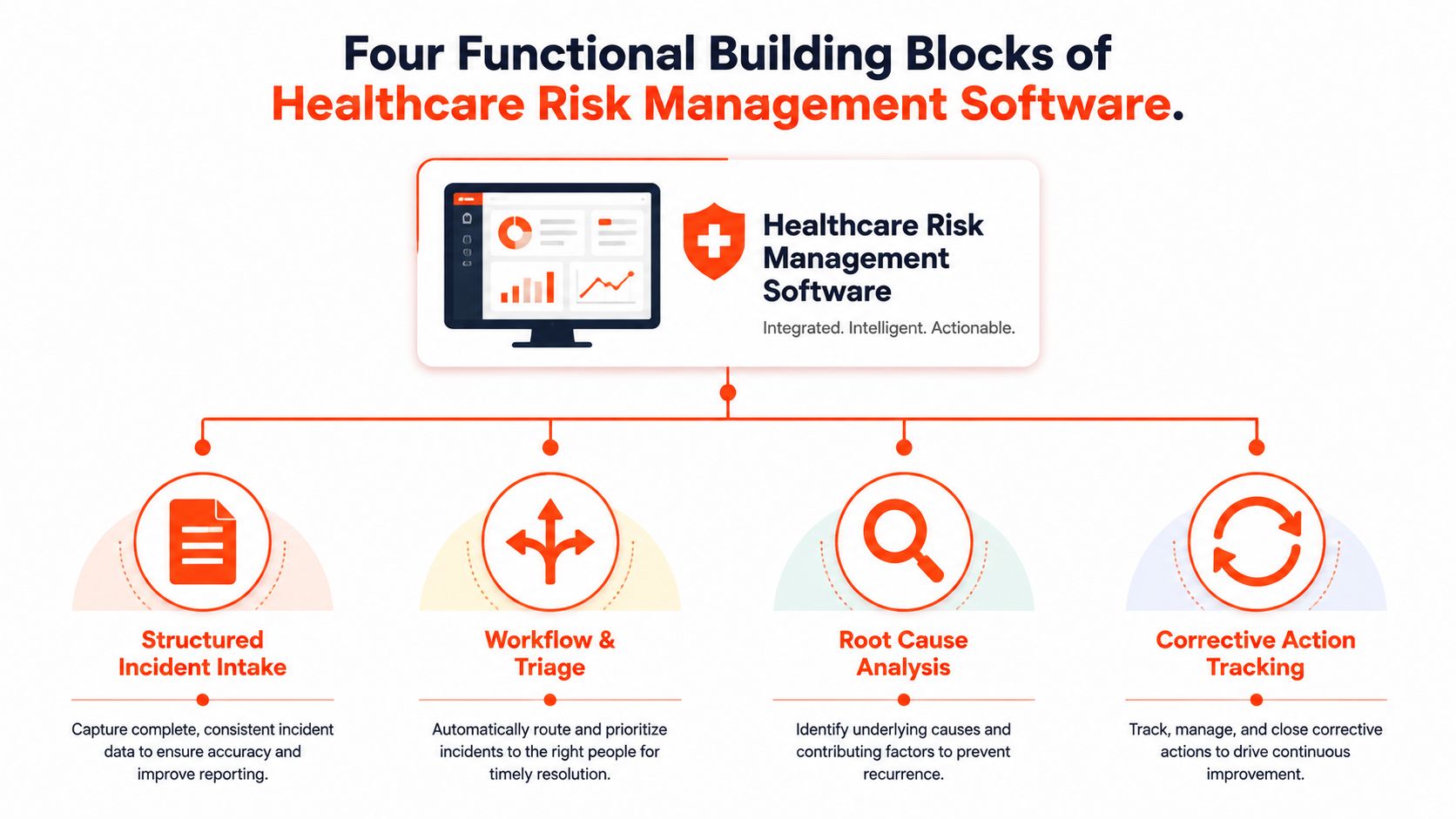
Incident intake functions as a triage desk
Incident intake should capture near-misses, patient complaints, adverse events, and other signals without forcing the user through a maze of forms. The best systems reduce documentation friction and still preserve enough structure for later analysis. If intake is clumsy, staff will route events around the system, and you will lose the very signals the platform is supposed to collect.
That is why the architecture in neutral industry guidance matters. Core designs combine incident reporting, a centralized risk register, workflow automation for RCA and CAPA, and interoperability with EHRs and devices through FHIR and HL7. That combination keeps the intake process usable while improving the quality of the signal (accountableHQ on healthcare risk management tools).
Centralized risk register
The risk register is the shared ledger. It should survive turnover, shifting priorities, and site-specific differences. If the record lives only in one person’s inbox or one department’s spreadsheet, the system will drift the moment someone changes role.
A good register gives leadership a durable view of open issues, ownership, and status. It also keeps clinical, operational, and compliance teams looking at the same source of truth. That is the difference between a record-keeping tool and a management tool.
RCA and CAPA workflow should behave like a to-do list with teeth
RCA and CAPA need to assign owners, due dates, reminders, and escalation paths that are visible to more than one team. If the workflow cannot drive action, it only documents delay. Software helps here, but only if the organization already knows who approves a fix, who verifies closure, and who owns follow-up after the meeting ends.
The vendor should show how root cause analysis links to corrective action, how tasks get reassigned, and how closure is validated. A polished dashboard is useless if nobody can see overdue work or trace why a fix was approved.
Audit evidence and control
Audit evidence is the flight recorder. It should preserve role-based access, encryption, retention controls, and immutable logs that support investigations and regulator-facing reporting. Embedded evidence controls matter because audits do not start when the auditor arrives, they start the moment a record is created.
The category is not a repackaged GRC suite with a hospital label. It is also not just an EHR module. If the vendor cannot show structured intake, a durable risk register, action workflow, and evidence controls in one operating model, keep looking.
Market Signals Every Shortlist Should Read Correctly
The market is expanding fast enough that the wrong vendor choice won’t be obvious until after implementation starts. That matters because fast growth changes vendor behavior. Roadmaps get more aggressive, sales teams promise more, and buyers often have more bargaining power than they realize if they ask the right questions early.
What growth says about vendor posture
When a market posts sustained double-digit growth, it usually means three things. Vendors have money to fund product expansion. Incumbent inertia gets stronger because switching costs rise. And buyers who know what they want can push for roadmap influence instead of accepting a generic package.
That’s the practical meaning of a category moving from emerging to core infrastructure. The data backs that up. Grand View Research put the market at USD 2.22 billion in 2024 with a projected rise to USD 4.36 billion by 2030 at 12.12% CAGR, while MarketsandMarkets projected USD 1.75 billion in 2025 to USD 2.99 billion by 2030 at 11.3% CAGR (Grand View Research market outlook, MarketsandMarkets patient safety and risk management software market). That’s enough momentum to keep the market crowded, but not enough to excuse weak product fit.
Buyer takeaway: growth helps the vendor land new logos. It doesn’t prove the platform can handle your workflow, your evidence model, or your rollout complexity.
What deployment data says about architecture
Cloud is no longer the fringe choice. Mordor Intelligence reported that cloud accounted for 70.92% of market share in 2025, and one industry report cited 70% of new deployments in 2024 as cloud implementations (Mordor Intelligence market breakdown, Grand View Research market outlook). The practical implication is blunt, on-premises-only shortlists are now a minority position.
That doesn’t mean every buyer should force a pure cloud model. Hybrid is the fastest-growing architecture for organizations that can’t move imaging, identity, or device telemetry all at once, and Mordor Intelligence projects hybrid deployment at 14.99% CAGR through 2031 (Mordor Intelligence market breakdown). If a vendor can’t explain cloud-first or cloud-hybrid deployment clearly, it’s probably too rigid for regulated healthcare.
HIPAA and GDPR as Product Requirements, Not Checkboxes
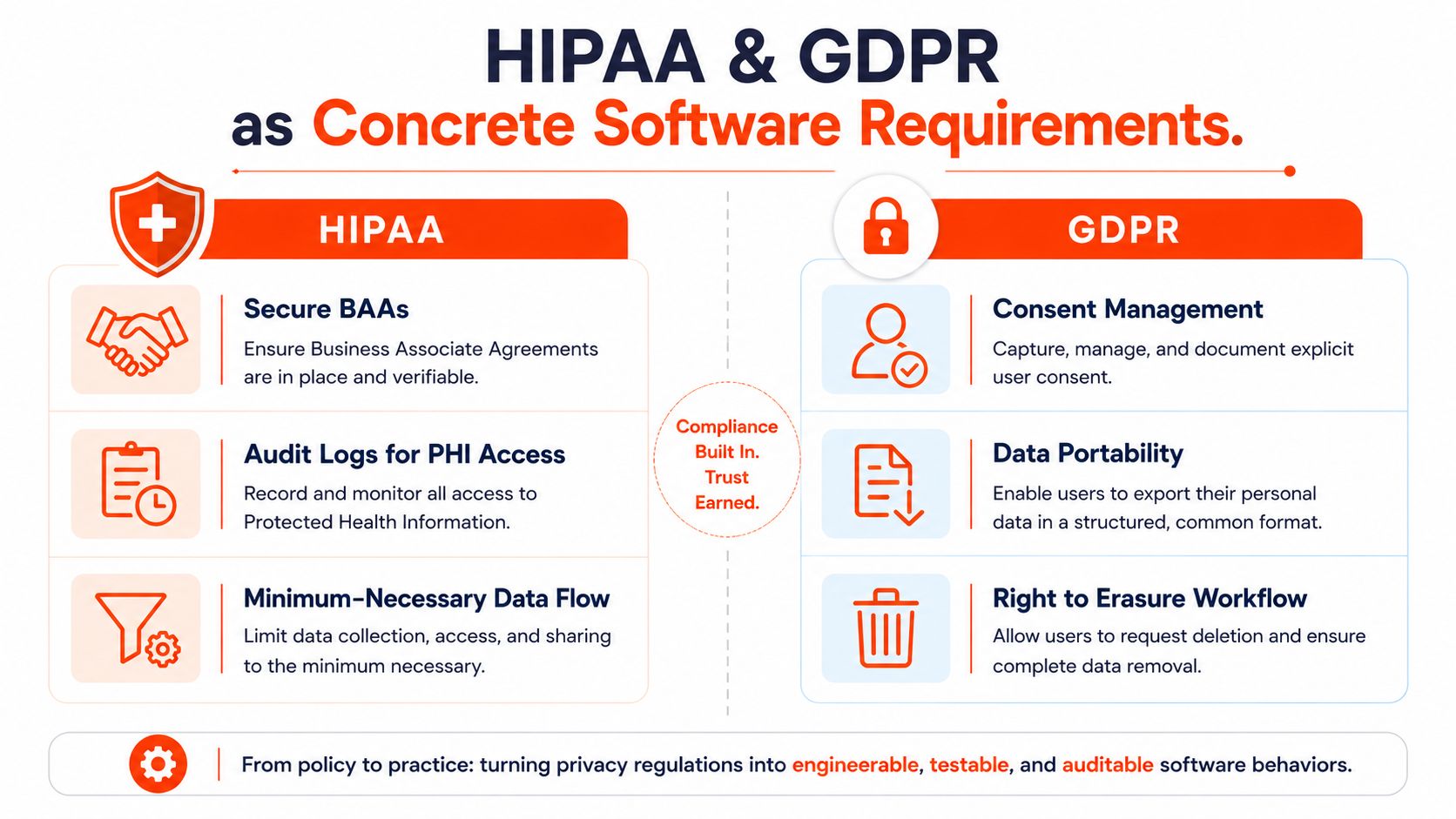
HIPAA and GDPR shape product design. A serious platform should show how those rules appear in the UI, the data model, and the evidence trail.
What HIPAA forces the software to do
HIPAA buyers should ask about Business Associate Agreements, role-based controls, and field-level audit logs. The UI should enforce minimum-necessary access, not just rely on policy documents. If a user can see more than they need, the software has failed before the audit even starts.
Data flow matters too. Any subprocessors must be BAA-aware, and the system should produce the evidence needed for breach notification clocks without manual reconstruction. Compliance is a behavior set the platform must demonstrate on demand, not a static settings page.
What GDPR forces the software to do
GDPR changes the problem in a different way. A platform needs a lawful basis for processing safety events involving EU data subjects, plus data subject access and erasure workflows that do not destroy the risk record. It also needs residency controls that fit the organization’s geography and retention rules.
Vendors often blur the hard parts. They talk about privacy in general terms, then fail to explain how a deletion request affects an incident trail, or how analytics survive without violating local rules. The software has to preserve governance evidence while respecting individual rights, and that is where rollouts break across jurisdictions.
How to score the platform on behavior
| Regulation | Behavior the software must prove |
|---|---|
| HIPAA | Secure BAAs, audit logs for PHI access, minimum-necessary data flow |
| GDPR | Consent handling, data portability, right to erasure workflow |
If you need a practical lens for downstream disposition of records and devices, the same behavior-first mindset applies to healthcare ITAD compliance requirements. Compliance teams often focus on policy, then discover the operational process is where risk lives.
The test is simple. Ask the vendor to show evidence generation, not compliance slogans. If the platform cannot produce the right records on demand, it will not hold up under either regime.
For teams building or extending the platform, healthcare software development choices determine whether these controls are native or bolted on later. That difference shows up fast once auditors, privacy teams, and security operations start asking for proof.
Integration Patterns With EHRs, Devices, and Identity
Integration decides whether the platform sits inside clinical workflow or becomes a side system people ignore. Strong products preserve context as events move across systems, and they keep the risk platform tied to daily work instead of trapping it in a separate queue.
Where the data should come from
The first surface is the EHR. ADT and ORU feeds should push patient context and event signals into the risk platform, so the record is not assembled from memory. HL7 v2 still matters for event capture because hospitals and operational systems use it widely.
The second surface is device telemetry. Infusion pumps, monitoring assets, and other connected devices generate signals that belong in the same risk model when they affect patient safety or operational exposure. A platform that ignores device data misses a growing slice of risk outside the hospital firewall.
What good integration looks like
FHIR should handle patient-context enrichment, not serve as a magical fix for a weak integration plan. A polished FHIR app that depends on nightly batch reconciliation is a warning sign. The demo may look clean, but the operating model is lagging.
Identity and access matter just as much. SSO and SCIM from the identity provider should make onboarding and offboarding predictable, while ITSM hooks let risk events trigger the right operational follow-up. If CAPA status cannot round-trip into the EHR or related system of record, the loop is still open.
For teams that want practical compliance for healthcare, identity failures usually sit underneath risk failures. For platform teams shaping the architecture, this healthcare software development overview helps frame which controls belong natively and which ones need to be built into the workflow.
- Live patient-context lookup: the vendor should show current context pulled during the demo, not a screenshot.
- Idempotent event ingestion: duplicate messages should not create duplicate incidents.
- Round-trip CAPA visibility: the user should see status updates where work happens.
A vendor that cannot explain integration latency and reconciliation rules is not ready for production healthcare.
The Hardest Problem Is Governance, Not Selection
A clean shortlist does not save a bad operating model. Most vendors are closer to each other on features than they want buyers to believe, and the divider is whether your organization can govern the system after go-live. That is the part leaders underestimate until the rollout starts breaking along local rules, ownership gaps, and reporting exceptions.
Why taxonomy breaks cross-border programs
A 2025 market report pointed to a major challenge in patient safety and risk software, the lack of globally standardized safety reporting protocols (MarketsandMarkets patient safety and risk management software market). The practical problem is straightforward. Incident taxonomies, severity scoring, and reporting workflows rarely transfer cleanly across jurisdictions, so a multinational group cannot force one rigid classification everywhere and expect consistent results.
The demo hides that friction. Every event type looks tidy in a sandbox. The first multi-country rollout exposes local reporting rules, field mismatches, and severity logic that conflict from one region to the next. At that point, the software is usually doing what it was built to do. The failure sits in the governance model around it.
What good governance actually looks like
A strong implementation needs a small taxonomy council, not a giant committee. It needs mapped fields between local reporting rules, and it needs those mappings documented before go-live. Working with a compliance consultancy can help define the mapped fields and escalation paths before the first rollout. It also needs one named owner for the risk register, not a vague shared responsibility model that leaves every handoff unclear.
Use a 60 to 90 day readiness sprint before signature if the rollout crosses regions or business units. That sprint should clean the data, align the taxonomy, and define escalation ownership. If the vendor says turnkey compliance will handle the hard parts, be suspicious. Software can store the truth, but it cannot invent common definitions for your organization.
The governance question is also why the buyer's internal team matters so much. Compliance, patient safety, legal, IT, and operations all shape the actual workflow, and each group will care about different edge cases. A product that looks elegant in a vendor demo can still stall if nobody owns the taxonomy, the migration plan, and the decisions that settle disputes once the system is live.
Third-Party and Connected-Device Risk Beyond the Firewall
Most buying guides stop at internal incidents, but that's where modern healthcare risk starts to get incomplete. Vendor access, remote support sessions, and connected medical devices are first-class risk surfaces now. If the platform doesn't model them, it's leaving a major blind spot in the open.
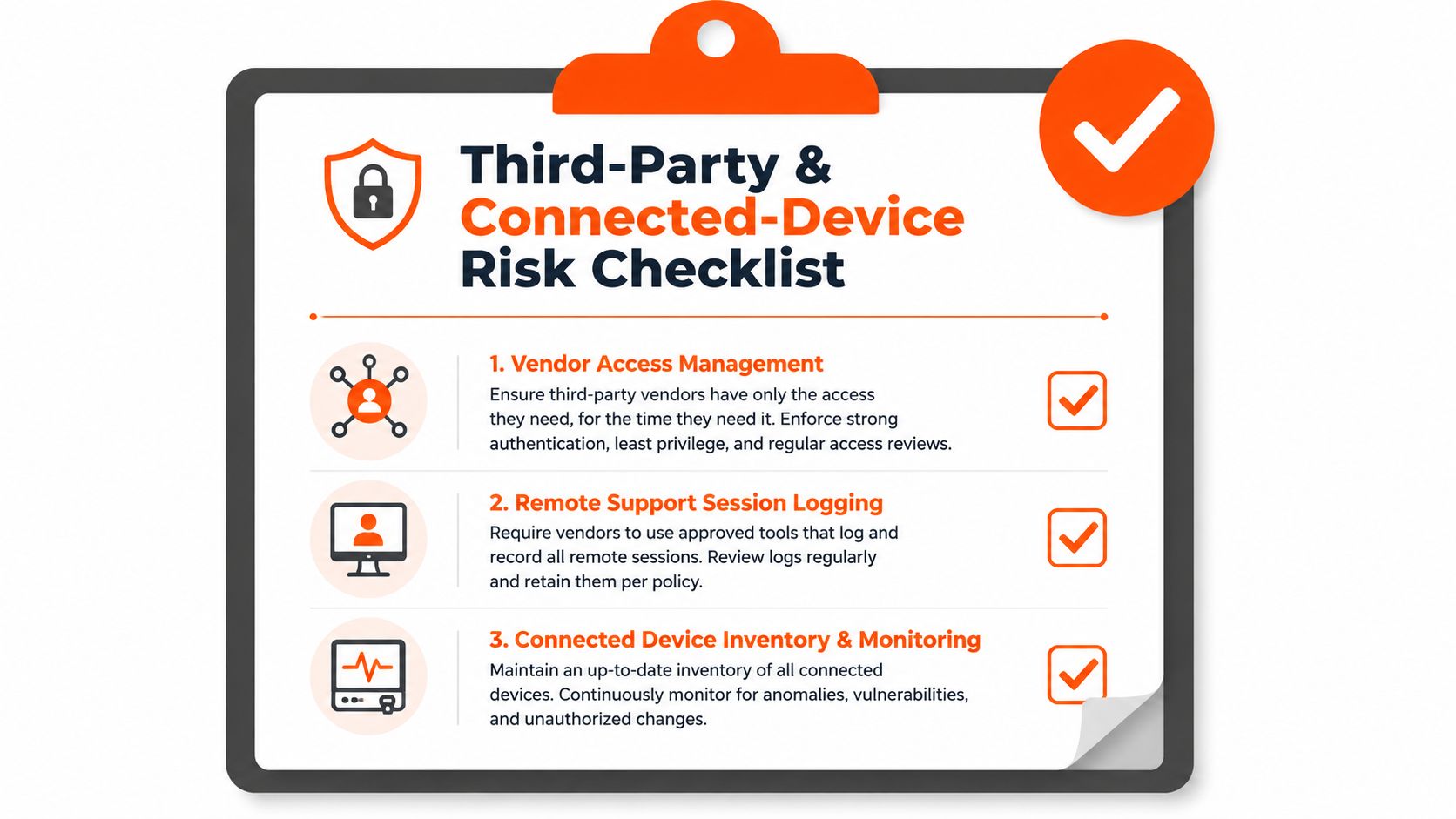
The four capabilities that matter
First, the platform should tie vendor onboarding and attestation records to the risk register. Third-party accountability starts before access is granted, not after an incident.
Second, it should preserve segmentation and access-review evidence for every external connection. Healthcare environments depend on EHR integrations, remote support, software vendors, and connected devices, which means access review can't be an annual paperwork exercise.
Third, the system should support anomaly detection on remote-support sessions and device traffic. A platform that can't surface unusual behavior across vendor pathways is only half watching the environment.
Fourth, there must be a defined incident-response path when a vendor fails. The software should make it obvious who owns the issue, what gets isolated, and how the blast radius is tracked.
The question vendors should answer directly
How does the software track vendor accountability across onboarding, access review, segmentation, anomaly detection, and incident response?
That's the FAQ buyers should force into every demo. A recent healthcare security analysis found that organizations still struggle with limited visibility across large vendor ecosystems, over-privileged remote access, and business-continuity risk when third parties fail (Armis healthcare third-party risk blind spots). If the vendor can't answer this coherently, the product is not ready for a modern care environment.
The issue is simple. Hospitals and MedTech firms don't just manage internal process risk anymore. They manage ecosystems. If the software can't see the ecosystem, it can't protect it.
A Practical Vendor Scorecard and Build-versus-Buy Outlook
A good shortlist comes from a scorecard, not a vibe check. The point is to separate what the vendor can prove from what the sales deck promises. Use the categories below to make the discussion concrete.
How to weight the scorecard
Start with compliance evidence. If the platform can't produce audit-ready logs, access controls, and retention behavior, nothing else matters. Next, score integration depth, because a shallow integration layer creates more work than it removes.
Then assess governance fit. That includes taxonomy flexibility, data migration support, and the ability to support multiple jurisdictions. After that, test third-party risk modeling, since vendor access and connected-device exposure are now operational realities. Finally, look at cost over a five-year horizon, not just license price.
| Dimension | What good looks like |
|---|---|
| Compliance evidence | Audit logs, access control, retention, evidence export |
| Integration depth | EHR, device, identity, and ITSM connectivity that works in real time |
| Governance fit | Taxonomy flexibility, migration support, named ownership model |
| Third-party risk modeling | Vendor access, device exposure, incident-response paths |
| Cost horizon | Licensing, implementation, support, and governance overhead |
Build or buy
Most mid-market and clinical organizations should buy and invest in configuration and governance. The edge cases are regulated providers with mature engineering teams, especially if they already run an enterprise GRC platform and want a workflow layer on top. In those cases, building can make sense, but only if the team can own security, integration, and long-term maintenance.
The build-versus-buy question is really a capability question. If you don't have a team that can sustain the platform, don't pretend a custom build is the safer option. It usually isn't.
For a deeper evaluation lens on partner selection, this technology partner evaluation guide is useful because the same procurement discipline applies here. Start the process with a shortlist week, move to reference calls the next week, then run a readiness sprint before signature so implementation risk doesn't hide until after go-live.
If you want a vendor shortlist that reflects real healthcare constraints, not just feature comparisons, devPulse can help you evaluate architecture, integration risk, and compliance fit before you commit. Their team builds and modernizes regulated digital systems, so they know where platforms break in practice and what good should look like in the room with vendors.