













TL;DR:
- Effective global team management relies on cultural intelligence, structured communication, and an asynchronous-first operating model. Leaders must adapt to diverse cultural contexts, establish clear norms, and use systems that make geography irrelevant to performance, fostering fairness and high output. Proper implementation of these frameworks enhances collaboration, engagement, and scalability for international teams.
Effective global team management is defined by three non-negotiable competencies: cultural intelligence (CQ), structured communication protocols, and an asynchronous-first operating model. Managers who know how to manage global teams don’t just coordinate across time zones. They build systems that make geography irrelevant to output quality. Research from the GLOBE Study, CCL, and Asana confirms that the gap between high-performing and struggling international teams almost always traces back to these same foundational failures. The good news is that each one is fixable with the right framework.
How does cultural intelligence shape global team leadership?
Cultural intelligence is the ability to recognize, interpret, and adapt your behavior across cultural contexts. It is not a soft skill. CCL 2025 research links higher CQ directly to better team performance, lower burnout rates, and more effective intercultural negotiation outcomes. That means CQ has a measurable ROI for any manager leading international teams.

The GLOBE Study, which surveyed more than 17,000 managers across 62 cultures, proves that leadership effectiveness is culturally contingent. What works in one cultural context actively undermines trust in another. A directive style that signals competence in Germany may read as disrespectful in Japan. A consensus-building approach valued in Sweden may frustrate teams in Brazil who expect faster decisions from leadership.
Approximately 70% of the world’s workforce operates within collectivist and hierarchical cultures. That figure means the default Western leadership model, which prizes individual autonomy and flat hierarchies, is the wrong starting point for most global teams. Managers who apply it without adjustment will see disengagement, not performance.
To build CQ in practice, focus on these steps:
- Audit your defaults. Write down three leadership behaviors you consider “normal.” Then ask whether each one assumes individualism, directness, or low power distance.
- Study your team’s cultural profiles. Use frameworks like Hofstede’s Cultural Dimensions or Meyer’s Culture Map to understand where your team members sit on key axes like hierarchy, communication style, and uncertainty avoidance.
- Adapt feedback delivery. In high-context cultures, public criticism damages face and trust. Deliver corrective feedback privately and frame it around the work, not the person.
- Observe before you act. In the first 60 days with a new global team, listen more than you direct. Patterns of deference, silence, or initiative will tell you more than any survey.
Pro Tip: Never assume that a quiet team member is disengaged. In many collectivist cultures, speaking up before a senior leader has spoken is considered inappropriate. Create structured turn-taking in meetings to give everyone a legitimate entry point.
What communication protocols enable clear global collaboration?
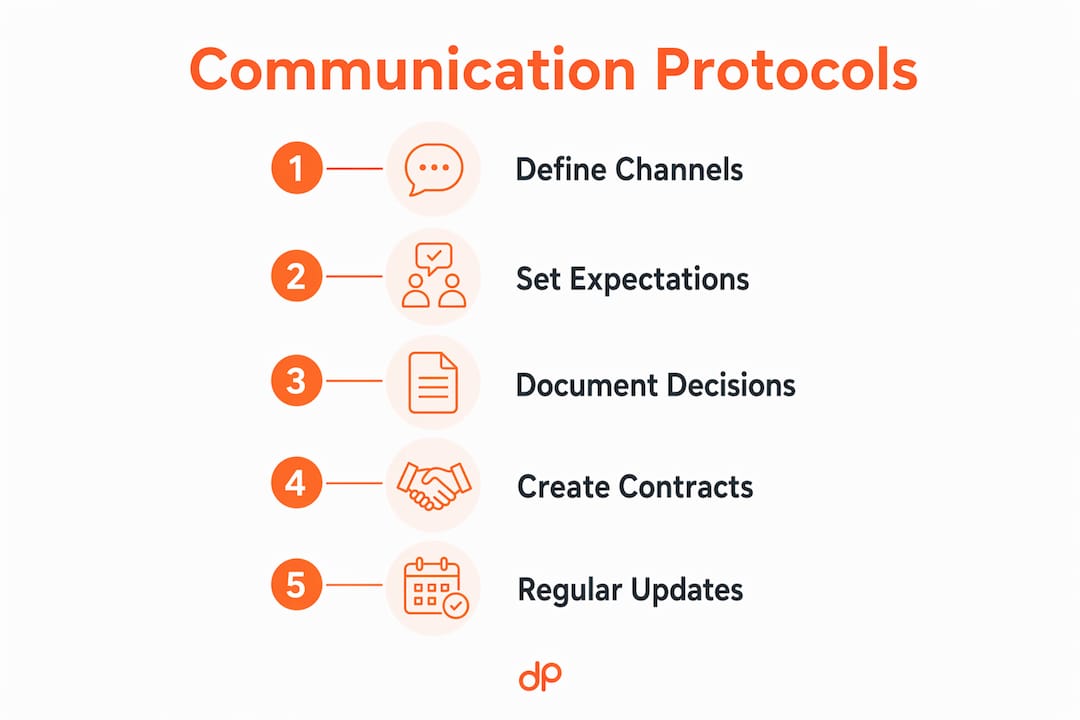
Clear communication norms are the single most preventable source of friction in distributed teams. Asana’s 2026 guidance identifies onboarding as the highest-leverage moment to set these norms. Teams that define communication expectations on day one spend far less time in repeated clarification meetings later.
A practical communication protocol covers four areas:
- Channel selection. Assign a purpose to each platform. Slack handles quick, informal exchanges. Email carries formal decisions and external communications. Zoom or Google Meet handles synchronous discussion that genuinely requires real-time dialogue. Confluence or Notion stores permanent documentation.
- Response time expectations. Define what “urgent” means in hours, not feelings. A reasonable default: Slack messages warrant a response within four business hours in the sender’s time zone. Email within 24 hours. Anything truly urgent gets a phone call.
- Synchronous vs. asynchronous defaults. Not every question needs a meeting. Build a decision tree into your team’s onboarding materials. If a decision affects more than two people and requires debate, schedule a call. If it requires input but not real-time discussion, use a shared document with a comment deadline.
- Equitable participation standards. Meeting recordings and post-meeting notes equalize information access for colleagues who could not attend live. This is not optional for global teams. It is a baseline fairness requirement.
Pro Tip: Write a one-paragraph decision summary at the end of every meeting and post it in your team’s shared channel within two hours. This single habit eliminates the most common complaint on distributed teams: “I didn’t know that decision had been made.”
Onboarding is also the right time to create what some practitioners call a “collaboration contract.” This document defines decision rights, ownership boundaries, and update flows. It removes the ambiguity that causes friction and excessive meetings in the first 90 days of a new team or project.
How to use async workflows to overcome time zone challenges
An asynchronous-first operating model treats synchronous meetings as the exception, not the default. Async practices include documenting handoffs, specifying owners, blockers, and next steps, setting time-zone-aware deadlines, and rotating meeting times. Each of these practices solves a specific coordination failure that time zone gaps create.
The table below compares synchronous and asynchronous communication across the dimensions that matter most for global teams.
| Dimension | Synchronous | Asynchronous |
|---|---|---|
| Speed of decision | Fast for simple decisions | Slower but more considered |
| Inclusion | Favors one time zone | Accessible to all regions |
| Documentation | Requires follow-up notes | Built into the workflow |
| Focus time protection | Interrupts deep work | Preserves focus blocks |
| Scalability | Degrades as team grows | Scales with clear SOPs |
The core discipline of async work is treating communication as an operating system. That means distinguishing between permanent artifacts (documented decisions, project briefs, SOPs) and ephemeral chat (Slack threads, quick questions). Permanent artifacts live in a searchable knowledge base. Ephemeral chat does not drive decisions.
Before logging off each day, every team member should post a brief status update covering three things: what they completed, what is blocked, and what the next owner needs to do. This SOP-style handoff keeps work moving across time zones without requiring anyone to stay online past their working hours.
Pro Tip: Always attach a time zone to every deadline. “Due Friday at 5 PM” is ambiguous across a global team. “Due Friday at 5 PM EST” is not. This one change eliminates a surprising number of missed handoffs.
Distributed teams that adopt document-driven workflows and measure output rather than presence consistently outperform teams that rely on real-time availability as a proxy for productivity. The shift requires discipline upfront but pays back in reduced meeting load and higher output quality within weeks.
Which tools support managing global distributed teams?
The right tool stack for a global team covers four functional areas: communication, project management, documentation, and visual collaboration. No single platform covers all four well.
For communication, Slack remains the standard for async messaging, with channel structures that mirror team and project hierarchies. Zoom and Google Meet handle video calls. Microsoft Teams works well for organizations already inside the Microsoft 365 ecosystem.
For project management, Asana, Jira, and Linear each serve different team types. Asana fits cross-functional teams with mixed technical and non-technical members. Jira is purpose-built for software development workflows. Linear is preferred by product and engineering teams that prioritize speed and minimal overhead.
For documentation, Notion and Confluence are the two dominant options. Notion offers flexibility for teams that need a combined wiki and project tool. Confluence integrates tightly with Jira and suits engineering-heavy organizations.
For visual collaboration, tools like Miro and online whiteboard platforms fill the gap that text-based tools leave open. Distributed teams use them for sprint planning, architecture diagrams, and retrospectives. Real-time collaboration tools reduce the isolation that remote engineers and designers often report in purely text-based environments.
The principle behind tool selection is this: choose platforms that match your team’s communication culture, not the ones with the most features. A tool that no one uses because it feels foreign to the team’s workflow has zero ROI.
What leadership practices build fairness and cohesion across borders?
Fairness in global team leadership is not a values statement. It is an operational requirement. Repeatedly scheduling meetings in one region’s time zone signals to other regions that their time matters less. That signal compounds over weeks and produces disengagement that looks like a motivation problem but is actually a structural one.
Rotating meeting times is the most direct fix. If your team spans New York, London, and Singapore, no single time slot works for everyone. Rotate the inconvenience fairly. Track which region takes the early morning or late evening slot each week and distribute it evenly over a quarter.
Beyond scheduling, strong global leadership practices include:
- Measure outputs, not hours. Document-driven work and outcome focus replace presence-based management. Define clear deliverables with deadlines and evaluate performance against them.
- Invest in 1:1 relationships across regions. Schedule regular one-on-one calls with team members in every geography. These calls build the trust that makes async communication work.
- Recognize contributions publicly and specifically. Generic praise lands flat across cultures. Name the specific behavior, the outcome it produced, and why it mattered to the team.
- Avoid the headquarters bias trap. Teams in satellite offices or distant time zones often feel invisible. Actively solicit their input in meetings, include them in decision threads, and give them ownership of visible deliverables.
The advantages of remote IT teams on high-impact projects are well documented, but those advantages only materialize when leadership actively counters the structural inequities that distributed work creates.
Key takeaways
Managing global teams effectively requires cultural intelligence, structured communication, async-first workflows, and deliberate fairness practices working together as a system.
| Point | Details |
|---|---|
| Cultural intelligence is foundational | Adapt your leadership style to collectivist and hierarchical cultures, which represent 70% of the global workforce. |
| Set communication norms at onboarding | Define channels, response times, and decision rights before misalignment takes hold. |
| Treat async as your operating model | Document handoffs, specify owners and blockers, and attach time zones to every deadline. |
| Rotate meeting times for fairness | Distributing inconvenient slots evenly prevents regional disengagement and trust erosion. |
| Measure outputs, not presence | Outcome-focused management scales across borders where presence-based oversight cannot. |
What i’ve learned leading teams across time zones
The biggest mistake I see managers make is assuming that good intentions substitute for good systems. You can genuinely care about your team in Nairobi, Warsaw, and Manila and still create a structure that systematically disadvantages them. The bias is usually invisible to the person at headquarters.
The shift that changed my own approach was treating communication as infrastructure rather than behavior. Once I stopped expecting people to “just communicate better” and started building explicit protocols, the team’s coordination improved within two weeks. Not because people changed. Because the system changed.
CQ is the other area where I’ve seen the most underinvestment. Most managers read one article about Hofstede and consider themselves culturally aware. Real CQ requires ongoing observation, genuine curiosity, and the humility to recognize that your instincts about “good leadership” are culturally encoded. The managers who get this right are the ones who ask questions before they give answers.
The trap I’d warn you against most strongly is the async theater problem. Some teams adopt async tools but still expect real-time responses on Slack. That is not async work. It is synchronous work with extra steps. Commit to the model fully or the benefits disappear.
— Vlad
How Devpulse helps you build and scale global engineering teams
Building the right technical foundation is what separates global teams that scale from those that stall. Devpulse works with startups, SaaS companies, and enterprise clients to design, build, and modernize the digital systems that distributed teams depend on every day.
Whether you need to modernize a legacy platform that your global team has outgrown, build custom collaboration workflows, or scale your engineering capacity across geographies, Devpulse brings the technical depth and cross-cultural project experience to deliver. Our engineering services are built for organizations that cannot afford coordination failures at scale. Explore how we approach complex, distributed software challenges in our client case studies and see what that looks like in practice.
FAQ
What is cultural intelligence and why does it matter for global teams?
Cultural intelligence (CQ) is the ability to adapt your leadership behavior across different cultural contexts. CCL research links higher CQ to better team performance, lower burnout, and stronger negotiation outcomes in multicultural environments.
How do you set communication norms for a distributed team?
Define channel purposes, response time expectations, and decision-making processes during onboarding. Asana’s 2026 guidance identifies this as the highest-leverage moment to prevent misalignment and reduce repeated clarification meetings.
What is an async-first operating model?
An async-first model treats synchronous meetings as the exception and builds workflow around documented handoffs, time-zone-aware deadlines, and shared knowledge bases. It allows work to progress continuously regardless of where team members are located.
How do you prevent time zone bias in global teams?
Rotate meeting times across regions so no single geography consistently bears the burden of inconvenient hours. Pair this with output-based performance measurement to remove presence as a proxy for contribution.
Which tools are best for managing international teams?
Slack handles async messaging, Asana or Jira manages projects, Notion or Confluence stores documentation, and Miro or similar visual collaboration tools support planning sessions. Match your tool stack to your team’s communication culture, not the feature list.