














TL;DR:
- IT outsourcing can save companies between 25 and 70 percent of their IT costs by contracting external providers. However, hidden expenses such as onboarding, attrition, and rework can significantly erode these savings, making careful cost management essential. Nearshore outsourcing offers a favorable balance of savings, quality, and project success compared to offshore options.
IT outsourcing cost savings are defined as the measurable reduction in total IT expenditure achieved by contracting external providers for functions previously handled in-house. According to Stealth Agents, companies that outsource IT functions realize total savings of 25–70% compared to equivalent in-house teams, with some specialized roles saving up to 87% against U.S. fully loaded costs. That range is wide because the actual return depends on which model you choose, how well you manage hidden costs, and whether your outsourcing goals extend beyond labor arbitrage. For C-level executives and financial decision-makers, understanding the full cost picture is what separates a successful engagement from a budget overrun.
What drives cost savings in IT outsourcing?
Cost savings in IT outsourcing fall into three distinct categories: labor cost reduction, overhead avoidance, and operational efficiency gains. Each works differently, and most engagements deliver all three simultaneously.
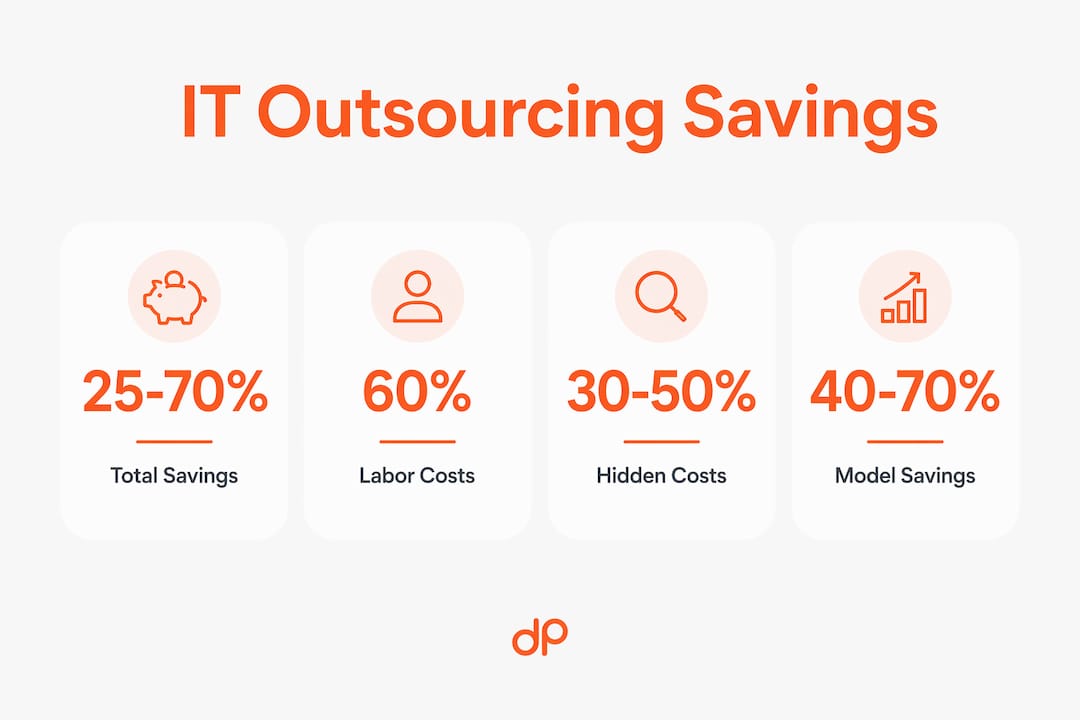
Labor cost reduction is the most visible driver. A senior full-stack developer in the U.S. costs $130,000–$175,000 fully loaded per year, including salary, benefits, payroll taxes, and equity. An equivalent offshore resource runs roughly $83,000. That gap represents raw savings before any management costs enter the equation.
Overhead avoidance is less obvious but equally significant. When you outsource, you eliminate recruiting fees (typically 15–25% of first-year salary), onboarding programs, training budgets, office space, hardware provisioning, and HR administration. For a team of ten engineers, those avoided costs can exceed $200,000 annually.
Operational efficiency comes from the ability to scale capacity up or down without the friction of hiring cycles or severance obligations. You pay for what you use. That flexibility directly reduces IT outsourcing budget waste during low-demand periods.
Key cost saving categories include:
- Direct labor substitution (replacing in-house salaries with contracted rates)
- Benefit and payroll tax elimination
- Recruiting and onboarding cost avoidance
- Infrastructure and tooling cost sharing across vendor client base
- Flexible capacity scaling without fixed headcount commitments
- Access to specialized skills without full-time specialist salaries
Pro Tip: Before signing any outsourcing contract, calculate your fully loaded in-house cost per role, including benefits, office space, and management time. That number is your true baseline for measuring savings, not just the salary line.
How do hidden costs erode your actual savings?
Hidden costs are the primary reason IT outsourcing engagements underperform financially. Headline hourly rates mask a 30–50% higher true cost once onboarding, QA cycles, and management overhead are factored in. That means a project quoted at $500,000 can realistically cost $650,000–$750,000 before it ships.
The cost breakdown on a typical outsourced software project looks like this:
| Cost Category | Share of Total Project Cost |
|---|---|
| Direct development labor | 60% |
| Onboarding and knowledge transfer | 10% |
| QA and testing cycles | 10% |
| Vendor management overhead | 10% |
| Rework buffer (miscommunication) | 10% |
Vendor attrition is one of the most underestimated line items. Replacing a vendor resource costs 4–8 weeks of lost productivity per departure. On a 12-month engagement with a team of five, even a 20% attrition rate translates to roughly 8–16 weeks of paid time spent on knowledge transfer rather than delivery.
Rework due to unclear requirements accounts for 15–30% of total outsourcing project costs. First-time offshore engagements are especially vulnerable because requirements that seem obvious to your internal team are rarely documented with enough precision for an external team operating in a different time zone and cultural context.
Three practical steps reduce hidden cost exposure significantly. First, invest 2–3 weeks in a structured discovery and requirements phase before any code is written. Second, request vendor attrition data for the past 12 months before signing. Third, build a 10–15% contingency buffer into your outsourcing budget from day one, not as an afterthought.
Pro Tip: Ask every vendor candidate for their trailing 12-month attrition rate. Any number above 20% is a red flag. High attrition is the single fastest way to turn a cost-effective engagement into an expensive one.
You can also review top IT outsourcing risks to build a more complete picture of where engagements typically break down financially.
Onshore vs. nearshore vs. offshore: which model saves more?
The three primary sourcing models deliver different savings profiles, and the right choice depends on your quality requirements, risk tolerance, and project complexity.

| Model | Typical Savings vs. Onshore | Quality Parity | Project Success Rate | Key Risk |
|---|---|---|---|---|
| Onshore | Baseline (0%) | 100% | ~85% | Highest cost |
| Nearshore | 40–45% | 85–90% | ~80% | Moderate attrition |
| Offshore | 50–70% | 70–80% | ~60% | Communication friction |
Nearshore outsourcing delivers approximately 40–45% savings versus onshore, with 85–90% quality parity and meaningfully lower attrition than offshore alternatives. Nearshore teams also improve project velocity by 25–40% compared to offshore standard velocity, largely because overlapping time zones reduce the daily communication lag that slows decision cycles.
Offshore outsourcing offers the deepest headline savings at 50–70%, but communication friction and rework cycles erode 10–15% of those savings in practice. The offshore project success rate of approximately 60% versus 80% for nearshore is a critical data point for any cost analysis for IT outsourcing. A failed or significantly delayed project eliminates the financial case entirely.
For most enterprise clients running complex, multi-quarter software programs, nearshore represents the best cost-to-quality balance. The savings are substantial, the attrition risk is lower, and the collaboration overhead is manageable. Offshore makes more sense for well-defined, commoditized tasks where requirements are locked and communication cycles are minimal.
Consider these factors when selecting your model:
- Time zone overlap with your internal team (aim for at least 4 hours of shared working hours)
- Language proficiency and written communication quality
- Vendor attrition history in the target geography
- Regulatory and data residency requirements for your industry
- Project complexity and the frequency of real-time decision-making required
For a deeper look at how remote IT teams perform across these models, the trade-offs become clearer when mapped to specific project types.
How to maximize IT outsourcing cost efficiency without losing quality
Achieving sustainable cost reduction through outsourcing requires more than selecting the cheapest vendor. The following steps reflect what actually works for enterprise clients managing multi-year outsourcing relationships.
-
Align outsourcing goals beyond cost. Cost reduction as a primary driver dropped from 70% to 34% of executive priorities between 2020 and 2026. Engagements structured around access to specialized talent and digital transformation consistently outperform those structured purely around rate arbitrage.
-
Conduct rigorous vendor due diligence. Evaluate attrition rates, client retention history, time zone alignment, and communication infrastructure before shortlisting. A vendor with a 15% lower rate and 30% higher attrition is more expensive in total cost of ownership terms.
-
Use hybrid contract models. Fixed-price contracts reduce overrun risk but increase scope creep disputes. Time and materials contracts reward flexibility but can drift without discipline. Hybrid models, where discovery and architecture phases are fixed-price and delivery phases are time and materials with defined sprint budgets, balance control and adaptability most effectively.
-
Invest in requirements quality upfront. Spending two additional weeks on requirements documentation before development begins consistently reduces rework costs by more than the time invested. This is the single highest-ROI activity in any outsourcing engagement.
-
Leverage managed services for commoditized functions. IT support, infrastructure monitoring, QA automation, and DevOps pipeline management are well-suited to managed service arrangements. These functions have defined outputs, measurable SLAs, and low knowledge transfer risk, making them ideal for cost-effective IT solutions without quality compromise.
-
Track total cost of ownership quarterly. Budget management in IT outsourcing fails when teams track only invoice totals. Include management time, rework hours, and attrition-related delays in your quarterly cost review to get an accurate picture of actual savings delivered.
Pro Tip: Structure your first engagement with a new vendor as a paid discovery sprint of 4–6 weeks before committing to a full project. You will learn more about their communication quality, technical depth, and attrition risk in one sprint than in any number of reference calls.
Generative AI is also beginning to reshape outsourcing economics by automating routine development tasks and shifting vendor accountability toward outcome-based, KPI-driven delivery. Executives who build AI-readiness into their vendor selection criteria now will capture additional efficiency gains as these tools mature.
Key takeaways
The most effective approach to IT outsourcing cost savings combines labor arbitrage with rigorous hidden cost management and model selection aligned to project complexity.
| Point | Details |
|---|---|
| Savings range is wide | IT outsourcing delivers 25–70% savings, but the actual figure depends on model, vendor quality, and hidden cost management. |
| Hidden costs are material | Onboarding, attrition, and rework add 30–50% to headline project costs if left unmanaged. |
| Nearshore often wins on ROI | Nearshore delivers 40–45% savings with 85–90% quality parity and higher project success rates than offshore. |
| Contract structure matters | Hybrid contract models balance cost control and flexibility better than fixed-price or time and materials alone. |
| Cost is no longer the only driver | Access to specialized talent and digital transformation now outrank cost reduction as primary outsourcing goals. |
The uncomfortable truth about chasing the lowest rate
I have worked with enough enterprise clients to say this plainly: the executives who focus exclusively on rate get burned the most often. They win the negotiation and lose the project.
The pattern is consistent. A company selects the lowest-bid vendor, skips a structured discovery phase to save time, and launches development. Six months later, they are managing a rework cycle that costs more than the rate savings generated. The vendor’s attrition rate was 35%, which nobody asked about during due diligence. The requirements were ambiguous, which nobody flagged because the pressure to start was too high.
What I have seen work is treating the outsourcing vendor as a strategic partner from day one. That means sharing business context, not just technical specs. It means paying a fair rate for a team with low attrition and strong communication infrastructure. It means building a relationship where the vendor has enough context to push back when requirements are unclear, rather than building what was asked and billing for the rework.
The shift toward talent and innovation-driven outsourcing is not a trend. It is a correction. The companies that treated outsourcing purely as a cost play discovered that the total cost of ownership was higher than in-house when you account for failed projects, attrition cycles, and the management overhead of a low-trust vendor relationship.
The financial case for outsourcing is real and substantial. But it is built on quality partnerships, not the lowest invoice.
— Vlad
How Devpulse helps you capture real IT outsourcing savings
Devpulse works with SaaS companies, enterprise clients, and startups across healthcare, legal tech, and cybersecurity to deliver cost-effective software engineering without the hidden cost traps that undermine most outsourcing engagements. Our teams are structured for low attrition, time zone alignment, and clear communication from the first sprint.
We bring a practical business mindset to every engagement, which means we help clients define requirements precisely, select the right contract model, and track total cost of ownership throughout delivery. Our client case studies show what that looks like in practice, including measurable savings and faster delivery timelines across complex, multi-quarter programs. If you are evaluating IT outsourcing as a cost reduction strategy, we are ready to walk through the numbers with you.
FAQ
What is the average cost savings from IT outsourcing?
IT outsourcing delivers total savings of 25–70% compared to equivalent in-house teams, with enterprise-level reductions typically falling in the 25–60% range depending on the sourcing model and role type.
What hidden costs reduce IT outsourcing savings?
Onboarding, vendor management overhead, QA cycles, and rework from unclear requirements add 30–50% to headline project costs. Vendor attrition alone can cost 4–8 weeks of lost productivity per departure.
Is nearshore or offshore outsourcing more cost-effective?
Nearshore outsourcing delivers approximately 40–45% savings with higher project success rates and quality parity, making it the better total cost of ownership choice for complex projects. Offshore delivers deeper headline savings but carries higher rework and attrition risk.
What contract model best controls outsourcing costs?
Hybrid contract models that combine fixed-price discovery phases with time and materials delivery phases balance cost control and flexibility more effectively than either model used alone.
Is cost reduction still the main reason companies outsource IT?
Cost reduction as a primary driver dropped from 70% to 34% of executive priorities between 2020 and 2026. Access to specialized talent and digital transformation now lead as the primary motivations for IT outsourcing decisions.