














DevOps engineering is a disciplined operating model that combines culture, automation, and measurement to deliver software faster while maintaining stability and reliability. Elite teams report change lead times of less than one hour and recovery times of less than one hour, while low-performing teams can take one week to one month to deploy changes and experience a 64% change-failure rate (2023 Accelerate State of DevOps research).
The gap usually appears on an ordinary release day. Product has promised a feature, developers have finished the code, and operations is waiting for deployment notes, security approval, environment changes, and a maintenance window. A small configuration difference then turns a routine release into an incident, while the people who built the change and the people responsible for production search for the missing context.
Table of Contents
- What Is DevOps Engineering and Why It Matters Now
- The Core Practices That Define DevOps Engineering
- Building the Foundation with CI/CD and Infrastructure as Code
- Measuring What Matters with DORA Metrics
- Choosing Team Models and Organizational Structures
- Implementing Observability and SRE Patterns
- Your Roadmap to DevOps Engineering Maturity
What Is DevOps Engineering and Why It Matters Now
That pattern is familiar in enterprises with legacy applications. Development optimizes for completing functionality, operations optimizes for protecting availability, and security joins late with findings that force rework. Each group may be competent, yet the handoffs create queues, duplicated checks, and weak feedback from production.
DevOps engineering addresses the operating system around software delivery. It joins development, infrastructure, security, quality engineering, and operations through shared ownership, automated workflows, observable systems, and measurable outcomes. The objective isn't to make developers carry every operational task. It's to make the path from code to reliable service visible, repeatable, and reversible.

The movement emerged as a response to this practical delivery problem. The first DevOps Days conference took place in Ghent, Belgium, in 2009, after growing recognition that separating development from deployment and operations caused delays, handoff problems, and weaker operational feedback (DevOps history). DevOps therefore began as an operating model, not as a product category or a synonym for cloud hosting.
Reliability is part of delivery
A release isn't successful merely because it reaches production. The service must remain available, defects must be detected quickly, and the team must be able to recover without improvising under pressure. That requires small changes, automated verification, clear ownership, and production feedback that engineers can act on.
Practical rule: If your delivery process measures only how much code reaches production, it can reward behavior that makes the service less reliable.
This matters especially during modernization. Replacing a legacy platform with containers or a managed database may change the infrastructure without fixing approval queues, brittle tests, undocumented dependencies, or unclear incident ownership. DevOps engineering treats those constraints as design problems. Teams improve the delivery system, not just the runtime environment.
Organizations working on specialized platforms also need domain-specific operating knowledge. Teams building decentralized products, for example, can use this practical resource on skills for blockchain DevOps to connect distributed-system concerns with deployment, security, and reliability responsibilities.
The Core Practices That Define DevOps Engineering
Mature DevOps programs don't begin with a shopping list of tools. They connect four practices into a feedback loop. Continuous integration and delivery shortens the path from code to a controlled release. Infrastructure as code makes the environments on that path reproducible. Observability shows what happened after deployment. Site reliability engineering turns that evidence into decisions about risk, capacity, and release pace.
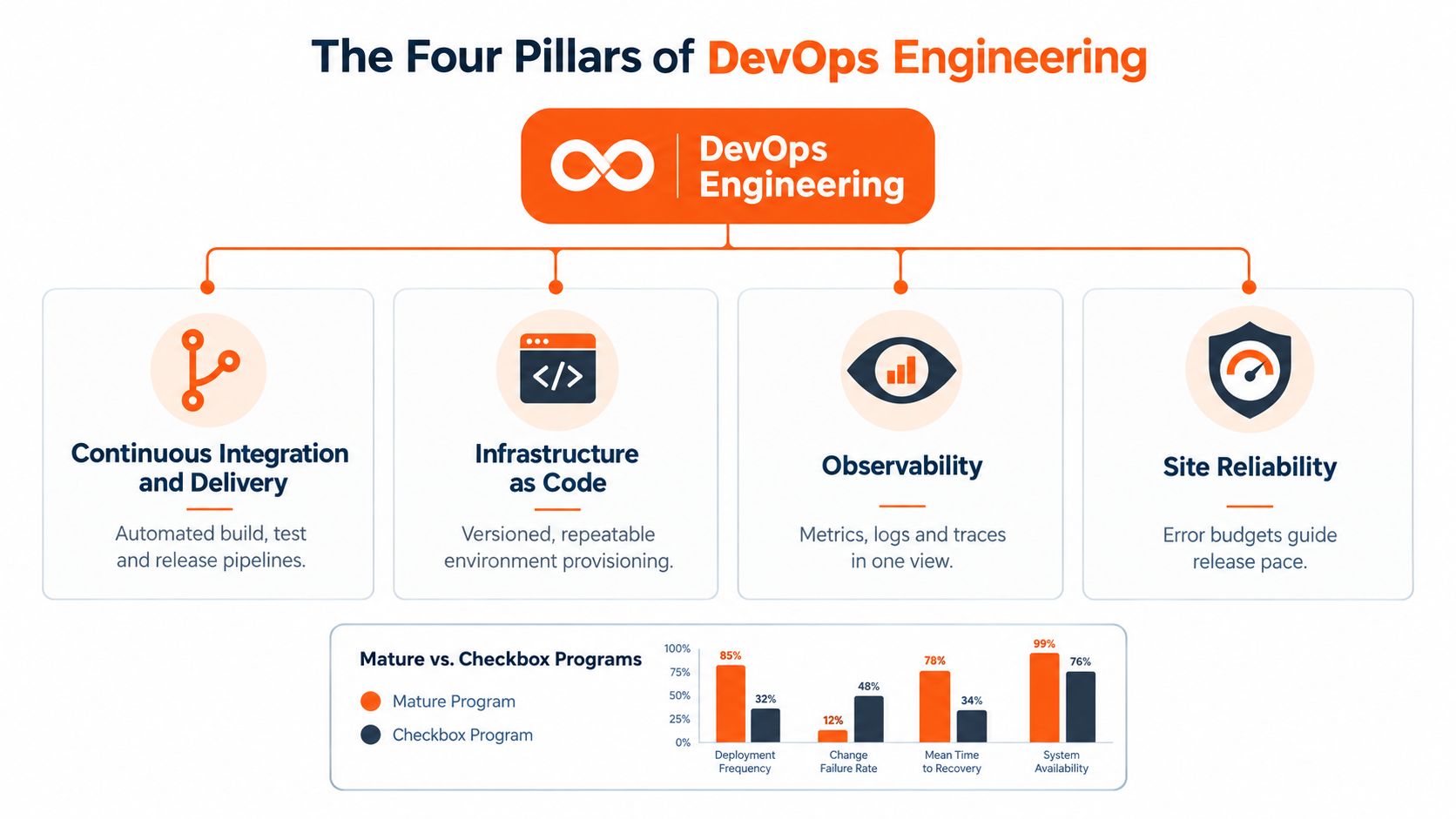
CI/CD creates a repeatable control loop
A pull request should trigger more than a build. Automated unit, integration, and contract tests should identify whether the change behaves as expected. Security checks should examine dependencies and source patterns. The pipeline should produce a traceable artifact, promote it through controlled environments, and record which commit, approvals, and checks supported the release.
That sequence gives developers feedback while the change is still familiar. It also gives operations a consistent mechanism for promotion and rollback. Manual intervention doesn't disappear, especially for sensitive systems, but it becomes explicit and auditable rather than hidden in a chat message or an engineer's shell history.
IaC removes environmental guesswork
Infrastructure as code stores network rules, service configuration, compute resources, and platform policies in reviewable definitions. A change can be tested, approved, and applied through the same delivery discipline as application code. Terraform, Bicep, and ARM are common choices, but the tool matters less than the properties of the process: version control, peer review, state management, policy enforcement, and repeatable execution.
IaC won't automatically create good architecture. Poorly structured modules can spread unsafe defaults across every environment. Teams should establish ownership boundaries, keep sensitive values out of source, validate plans, and test representative changes before they reach production.
Observability and SRE turn events into decisions
Monitoring tells a team that a threshold was crossed. Observability helps engineers investigate why a system behaved that way by correlating metrics, logs, and traces. SRE practices add service-level objectives, error budgets, incident learning, and reliability reviews, so teams can decide whether to ship, pause, simplify, or invest in resilience.
These practices reinforce one another. Without observability, CI/CD can deliver failures faster. Without IaC, a healthy release may depend on an environment that nobody can recreate. Without SRE decision rules, teams argue about reliability after every incident. Even adjacent operational workflows, such as checking business identities during onboarding, benefit from the same principle of controlled automation. Teams can evaluate VAT validation tools as an example of turning a manual verification step into a traceable service workflow.
Building the Foundation with CI/CD and Infrastructure as Code
A production pipeline is a controlled software supply chain, not a deployment script with a few test commands attached. NIST describes CI/CD as an automated workflow that builds, functionally tests, security-scans, packages, and deploys software while producing evidence throughout the stages (NIST DevSecOps reference model).
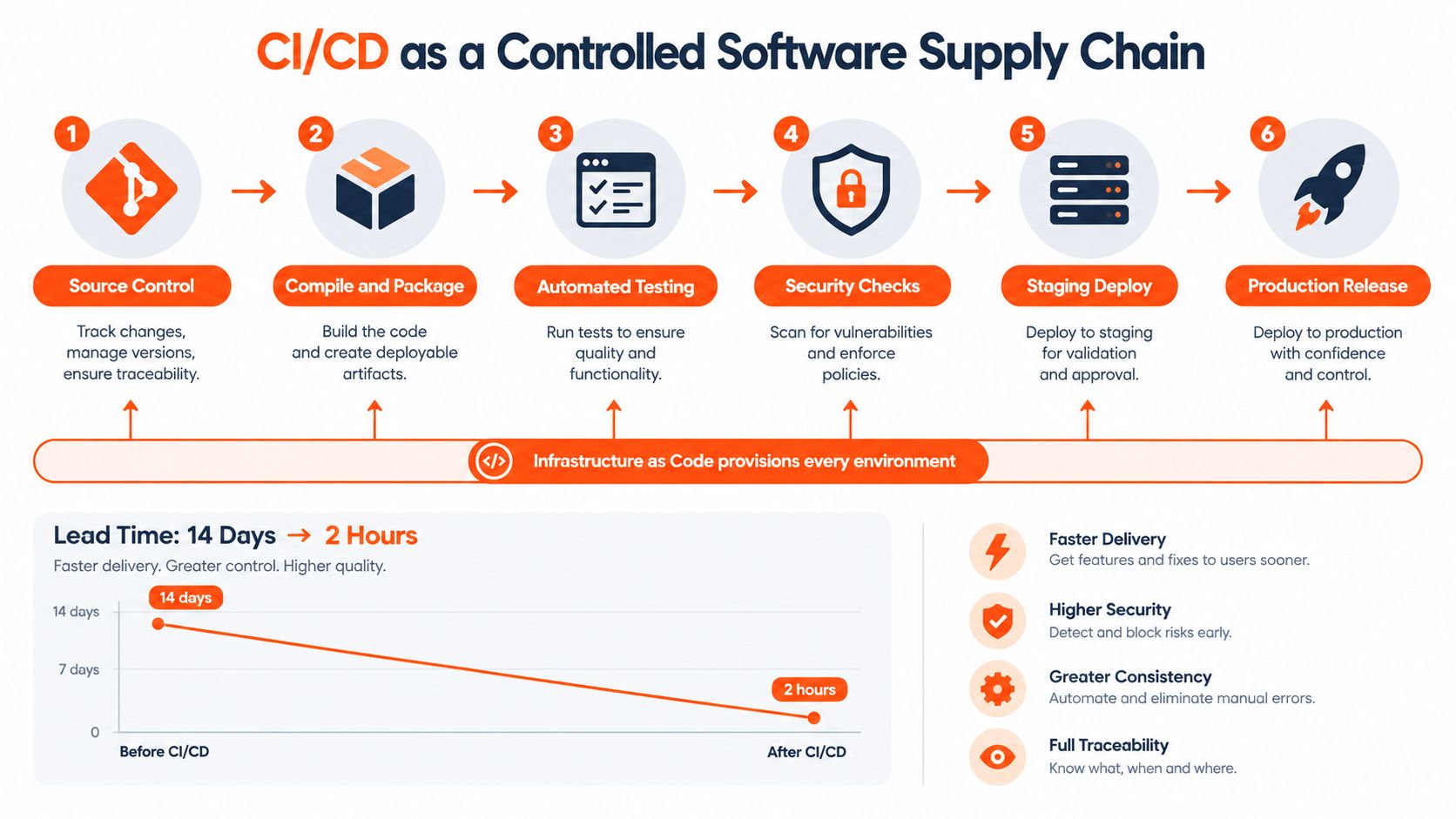
Build the pipeline as an evidence chain
Start with source control and commit-level traceability. Each build should identify the source revision, dependencies, compiler or runtime inputs, and resulting artifact. Store the artifact immutably, scan it before promotion, and prevent production from rebuilding the same version with different inputs.
A practical sequence looks like this:
- Validate the change: Run formatting, unit tests, static analysis, and dependency checks on every merge request.
- Create the artifact: Compile or package once, assign a traceable version, and retain the build metadata.
- Apply security gates: Prioritize findings that block promotion, and document accepted exceptions with an owner and review path.
- Deploy to a representative environment: Use IaC to provision or update the environment rather than relying on manually configured servers.
- Verify behavior: Run integration, contract, smoke, and performance checks that reflect actual failure modes.
- Release progressively: Use feature flags, canary exposure, or staged rollout so a defect has a limited blast radius.
- Record the outcome: Connect deployment events to commits, incidents, rollbacks, hotfixes, and remediation work.
The final step is often neglected. Without it, teams can't distinguish a fast, safe release from a frequent release that creates hidden cleanup work.
Make infrastructure reviewable
Keep reusable infrastructure modules separate from environment-specific composition. Store configuration in version control, require plan review, enforce policies as code, and give pipeline identities only the permissions they need. Test modules with representative inputs, including failure paths such as missing permissions, unavailable dependencies, and invalid configuration.
A pipeline that can deploy application code but can't reproduce the database, queues, secrets integration, or network policy is only partially automated. The same applies to an infrastructure pipeline that creates resources without testing whether the application can use them.
Pipeline test: Ask whether another engineer can identify the commit, artifact, approvals, environment definition, security checks, and rollback path for the last production release without asking the author.
Teams hiring or developing delivery capability can use this practical DevOps interview questions guide to assess whether candidates understand these controls rather than merely naming popular tools. Tool selection should follow the required auditability and recovery model. For a broader comparison of repository workflows, see GitHub versus GitLab, then evaluate the choice against access control, runners, integration, and governance requirements.
Measuring What Matters with DORA Metrics
A delivery dashboard that reports deployment count alone is incomplete. DORA's current model separates throughput from instability, using deployment frequency, change lead time, failed deployment recovery time, change fail rate, and deployment rework rate (DORA metrics guide). The earlier four-key framework grouped deployment frequency and lead time as throughput indicators, then paired them with change failure rate and time to restore service as stability indicators (State of DevOps report).
Read speed and safety together
Change lead time runs from a version-control commit to successful production deployment. Deployment frequency describes how often changes reach production. Failed deployment recovery time measures the time needed to recover from a deployment requiring immediate intervention. Change fail rate captures deployments that cause production failures, while deployment rework rate identifies deployments that consist of unplanned corrective work. DORA added deployment rework rate as a fifth metric in 2024 (DORA metrics history).
Collect the data from CI/CD events, commit identifiers, incidents, rollbacks, hotfixes, and remediation tickets. Segment results by service and deployment type. Percentiles are more revealing than averages when a small number of severe failures affect regulated or high-availability systems.
Compare delivery bands carefully
| Performance Level | Change Lead Time | Deployment Frequency |
|---|---|---|
| Elite | Less than one hour | On demand, with frequent delivery |
| High | Several hours to one week | Frequent delivery |
| Medium | Several weeks to six months | Periodic delivery |
| Low | More than six months | Infrequent delivery |
The lead-time bands come from DORA performance guidance, and lead time starts at the commit to the main branch, not at project approval or ticket creation (IBM explanation of DORA metrics). Deployment frequency should be interpreted alongside failure and recovery measures. A team that ships often but spends its capacity repairing production isn't demonstrating healthy throughput.
The useful comparison isn't between teams with different systems and risk profiles. Compare a service with itself over time, identify the largest constraint, run a targeted experiment, and check whether speed improved without worsening instability.
Choosing Team Models and Organizational Structures
Team structure determines who owns the paved road, who understands product constraints, and who responds when reliability declines. There isn't one correct arrangement for every enterprise. The right model depends on platform complexity, regulatory obligations, service boundaries, and the amount of autonomy product teams can safely handle.
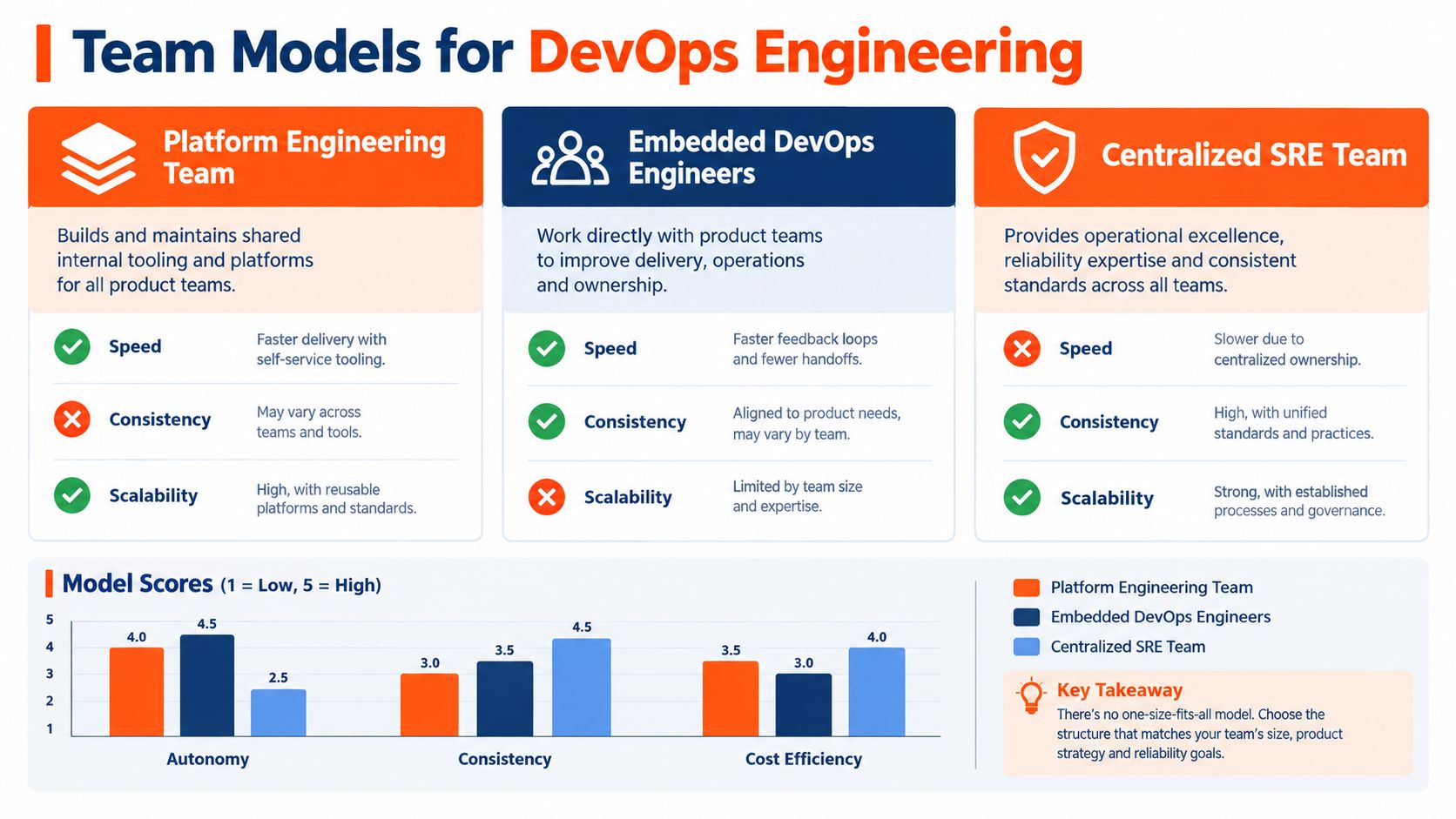
Three workable models
A platform engineering team builds shared internal capabilities such as deployment templates, observability integrations, identity patterns, and infrastructure modules. This model improves consistency and reduces duplicated work, but a platform team can become a ticket queue if it designs for its own abstractions instead of developer workflows.
Embedded DevOps engineers work directly with product teams. They gain close knowledge of service behavior and business risk, which helps adoption, but practices can diverge across teams. Without shared standards, the organization accumulates several ways to deploy, monitor, and recover.
A centralized SRE team establishes reliability practices, incident standards, and service objectives across the estate. It can protect consistency in healthcare or financial services, where auditability and controlled change matter. The trade-off is distance from everyday product decisions, especially when the central team owns reliability without owning the code or roadmap.
Choose boundaries before titles
Regulated organizations often need separation of duties for approvals, evidence retention, and access management. That doesn't require isolating developers from production feedback. A platform team can provide policy-enforced templates, while product teams own service behavior and SRE sets reliability expectations. Clear escalation paths matter more than whether the organization uses the label DevOps.
Start with one service or value stream. Define who owns its pipeline, infrastructure, alerts, incident response, and recovery decisions. Then publish reusable patterns based on what that team needed. This avoids the common mistake of building a large internal platform before validating its users and operational value.
Implementing Observability and SRE Patterns
Observability earns its place when it helps an engineer explain a failure quickly. A dashboard full of isolated CPU, memory, and request charts isn't enough if the team can't connect a slow request to a dependency, deployment, or data condition.
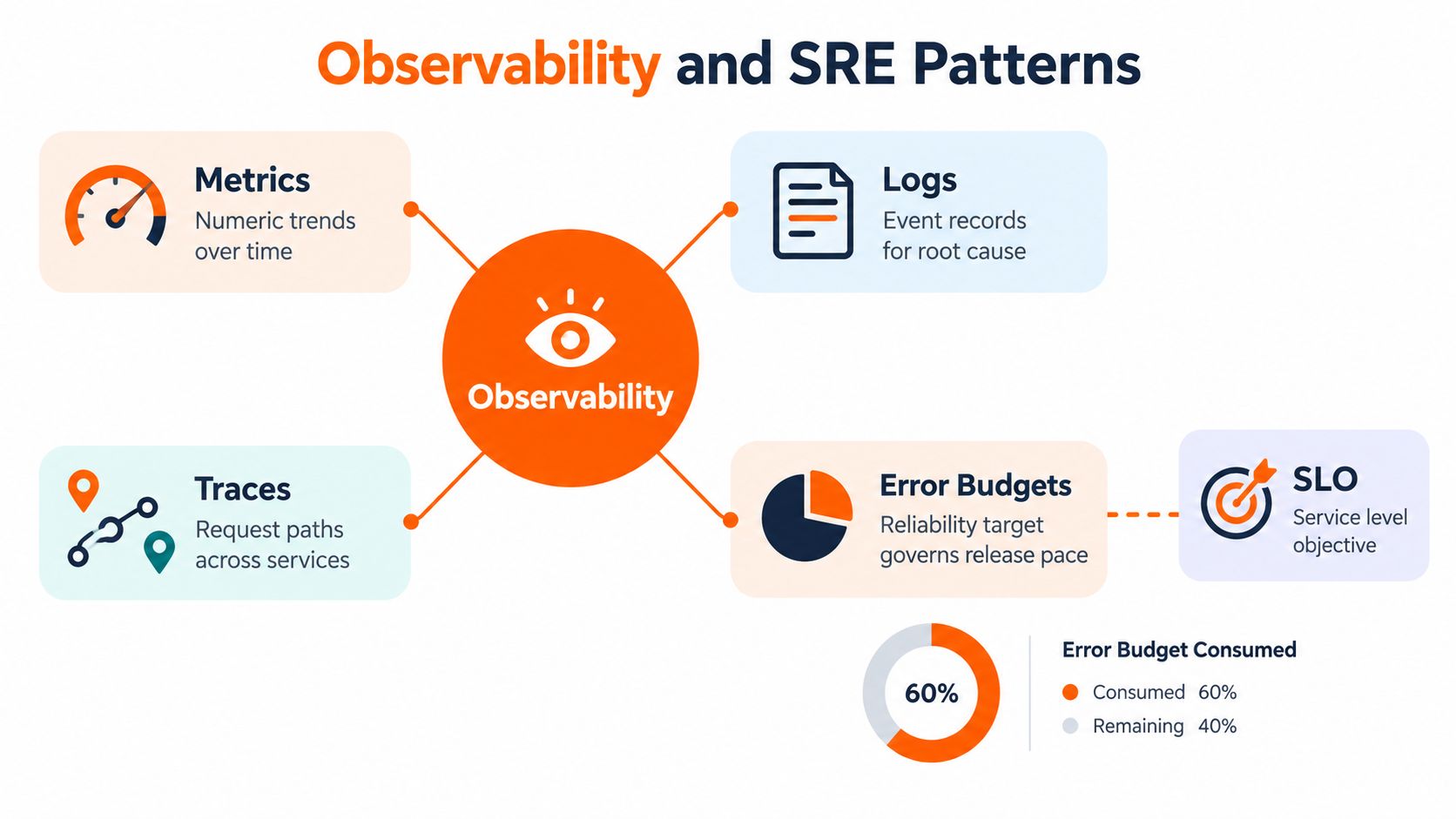
Instrument the path users depend on
Use metrics for trends and alertable symptoms, logs for event detail, and traces for request paths across services. Include deployment identifiers and correlation data so an incident responder can compare behavior before and after a release. Alert on user-visible symptoms such as failed requests, unacceptable latency, or queue delay, then use lower-level signals for diagnosis.
SRE adds service-level indicators, service-level objectives, and error budgets. The objective defines the reliability target. The error budget represents the amount of unreliability the service can absorb while still meeting that target. When a team consumes too much of the budget, it should slow risky releases and prioritize reliability work. When the service remains within its target, the team has evidence to continue delivering.
That mechanism creates a better conversation than “operations says no.” Product, engineering, and operations can discuss the cost of a release against an agreed reliability objective.
For the incident workflow itself, use a documented incident management process with clear severity levels, roles, communication paths, and recovery records. Afterward, conduct a blameless review focused on contributing conditions, detection gaps, rollback design, and systemic fixes. Blameless doesn't mean consequence-free. It means the investigation seeks better controls rather than a convenient individual to punish.
Your Roadmap to DevOps Engineering Maturity
Begin with visibility. Map one service's commit, build, test, deployment, incident, and recovery events. Then fix the most expensive constraint, whether that's unreliable tests, manual environment work, absent rollback, or missing production telemetry.
A practical sequence is:
- Stabilize the path: Version infrastructure, automate essential tests, and make artifacts traceable.
- Measure delivery: Establish DORA throughput and instability metrics for a service.
- Control production risk: Add observability, progressive delivery, rollback, and error-budget decisions.
- Scale the model: Offer platform capabilities and governance patterns that product teams can adopt without surrendering ownership.
- Govern AI-assisted change: The 2025 DORA research found that 90% of surveyed technology professionals use AI at work, more than 80% report productivity gains, and AI adoption is positively associated with throughput but negatively associated with software-delivery stability (2025 DORA report). Stack Overflow's 2025 survey found that 66% of developers identified “almost right” output as their biggest AI frustration, while 45% said debugging AI-generated code takes more time (Stack Overflow 2025 survey).
Use the DevOps implementation guide to turn these principles into a staged program. AI adoption should expand only when review, testing, observability, recovery, ownership, and auditability can absorb the additional change volume.
devPulse helps enterprises design and operate CI/CD, infrastructure as code, observability, cloud migrations, and reliability practices for modern and legacy systems. Visit devPulse to discuss a practical DevOps engineering roadmap grounded in your services, risks, and delivery data.