














A product team has finished a feature, but nobody can test it in a realistic environment. Someone files a ticket, someone else asks for access, and the release still happens by hand on a Friday. If that sounds familiar, you're not facing a talent problem. You're facing a repeatability problem, and that's where DevOps platform engineering earns its place.
Table of Contents
- What DevOps Platform Engineering Actually Means
- DevOps, SRE and Platform Engineering Side by Side
- Business Benefits and Governance for Regulated Enterprises
- Reference Architecture, Team Models and Tooling Patterns
- Metrics That Prove the Platform Works
- Confirm Your Platform Baseline Before You Invest
- Implementation Roadmap From Pilot to Governed Scale
- Enterprise Modernization Case Examples
What DevOps Platform Engineering Actually Means
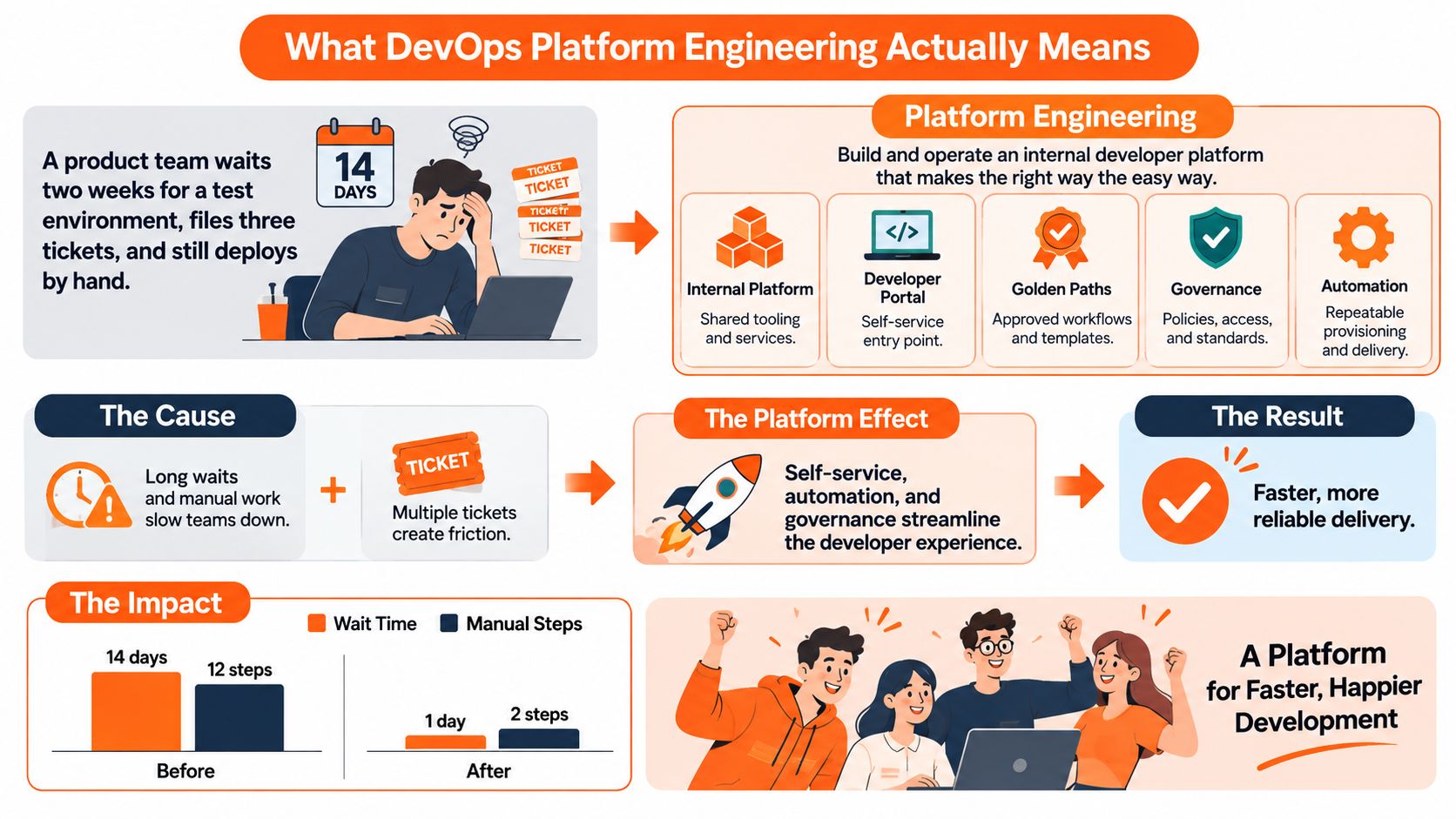
Say a product team waits two weeks for a test environment, files three tickets, and still deploys by hand. Every step works eventually, but each release depends on who is available, who remembers the checklist, and who can fix the environment when it drifts.
DevOps platform engineering means building an internal platform that gives product teams self-service paths for building, securing, deploying, and running software. Teams stop rebuilding the same plumbing for every service. They start from a tested path and spend their time on the product.
Think of an airport. The platform is the terminal, runways, and air traffic control. Product teams are the airlines focused on their own flights, passengers, and schedules.
The Three Parts to Recognize
- Golden paths: Opinionated templates that create a service with its pipeline, deployment settings, and monitoring already wired in.
- Self-service infrastructure: Environments and resources defined as code, requested through a portal or API instead of a ticket queue.
- Built-in guardrails: Policy-as-code, secrets handling, and audit logs placed inside the path, not checked after a team has finished.
The idea has a clear origin. DevOps emerged as a formal movement in 2009, when Flickr engineers presented frequent releases built on shared responsibility and the first DevOpsDays gathered practitioners in Ghent, according to BMC's history of DevOps. Platforms are a later answer to that same coordination problem between development and operations.
Other industries use a similar platform logic when they package shared capabilities for many builders to reuse. Readers comparing platform business models can explore the BaaP business model for a banking example of that pattern.
If every team solves the same deployment problem separately, your organization is a candidate for a platform.
DevOps, SRE and Platform Engineering Side by Side
Confusion starts because the same people often do all three kinds of work. The table separates the disciplines by what each one optimizes and produces.
| Dimension | DevOps | Site Reliability Engineering | Platform Engineering |
|---|---|---|---|
| Core goal | Shared delivery culture and automation across development and operations | Reliable production services managed with error budgets | Self-service internal platform that product teams use to ship safely |
| Primary output | Pipelines, shared practices and release habits | SLOs, error budgets, alerting and incident response | Golden paths, templates and self-service APIs |
| Who builds it | Cross-functional product and operations teams | Reliability engineers embedded with services | Dedicated platform team serving product teams as customers |
| Main question | How do we ship faster together? | How reliable is this service and when do we pause features? | How do teams ship without rebuilding the same path? |
| Success signal | Deployment frequency and lead time for changes | Error budget status and incident load | Self-service completion rate and time to first deployment |
DevOps is a way of working. It joins development and operations around shared delivery, automation, and production feedback, so handoffs don't become queues. Our own overview of DevOps engineering practices and delivery work covers how that shared model runs in practice.
Reliability and the Platform Product
Site Reliability Engineering, or SRE, applies software engineering to reliability. Teams set service level objectives and error budgets, then use the remaining budget to decide whether to ship features or stabilize the service. A structured document such as SpecStory's SRE review template helps teams record those decisions consistently.
Platform engineering packages the results into a product. If SRE defines a sensible alert threshold and DevOps automates a pipeline, the platform team turns both into a template other teams can consume without asking for help.
In practice, one engineer may write a pipeline in the morning, tune an alert at midday, and publish a template in the afternoon. The labels describe the work, not three separate empires.
Use a simple decision rule. If painful handoffs are the problem, start with DevOps practices. If unreliable services are the problem, start with SRE. If many teams repeat the same setup, build a platform.
A platform team without shared ownership of reliability tends to optimize for speed alone. Keep the three disciplines connected, with shared measures and shared consequences, rather than splitting them across separate budgets.
Business Benefits and Governance for Regulated Enterprises
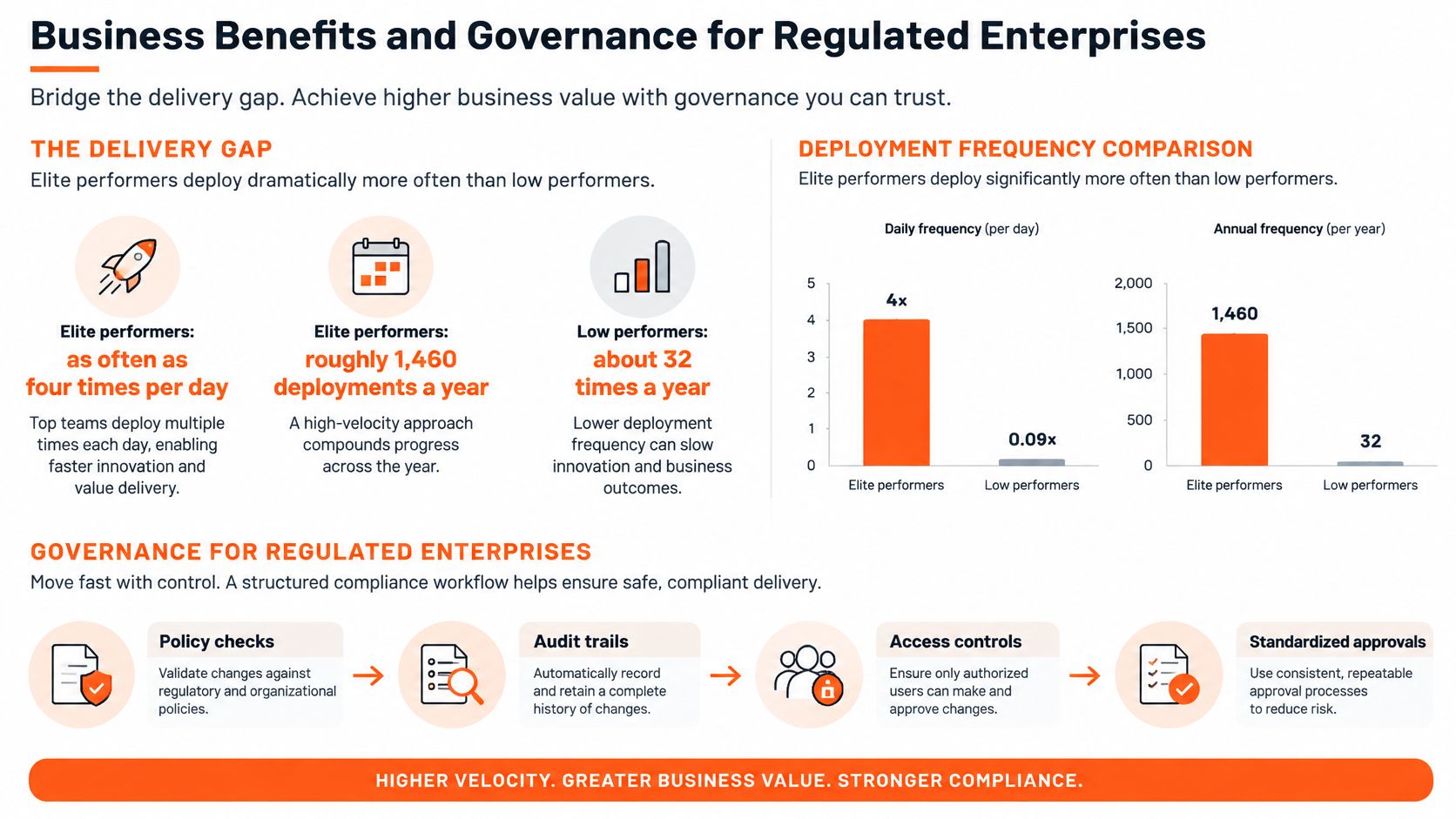
The delivery gap is large enough to change how leaders plan modernization. In the 2018 DORA State of DevOps report, elite performers deployed as often as four times per day, about 1,460 deployments per year, while low performers deployed about 32 times per year. Elite teams also reported change lead time of less than one hour, while low performers reported one month to six months.
| Performance group | Deployments per year | Change lead time |
|---|---|---|
| Elite | approximately 1,460 | under 1 hour from commit to production |
| Low | approximately 32 | one month to six months |
| Gap | roughly 46 times more frequent | roughly 2,555 times faster on a conservative 60-minute estimate |
Treat those ratios as research figures, not targets to copy. Architecture, risk, and domain shape how often any system should change. The useful lesson is that a reusable delivery system can close part of the gap.
Benefits, Costs, and Controlled Acceleration
For a modernization program, the benefits usually arrive in this order. Lead time for changes falls, new engineers ship their first change sooner, inconsistent environments create less rework, and ownership of security controls becomes clearer.
Name the costs before promising returns. You'll fund a dedicated platform team sized to the product teams it serves, engineering time for the first golden path, tooling licences, and compliance work to certify controls once. Cost per team isn't a universal figure, so use your own baseline data for that cell in the business case.
In healthcare, education, and legal technology, governance should live inside the platform. Embed access control, encryption defaults, audit logging, and approval gates once, so product teams inherit compliance instead of rebuilding it. A linked risks and controls matrix for mapping delivery controls can help you match each control to the risk it covers.
The goal is controlled, auditable acceleration, not maximum release speed. A slower, well-evidenced path that auditors trust beats a fast path that creates manual evidence work after every release.
Ask three questions before funding more tooling. Which control does every team repeat? Which approval has become a bottleneck? Which audit evidence do people still assemble by hand?
Reference Architecture, Team Models and Tooling Patterns
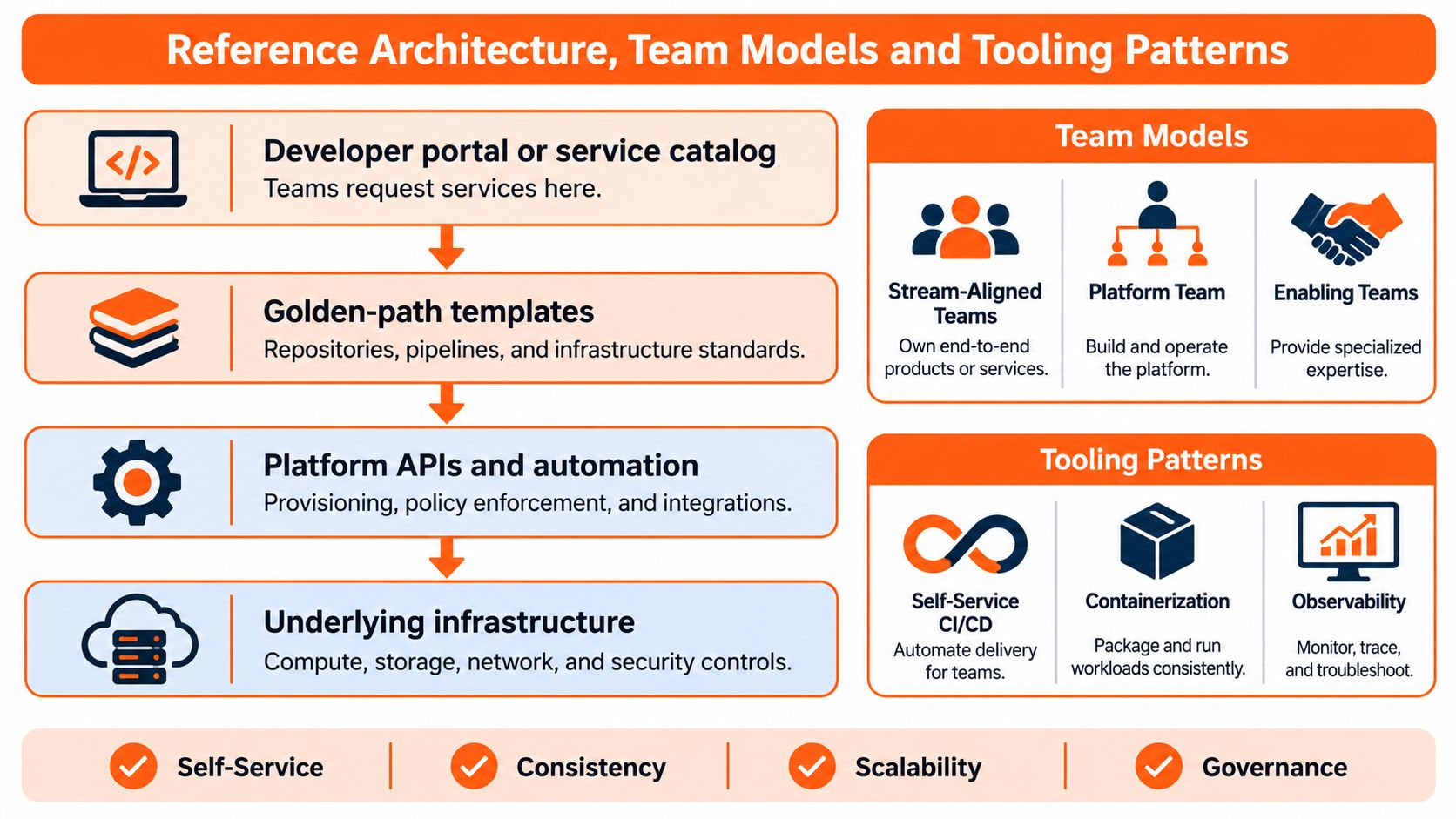
A useful reference architecture has four layers, and each layer serves identifiable users. If a layer has no users, no backlog, and no feedback loop, it isn't a platform product yet. It's just shared infrastructure with a new name.
Four Layers From Top to Bottom
At the top sits a developer portal or service catalog where teams discover services, owners, and approved ways to create new work. Below it, golden-path templates generate repositories, pipelines, deployment configuration, and default dashboards.
The third layer defines infrastructure and environments as code, with reusable modules for networks, databases, queues, and access. Beneath that runs the shared runtime, such as managed Kubernetes or container services, plus observability and policy-as-code enforcement.
Teams That Build and Consume the Platform
A platform team owns the layers as a product, talks to users, and retires paths nobody uses. Stream-aligned product teams consume those paths to deliver customer features. An enabling team helps product teams adopt the paths, then steps away rather than becoming a permanent dependency.
Platform team size scales with the number of product teams served and the variety of workloads supported. Undersizing turns the team into a ticket queue. Oversizing too early tempts the team to build features before anyone has proven the need.
Research shows why user outcomes matter more than adoption counts. In a DORA executive summary shared by Google Cloud, organizations with a dedicated platform team reported a 6% team-level productivity gain, developers who completed platform tasks without an enabling-team dependency reported a 5% productivity improvement, and platform users showed an 8% throughput decrease compared with non-users while platforms matured.
Practical rule: Adoption is a weak success signal. A mandated platform can have full adoption and still make delivery slower.
Tooling Patterns That Hold Up
Use GitOps so desired state lives in version control and changes get reviewed like code. Keep one shared CI/CD template library rather than forks per team, drawing on CI adoption advice from F1Group when you standardize build and test stages. Store secrets in a vault, not pipeline variables, and emit telemetry with open standards so tools can change later. If you're choosing where those pipelines live, our GitHub and GitLab comparison for delivery teams is a useful starting point.
Watch for these anti-patterns:
- Ticket queue in disguise: A portal that still requires platform engineers to do every task by hand.
- Premature mandate: Forcing adoption before a golden path has proven value with a willing team.
- Tool-first purchasing: Buying products before doing user research with product teams.
- One standard for every workload: Applying the same controls and runtime regardless of risk or shape.
- Template counting: Judging success by templates shipped instead of tasks completed without help.
Metrics That Prove the Platform Works
Charts only help when they separate speed from stability. Plot the four DORA measures together, and you'll see whether faster delivery is also safer delivery.
Deployment frequency and lead time for changes show throughput. Change failure rate and time to restore service show stability. A platform should raise throughput without raising production failures.
The arithmetic is simple enough for any team to reuse. Four deployments with one failure give a 25% change failure rate. Chart that rate by service and month, and patterns appear quickly.
Performance bands give those charts context. IBM's summary of DORA classifications lists elite change-failure rate as 0-15%, high as 16-30%, medium as 31-45%, and low as 46-60%.
| Performance band | Change failure rate |
|---|---|
| Elite | 0-15% |
| High | 16-30% |
| Medium | 31-45% |
| Low | 46-60% |
Treat these bands as performance categories, not targets every system must meet. A payment service and an internal reporting tool don't carry the same risk, so they shouldn't be forced onto identical thresholds.
Measures Specific to the Platform
Add measures that show whether the platform itself removes work:
- Self-service completion rate: Tasks finished without platform-team intervention.
- Time to first deployment: How quickly a new service or engineer reaches production safely.
- Onboarding duration: Time from starting to shipping a first meaningful change.
- Golden-path adherence: Share of services using supported paths rather than custom setups.
- Internal user satisfaction: Whether teams would choose the path again.
To separate platform impact from unrelated changes, record a baseline before launch. Compare pilot teams with comparable teams that haven't adopted yet, and segment results by service criticality and regulatory constraint.
Expect a possible dip while people learn new paths and the platform matures. Judge the trend over several quarters, not the first month. A monthly scorecard works well with the four DORA measures, three platform measures, and one compliance measure, such as audit evidence generated automatically.
Confirm Your Platform Baseline Before You Invest
The funding decision comes down to one question. Where does delivery friction really sit, and can you prove it with your own records?
DevPulse's IT Infrastructure service sets up and manages secure development and delivery infrastructure, including access control, environments, CI/CD, and monitoring. That kind of work only pays off when the starting point is measured first. We bring 50+ senior engineers to programs like this, but headcount doesn't replace evidence.
A Five-Step Baseline Routine
- Pull deployment records: Collect 90 days of records for the three services with the most release friction. You're finished when every deployment has a timestamp, outcome, and rollback flag.
- Calculate the four measures: Work out deployment frequency, lead time, change failure rate, and time to restore for each service. You're finished when all four sit on one sheet per service.
- Count the tickets: Count environment, access, and release-approval requests over the same period. You're finished when each ticket type has a count and a median wait time.
- Name the heaviest path: Identify the one path generating the most manual work. You're finished when it has a named owner and a written list of steps.
- Choose the pilot scope: Pick one team and one golden path. You're finished when the team, path, and success metric are written down.
This baseline becomes the comparison point for every later claim about value. Without it, you'll argue from impressions, and impressions favor whoever speaks loudest.
Don't fund a platform until the baseline shows where the friction sits.
Implementation Roadmap From Pilot to Governed Scale
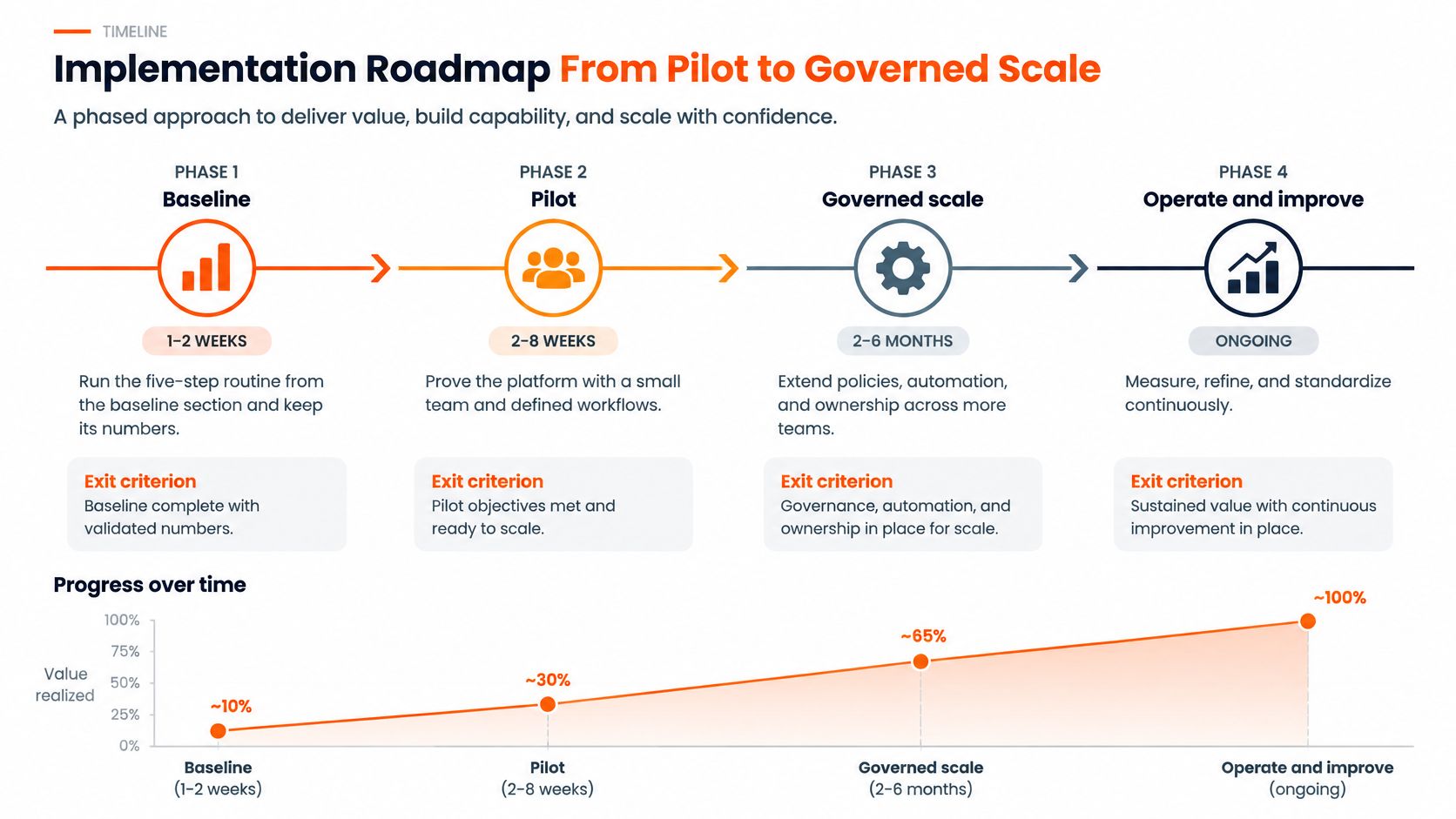
Move in phases, and don't start the next one until the exit criterion for the current phase is met. Scaling an unproven path only spreads its problems to more teams.
| Phase | Core practices | Exit metric |
|---|---|---|
| 1. Baseline | Measure four DORA metrics per service; log manual tickets for environments, access and releases | Baseline recorded for every service in scope |
| 2. Pilot | One golden path with infrastructure as code, CI/CD and default monitoring for one team | Pilot team deploys without filing platform tickets |
| 3. Scale and govern | Policy-as-code, secrets management, audit logging and a self-service catalog for more teams | Golden-path adoption and change failure rate trend against baseline |
| 4. Optimize | Retire unused templates, add escape hatches, tune cost and review ownership | Stable lead time and task success rate across all teams |
How Each Phase Earns the Next
Baseline keeps the numbers from your five-step routine as the reference point. If a service has no baseline, it doesn't enter the pilot.
Pilot means one golden path for one team, covering repository setup, CI/CD, infrastructure as code, and default monitoring. The test is blunt. Can that team deploy without filing platform tickets?
Scale and govern adds policy-as-code, secrets management, audit logging, and a self-service catalog for more teams. Use approval gates only where risk requires them, because every extra gate taxes every release.
Optimize is where mature teams retire unused templates, add escape hatches for exceptional workloads, tune cost, and review ownership. Deleting a bad path is progress, not failure.
Most enterprises are still mid-journey. In 2025, 26% of 326 surveyed software engineering leaders said they had mastered platform engineering, while 41% were still applying it across multiple projects, according to Futurum Research reported by Platform Engineering. So don't assume your pilot model is finished just because it works for one team.
Enterprise Modernization Case Examples
The examples below are illustrative composites, not reported results. They show how the baseline, charts, and phased roadmap work together in regulated settings.
A Legacy Healthcare Provider
Product teams waited two weeks for test environments and filed three tickets per release. The pilot covered one patient-portal team with a golden path for repository setup, CI/CD, infrastructure as code, and default monitoring. Leaders tracked ticket counts against the baseline instead of celebrating portal sign-ups.
During scale-up, encryption defaults and audit logging moved into the path itself. Auditors received evidence from the platform rather than hand-assembled spreadsheets. Two questions guided each expansion: which control is repeated in every team, and which audit evidence is still assembled by hand?
A Legal Technology Firm
This firm modernized a monolithic document system and releases sped up, then failures followed. Four deployments with one failure produced a 25% change failure rate, placing the team in the high band. Speed alone wasn't success.
The fix added progressive delivery and automated tests to the golden path, with results judged over several quarters rather than one month. Teams kept asking the same two questions: which control is repeated in every team, and which audit evidence is still assembled by hand?
If your teams are waiting on environments, tickets, and hand-built audit evidence, devPulse can help you baseline delivery friction, build a proven golden path, and scale governance without slowing product teams down. Visit devPulse to talk through your platform roadmap and the first pilot worth funding.