













89% of surveyed U.S. operations and supply-chain leaders said technology investments hadn't fully delivered their expected results, according to PwC's Digital Trends in Operations Survey. That reframes the buying decision: enterprises don't just need someone to implement technology. They need someone accountable for whether employees use it, operations improve, and benefits survive after the implementation team leaves.
The practical test for enterprise digital transformation services is therefore what happens after go-live. Every service category should connect a technical deliverable to a business outcome, a governance control, and contract terms that keep the result measurable years later.
Table of Contents
- Enterprise Digital Transformation Services at a Glance
- Why Most Transformation Programs Miss Their Targets
- KPIs That Prove Transformation Value Over Time
- Zero-Trust Security and Governance From Day One
- Modernizing Legacy Systems Without Stopping the Business
- Content Engineering for Content-Heavy Domains
- Pricing Models and Delivery Models Compared
- A Sample Roadmap and What Case Studies Show
- Choosing a Provider and Taking the First Step
Enterprise Digital Transformation Services at a Glance
Enterprise digital transformation services are the engineering, architecture, data, and operating-model work that changes how a company builds, runs, and governs its software.
Buy the category that addresses your constraint, not the broadest transformation package. Scope describes what the provider touches. A typical deliverable is what you should receive. The signal identifies the business symptom that makes the service relevant.
Core service categories and what each delivers
| Service category | Scope | Typical deliverable | Signal you need it |
|---|---|---|---|
| Discovery | Validate needs, users, and feasibility | Opportunity map and scoped MVP or PoC | Investment decisions with unclear scope |
| Architecture | Target-state design, integration, and data flows | Reference architecture and sequenced roadmap | Systems that cannot change safely |
| Legacy modernization | Refactor, replatform, or replace core systems | Strangler plan and migration waves | Fragile platforms and slow release cadence |
| Cloud migration | Move and optimize workloads | Migration runbooks and cost model | Data-center contracts ending or scaling limits |
| Data and AI integration | Pipelines, RAG search, and secure LLM integration | Governed data layer and deployed use cases | Fragmented knowledge and manual analysis |
| DevOps and platform engineering | CI/CD, infrastructure as code, and observability | Automated pipelines and SRE practices | Slow or risky releases |
| Content engineering | Structured content models and publishing pipelines | Content schema and reuse pipelines | Duplicate content across channels |
| Compliance and governance | Audits, access control, and anonymization | Control mapping and audit trails | Regulatory exposure or privacy risk |
Gartner's technology-spending forecast identifies AI and generative-AI digitization initiatives as important investment drivers. For buyers, the implication isn't to purchase an AI workstream automatically. It's to assess whether architecture, data access, and operating controls can support the proposed use case.
Buy against the constraint
Say a retailer's order system requires a two-week change freeze for every release. In this hypothetical scenario, the immediate symptoms point to DevOps and legacy modernization, but neither should begin with a wholesale rewrite.
Discovery establishes which order functions cause the freeze and which business processes depend on them. Architecture defines extraction boundaries and the migration sequence. The delivery team then builds automated tests, deployment pipelines, and rollback procedures around the selected functions.
Acceptance should reflect the original problem: can the retailer change an extracted function without freezing unrelated order processing? Request the dependency map, pipeline configuration, operational runbook, and evidence from a production-like release.
The categories build on each other. Discovery sets scope, architecture sets sequence, and delivery and governance preserve results after launch. A deliverable without an accountable owner and an acceptance test is an incomplete purchase.
Why Most Transformation Programs Miss Their Targets
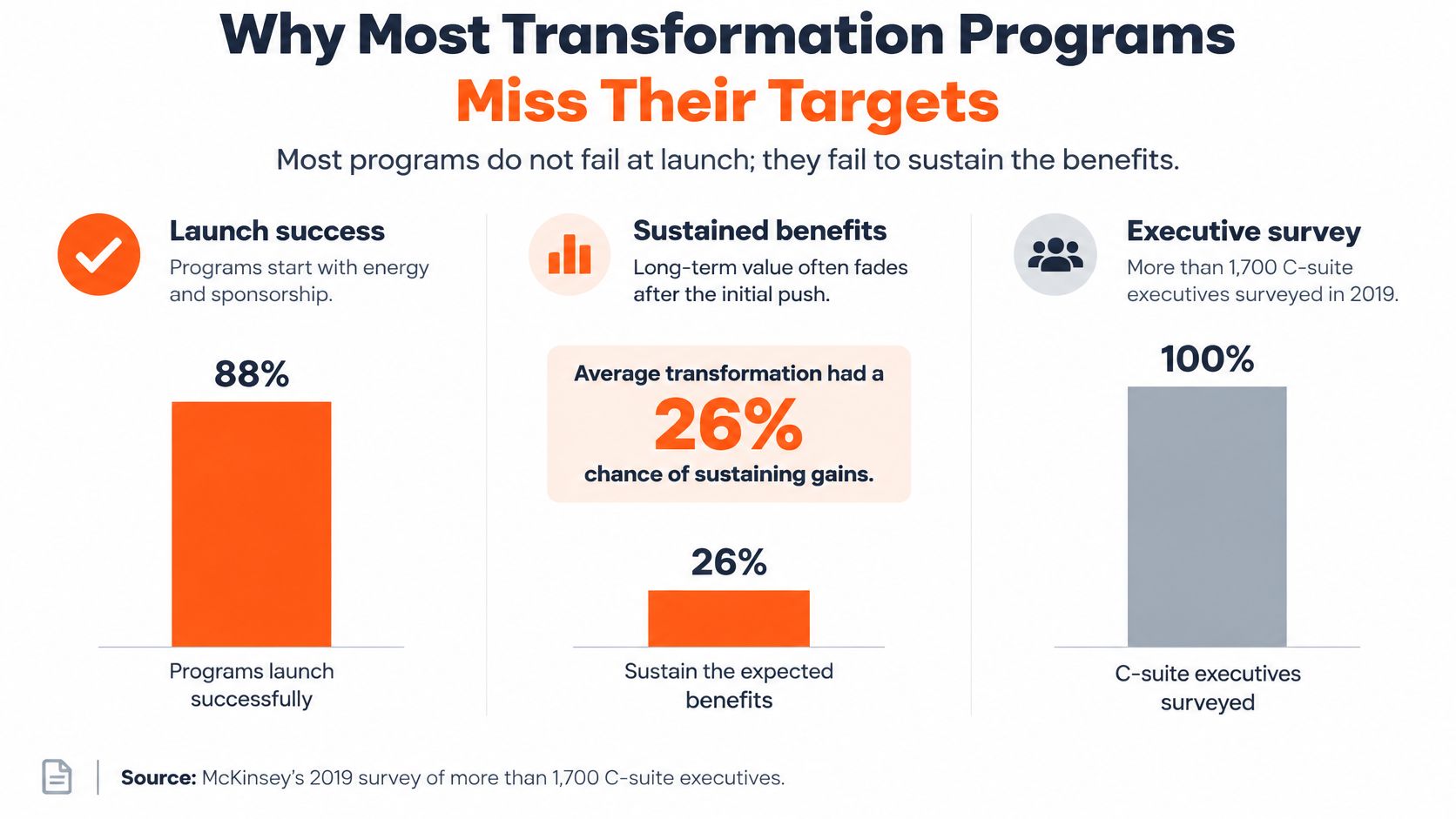
Going live is a milestone; sustained benefit is the test. McKinsey's historical findings warn against treating implementation completion as business success.
In McKinsey's research on improving transformation outcomes, a 2019 survey of more than 1,700 C-suite executives found that the average transformation had a 45% chance of delivering less profit than expected, versus about one in ten of exceeding expectations. Separate findings reported that approximately eight in ten respondents' organizations had begun digital transformations, but only 14% reported sustained performance improvements and 3% described complete success in sustaining change; reported success rates in pharmaceuticals, infrastructure, automotive, and oil and gas ranged from 4% to 11%.
The gap between activity and durable improvement
The bars below visualize those historical adoption and outcome findings. They are separate survey results, so the drop cannot be read as one cohort moving through launch, adoption, and renewal.
Organizations that had begun transformation   ████████████████  About 80%
Sustained performance improvements            ███               14%
Completely successful at sustaining change    ▌                  3%
The pattern still matters for buyers. Starting work is common; keeping the improved result after the program team exits is rare. A program can deliver software, hit a launch date, and still leave the operating model unchanged. Where approvals, records retention, accessibility checks, or regulated content workflows cross several teams, the gap appears faster: people keep the old workaround because the new process has no owner, no escalation path, or no baseline for proving the improvement.
These benchmarks do not establish a single cause. They justify testing scope beyond software delivery: who changes decision rights, resolves architecture dependencies, teaches new workflows, and owns benefits after handover?
A credible contract makes those responsibilities explicit. Governance needs named decision rights, escalation routes, and a review cadence. Architecture needs dependency resolution tied to business functions. Measurement needs a baseline, an outcome owner, and acceptance criteria that survive after launch. A dashboard by itself only reports the drift.
People need deliverables too
In IBM's 2024 global CEO study, 64% of CEOs said successful generative-AI adoption would depend more on people's adoption than technology, 61% were pushing adoption faster than some employees found comfortable, and 56% hadn't assessed the employee impact. CEOs estimated that 35% of their workforce would need retraining or reskilling over the following three years, compared with 6% in 2021.
Translate that concern into contractual scope:
- Workforce capability: Require role-specific training using actual tasks, including exceptions and escalation.
- Change adoption: Define milestones around successful workflow completion, not training attendance alone.
- Operational ownership: Name the managers responsible for resolving barriers after launch.
- Benefits evidence: Tie adoption milestones to the same baseline used for the business case, so usage and outcome are reviewed together.
Contract test: If employees continue using the old workaround, who must investigate and fix the reason?
KPIs That Prove Transformation Value Over Time
Start with a shared scorecard. The review cadences below are recommended operating practices, not external performance benchmarks.
Transformation KPIs, what they measure and how to review them
| Metric | Definition | Direction for improvement | Review level |
|---|---|---|---|
| Change lead time | Code commit to successful production deployment | Shorter | Team, weekly |
| Deployment frequency | Production releases per period | Higher, with stable failure rate | Team, weekly |
| Change fail rate | Share of deployments needing immediate intervention | Lower | Portfolio, monthly |
| Failed-deployment recovery time | Time to restore service after a failed release | Shorter | Portfolio, monthly |
| Enterprise EBIT impact | Financial result attributable to the transformation | Measured against pre-launch baseline | Executive, quarterly |
| Privileged-access coverage | Share of privileged paths under policy control | Higher | Security, monthly |
| Time to revoke access | Time to remove access after a role change | Shorter | Security, monthly |
The delivery and stability definitions follow DORA's software-delivery metrics guidance. Change lead time measures the interval from a code commit to successful production deployment; deployment frequency measures release rate; change fail rate captures deployments requiring immediate intervention; and failed-deployment recovery time measures restoration after a failed release.
Read them together. Frequent releases accompanied by frequent incidents aren't evidence of mature delivery. Likewise, a low failure rate achieved by avoiding necessary changes can conceal an ineffective release process.
Instrument before setting targets
Connect version-control commits, CI/CD runs, deployment events, incident records, and rollback actions using consistent service and environment identifiers. GitHub or GitLab events, pipeline metadata, OpenTelemetry traces, and incident-management records can provide the underlying evidence.
Baseline each application before agreeing to improvement targets. Separate planned deployments from emergency fixes, define what qualifies as immediate intervention, and document exclusions. Otherwise, suppliers and internal teams can produce different answers from the same operational history.
- Application owner: Confirms the service boundary and business process affected.
- Engineering lead: Maintains event collection and investigates delivery constraints.
- Finance partner: Validates attributable savings, additional revenue, and continuing operating costs.
- Security lead: Tests whether access controls work, rather than accepting configuration screenshots.
Connect engineering improvements to business outcomes
In McKinsey's 2025 global AI survey, 88% of respondents said their organizations regularly used AI in at least one business function, yet only 39% reported enterprise-level EBIT impact, a gap of approximately 49 percentage points. Functional deployment and enterprise financial value are different measures.
For each technical target, name the business outcome it is expected to support. Faster releases might shorten the wait for a policy correction. Better recovery might reduce interrupted claims processing. Finance should distinguish staff time made available from expenditure removed.
Attach a benefits register to the contract. Record the baseline, calculation method, owner, evidence location, review cadence, and corrective action when results deteriorate. Preserve measurement access after supplier handover.
Measure whether the business can perform the task better, not just whether the software can perform it faster.
A strangler migration routes traffic for replaced functions to new services while the legacy system continues serving everything else. For the retailer, extracting order-status lookup could shorten that service's lead time while the monolith remains operational. The result is credible only if incident exposure stays controlled and customer-service staff can retrieve accurate order information more effectively.
Zero-Trust Security and Governance From Day One
Governance begins with decisions about who may access which resources, under what conditions, and with what evidence. Choosing an identity platform comes afterward.
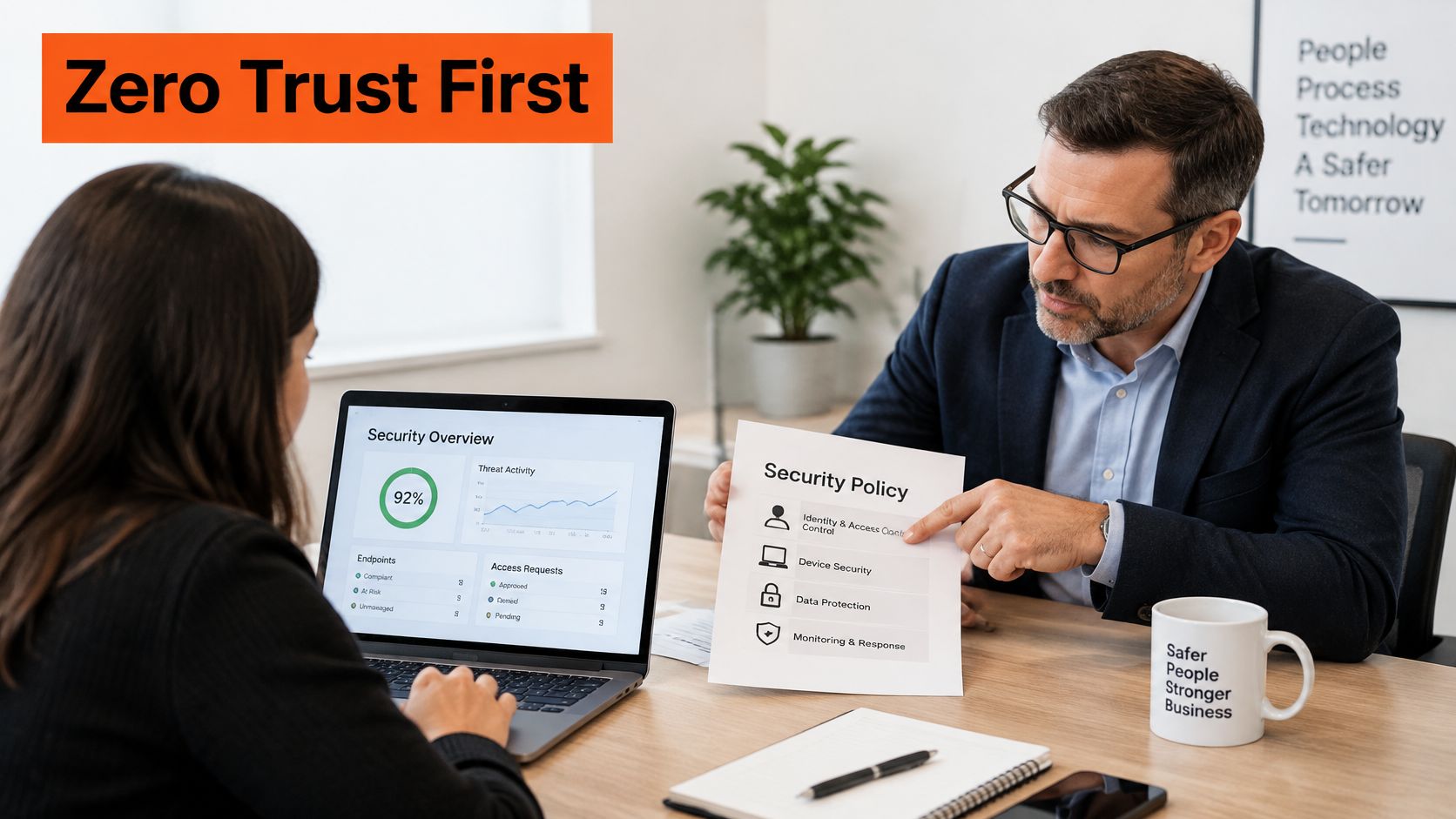
NIST's zero-trust implementation guidance addresses authorized access to enterprise resources distributed across on-premises and multiple cloud environments for workers and partners. Network location alone isn't sufficient grounds for trust.
Evaluate requests against explicit policy using identity assurance, device state, role, location, authentication method, time, and relevant resource attributes. Apply the same reasoning to workloads and service accounts, not only human users.
Build the control architecture in sequence
- Inventory the protected estate. List applications, data stores, service accounts, APIs, privileged paths, owners, and authentication dependencies. Include unattended integration jobs that may otherwise bypass the proposed controls.
- Place policy-enforcement points. Position gateways, identity-aware proxies, or workload controls between callers and protected resources. Document failure behavior so an unavailable policy service doesn't create an accidental bypass.
- Centralize telemetry. Collect access decisions, administrative changes, authentication events, and policy versions. Maintain identifiers that let investigators reconstruct an action across systems.
- Reassess continuously. Reevaluate authorization when roles, device posture, session risk, or resource sensitivity changes. Test revocation through existing sessions and downstream integrations.
Begin with externally exposed systems, sensitive regulated data, administrative interfaces, and high-value integration paths. Extending controls in risk order is more defensible than selecting whichever applications are easiest to migrate.
Make evidence part of acceptance
During coexistence, segmentation and least-privilege policies constrain lateral movement between old and new environments. They don't remove the need to patch vulnerable software or resolve overly broad service-account permissions.
For healthcare and legal-tech workflows, specify anonymization, redaction, and audit requirements against the actual data use. Don't assume masking a name removes every identifying detail, or that anonymization and reversible pseudonymization are interchangeable.
- Audit evidence: Record the actor, action, resource, decision, policy version, and relevant approval.
- Privacy testing: Use representative documents and restricted evaluation sets to test missed identifiers and excessive removal.
- Control ownership: Assign responsibility for policy changes, exceptions, review, and incident investigation.
A scoped cybersecurity consulting engagement should produce control mappings, test evidence, and operational responsibilities, not merely a product recommendation.
Include policy export, log access, retention configuration, and exception handling in acceptance terms. Use the security measures in the KPI scorecard to verify progress; counting migrated applications alone doesn't establish that access is controlled.
Modernizing Legacy Systems Without Stopping the Business
In OneTrust's 2025 survey of 1,250 governance-focused IT decision-makers in Europe and North America, 60% reported advanced or mature AI usage, while 70% said governance capability was often in tension with delivery speed and 73% reported gaps in visibility, collaboration, or policy enforcement. Modernization and AI governance therefore deserve a shared design process, not disconnected procurement tracks.
Legacy migration approaches compared
| Approach | Best when | Main risk |
|---|---|---|
| Rehost | Speed to cloud matters more than redesign | Legacy design and defects carry over |
| Replatform | Core logic is sound but infrastructure is outdated | Partial gains with hidden dependencies |
| Refactor | Code is maintainable and business rules are documented | Long timeline before visible benefit |
| Strangler replacement | Core system must keep running during change | Two platforms to operate in parallel |
| Outright replacement | Legacy system cannot meet security or compliance needs | Highest cost and cutover risk |
For a core transactional system, evaluate strangler replacement first, rather than making it an unconditional rule. APIs, event streams, structured content models, and policy enforcement can provide boundaries around legacy functions before components are replaced in waves.
Parallel operation carries real costs. Teams must reconcile records, monitor both platforms, manage schema changes, and prevent conflicting writes. Require an authoritative source for each data entity, idempotent event handling, and explicit rollback conditions.
Attach AI controls to migration boundaries
Permission-aware retrieval must enforce source permissions when content is retrieved, including permission changes after indexing. Data lineage should identify where a retrieved record originated and which transformations affected it.
Require the following production artifacts:
- Versioned behavior: Model identifiers, prompt versions, evaluation datasets, and release approvals.
- Data handling: Retention rules, redaction procedures, lineage, and permission synchronization.
- Operational safeguards: Audit trails, incident response, human escalation, and fallback procedures for AI agents.
Eurostat's Digital Decade reporting states that 47% of EU businesses used advanced or intermediate cloud services in 2025, while 20% used at least one AI technology. Those figures don't prescribe a migration sequence, but they reinforce the need to assess cloud, data, and AI capabilities separately before combining them.
A legacy-system modernization engagement should identify which dependencies must change before an AI use case can safely access operational data. Moving a workload doesn't automatically make its information governed or usable.
Domain discovery also matters. A team working with church-fund finance workflows can consult CEFCore's resources for church fund finance leaders to inform stakeholder questions, while validating actual rules with finance owners rather than treating external materials as system specifications.
Say a claims platform contains undocumented exception rules. Capture decision events with controlled payloads, compare outcomes against approved examples, and ask claims specialists to explain exceptions before rewriting code. Event streams expose behavior; they don't explain intent without domain review.
Content Engineering for Content-Heavy Domains
The symptom is recognizable: the same product fact, policy, or article appears in competing versions across the website, mobile app, PDF library, and partner feeds. Editors correct one copy but can't reliably identify every downstream version.
Content engineering deserves its own scope because application migration alone won't establish content ownership, reuse, or publishing controls. The buyable deliverable is a managed path from authoritative content to every supported channel.
Build a structured source and controlled publishing path
Start with a content schema. Define typed models, required fields, controlled vocabularies, relationships, and reusable components. A clinical guidance item, for example, might separate applicability, contraindications, evidence references, approval status, and effective dates instead of storing everything in an undifferentiated page body.
Next, build a publishing pipeline that transforms structured content into channel-specific formats. Validate schema conformance during publishing, test rendering, and track which source version produced each output.
The governance layer assigns owners, review states, version history, and retention rules. For clinical or legal material, require approval workflows that connect each published version to its approver and preserve the record of subsequent corrections.
Migrate by reuse and consequence
For an illustrative first wave, model the five most reused content types, then migrate the highest-traffic templates selected for that wave. Reconcile fields before import, test channel outputs, and retire duplicate sources only after confirming their replacements.
- Structured-source coverage: Define which eligible published items must originate in the structured store.
- Duplicate-content rate: Distinguish uncontrolled copies from intentional, governed reuse.
- Correction time: Measure from approved correction to verified publication across affected channels.
A content engineering service should include schema documentation, transformation rules, migration reports, and editorial operating procedures. Ask for a correction drill as an acceptance test: change an approved fact, publish it, and demonstrate where the updated version appears.
Acceptance rule: A successful import isn't a successful migration if editors still maintain competing sources afterward.
Contract terms should also preserve exportable content, model definitions, media relationships, and publishing configurations. Otherwise, replacing a content platform later can recreate the fragmentation the program was intended to remove.
Pricing Models and Delivery Models Compared
Compare paid scope and retained responsibility, not day rates alone. The cheapest quote may exclude test automation, production instrumentation, or the work needed to retire the old system.
What each pricing model puts at risk
Fixed-price discovery or PoC charges a defined fee for agreed deliverables. It suits bounded validation, but under-scoped questions can produce a polished answer to the wrong problem.
A fixed-price build ties payment to milestones. Use it where scope and acceptance evidence are stable; ambiguous milestones invite change requests and disputes.
Time and materials pays hourly or daily team rates and accommodates evolving scope. Require burn-rate reviews, backlog prioritization, and a forecast to complete, or flexibility becomes an uncontrolled budget.
A dedicated-team retainer funds a cross-functional team through a recurring monthly fee. It can support continuing modernization and maintenance, but needs capacity rules, replacement provisions, and exit terms.
Outcome-linked fees put part of payment against agreed KPIs. Use them only when a baseline, attribution method, exclusions, and measurement access already exist. Don't make a supplier financially responsible for outcomes it cannot materially influence.
Separate delivery responsibility from billing
| Delivery model | Buyer retains | Provider responsibility to define |
|---|---|---|
| In-house team with augmentation | Product direction and integration leadership | Named skills, availability, and handover |
| Managed transformation partner | Business decisions and acceptance authority | Delivery coordination and operational boundaries |
| Cross-functional product team | Outcome priorities and funding | Product, design, engineering, QA, data, and ML collaboration |
Put CI/CD and observability in base build scope. Price continuing support and SRE separately, including incident coverage and reliability work.
Each phase needs exit criteria and a measurement baseline. Compare quotes against identical assumptions, and apply the provider checklist's ownership and exit requirements before signing.
A Sample Roadmap and What Case Studies Show
A healthcare organization modernizing a document and claims platform faces two pressures at once: the product owner wants faster processing, and the security lead needs evidence that sensitive information will not leak into analytics or AI workflows.
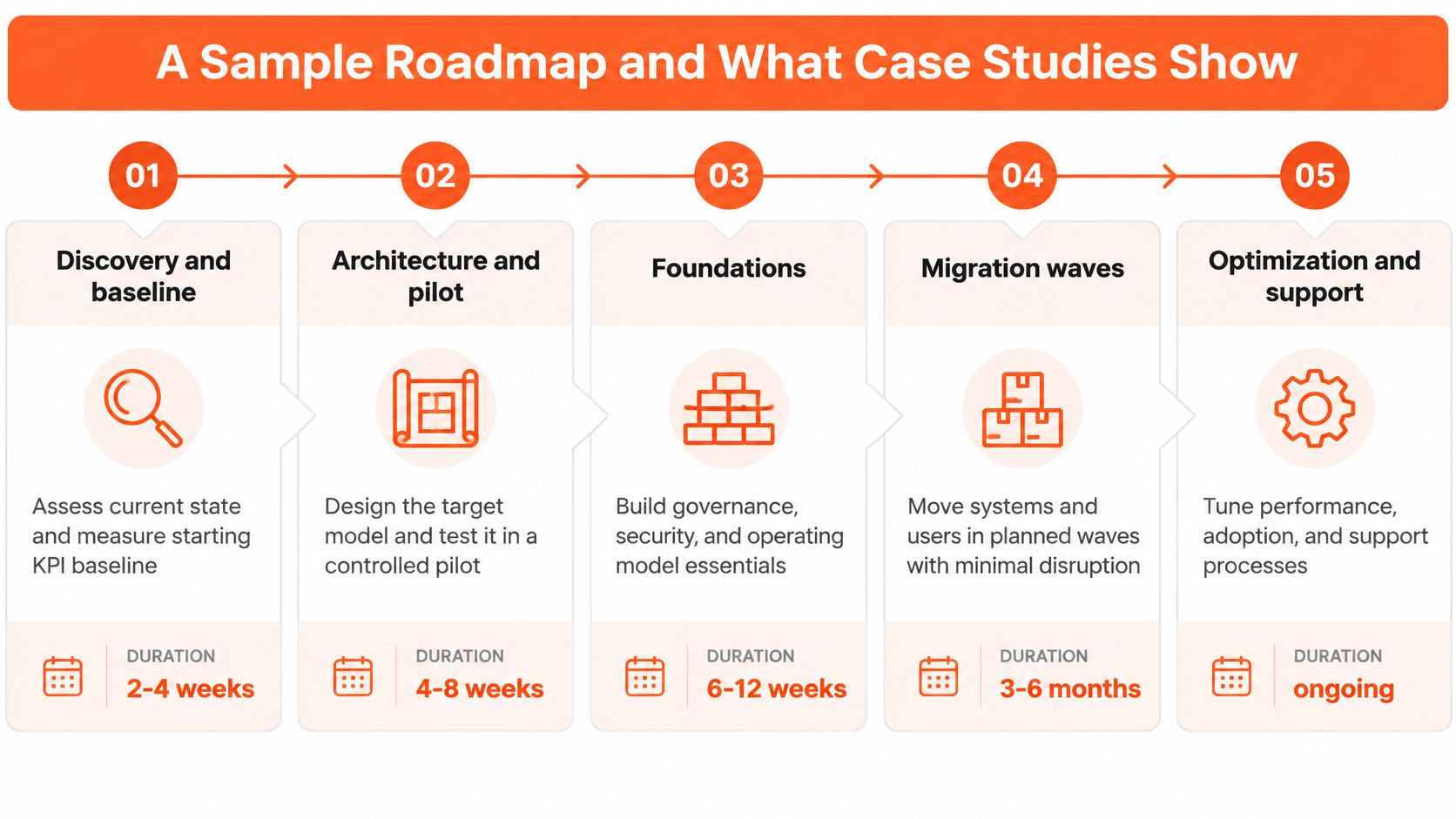
The phase durations below are planning allowances for scoping. System count, integration complexity, data condition, and regulatory review can each stretch or compress the schedule, so treat them as ranges to test during discovery.
Sample transformation roadmap by phase
| Phase | Typical duration | Core output | Exit check |
|---|---|---|---|
| Discovery and baseline | 4–8 weeks | Opportunity map and KPI baseline | Agreed metrics and owners |
| Architecture and pilot | 6–12 weeks | Target architecture and PoC | Pilot meets success criteria |
| Foundations | 2–4 months | CI/CD, data access, and security controls | Deployments automated and policies enforced |
| Migration waves | Scheduled per approved dependency map | Modernized services and cutovers | Each wave hits its KPI targets |
| Optimization and support | Ongoing | SRE, cost tuning, and legacy retirement | Benefits reviewed quarterly |
Release budget when evidence is ready
During discovery, the product owner maps claims workflows and establishes the starting measures. The architect inventories dependencies, and the security lead classifies documents and access paths. Agreement on the problem and its evidence releases funding for the pilot.
The pilot tests a bounded document-processing workflow against representative material. The team must demonstrate useful output, permission handling, and failure behavior before expanding scope.
Foundations then establish deployment automation, governed data access, and operational monitoring. Migration waves move selected functions and users, with reconciliation and rollback rehearsed before cutover. Each wave answers to the KPI targets set during discovery.
- Product owner: Accepts workflow usefulness and confirms business readiness.
- Architect: Signs off integration boundaries, data ownership, and coexistence behavior.
- Security lead: Verifies privacy controls and audit evidence before production access.
- Operations owner: Accepts runbooks, alerts, incident procedures, and support coverage.
Optimization carries its own funding rather than drawing on leftover capacity. Teams tune resource costs, investigate adoption barriers, and remove obsolete components only when dependencies have ended. Because benefits are reviewed quarterly against the original baseline, this phase is where the business case gets proven or revised.
Read case studies for the decisions they document
The publisher's documented work spans cloud file management, document anonymization, smart learning, and ad-blocking. Each category supplies a different set of questions for a case-study walk-through, and each claimed outcome should be traced to the evidence the provider can produce.
For cloud file management, inspect the modernization decision, storage boundaries, synchronization behavior, and recovery approach. For document anonymization, examine how privacy controls were tested and how reviewers handled uncertain results.
A smart-learning case can show how a team connected content, user workflows, and feedback. An ad-blocking case can illuminate compatibility testing, release practices, and ongoing maintenance. None guarantees the same commercial outcome for another enterprise.
For the healthcare scenario, the decisive gate is concrete: the security lead must be able to reproduce anonymization evidence during audit before the data platform goes live. The product owner accepts the operational trade-off, and the architect confirms that rejected or uncertain documents follow a safe alternative path.
Choosing a Provider and Taking the First Step
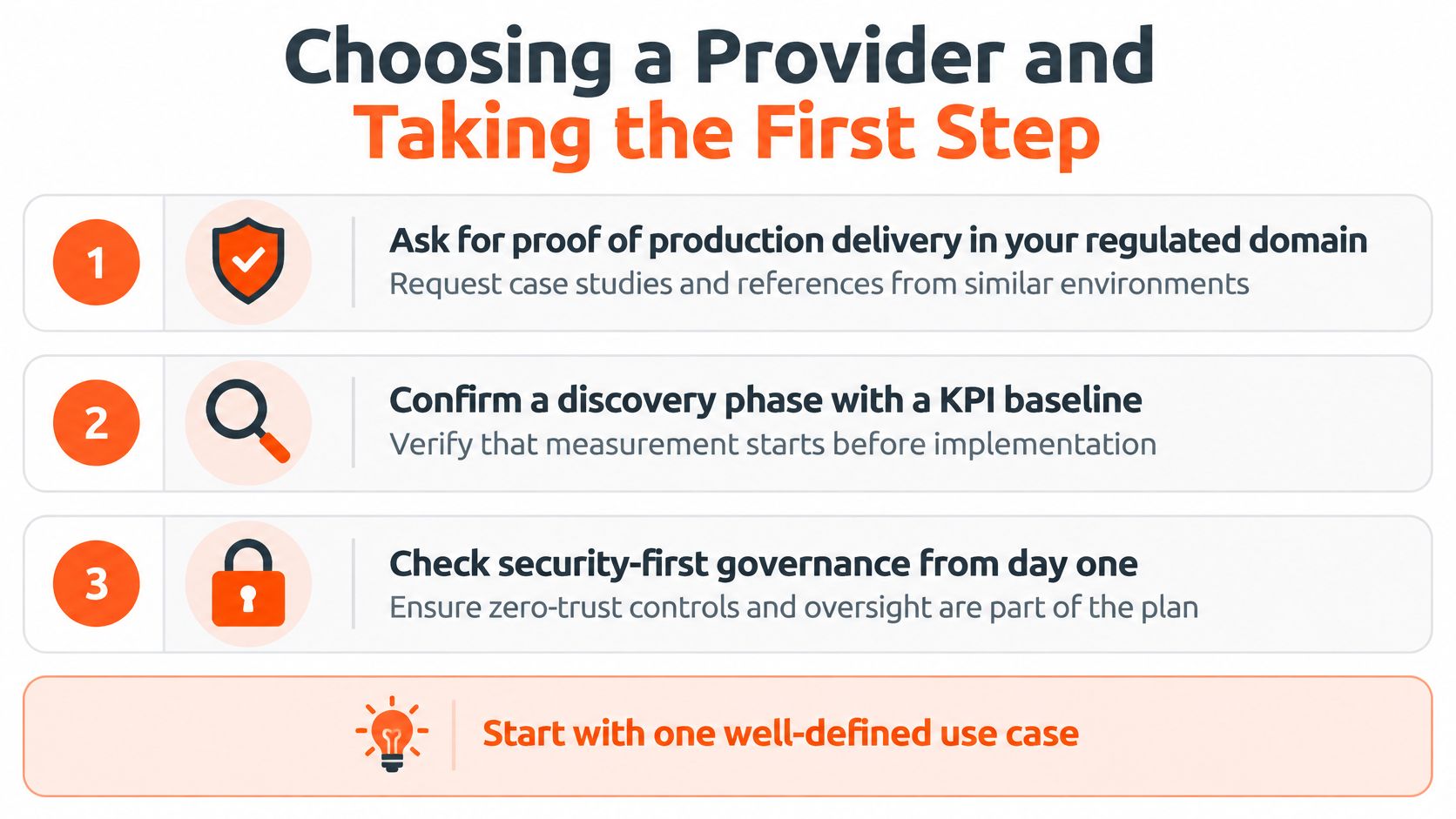
Use a scored checklist rather than a capabilities presentation. Ask every bidder to answer against the same scope and identify the evidence behind each answer.
- Production delivery: Request proof in your regulated domain.
- Discovery: Confirm a defined phase with a KPI baseline.
- Security: Inspect security-first methods and compliance patterns.
- DevOps: Review CI/CD, observability, and rollback demonstrations.
- Team composition: Verify product, design, engineering, QA, data, and ML responsibilities.
- AI governance: Examine lineage, evaluation, permission enforcement, and audit trails.
- References: Request a case-study walk-through and check figures against publication.
- Ownership: Confirm code, data, documentation, and knowledge-transfer rights.
- Post-launch service: Review support boundaries and SRE terms.
- Exit: Agree transition assistance, export formats, access removal, and handover acceptance.
Score the risks that matter to your organization
Select your top three risks, such as service interruption, sensitive-data exposure, and supplier dependence. Score evidence as absent, asserted, documented, or demonstrated, and weight the risks before reviewing proposals.
Separate transformation delivery from routine IT operations. If local operational coverage is a distinct requirement, compare it independently, for example by reviewing the scope of an NYC managed IT provider such as RDE Technologies. Require a responsibility matrix wherever providers share an incident or infrastructure boundary.
One option to test against the checklist is the publisher's software engineering consultancy, operating since 2015, with CTO-led architecture under Anna Tukhtarova, whose stated experience exceeds 15 years. Its service scope includes discovery, legacy modernization, cloud migration, and secure LLM integration; those capabilities should still be validated through relevant delivery evidence.
This month, commission a short discovery with a narrow decision: establish the starting KPI baseline and select a modernization wave. Don't commit to the full program until owners, acceptance evidence, and exit conditions are clear.
devPulse offers discovery, architecture, legacy modernization, secure AI integration, and ongoing engineering support for enterprise transformation. Visit devPulse to discuss a bounded discovery engagement that establishes your KPI baseline, identifies a modernization wave, and defines how its value will be verified after go-live.