














TL;DR:
- Engineering resource planning forecasts, allocates, and manages engineering personnel based on demand and realistic capacity. Regular weekly reviews and skill-matched assignments improve project delivery success, minimizing delays and budget overruns. Using tools like resource matrices and prioritization frameworks such as RICE ensures effective, value-driven resource utilization.
The engineering resource planning process is the structured method for forecasting, allocating, and managing engineering resources to deliver projects on time, within budget, and within scope. Unlike generic project staffing, this process accounts for the non-fungible nature of engineering skills, where a firmware engineer cannot simply replace a cloud architect. Resource plans must align with the project triple constraints of scope, schedule, and budget, and require formal sponsor approval before any acquisition begins. The foundational tools are the work breakdown structure (WBS), the resource matrix, and the utilization rate. Get these three elements right, and the rest of the process follows a clear, repeatable path.
What are the prerequisites for the engineering resource planning process?
Effective resource planning starts before you open any scheduling tool. You need two things in place first: an accurate picture of demand and an honest picture of supply.
Demand forecasting means identifying which roles, skills, and seniority levels each project phase requires, and when. A mobile app project needs iOS engineers in sprint one, a backend engineer by sprint two, and a QA specialist before release. Forecasting at this level of specificity prevents the last-minute scramble that derails timelines.
Real capacity calculation is where most teams make their first mistake. Assuming 100% availability is a guaranteed path to over-allocation. Non-billable time, including holidays, training, internal meetings, and support rotations, typically reduces productive capacity by 20–30%. A senior engineer nominally available for 40 hours per week may realistically deliver 28–32 billable hours. Plan against that number, not the theoretical maximum.
Engineering specialization adds another layer of complexity. Unlike generalist roles, engineering skills are largely non-interchangeable. A DevOps engineer and a data scientist both carry “engineer” in their title, but they solve entirely different problems. Your planning process must account for this by mapping skill requirements at the task level, not just the headcount level.
- Identify required roles by project phase using the WBS as your source of truth
- Calculate real capacity per person by subtracting non-billable commitments
- Document skill constraints and flag roles with limited internal supply
- Build at least two scenarios: one baseline and one contingency for key resource unavailability
Scenario planning tests what happens when a project start date shifts by three weeks or a senior engineer goes on leave. Running these scenarios before problems occur gives you a response plan instead of a crisis.
Pro Tip: Build your capacity baseline in a shared spreadsheet or resource planning tool before any project kickoff meeting. Walking into that meeting with real numbers changes the conversation from optimistic guessing to grounded negotiation.
How to execute engineering resource planning step by step
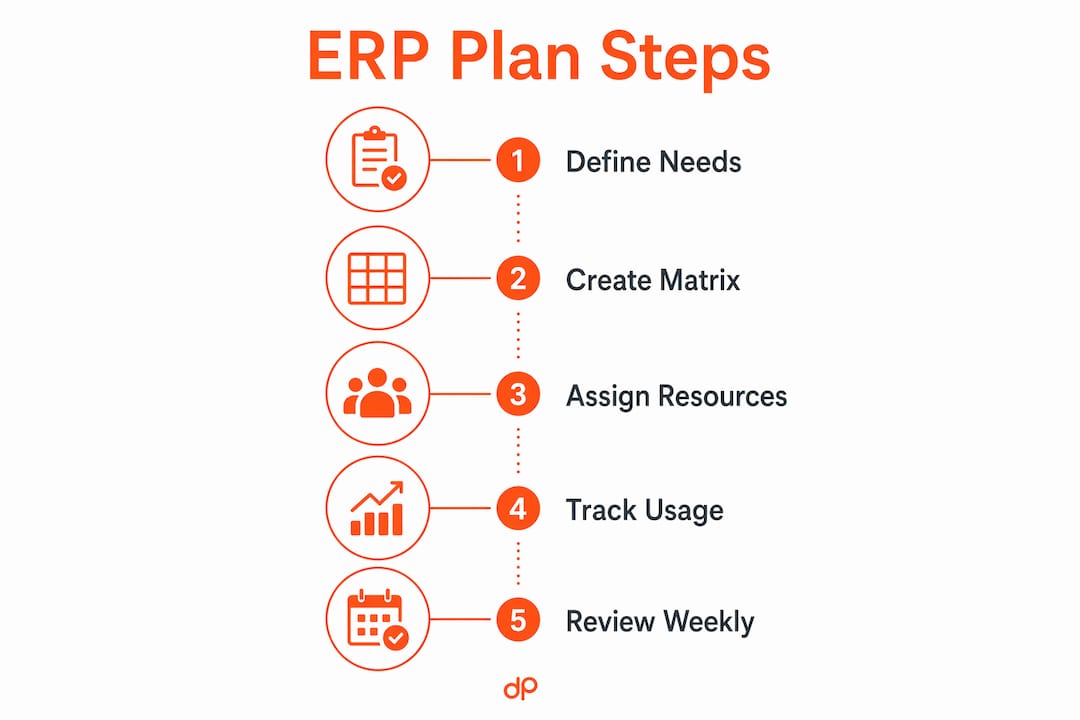
The resource planning process follows four primary stages: determine resource needs, acquire talent or assets, manage performance, and control usage through utilization metrics. Here is how each stage plays out in practice.

Step 1: Build the WBS and extract resource requirements
Start with the work breakdown structure. Decompose the project into deliverables, then into work packages, then into tasks. Each task gets a role assignment, an effort estimate in person-days, and a timing window. This is not optional groundwork. Without the WBS, every resource estimate is a guess.
Step 2: Create the resource matrix
A resource matrix maps work packages against roles and person-day estimates. It gives you a single view of who is needed, for how long, and when. The matrix also surfaces conflicts immediately. If your lead backend engineer is assigned 60 person-days across two projects in the same six-week window, the matrix shows that before it becomes a delivery problem.
| Resource matrix column | What it captures |
|---|---|
| Work package | The specific deliverable or task group |
| Required role | The engineering skill or seniority level needed |
| Effort estimate | Person-days required to complete the work |
| Timing window | Start and end dates for the assignment |
| Assigned engineer | Named individual or TBD if not yet filled |
Step 3: Assign resources by fit, availability, and cost
Match engineers to tasks based on three criteria in this order: skill fit first, availability second, cost third. Assigning a mid-level engineer to a task requiring senior judgment creates rework. Assigning a senior engineer to a task a junior could handle wastes budget. The right fit at the right time is the goal.
Step 4: Track utilization and manage workloads actively
Utilization rate is the primary KPI for resource efficiency. Calculate it as billable hours divided by total working hours. An engineer logging 24 billable hours out of 40 total hours runs at 60% utilization. That number tells you whether someone is over-committed, underused, or appropriately loaded. Track it weekly, not monthly.
Step 5: Run weekly review cycles
Plans drift. Scope changes, engineers get sick, and client priorities shift. A weekly review cycle catches these changes before they compound. Review actual hours logged against planned hours, rebalance assignments where needed, and update the resource matrix to reflect current reality.
Pro Tip: Set a fixed 30-minute weekly slot with your project leads to review utilization data. Decisions made with current data take minutes. Decisions made after two weeks of drift take days to untangle.
What are the most common mistakes in engineering resource planning?
Most resource planning failures share the same root causes. Recognizing them early is the fastest way to avoid them.
- Over-allocation from optimistic capacity assumptions. Teams plan against 100% availability and then wonder why deadlines slip. Real capacity is always lower than theoretical capacity.
- Context switching across too many concurrent projects. Spreading specialized engineers thin across multiple projects simultaneously produces multiple half-finished deliverables. One engineer split across four projects delivers a fraction of the focused output they would produce on two.
- Infrequent plan reviews. Failure to review plans weekly causes scope creep and plan obsolescence within days. A resource plan updated monthly is not a plan. It is a historical document.
- Maximizing utilization as the primary goal. Keeping engineers at 90% utilization sounds efficient. It is not. It leaves no buffer for urgent requests, bug fixes, or knowledge transfer.
Prioritizing initiatives with a framework like RICE, which scores work on Reach, Impact, Confidence, and Effort, focuses your team on high-value outcomes rather than simply keeping everyone busy. A fully occupied team working on low-priority tasks is a resource planning failure, not a success.
Scenario planning is the antidote to reactive management. When you have already modeled what happens if your cloud architect is unavailable for two weeks, you respond with a prepared plan rather than improvised decisions. Build at least one contingency scenario for every critical resource dependency in your project.
What tools and frameworks support engineering resource planning?
Resource planning software handles the mechanical work of tracking availability, logging hours, and generating utilization reports. The feature categories that matter most for engineering teams are capacity forecasting, role-based allocation views, scenario modeling, and integration with project tracking systems like Jira or Azure DevOps.
Enterprise platforms offer portfolio-level views that show resource demand across all active projects simultaneously. This is the feature that separates a planning tool from a simple calendar. Entry-level tools handle single-project allocation but break down when you need to balance resources across a portfolio of five or more concurrent projects.
Hybrid AI models integrating machine learning and operations research represent the current frontier for dynamic resource distribution. These systems analyze historical project data, identify demand patterns, and suggest allocation adjustments before bottlenecks form. The practical benefit is faster response to change and fewer planning errors caused by manual data entry.
For prioritization, the RICE framework scores each initiative on four dimensions: Reach (how many people it affects), Impact (how significantly it moves a key metric), Confidence (how certain you are of the estimates), and Effort (how many person-weeks it requires). RICE gives resource allocation decisions a defensible, data-grounded basis. The ICE framework, a simplified version scoring Impact, Confidence, and Ease, works well for teams that need faster triage. Both frameworks shift the conversation from “who is available?” to “what is worth doing?”
For engineering teams managing IT resource management at scale, integrating these prioritization frameworks directly into your planning cadence produces measurably better outcomes than availability-first scheduling.
Key Takeaways
A disciplined engineering resource planning process, built on real capacity data, weekly review cycles, and skill-matched allocation, is the single most reliable driver of on-time, on-budget project delivery.
| Point | Details |
|---|---|
| Use real capacity, not theoretical | Subtract non-billable time to avoid over-allocation from the start. |
| Build a resource matrix | Map roles, effort, and timing to surface conflicts before they become delays. |
| Track utilization weekly | Monitor billable hours against total hours to catch over-commitment early. |
| Prioritize with RICE or ICE | Score initiatives by value, not just availability, to focus teams on high-impact work. |
| Plan as a weekly cycle | Review and rebalance every week to prevent scope creep and plan drift. |
Why I think most teams treat resource planning as a one-time event
Most engineering teams build a resource plan at project kickoff, present it to stakeholders, and then let it sit untouched for weeks. That is the single most common reason projects run over budget and over schedule. The plan becomes a fiction while the project becomes a fire drill.
What I have found working with engineering organizations is that the teams with the best delivery records treat resource planning the same way they treat sprint planning. It is a recurring ritual, not a document. They review utilization data every week, they rebalance assignments when reality diverges from the plan, and they communicate trade-offs to stakeholders before those trade-offs become crises.
The other thing I see consistently is the utilization trap. Managers chase high utilization numbers because they look good in reports. But an engineer running at 95% utilization has no capacity to mentor a junior, respond to a production incident, or think carefully about a complex architectural decision. The best teams I have worked with target 70–80% utilization for senior engineers and treat the remaining capacity as a deliberate investment in quality and resilience.
Transparent stakeholder communication is the piece most planning guides skip entirely. When scope changes force a trade-off between features and timeline, the resource plan is your evidence. It shows exactly what the change costs in person-days and which other commitments it displaces. That conversation is far easier when you have current data. For teams scaling their engineering workforce, building this communication discipline early pays compounding returns as project complexity grows.
— Vlad
How Devpulse supports engineering teams with resource-intensive projects
Engineering resource planning only works when the underlying software systems give your team accurate, timely data. Poorly integrated tools, manual data entry, and disconnected project tracking systems all introduce errors that compound across the planning cycle.

Devpulse builds custom software solutions that connect your project management, resource tracking, and delivery workflows into a single, reliable system. Our engineering teams have delivered end-to-end platforms for clients in healthcare, legal tech, and enterprise SaaS, where resource allocation accuracy directly affects compliance and client outcomes. If your current tooling creates friction in your planning process, we can help you build something that does not. Contact Devpulse to discuss your project requirements.
FAQ
What is the engineering resource planning process?
The engineering resource planning process is the structured method for forecasting, allocating, and managing engineering personnel and assets across projects. It follows four stages: determining resource needs via WBS, acquiring resources, managing performance, and controlling usage through utilization metrics.
How do you calculate real engineering capacity?
Subtract non-billable time, including holidays, training, and internal meetings, from total working hours. This typically reduces available capacity by 20–30% compared to theoretical full-time hours.
What is a resource matrix in engineering project management?
A resource matrix maps work packages against required roles, effort estimates in person-days, and timing windows. It provides a single view of resource demand and surfaces allocation conflicts before they affect delivery.
What is the RICE framework and how does it apply to resource allocation?
RICE scores initiatives on Reach, Impact, Confidence, and Effort to prioritize which work receives engineering resources first. It shifts allocation decisions from availability-based to value-based, focusing teams on high-impact outcomes.
How often should engineering resource plans be reviewed?
Resource plans require weekly review. Reviewing less frequently allows scope creep and plan drift to compound, turning a manageable adjustment into a project-level problem.