














TL;DR:
- Resource-based teams are non-hierarchical groups formed around specific tasks, utilizing unique and complementary skills. They prioritize flexibility, collective accountability, and strategic resource composition based on the Resource-Based View theory. Proper leadership focuses on maintaining team context and resisting organizational pressures to undermine their flexibility.
A resource-based team is a non-hierarchical, strategically configured group of people and assets assembled to execute tasks by combining unique, complementary skills rather than following fixed reporting lines. The concept draws from two distinct but related frameworks: the operational resource team definition used in platforms like Oracle Cloud, and the strategic Resource-Based View (RBV) theory developed by economists Jay Barney and Birger Wernerfelt. Understanding both interpretations is what separates managers who build high-performing teams from those who simply fill seats. This guide covers the resource team definition, its key characteristics, and the steps you need to build one that actually delivers results.
What is a resource-based team, and how does it differ from a traditional team?
A resource-based team is explicitly not an organizational reporting structure. It exists to get work done, not to reflect a company hierarchy. That distinction matters more than it sounds.
Traditional functional teams are organized around departments: engineering, marketing, finance. Members report to a department head, and their primary loyalty is to that function. A resource-based team cuts across those lines. It pulls the right skills from wherever they exist in the organization and groups them around a specific task or outcome.
The difference also shows up in how resources are categorized versus deployed. A Resource Breakdown Structure (RBS), used in project planning tools, extends 3–4 levels deep to categorize labor, equipment, and materials. That is a planning artifact. A resource-based team is the execution unit that actually uses those resources to deliver outcomes. Confusing the two leads to over-engineered org charts and under-resourced projects.
Here is what distinguishes a resource-based team in practice:
- Non-hierarchical structure. No single member outranks others based on title alone. Authority follows expertise and task relevance.
- Complementary skill composition. Members are selected because their abilities combine to produce output no single person could achieve alone.
- Temporary or permanent formation. Some resource teams dissolve after a project. Others become standing units for recurring operational needs.
- Flexible resource allocation. Members can be reassigned as task demands shift, without restructuring the broader organization.
- Task-driven accountability. Performance is measured against outcomes, not departmental KPIs.
This structure gives managers a tool that traditional org design simply does not offer: the ability to configure the exact capability set a project needs, when it needs it.
How does RBV theory define the characteristics of resource-based teams?

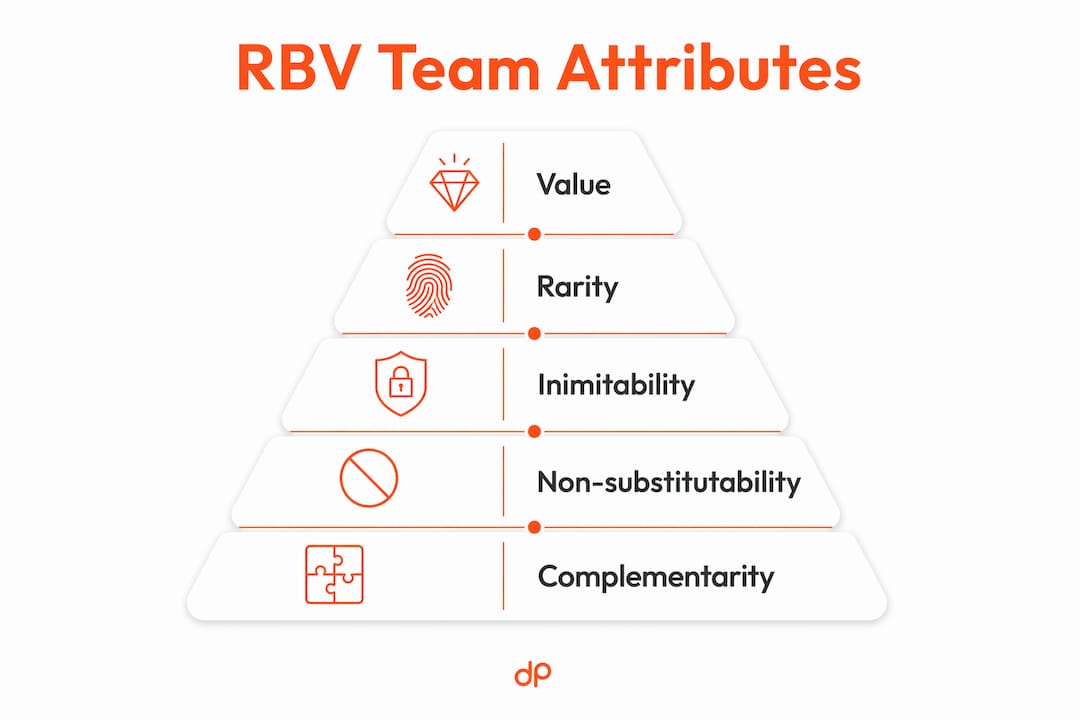
The Resource-Based View of the firm, originally articulated by Barney and Wernerfelt, holds that sustained competitive advantage comes from resources that are valuable, rare, imperfectly imitable, and nonsubstitutable. Applied to teams, this framework explains why some groups consistently outperform others with similar headcounts and budgets.
Complementary skills create team value that exceeds the sum of individual contributions. A team where a systems architect, a security engineer, and a UX researcher work together produces outcomes none of them could generate independently. That combined output is the competitive asset, not any single person.
The table below maps the four RBV attributes directly to team design decisions:
| RBV Attribute | What it means for team design |
|---|---|
| Value | Each member’s skills must contribute directly to the team’s core task. No passengers. |
| Rarity | The combination of skills should be difficult for competitors to replicate quickly. |
| Imperfect imitability | Team chemistry, shared context, and trust built over time cannot be copied by hiring alone. |
| Nonsubstitutability | The specific configuration of people and skills produces outcomes that generic teams cannot match. |
The strategic version of a resource-based team is built with these four attributes in mind. The administrative version, used in platforms like Oracle Cloud for task routing, focuses on operational efficiency rather than competitive positioning. Both interpretations are valid but distinct. Practitioners who conflate them end up applying the wrong design logic to the wrong problem.
Pro Tip: When assessing whether your team qualifies as strategically resource-based, ask one question: could a competitor hire their way to the same output in six months? If the answer is yes, you have an administrative team, not a strategic one.
How do resource-based teams improve project outcomes?
The performance gains from resource-based teams come from three specific mechanisms: faster task assignment, collective accountability, and flexible decision-making under pressure.
Faster task assignment happens because the team is already configured around the work. There is no need to negotiate with department heads or wait for approval chains. The right person is already on the team and can be directed to the right task in real time. This is especially valuable in software development, where requirements shift mid-sprint and waiting for organizational approval kills momentum.
Collective accountability changes how team members behave. Shared compensation tied to collective outcomes reduces internal friction and improves collaboration. When individuals are rewarded based on team results rather than personal metrics, they stop hoarding information and start solving problems together. That behavioral shift is the actual driver of performance improvement.
The numbered steps below show how these mechanisms play out across a typical project lifecycle:
- Scoping. The team assesses the task together, identifying which skills are needed and flagging gaps before work begins.
- Assignment. Resources are allocated based on current task demands, not fixed role descriptions.
- Execution. Members make real-time decisions within their domain without waiting for managerial sign-off on every action.
- Review. The team evaluates outcomes collectively and adjusts resource allocation for the next phase.
- Closeout. Lessons are documented at the team level, not siloed within individual departments.
The challenge is that high functional diversity in teams boosts capability for complex tasks but can slow response time. Teams with highly varied skill sets need simpler coordination plans, not more detailed ones. Overloading a diverse team with rigid tactical frameworks cancels out the flexibility advantage.
“Dynamic resource deployment and team mobilization impact performance more than fixed structural configurations. Managers should foster flexible role allocation over rigid assignment models.” — Organisation of functional competence within teams
How to build and manage an effective resource-based team
Building a resource-based team is a deliberate process. It starts with understanding what the task actually requires, not what your current org chart can conveniently provide.
Follow these steps to construct a team with genuine resource-based characteristics:
- Define the task before defining the team. Identify the specific outcomes required, the complexity level, and the decision-making speed needed. Task complexity and team-level properties must both be considered before any member is selected.
- Map required competencies, not job titles. List the skills the task demands. Then find the people who hold those skills, regardless of their department or seniority level.
- Balance diversity with coordination capacity. Diverse teams handle complex problems better, but they require simpler, less rigid plans to coordinate effectively. Do not add complexity to your process just because you added complexity to your team.
- Stabilize core roles while keeping the edges flexible. Excessive role switching associates with poorer team performance. Assign clear ownership for critical functions, then allow flexibility at the margins where task demands shift.
- Align compensation with shared outcomes. Individual performance bonuses undermine resource team cohesion. Tie at least a portion of rewards to collective results to reinforce collaborative behavior.
- Use the right tools for resource tracking. Platforms like Oracle Cloud allow managers to configure resource teams directly, assign members, and track task allocation without rebuilding the org chart. For IT resource management, this kind of tooling is the difference between reactive and proactive resource deployment.
Pro Tip: Avoid the common mistake of treating a resource team as a permanent committee. If the task changes significantly, rebuild the team composition to match. A team that outlives its original purpose becomes bureaucracy.
Leadership in a resource-based team looks different from traditional management. You are not directing a hierarchy. You are maintaining the conditions under which complementary skills can combine effectively. That means removing blockers, clarifying priorities, and protecting the team from organizational interference, not micromanaging task execution.
For remote IT teams, these principles apply with even greater force. Distributed resource-based teams require explicit communication norms and shared documentation practices to compensate for the absence of physical proximity. Tools like shared project documentation become structural requirements, not optional conveniences.
Key Takeaways
A resource-based team delivers competitive advantage only when its members hold complementary, hard-to-replicate skills and are held accountable to shared outcomes rather than individual metrics.
| Point | Details |
|---|---|
| Non-hierarchical by design | Resource-based teams are not reporting structures; authority follows expertise, not title. |
| RBV drives team composition | Select members based on value, rarity, imitability, and nonsubstitutability of their skills. |
| Shared rewards improve performance | Compensation tied to collective outcomes reduces friction and builds team cohesion. |
| Balance diversity with simplicity | Highly diverse teams need simpler coordination plans to maintain decision-making speed. |
| Role stability matters | Excessive role switching hurts performance; stabilize core functions and flex at the edges. |
What I’ve learned about resource teams that most guides get wrong
Most articles on resource-based teams treat the concept as purely theoretical, something borrowed from academic strategy papers and applied loosely to project management. That framing misses the practical tension that actually determines whether these teams succeed.
The real challenge is not building the team. It is resisting the organizational pressure to turn it into something familiar. Executives and department heads instinctively want to add reporting lines, assign permanent titles, and fold the team into the existing hierarchy. Every one of those moves erodes the flexibility that makes a resource-based team valuable in the first place.
What I have seen work consistently is a clear mandate from leadership that the team exists to deliver a specific outcome, not to become a permanent fixture. That mandate needs to be stated explicitly at the start, revisited at each project phase, and enforced when organizational politics push back. The teams that perform best are the ones where the manager acts as a shield, not a supervisor.
The other thing most guides understate is the role of shared context. RBV theory talks about inimitability, and the hardest thing to replicate is not a skill set. It is the accumulated understanding a team builds about how its members think, communicate, and make decisions under pressure. That context takes time to develop and is destroyed every time you rotate members in and out for convenience. Protect it deliberately.
— Vlad
How Devpulse helps teams deliver better project outcomes
Devpulse works with engineering teams across healthcare, SaaS, and enterprise software to build and scale digital products that require exactly the kind of resource-based thinking this article describes.
When a project demands a specific combination of AI expertise, cloud architecture, and domain knowledge, Devpulse configures the right team for the task rather than applying a generic delivery model. Our software engineering services are built around this principle: the right skills, assembled for the right problem, accountable to shared outcomes. If you are building a complex platform or modernizing a legacy system and need a team configured to deliver, review our case studies to see how we approach resource-driven project delivery in practice.
FAQ
What is the resource team definition in project management?
A resource team is a non-hierarchical group formed to assign and execute tasks efficiently. It is not an organizational reporting structure and can be temporary or permanent depending on the project.
How does a resource-based team differ from a functional team?
A functional team is organized around a department with fixed reporting lines. A resource-based team is assembled around a specific task using complementary skills drawn from across the organization.
What are the key characteristics of resource-based teams?
Resource-based teams are defined by non-hierarchical structure, complementary skill composition, flexible resource allocation, and collective accountability tied to shared outcomes.
What is the Resource-Based View (RBV) and why does it matter for teams?
RBV theory holds that competitive advantage comes from resources that are valuable, rare, imperfectly imitable, and nonsubstitutable. Applied to teams, it explains why unique skill combinations outperform generic staffing models.
What is the biggest risk when managing a resource-based team?
Excessive role switching is the most common performance risk. Research shows that too much role variability within a team associates with poorer outcomes. Stabilize core functions and allow flexibility only at the margins.