













TL;DR:
- Remote team management relies on documented workflows, async communication, and outcome-based performance systems. It improves productivity and retention by reducing meetings, increasing focus, and fostering trust through consistent behavior. Effective management requires deliberate systems and clear frameworks rather than informal practices.
Remote team management is defined as the structured practice of organizing, guiding, and supporting geographically dispersed teams through deliberate communication systems, documented workflows, and outcome-driven processes. The term “virtual team management” is also widely used in organizational psychology literature, and both phrases describe the same operational discipline. Structured remote management frameworks produce 25% higher retention, 21% greater profitability, and 34% faster project completion than ad hoc approaches. Those numbers confirm that the definition of remote team management is not just an HR concept. It is a measurable performance system that replaces informal office signals with intentional processes.
What are the core components of remote team management?
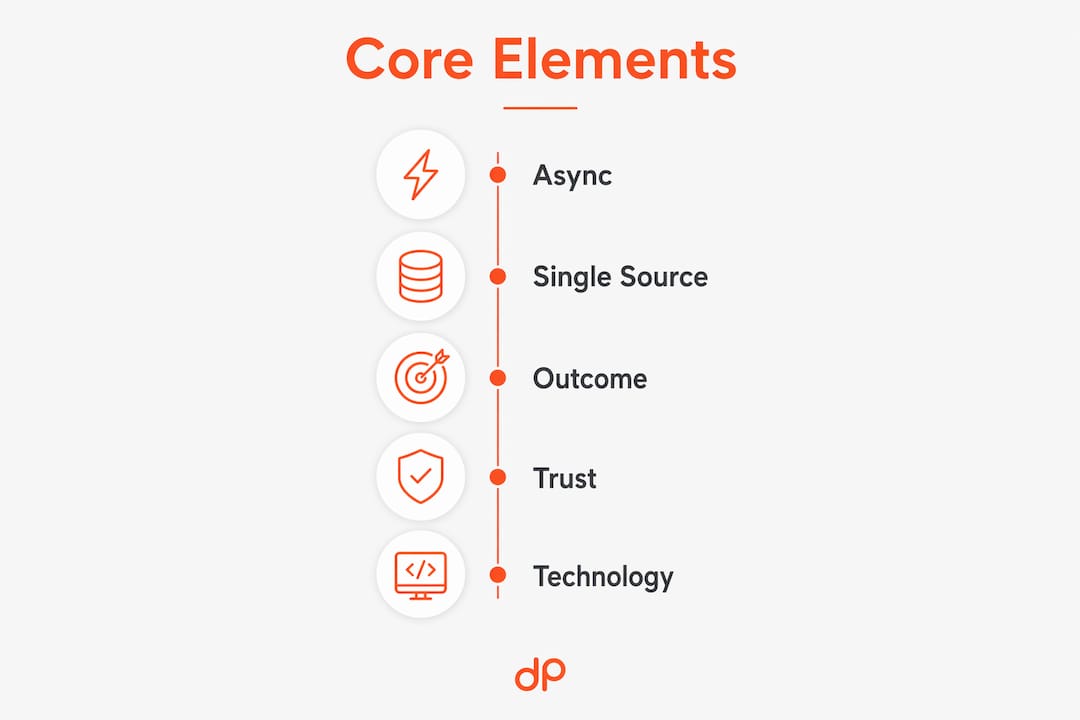
Effective remote team leadership rests on five foundational elements. Each one compensates for something the office environment provided automatically.

1. Async-first communication protocols
Async-first communication means teams default to written, time-independent messages rather than live calls. This approach reduces interruptions, creates a searchable record, and respects time zones. Synchronous meetings are reserved for high-stakes decisions and sensitive conversations only.
2. A single source of truth
Administrative fragmentation occurs when team members waste time hunting for context across email threads, chat logs, and shared drives. A project board or team wiki eliminates this by centralizing task status, decisions, and documentation in one place. Every team member knows exactly where to look.
3. Outcome-based performance management
High-performing remote organizations replace time-tracking with task visibility and accountability. Managers define clear deliverables, set measurable goals, and coach priorities instead of monitoring hours. This shift is the single biggest mindset change for managers moving from office to remote leadership.
4. Trust built through consistent behavior
Trust in remote teams is built through consistency, transparency, and predictable management behaviors. Physical proximity creates informal trust signals. Without them, managers must be deliberate: follow through on commitments, communicate decisions openly, and respond within defined windows.
5. Technology that creates visibility
The right tech stack does not need to be complex. Chat tools, shared document platforms, and task trackers cover the core needs. The goal is visibility into work status without requiring a meeting to get it.
Pro Tip: Design your communication system before you hire your first remote team member. Retrofitting communication norms onto an existing team is significantly harder than building them from day one.
How does remote team management improve productivity and retention?
The business case for structured virtual team management is strong and well-documented. 94% of employees stay longer at companies that invest in their professional growth within remote structures. That figure means formal frameworks directly reduce turnover costs, which are typically estimated at six to nine months of an employee’s salary.
Cost savings are equally significant. Remote work generates roughly $11,000 in annual savings per employee and gives organizations access to a talent pool that is 340% larger than local hiring alone. That scale changes how you think about team composition and competitive hiring.
Productivity gains come from three specific mechanisms:
- Reduced commute time converts directly into focused work hours
- Fewer unplanned interruptions compared to open-plan offices
- Documented workflows that let team members execute without waiting for manager input
The advantages of remote IT teams are especially pronounced in knowledge work, where deep focus time drives output quality. A software engineer interrupted every 23 minutes loses far more than 23 minutes of productive time due to context-switching costs.
Pro Tip: Track meeting hours per week per team member. If the average exceeds six hours, you have a synchronous meeting problem that will erode both productivity and morale.
What are the common challenges of remote team management?
Managing remote teams surfaces challenges that office environments absorb invisibly. Naming them precisely is the first step to solving them.
-
Visibility loss. Managers lose the ambient awareness of who is working on what. Without structured check-ins and task boards, work becomes invisible until it is late or blocked.
-
Participation disparities. The Center for Creative Leadership identifies participation disparities and conflict resolution as common hurdles in virtual teams. Quieter team members disengage in video calls dominated by a few voices. Async formats give everyone equal space to contribute.
-
Administrative fragmentation. Context lives in too many places. A new team member joining a six-month-old project spends days reconstructing decisions that were never documented. A shared wiki solves this permanently.
-
Synchronous meeting overload. Over-indexing on synchronous meetings increases burnout. High-performing remote teams run 80–90% of communication asynchronously. When every question triggers a meeting invite, the team stops asking questions.
-
Trust deficits from inconsistent management. Remote team members cannot read body language or overhear hallway conversations. Inconsistent communication from managers creates anxiety and speculation that damages team cohesion.
The mitigations are practical and repeatable:
- Document every significant decision in a shared space immediately after it is made
- Set explicit response-time expectations for different communication channels
- Create a written team operating agreement covering working hours, availability signals, and escalation paths
- Reserve video calls for onboarding, retrospectives, and conflict resolution
Pro Tip: Treat communication as a product. Write a one-page “how we communicate” document for your team and update it quarterly. Teams that design communication deliberately outperform those that leave it to chance.
What practical strategies and tools optimize remote team management?
The best practices for remote management come down to four operating principles. Each one translates directly into team behavior.
Establish a single source of truth
Every project needs one authoritative location for status, decisions, and documentation. Project boards work well for task tracking. Wikis work well for process documentation and onboarding. The format matters less than the consistency of use.
Set a defined operating rhythm
An operating rhythm is a predictable schedule of team touchpoints. A weekly written status update, a biweekly team call, and a monthly retrospective cover most coordination needs. Defined operating rhythms replace the informal cadence of office life with something explicit and reliable.
Choose a simple, stable tech stack
| Communication type | Recommended approach |
|---|---|
| Day-to-day messaging | Dedicated chat platform with organized channels |
| Document collaboration | Cloud-based shared document system |
| Task and project tracking | Visual project board with clear ownership fields |
| Video calls | Lightweight video conferencing tool |
| Knowledge base | Team wiki or internal documentation site |
The goal is not to use every available tool. The goal is to use the fewest tools that cover all communication needs without creating overlap or confusion.
Shift from supervision to managerial leverage
Managerial leverage means spending your time removing blockers, clarifying priorities, and creating conditions for team members to work independently. Managers who supervise activity create dependency. Managers who remove obstacles create performance. The types of remote teams that consistently outperform are those where team members can make decisions without waiting for approval on routine matters.
Autonomy requires clear frameworks. Define the boundaries of independent decision-making explicitly. Tell your team what they can decide alone, what requires a check-in, and what requires full approval. That clarity is what makes autonomy safe and productive.
Key takeaways
Effective remote team management is an operational discipline built on documented systems, outcome-based accountability, and deliberate communication, not a set of soft skills applied informally.
| Point | Details |
|---|---|
| Define the system first | Build communication protocols and workflows before scaling the team. |
| Measure outcomes, not hours | Replace time-tracking with task visibility and clear deliverables. |
| Default to async communication | Run 80–90% of communication asynchronously to prevent burnout and improve focus. |
| Build trust through consistency | Predictable, transparent management behavior replaces the trust signals of physical proximity. |
| Use a single source of truth | Centralize decisions and documentation to eliminate administrative fragmentation. |
Remote management is an operational discipline, not a personality trait
I have seen managers approach remote leadership as a softer version of what they already do in person. That assumption costs them months of lost productivity and team trust. Remote management is not about being warmer on video calls or sending more check-in messages. It is about building systems that work without you in the room.
The managers who get this right early do one thing differently: they invest heavily in documentation upfront. They write down how decisions get made, how work gets tracked, and how communication flows. That investment feels slow at first. Six months later, it is the reason their teams execute without constant hand-holding.
The shift from managing people’s time to managing defined processes is the hardest transition for experienced managers. Office management rewards presence and visibility. Remote management rewards clarity and trust. Those are different skills, and they require deliberate practice.
My honest advice: stop trying to replicate the office experience online. Async communication, written documentation, and outcome-based metrics are not compromises. They are upgrades. Teams that adopt them fully consistently outperform those that treat remote work as a temporary arrangement requiring constant synchronous oversight.
— Vlad
Devpulse’s approach to distributed engineering teams
Building and managing distributed engineering teams requires more than good communication habits. It requires software infrastructure that supports visibility, collaboration, and delivery at scale.
Devpulse works with startups, SaaS companies, and enterprise clients to build, modernize, and scale digital products across distributed teams. Our software engineering services cover custom development, product modernization, and cloud-based systems designed for teams that operate across time zones and geographies. Whether you are scaling an existing platform or building from the ground up, Devpulse brings the technical depth and process discipline that distributed teams require. View our work to see how we have delivered for clients across healthcare, legal tech, and enterprise software.
FAQ
What is the definition of remote team management?
Remote team management is the structured practice of leading geographically dispersed teams through documented workflows, async-first communication, and outcome-based performance systems. It replaces informal office coordination with deliberate, repeatable processes.
How does remote team management differ from in-person management?
Remote management requires explicit documentation of decisions, communication norms, and workflows that office environments provide informally through ambient cues and physical presence. The core shift is from managing time and activity to managing outcomes and process clarity.
What are the biggest challenges in managing remote teams?
The most common challenges are visibility loss, participation disparities in meetings, administrative fragmentation from scattered information, and synchronous meeting overload. Each is addressable through documented workflows, async communication defaults, and a single source of truth.
What tools do remote teams need to collaborate effectively?
Remote teams need a chat platform for day-to-day messaging, a shared document system, a visual project board with clear ownership, and a team wiki for process documentation. Keeping the tech stack minimal and consistent prevents tool sprawl and confusion.
How does remote team management improve employee retention?
Companies that invest in professional growth and structured remote frameworks see 94% of employees stay longer. Clear systems reduce ambiguity and frustration, which are two of the primary drivers of voluntary turnover in distributed teams.