














TL;DR:
- Engineering capacity planning aligns engineering effort with project demand to improve delivery predictability. Most teams operate at 50-60% effective capacity after accounting for meetings and unplanned work, which often causes delivery issues. Regularly tracking actual output and adjusting plans enhances reliability and stakeholder trust.
Engineering capacity planning is the systematic process of determining how engineering resources are allocated to meet changing project demands effectively and predictably. Most engineering teams operate at 50–60% of total working hours as effective capacity once meetings, incidents, and unplanned work are subtracted. That gap between headcount and actual output is where delivery commitments break down. This guide covers the frameworks, strategies, and practical steps engineering managers need to close that gap and build reliable delivery pipelines.
What is engineering capacity planning and why does it matter?
Engineering capacity planning is the practice of matching available engineering effort to project demand across a defined time horizon. The industry standard allocation starts at roughly 60% feature delivery, 15% reliability, 15% technical debt, and 10% team investment. Those percentages are not arbitrary. They reflect the reality that engineers spend significant time on work that never appears in a sprint backlog.

The distinction between total working hours and effective capacity is the foundation of accurate planning. A team of eight engineers working five days a week does not produce 320 person-days of feature output per sprint. Code reviews, mentorship, incident response, and recurring meetings consume a substantial share of that time. Treating headcount as a direct proxy for output is the most common planning mistake engineering managers make.
Effective capacity planning also builds stakeholder trust. Predictable delivery, earned through honest forecasting, gives teams more autonomy over how they work. The primary aim of capacity planning is not output maximization. It is making commitments you can actually keep.
How do you measure real engineering team capacity?
Real capacity starts with the focus factor, a multiplier applied to total available working days. The formula is straightforward: Effective Capacity = Total Available Days × Focus Factor. Focus factor typically ranges 0.6–0.7, meaning a 10-day sprint yields 6–7 productive engineering days per person after accounting for overhead.
The following factors reduce capacity below the theoretical maximum:
- Meetings and ceremonies: Daily standups, sprint planning, retrospectives, and one-on-ones consume 1–2 hours per day for many engineers.
- Code reviews: Senior engineers often spend 20–30% of their time reviewing others’ work, which rarely appears in task estimates.
- Mentorship and onboarding: New team members require significant support from experienced engineers for the first 60–90 days.
- Unplanned interruptions: Support escalations, production incidents, and ad hoc requests arrive without warning and displace planned work.
- Context switching: Moving between multiple projects in a single day degrades throughput significantly.
The planned versus unplanned work split deserves special attention. Unplanned work is not exceptional. It is a predictable category that belongs in your capacity model. Teams that treat every incident as a surprise consistently miss sprint commitments.
Pro Tip: Track your team’s actual delivery against planned capacity for six consecutive sprints. The ratio of delivered story points to planned story points gives you a team-specific focus factor far more accurate than any industry benchmark.
Measuring throughput over multiple sprints improves accuracy considerably. Teams that track capacity data over multiple quarters can improve delivery accuracy to within 10%. That level of precision changes how confidently you can commit to roadmap dates. For a deeper look at resource planning best practices, the principles of focus factor and throughput tracking apply directly.
What are the main capacity management strategies?
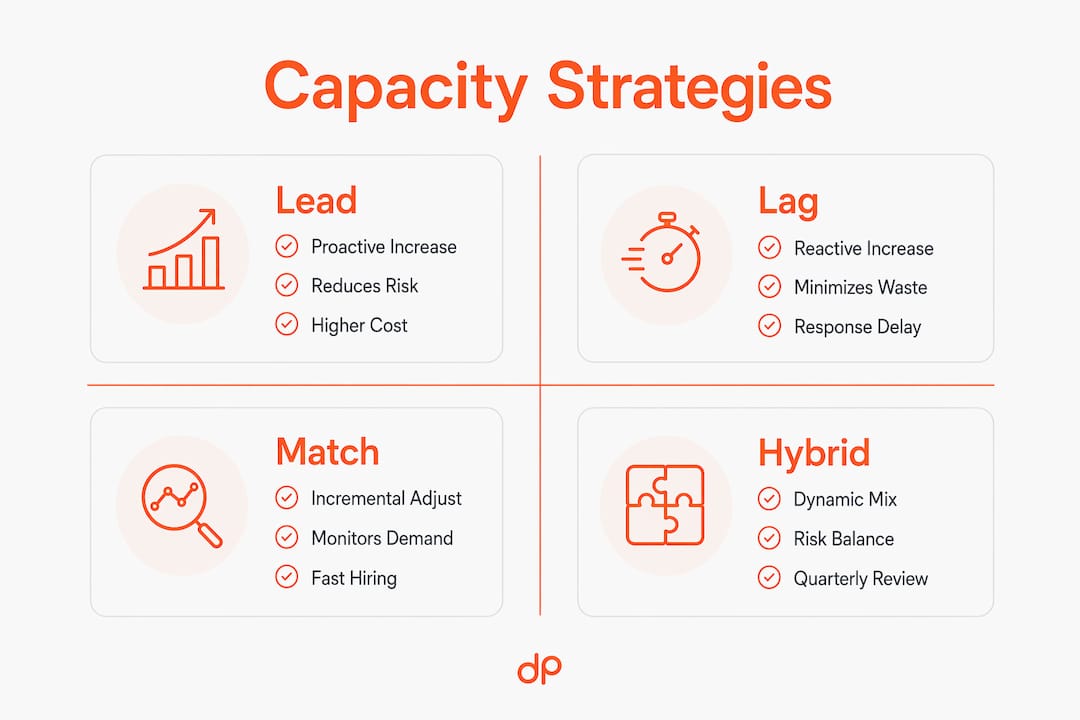
Three core strategies define how organizations respond to demand changes: lead, lag, and match. Each carries different risk profiles and suits different organizational contexts.
| Strategy | Timing | Approach | Best fit |
|---|---|---|---|
| Lead | Before demand arrives | Add capacity proactively | High-growth, low risk tolerance |
| Lag | After demand is confirmed | Expand reactively | Cost-sensitive, stable demand |
| Match | Continuously | Incremental adjustments | Dynamic teams, agile environments |
The lead strategy adds engineers or infrastructure before demand materializes. It reduces the risk of missed deadlines but increases cost if demand does not arrive as projected. SaaS companies launching new product lines often use this approach to avoid bottlenecks at critical release windows.
The lag strategy waits for demand to be confirmed before adding capacity. It minimizes waste but creates a response lag that can delay delivery. Organizations with stable, predictable workloads and tight budget constraints favor this model.
The match strategy adjusts capacity incrementally as demand signals emerge. It requires strong monitoring and fast hiring or contractor pipelines. Most mature engineering organizations operate a hybrid of all three, shifting emphasis based on current market conditions and risk tolerance.
Dynamic and hybrid strategies tailored to organizational risk tolerance outperform fixed models over time. No single approach works across all contexts. The right strategy depends on your team’s hiring speed, budget flexibility, and how accurately you can forecast demand.
Pro Tip: Review your capacity strategy quarterly, not annually. Market conditions and product priorities shift faster than most annual planning cycles can accommodate.
How to optimize engineering resource allocation for skill alignment
Engineering resources are specialized and not interchangeable. A backend engineer with deep database expertise cannot substitute for a mobile developer on a React Native project without significant ramp-up time. Spreading engineers too thin across many initiatives creates half-finished projects and kills effective throughput.
The core principle of workload optimization is finishing fewer projects faster rather than starting many projects simultaneously. When five engineers are spread across eight initiatives, each initiative moves slowly and none reaches completion quickly. Concentrating the same five engineers on three initiatives produces faster delivery and cleaner handoffs.
Skill alignment requires mapping work to the right people at the right time. Consider these factors when assigning capacity:
- Specialization depth: High-risk architectural decisions require your most experienced engineers. Routine maintenance tasks do not.
- Cognitive load: Pairing complex greenfield work with heavy on-call rotations degrades both. Separate them where possible.
- Hidden work categories: Incidents, support tickets, and on-call duties must be subtracted from available capacity before assigning project work.
- Cross-training investment: Building redundancy in critical skills protects capacity when key engineers are unavailable.
Engineering resources require careful skill matching because multitasking across many initiatives reduces throughput measurably. Tracking hidden work like incidents and on-call time gives you a realistic picture of what your team can actually deliver. Teams that ignore this category consistently over-commit and under-deliver. For practical guidance on managing engineering workflows, skill alignment and workload balance are central themes.
Pro Tip: Build a capacity register that lists each engineer’s primary skill, secondary skill, and current on-call or support obligations. Update it at the start of every sprint cycle.
What practical steps help engineering managers implement capacity plans?
Effective implementation follows a repeatable four-step cycle: demand forecasting, capacity calculation, gap identification, and adjustment. Each step feeds the next, and the cycle repeats every sprint or planning period.
- Forecast demand. Collect the full backlog of planned work, including features, technical debt, and known maintenance tasks. Assign rough effort estimates to each item using historical velocity as a baseline.
- Calculate effective capacity. Multiply total available person-days by your team’s focus factor (0.6–0.7). Subtract planned time off, public holidays, and known commitments like quarterly reviews or major incidents from the previous period.
- Identify the gap. Compare forecasted demand against effective capacity. If demand exceeds capacity, you have three options: reduce scope, extend the timeline, or add resources. All three are legitimate. Choosing none is not.
- Reserve a buffer. Hold 15–20% of effective capacity as a buffer for estimation errors and emergencies. This buffer is risk management, not wasted time. Teams that plan to 100% capacity consistently miss commitments when any unexpected work arrives.
- Adjust and iterate. After each sprint, compare planned capacity against actual delivery. Update your focus factor and throughput estimates based on real data.
Historical sprint data is the most reliable input for capacity forecasting. A study of 6,450 sprint records using data-driven frameworks showed significant improvements in delivery prediction over manual estimation. That finding confirms what experienced engineering managers already know: gut-feel estimates degrade over time, while data-calibrated models improve. For teams working on scaling engineering capacity, this iterative calibration process is the foundation of predictable growth.
Capacity planning templates and tracking tools help teams maintain consistency across planning cycles. The specific tool matters less than the discipline of recording actuals and comparing them to plans every sprint.
Key Takeaways
Effective engineering capacity planning requires accurate measurement, honest forecasting, and disciplined scope management to produce reliable delivery commitments.
| Point | Details |
|---|---|
| Effective capacity is 50–60% of total hours | Subtract meetings, incidents, and hidden work before committing to any delivery timeline. |
| Focus factor drives accurate forecasting | Multiply available days by 0.6–0.7 and calibrate the multiplier using your team’s actual sprint history. |
| Strategy choice depends on risk tolerance | Lead, lag, and match strategies each fit different contexts; hybrid approaches work best for dynamic teams. |
| Skill alignment beats headcount math | Assign work based on specialization and cognitive load, not just availability. |
| Buffer 15–20% of capacity | Reserve this portion for estimation errors and emergencies to protect sprint commitments. |
Why most capacity plans fail before the first sprint ends
The most persistent mistake I see engineering managers make is planning to 100% of theoretical capacity. It feels responsible. It looks thorough on a spreadsheet. It almost always fails. The moment one engineer takes a sick day or a production incident runs three hours longer than expected, the entire plan collapses.
The second mistake is treating capacity planning as a one-time quarterly exercise. Real teams change week to week. Engineers go on vacation, get pulled into cross-functional projects, or pick up unexpected on-call shifts. A plan built in january and never updated is fiction by march.
What actually works is building the discipline of comparing planned capacity to actual delivery every single sprint. Not to assign blame, but to recalibrate. Over time, your focus factor becomes a reliable team-specific constant. Your forecasts get tighter. Stakeholders start trusting your commitments because you stop over-promising.
The hardest skill in capacity management is saying no. Spreading five engineers across eight initiatives yields poor outcomes because context switching destroys throughput. Saying no to the eighth initiative is not a failure of ambition. It is the discipline that makes the other seven possible. The teams I have seen build the most predictable delivery records are not the ones with the largest headcount. They are the ones that protect focus ruthlessly and track actuals honestly.
— Vlad
How Devpulse supports engineering capacity and delivery
Engineering teams that struggle with capacity often face the same root problem: the gap between what the business expects and what the team can realistically deliver. Devpulse works directly with engineering organizations to close that gap through custom software engineering services that align technical capacity with product goals.

Devpulse brings hands-on experience across SaaS, enterprise, and startup environments, helping teams modernize legacy systems, scale product delivery, and build the technical foundations that make capacity planning reliable. Our case studies show how we have helped clients move from unpredictable delivery cycles to consistent, data-backed release cadences. If your team needs additional engineering capacity or a clearer framework for managing what you already have, Devpulse is ready to work alongside you.
FAQ
What is engineering capacity planning?
Engineering capacity planning is the process of calculating how much work an engineering team can realistically deliver in a given period, accounting for meetings, unplanned work, and skill constraints. It translates headcount into actual deliverable output.
How is effective engineering capacity calculated?
Effective capacity equals total available person-days multiplied by a focus factor of 0.6–0.7. Teams should also subtract planned time off, on-call duties, and recurring overhead before committing to sprint scope.
What is the difference between lead, lag, and match capacity strategies?
Lead adds capacity before demand arrives, lag adds it after demand is confirmed, and match adjusts incrementally as demand signals emerge. Most engineering teams benefit from a hybrid approach that shifts between all three based on current conditions.
How much buffer should an engineering team hold in capacity plans?
Engineering teams should reserve 15–20% of effective capacity as a buffer for estimation errors and unexpected work. This buffer protects sprint commitments without requiring teams to under-plan deliberately.
Why do engineering capacity plans fail?
Capacity plans fail most often because teams plan to 100% of theoretical capacity, ignore hidden work categories like incidents and support, and treat planning as a one-time exercise rather than an iterative process calibrated by real sprint data.