














TL;DR:
- Many organizations, regardless of size, are outsourcing IT to reduce costs and improve security.
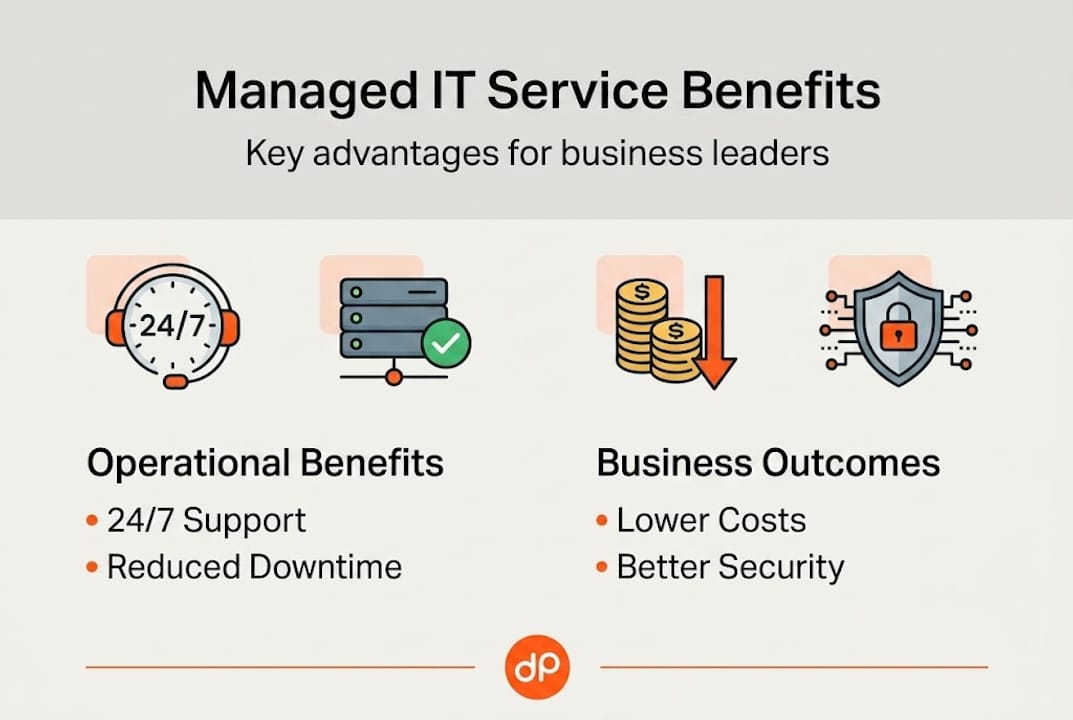
- Managed IT services provide continuous support, network monitoring, cloud management, security, and backups.
- Successful MSP engagement requires ongoing strategic partnership and clear communication beyond initial selection.
Outsourcing IT operations is no longer an enterprise-only strategy reserved for Fortune 500 companies with sprawling tech departments. Organizations of every size are making the shift, and the numbers back it up. Businesses that move to managed service providers reduce IT costs by 20-30% while simultaneously improving service reliability and security posture. This guide breaks down exactly what managed IT services are, where they deliver the most value, how the adoption landscape looks in 2026, and what your organization needs to evaluate before signing with a provider.
Table of Contents
- Defining managed IT services: Core functions and value
- How managed IT services impact business performance and cost
- Why companies choose MSPs: Adoption trends, industries, and outcomes
- What to look for in a managed IT service provider
- The hard truth about managed IT: What most guides leave out
- Take the next step with managed IT solutions
- Frequently asked questions
Key Takeaways
| Point | Details |
|---|---|
| Comprehensive coverage | Managed IT services deliver end-to-end support across infrastructure, cloud, cybersecurity, and operations. |
| Cost savings and ROI | Businesses typically save 20-30% in IT spend and gain predictable, scalable solutions with managed services. |
| Strategic business impact | Adopting managed IT services boosts agility, frees leadership for innovation, and strengthens security. |
| Modern MSP essentials | Look for cybersecurity, cloud, and AI capabilities when choosing a provider to future-proof your tech. |
Defining managed IT services: Core functions and value
Understanding the surge in outsourcing makes it necessary to clearly define exactly what managed IT services encompass. At its core, a managed IT service is an arrangement where an external provider, called a managed service provider (MSP), takes ongoing operational responsibility for some or all of a company’s IT environment. This is not a one-time project or a break-fix relationship where you call someone when something breaks. It is a continuous, proactive model built on defined service agreements.
Core services include end-user support, network monitoring, cloud management, security, and backup/recovery as the foundational pillars of virtually every MSP engagement. Here is how those categories break down in practice:
- Helpdesk and end-user support: Day-to-day technical assistance for employees, covering password resets, software issues, device troubleshooting, and onboarding workflows. This is often the most visible layer of an MSP relationship.
- Network and infrastructure monitoring: Continuous surveillance of routers, servers, firewalls, switches, and endpoints. MSPs use remote monitoring and management (RMM) tools to detect anomalies before they escalate into outages.
- Cloud management: Provisioning, optimizing, and securing cloud environments across platforms like AWS, Microsoft Azure, and Google Cloud. This includes cost management, resource scaling, and governance.
- Security services: Threat detection, patch management, vulnerability scanning, endpoint protection, and compliance reporting. In regulated industries, this layer is non-negotiable.
- Backup and disaster recovery: Automated data backup, offsite storage, and tested recovery procedures that minimize downtime when hardware fails or ransomware hits.
The value proposition runs across four dimensions. First, reliability improves because monitoring is continuous, not reactive. Second, cost control becomes easier because you shift from unpredictable capital expenses to flat monthly operational fees. Third, you gain access to expertise that would be prohibitively expensive to hire internally, especially in specialized areas like cybersecurity or cloud architecture. Fourth, scalability becomes straightforward because MSPs can adjust capacity as your business grows or contracts.
For organizations that require technical support and maintenance that goes beyond basic helpdesk functions, modern MSPs are also layering in software lifecycle management, API integration support, and DevOps tooling. This evolution matters because IT is no longer just infrastructure. It is a strategic enabler, and the best MSPs position themselves accordingly.
| Service category | What it covers | Primary benefit |
|---|---|---|
| Helpdesk support | End-user issue resolution | Productivity and satisfaction |
| Infrastructure monitoring | Servers, networks, endpoints | Uptime and reliability |
| Cloud management | Cloud resource governance | Cost and performance control |
| Security services | Threat detection, compliance | Risk reduction |
| Backup and disaster recovery | Data protection, recovery plans | Business continuity |
How managed IT services impact business performance and cost
With a clear understanding of the functions, it’s critical to see how these services translate into concrete business results. The financial case is well-documented. The global managed services market was valued at approximately $340 billion in 2023 and is growing at a compound annual growth rate (CAGR) between 7% and 14%, fueled by consistent demand from organizations that prioritize IT cost predictability and operational efficiency.
The typical 20-30% cost reduction happens through several mechanisms working together. First, you eliminate the overhead of recruiting, training, and retaining in-house IT staff for every specialty your environment requires. Second, proactive monitoring catches problems early, reducing the frequency and severity of outages that carry significant hidden costs. Third, fixed monthly fees replace the volatile capital expenditure cycle tied to hardware refresh and emergency repairs.

| Factor | Traditional IT model | Managed IT model |
|---|---|---|
| Cost structure | Variable, often unpredictable | Fixed monthly fees |
| Staffing | Internal hires per specialty | MSP team with broad expertise |
| Issue response | Reactive (after failure) | Proactive (before failure) |
| Scalability | Slow, capital-intensive | Rapid, operationally flexible |
| Security posture | Inconsistent | Structured, monitored |
Beyond direct cost savings, business performance gains are measurable. Uptime improves because 24/7 monitoring catches degradation before users feel it. User satisfaction rises when helpdesk response times are governed by service level agreements (SLAs). Scalability becomes a commercial decision rather than an infrastructure bottleneck. Companies that explore cost savings with remote teams often find that combining managed IT with distributed engineering creates compound operational efficiency.
Statistic to note: The managed services market is one of the fastest-growing segments in enterprise technology spending, reflecting a structural shift away from ownership-heavy IT models toward subscription-based operational models.
Perhaps the most underrated benefit is strategic focus. When your leadership team is not spending executive cycles on infrastructure outages, vendor management chaos, or compliance fire drills, those cycles redirect toward product development, customer experience, and market expansion. This is the argument that resonates most with C-suite stakeholders who are ultimately evaluating ROI from a business growth lens, not a technology lens.
Pro Tip: When calculating ROI on managed IT services, include the cost of unplanned downtime, which industry benchmarks place at $5,600 per minute for large enterprises and significantly lower but still damaging for SMBs. Even preventing a single major outage per year can justify the annual MSP contract cost.
Why companies choose MSPs: Adoption trends, industries, and outcomes
After understanding the results, it’s helpful to learn more about who is embracing managed IT services and why they’re making the switch. The adoption picture is clearer than most assume. 72% of enterprises outsource IT to MSPs, SMB adoption sits at 65%, and 91% of current users plan to increase usage in the near term. These numbers tell a consistent story: managed IT is not a niche workaround. It has become a standard operating model across organizational sizes and industries.
The top reasons organizations cite for making the switch follow a consistent pattern:
- Cost efficiency: Predictable monthly spend replaces unpredictable capital and personnel costs. This is the primary driver for SMBs that cannot justify full IT departments for every specialty.
- Access to specialized skills: Cybersecurity expertise, cloud architects, and compliance specialists are expensive to recruit and retain internally. MSPs offer access to these skills at a fraction of the cost.
- Compliance and security requirements: Regulated industries like healthcare (HIPAA), finance (SOX, PCI-DSS), and legal tech cannot afford security gaps. MSPs with compliance specialization provide frameworks, documentation, and continuous monitoring aligned to regulatory standards.
- Scalability and agility: Businesses entering growth phases need IT capacity that can expand quickly without lengthy procurement cycles. MSPs adjust service scope under existing agreements.
- Strategic IT alignment: Mature organizations want IT planning to align with business strategy, not just keep the lights on. MSPs with virtual CIO (vCIO) offerings provide that strategic layer.
“The shift to managed services is not just about cost. It reflects a fundamental change in how businesses think about technology ownership. Most organizations now recognize that running IT infrastructure is not their core competency.” — A commonly shared view among enterprise technology analysts and CIOs who have led MSP adoption initiatives.
The industry breakdown reveals interesting patterns. Healthcare organizations prioritize security and compliance-driven MSP relationships. Legal tech firms focus heavily on data integrity and uptime. SaaS companies often engage MSPs for infrastructure management while keeping engineering in-house. Manufacturing firms use MSPs primarily for operational technology (OT) and network reliability. Understanding how outsourcing best practices vary by industry helps you set appropriate expectations for your engagement.
SMBs, in particular, experience an outsized benefit from managed IT because they gain enterprise-grade capabilities they could not otherwise afford. A 50-person company working with the right MSP has access to the same quality of security monitoring and cloud management that a 5,000-person enterprise expects. That leveling effect is significant, and understanding outsourcing software support strategies helps SMB leaders structure their agreements for maximum impact.
What to look for in a managed IT service provider
Knowing why and how others adopt managed IT services, it’s time to lay out what business leaders should prioritize when engaging a provider. Not all MSPs are created equal, and the wrong choice can introduce as much risk as it removes.
Start with cybersecurity capabilities. Cybersecurity is the top MSP priority, with 81% of MSPs offering security services and 90% of clients making it a primary evaluation criterion. Cloud managed services account for approximately 45% of market share, and AI and automation capabilities are rapidly becoming differentiators among leading providers. These three areas, security, cloud, and AI, form the foundation of a forward-looking MSP evaluation.
Here is a practical checklist for evaluating potential providers:
- Security depth: Do they offer endpoint detection and response (EDR), zero-trust network access (ZTNA), SIEM (security information and event management) monitoring, and compliance reporting? Generic antivirus is insufficient for modern threat environments. For a deeper view of cybersecurity in IT outsourcing, assess how providers handle incident response and breach notification.
- Cloud expertise: Can they manage multi-cloud environments? Do they have certifications with major cloud platforms? Can they optimize your cloud spend, not just keep resources running?
- AI and automation maturity: Are they using automation to reduce ticket resolution times, predict infrastructure failures, and automate patching cycles? MSPs leveraging AI and automation in managed IT will consistently outperform those relying on manual processes.
- SLAs with teeth: Service level agreements should specify response times, resolution targets, and uptime guarantees with defined penalties for non-compliance. Vague SLAs protect the provider, not you.
- Proactive management vs. reactive ticketing: Ask specifically how many issues are resolved before users report them. A strong MSP should be able to demonstrate a ratio showing proactive catches versus reactive tickets.
- Scalability of their own operations: An MSP that cannot scale their own team or tooling as your organization grows becomes a bottleneck rather than an accelerant.
- Communication and reporting: Monthly business reviews, transparent dashboards, and proactive communication about risks and recommendations separate strategic partners from order-takers.
Common selection pitfalls include choosing on price alone without evaluating technical depth, signing long-term contracts without clearly defined exit provisions, and failing to verify that the MSP has experience in your specific industry or regulatory context. A healthcare organization selecting a generalist MSP without HIPAA expertise is a mismatch that creates compliance exposure.
Pro Tip: During provider evaluation, request a sample incident report and a recent client business review deck. These documents reveal more about an MSP’s operational maturity and communication quality than any sales presentation will.
The hard truth about managed IT: What most guides leave out
Most articles on managed IT services stop at the checklist stage, as if selecting the right provider is the final step. It is not. The organizations that extract the most value from MSP relationships are the ones that stay strategically engaged after the contract is signed.
Managed IT is not a hands-off arrangement. The set-it-and-forget-it expectation leads to underperformance on both sides. Your internal stakeholders need to communicate business priorities, upcoming initiatives, and risk tolerance to the MSP consistently. Without that input, the provider optimizes for operational continuity rather than strategic enablement.
Purely ticket-driven MSP relationships are particularly limiting. When the entire engagement reduces to “submit a ticket, get a resolution,” you lose the strategic layer that justifies the investment. The best MSP relationships include quarterly business reviews, proactive technology roadmap planning, and joint risk assessments. These conversations surface opportunities that no monitoring dashboard will flag automatically.
Understanding the real benefits for executives requires reframing the MSP relationship as a partnership, not a vendor transaction. Leaders who treat their MSP as an extension of the business, sharing context, strategy, and constraints, consistently report better outcomes than those who treat it as a utility subscription.
Take the next step with managed IT solutions
If your organization is ready to tap into the strategic and operational value of managed IT, you don’t have to figure it out alone.
At DevPulse, we combine engineering depth with a practical business mindset to help organizations modernize, scale, and secure their technology operations. Whether you need to explore our engineering and modernization services to address legacy system risk, review our case studies to see how we’ve driven IT transformation across industries, or evaluate our AI-driven IT solutions to future-proof your operations, we are equipped to support every stage of your managed IT journey. Request a consultation to discuss where your IT strategy stands today and what it will take to scale with confidence.
Frequently asked questions
What services are typically included in managed IT?
Core services include end-user support, network monitoring, cloud management, security, and backup/recovery, forming the standard foundation of any MSP engagement.
How much can a business save by using managed IT services?
Businesses typically see a 20-30% reduction in IT costs by outsourcing to managed service providers, driven by predictable fees and reduced overhead.
Why do most companies outsource IT to MSPs?
Companies outsource primarily for cost efficiency, access to specialized skills, and improved security, with 91% of current users planning to increase usage reflecting consistent satisfaction with outcomes.
What should I ask when evaluating a managed IT provider?
Ask specifically about cybersecurity depth, cloud platform certifications, AI and automation capabilities, and how their SLAs are structured, since cybersecurity tops the client priority list at 90% in provider evaluations.
Are managed IT services only for large enterprises?
No. SMB adoption sits at 65%, demonstrating that managed IT services deliver strong value at every organizational scale, not just for large enterprises.