













TL;DR:
- The outsourcing lifecycle includes four phases: strategic planning, vendor selection, implementation, and ongoing management. Proper management of each phase significantly improves project success rates and reduces risks. Leadership involvement and disciplined processes are essential for sustainable outsourcing success.
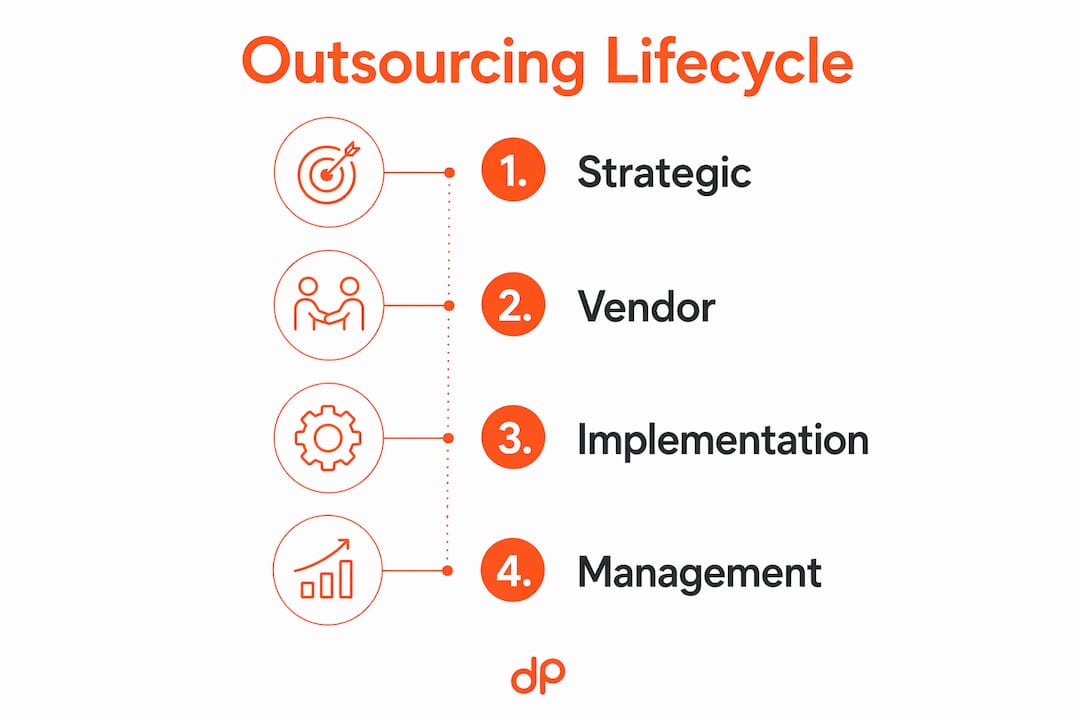
The outsourcing lifecycle is defined as the structured sequence of four phases, including strategic planning, vendor selection, implementation, and ongoing management, that organizations follow to execute external partnerships successfully. Understanding this lifecycle is not optional for business leaders. 60% of organizations report unmet expectations in outsourcing due to complexity and underestimated lifecycle phases. That statistic reflects a systemic failure to treat outsourcing as a managed process rather than a one-time vendor decision. When you understand what the outsourcing lifecycle requires at each stage, you give your organization a real chance at the outcomes you planned for.
What is the outsourcing lifecycle and its four core phases?
The outsourcing lifecycle is the industry’s standard framework for managing external work relationships from initial strategy through long-term governance. It differs from freelancing or offshoring because it requires structured contracts and team execution, not just task delegation. Each phase has defined objectives, timelines, and deliverables that feed directly into the next.

Strategic planning (8–12 weeks)
Strategic planning is the foundation of every outsourcing engagement. This phase requires you to assess internal capabilities, define project scope, and align the outsourcing decision with corporate goals. Clear scope and expectations reduce delivery risks and prevent misaligned vendor relationships before they start. Leaders who skip or rush this phase consistently face scope creep, budget overruns, and vendor mismatches downstream.
Vendor selection (12–16 weeks)
Vendor selection involves issuing requests for proposals, evaluating responses, and conducting due diligence on shortlisted providers. The engagement model you choose, whether a freelancer, agency, or managed team, directly affects your control level, cost structure, and partnership dynamics. This phase is longer than most leaders expect because thorough vetting requires reference checks, technical assessments, and contract negotiation. Rushing it is one of the most common and costly mistakes in the process.
Implementation (16–24 weeks)
Implementation covers knowledge transfer, system setup, and the formal transition of work to the external team. Effective knowledge transfer typically requires 4–6 weeks and is critical for on-time product launches. When managed properly, 55% of product launches happen on schedule. This phase also demands significant internal resource commitment, which often causes a temporary productivity dip that surprises unprepared organizations.
Ongoing management (continuous)
Ongoing management is where the real value of outsourcing is either captured or lost. This phase involves monthly performance monitoring, quarterly business reviews, and annual contract evaluations to sustain value over time. Active governance drives continuous improvement and keeps vendor relationships aligned with your evolving business needs. Without this structure, even a well-executed implementation degrades into a transactional, low-accountability arrangement.
| Phase | Key activities | Typical timeframe |
|---|---|---|
| Strategic planning | Capability assessment, scope definition, goal alignment | 8–12 weeks |
| Vendor selection | RFPs, due diligence, contract negotiation | 12–16 weeks |
| Implementation | Knowledge transfer, system setup, phased handoff | 16–24 weeks |
| Ongoing management | Performance reviews, SLA monitoring, contract renewal | Continuous |
What challenges and risks arise during the outsourcing lifecycle?
Implementation failures destroy 70% of IT outsourcing relationships within the first year. That number reflects a pattern, not a series of isolated incidents. The root causes are predictable: underestimated timelines, inadequate knowledge transfer, and poor communication between internal teams and vendors.
The transition period is the highest-risk window in the entire lifecycle. Your internal team must dedicate significant time to documentation and handoff while still maintaining current operations. This dual burden is where productivity dips and timelines slip. Leaders who treat the transition as a background activity, rather than a primary project, consistently underdeliver.
Poor scope definition in the planning phase creates compounding problems. Vague requirements lead to misaligned vendor expectations, which then require expensive renegotiation during implementation. Lifecycle phases are interdependent, meaning poor execution in one phase increases failure risk exponentially in every phase that follows.
Do’s and Don’ts for managing lifecycle risk:
- Do document all processes before the transition begins, not during it.
- Do assign a dedicated internal project manager with clear authority.
- Do establish escalation paths in writing before the vendor starts work.
- Don’t assume the vendor will fill gaps left by incomplete planning.
- Don’t treat the first 90 days of implementation as a grace period.
- Don’t skip reference checks during vendor selection to save time.
Pro Tip: Start with a small, low-risk task before committing to a full function. Graduating from simple tasks to whole functions as trust builds is the single most reliable way to reduce early-stage failure risk.
How does understanding the outsourcing lifecycle improve project outcomes?
Companies that invest adequate time in all four lifecycle phases achieve an 85% project success rate, compared to the 40% industry average. That gap is not explained by budget size or vendor quality alone. It is explained by process discipline.
Understanding the lifecycle reframes outsourcing from a cost-cutting tactic into a strategic function enabling speed, expertise, and risk management. Organizations that treat vendors as strategic partners, rather than interchangeable suppliers, consistently extract more value from their engagements. This shift in mindset is visible in how they structure governance, set performance metrics, and handle contract renewals.
The business benefits of disciplined lifecycle management are concrete and measurable:
- Faster delivery: Structured implementation timelines reduce delays caused by unclear handoffs.
- Lower risk: Phased execution limits exposure at each stage before committing further resources.
- Better vendor alignment: Quarterly reviews catch misalignment before it becomes a contract dispute.
- Cost predictability: Clear scope and SLAs prevent the budget overruns that plague unstructured engagements.
- Increased flexibility: Ongoing management creates natural checkpoints to scale, pivot, or exit engagements.
For SaaS companies in particular, lifecycle discipline directly affects product velocity. You can read more about outsourcing for SaaS growth and how structured engagement models support faster iteration cycles. The lifecycle is not just a project management tool. It is the mechanism that converts outsourcing intent into business outcomes.
What are best practices for managing each outsourcing phase effectively?
Effective lifecycle management requires specific actions at each phase, not a single governance framework applied uniformly. The planning phase demands internal alignment before any vendor conversation begins. Define what success looks like in measurable terms, identify which internal capabilities are missing, and document the scope in enough detail that a vendor can price it accurately.
During vendor selection, avoid evaluating providers on cost alone. Run a small paid test project before signing a long-term contract. This approach reveals how a vendor communicates, handles ambiguity, and delivers under real conditions. Match the engagement model to your actual needs: freelancers suit isolated tasks, agencies suit project-based work, and managed teams suit ongoing functions requiring deep integration.
Best practices by phase:
- Strategic planning: Set measurable objectives, complete an internal capability gap analysis, and get executive alignment in writing before issuing any RFP.
- Vendor selection: Use structured scoring criteria, conduct reference calls with past clients, and run a paid pilot before committing to a full engagement.
- Implementation: Assign a dedicated internal knowledge transfer lead, document all processes before handoff begins, and use a phased transition rather than a hard cutover.
- Ongoing management: Define KPIs at contract signing, hold monthly check-ins, and schedule quarterly business reviews with both operational and leadership stakeholders.
Pro Tip: Assign an internal project manager who owns the vendor relationship from day one. SLA-driven governance only works when someone inside your organization is accountable for enforcing it.
For leaders managing IT outsourcing risks across multiple vendors, the ongoing management phase is where governance frameworks pay the highest return. Build feedback loops into every review cycle. Treat vendor performance data as a continuous input to your sourcing strategy, not an annual audit exercise.
Key Takeaways
Disciplined execution across all four outsourcing lifecycle phases is the single most reliable predictor of project success, separating the 85% success rate of structured engagements from the 40% industry average.
| Point | Details |
|---|---|
| Four defined phases | Strategic planning, vendor selection, implementation, and ongoing management each have distinct timelines and deliverables. |
| Phase interdependence | Poor execution in any one phase increases failure risk in every subsequent phase. |
| Knowledge transfer is critical | A managed 4–6 week knowledge transfer period drives on-time delivery and reduces implementation failures. |
| Start small to reduce risk | Beginning with low-risk tasks before scaling builds trust and lowers early-stage failure probability. |
| Governance sustains value | Monthly reviews, quarterly business meetings, and annual contract evaluations keep vendor relationships aligned over time. |
Why most outsourcing failures are leadership failures in disguise
The uncomfortable truth I’ve observed across dozens of outsourcing engagements is this: most failures are not vendor failures. They are leadership failures. The vendor did exactly what the contract allowed. The problem was that the contract was written against a scope that was never properly defined, by a team that never fully committed to the transition.
Business leaders often treat the outsourcing decision as the hard part. It isn’t. The hard part is the 16–24 weeks of implementation that follow, when your internal team is stretched thin and the vendor is still learning your systems. I’ve seen organizations where the internal project manager was also running two other initiatives simultaneously. That arrangement guarantees a slow, painful transition.
The other misconception I encounter regularly is that outsourcing saves money immediately. It doesn’t. The transition phase requires significant internal investment before any cost benefit materializes. Leaders who go in expecting instant savings get frustrated and pull back too early, right before the engagement would have started delivering returns.
What actually works is treating the lifecycle as a management discipline, not a procurement event. The organizations I’ve seen succeed are the ones where a senior leader owns the vendor relationship personally, reviews performance data monthly, and treats the external team as an extension of their own. That posture changes everything about how vendors perform and how quickly problems get resolved.
If you’re a decision-maker preparing for an outsourcing engagement, read the transition management guide before you sign anything. The implementation phase will define your outcome more than any other factor.
— Vlad
How Devpulse supports your outsourcing lifecycle
Devpulse works with business leaders who need more than a vendor. They need a technical partner who understands every phase of the outsourcing lifecycle and can execute with accountability.
From initial scoping and architecture decisions through implementation and long-term product support, Devpulse’s engineering services are built to integrate with your existing teams and governance processes. We’ve delivered across healthcare, legal tech, SaaS, and enterprise software, giving us the cross-industry pattern recognition that generic vendors lack. If you want to see how structured lifecycle management translates into real delivery outcomes, our client case studies show exactly how that works in practice. Request a consultation to discuss where your current engagement stands and what the next phase requires.
FAQ
What is the outsourcing lifecycle in simple terms?
The outsourcing lifecycle is the structured sequence of four phases, including strategic planning, vendor selection, implementation, and ongoing management, that organizations follow to manage external work relationships from start to finish.
How long does the full outsourcing lifecycle take?
The first three phases alone span roughly 36–52 weeks. Strategic planning takes 8–12 weeks, vendor selection takes 12–16 weeks, and implementation takes 16–24 weeks, with ongoing management continuing indefinitely.
Why do so many outsourcing engagements fail?
Implementation failures destroy 70% of IT outsourcing relationships within the first year, most often because of inadequate knowledge transfer, vague scope definitions, and insufficient internal resource commitment during the transition period.
What is the most critical phase of the outsourcing lifecycle?
Implementation is the highest-risk phase. A properly managed 4–6 week knowledge transfer period is the single factor most correlated with on-time delivery and long-term engagement success.
How do you measure success in ongoing outsourcing management?
Success in ongoing management is measured through monthly performance monitoring against defined KPIs, quarterly business reviews, and annual contract evaluations that assess whether the vendor relationship still aligns with your business goals.