













TL;DR:
- A team extension strategy involves integrating external skilled professionals into your in-house team to increase capacity and meet project demands. Success depends on strong leadership, a structured management system, and regular communication practices established before onboarding external engineers.
A team extension strategy is the deliberate approach to expanding your in-house technology capabilities by integrating external skilled professionals to increase project capacity and meet scaling demands. The industry term for this model is “staff augmentation” or “extended team model,” and both phrases describe the same core practice. This team extension strategy guide covers the prerequisites, implementation steps, management tactics, and common pitfalls that technology leaders need to scale effectively. Research across 3.3 million employees confirms that 70% of engagement variance is attributable to the manager. That single finding reframes team extension as a leadership challenge first and a hiring challenge second.
What does a team extension strategy guide require before you start?
The foundation of any extended team model is leadership quality. Without it, no amount of tooling or process will hold an integrated team together. 70% of team engagement variance traces back to the manager, which means your first investment is in developing the leaders who will run these teams day to day.
Before you bring in a single external engineer, you need a management operating system in place. Research from QuestWorks identifies five layers that must exist for extended teams to function: cadence, decision frameworks, feedback, development, and measurement. Building these layers in strict order is not optional. Skipping cadence and jumping to measurement produces chaos, not performance.
Communication cadence

The cadence layer is where most leaders underinvest. Weekly one-on-one meetings, daily standups, and structured retrospectives are the minimum. Weekly 1:1s correlate with three times higher employee engagement and 67% lower turnover rates. That is not a soft benefit. It is a retention mechanism with a measurable ROI.
Decision frameworks
Every extended team needs a clear decision framework. DACI (Driver, Approver, Contributor, Informed) and RAPID are the two most widely used models in technology organizations. Delegation clarity using DACI or RAPID increases decision speed and accountability across distributed teams. Without a named framework, decisions stall at the boundary between your in-house team and your external partners.
The table below maps each management layer to its primary tool and the risk of skipping it.
| Management layer | Primary tool | Risk if skipped |
|---|---|---|
| Cadence | Weekly 1:1s, daily standups | Low engagement, high turnover |
| Decision frameworks | DACI or RAPID | Slow decisions, unclear ownership |
| Feedback | Structured performance reviews | Blind spots, unresolved conflict |
| Development | Coaching plans, learning sprints | Skill stagnation, attrition |
| Measurement | OKRs, velocity metrics | No ROI visibility |
Pro Tip: Set up your cadence layer in week one of any team extension. Do not wait until the team is fully onboarded. The meeting rhythm creates psychological safety before the work pressure arrives.
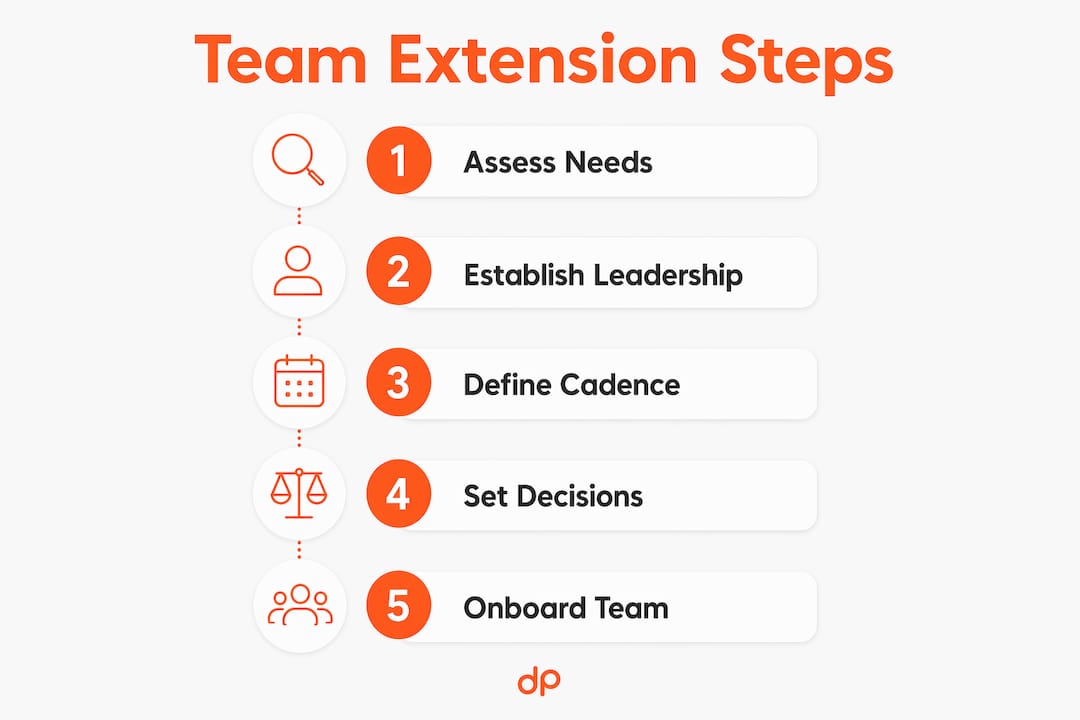
How to implement team extension step by step
Effective implementation follows a defined sequence. Skipping steps creates integration debt that compounds over time.
-
Assess your capacity gap. Map current team output against project demand. Identify which skills are missing and which workstreams are blocked. Be specific: “we need two senior React engineers for a 6-month product sprint” is actionable. “We need more developers” is not.
-
Define roles with precision. Clear role clarification reduces coordination friction and conflict in extended teams. Write role charters that include decision rights, communication expectations, and success metrics before the first interview.
-
Select partners aligned with your culture. Technical skill is table stakes. The harder filter is cultural fit: Does the partner organization share your communication norms? Do their engineers work in your time zones? Do they use your preferred DevOps toolchain? Misalignment here creates friction that no process layer can fix.
-
Run a structured onboarding sprint. Treat external engineers like new hires, not contractors. Give them access to your documentation, your Slack channels, and your architecture decision records. Assign an internal buddy for the first 30 days. The goal is context transfer, not just access provisioning.
-
Apply your management operating system from day one. Start 1:1s in week one. Introduce the decision framework in the first team meeting. Do not let the extended team operate in a process vacuum while you finalize internal approvals.
-
Measure and iterate. Track velocity, code quality, and engagement signals from the first sprint. Measuring outcomes with real performance metrics enables accurate ROI demonstration and ongoing improvement. Review the data in your retrospectives and adjust role scope or cadence as needed.
Pro Tip: For remote team extension specifically, document your communication protocols in a shared team handbook on day one. Ambiguity about response times and meeting attendance is the fastest way to erode trust across time zones. Devpulse’s remote team management guide covers this in detail.
The comparison below shows how structured onboarding differs from ad hoc integration across three dimensions.
| Dimension | Structured onboarding | Ad hoc integration |
|---|---|---|
| Time to productivity | 2–4 weeks | 6–10 weeks |
| Role clarity | Defined in writing before start | Emerges through trial and error |
| Engagement at 90 days | High | Variable |
Which team management strategies maximize engagement in extended teams?
Psychological safety is the single most powerful predictor of team performance. Teams where members feel safe to raise problems, ask questions, and disagree with decisions outperform those that do not. High-performing teams result from management that provides psychological safety and clear direction while modeling the behavior it expects. That last part matters: if you want your extended team to flag risks early, you have to flag risks early yourself.
Specific goal setting and structured communication protocols are the operational expression of psychological safety. Vague goals create anxiety. Clear OKRs and sprint targets give both in-house and external engineers a shared definition of success.
Regular team debriefs are a zero-cost intervention that boosts performance by 20%–25%. Most teams skip them under deadline pressure, which is precisely when they are most valuable. A 30-minute retrospective after a difficult sprint recovers more time than it costs.
Manager span of control directly affects engagement quality. Manager effectiveness peaks at 8–9 direct reports. Engagement drops significantly when a manager oversees more than 12. When you extend your team, recalculate every manager’s span. If an engineering manager already has 10 reports and you add three external engineers to their scope, you have created an engagement risk before the first line of code is written.
Techniques that sustain high engagement across integrated teams include:
- Role clarity reviews every quarter, not just at onboarding
- Cross-team pairing between in-house and external engineers on at least one task per sprint
- Public recognition of external team contributions in all-hands meetings
- Learning retrospectives that capture what the team learned, not just what went wrong
- Transparent escalation paths so external engineers know exactly who to contact when blocked
Managing flexible and extended teams across different employment structures requires consistent application of these tactics regardless of contract type.
What common mistakes derail team extension efforts?
The most expensive mistake is misaligning your intervention with the team’s development stage. A newly formed extended team needs role clarity and relationship building. Throwing them into a high-stakes delivery sprint without that foundation wastes resources and reduces effectiveness. Match your management investment to where the team actually is, not where you wish it were.
Overloaded managers are the second most common failure point. When a manager’s direct report count exceeds 12, engagement declines measurably. Adding external engineers to an already stretched manager’s portfolio is not team extension. It is team neglect with extra headcount.
Common mistakes to avoid:
- Skipping the cadence layer. Teams without regular meeting rhythms default to silence. Silence in an extended team means misalignment is compounding invisibly.
- Treating team building as a one-time event. A kickoff workshop does not substitute for ongoing development. Sustained leadership development over 6–12 months produces lasting performance improvements. One-time training does not.
- Forcing artificial harmony. Discouraging disagreement between in-house and external engineers suppresses the constructive conflict that surfaces real problems. Build psychological safety so that conflict is productive, not personal.
- Ignoring engagement signals. Turnover in an extended team is expensive and disruptive. Monitor engagement data the same way you monitor sprint velocity.
Pro Tip: Run a “team health check” survey every 8 weeks. Ask four questions: Do you know what is expected of you? Do you have what you need to do your work? Did you receive feedback this week? Do you feel your contributions matter? The answers tell you where your management operating system is breaking down.
For a deeper look at IT workforce scalability and how to structure growth without overloading your managers, the patterns apply directly to extended team scenarios.
Key takeaways
A team extension strategy succeeds when leadership quality, a structured management operating system, and consistent communication cadence are in place before external engineers join the team.
| Point | Details |
|---|---|
| Leadership drives engagement | 70% of team engagement variance traces to the manager, not the team structure. |
| Build the operating system first | Cadence, decision frameworks, feedback, development, and measurement must exist before scaling. |
| Debriefs are high-ROI | Regular team debriefs boost performance by 20%–25% at zero cost. |
| Control manager span | Keep direct reports at 8–9 per manager to maintain engagement quality. |
| Match intervention to stage | Misaligned team-building wastes resources; target your actions to the team’s current development stage. |
What I’ve learned about team extension that most guides miss
Most writing on team extension focuses on vendor selection and contract structure. Those matter, but they are not where extended teams fail. They fail in the first 60 days, when the management operating system is absent and the extended engineers are operating without context, feedback, or a clear escalation path.
The leaders I have seen run this well share one habit: they treat external engineers with the same management investment they give their best in-house staff. Same 1:1 cadence. Same performance conversations. Same access to the team’s strategic context. That is not a soft cultural preference. It is the mechanism that produces retention and output quality.
The other insight that rarely appears in guides: do not wait for the extended team to “gel” before you introduce constructive conflict. Artificial harmony in the early weeks creates a false sense of cohesion that collapses under the first real deadline. Build psychological safety early, then use it. Encourage engineers to challenge architecture decisions, flag scope risks, and push back on unrealistic timelines. That behavior, modeled from the top, is what separates high-performing extended teams from expensive staff augmentation that delivers mediocre results.
Finally, measure everything from sprint one. Not to punish, but to learn. The data tells you where your management operating system is working and where it is not. Teams that measure early adjust early. Teams that wait until a project is in trouble have already lost the window to course-correct without cost.
— Vlad
How Devpulse supports your team extension goals
Scaling a technology team is a structural challenge, not just a hiring one. Devpulse works with startups, SaaS companies, and enterprise clients to build, extend, and modernize engineering teams across custom software, AI-powered systems, and cloud-based platforms.

If your team needs additional engineering capacity without the overhead of full-time hiring, Devpulse’s engineering services are built for exactly that scenario. From custom software development to legacy system modernization, the team brings both technical depth and a practical business mindset to every engagement. You can also review Devpulse’s client case studies to see how extended engineering partnerships have delivered measurable results across healthcare, cybersecurity, and enterprise software.
FAQ
What is a team extension strategy?
A team extension strategy is a structured approach to integrating external skilled professionals into your in-house team to increase capacity and meet project demands. It differs from traditional outsourcing because the external engineers work within your processes, tools, and management system.
How does team extension differ from outsourcing?
Team extension integrates external engineers directly into your management structure, cadence, and culture. Traditional outsourcing delegates a project to an external vendor who manages their own team independently.
How many direct reports can a manager handle in an extended team?
Manager effectiveness peaks at 8–9 direct reports. Engagement drops significantly when a manager oversees more than 12, making span of control a critical factor when adding external engineers to existing teams.
What is the fastest way to improve extended team performance?
Regular team debriefs are the highest-impact, zero-cost intervention available. Research shows they boost team performance by 20%–25% and can be introduced immediately without budget approval or tooling changes.
What decision framework works best for extended teams?
DACI and RAPID are the two most effective frameworks for extended teams. Both clarify who drives decisions, who approves them, and who needs to be informed, which reduces delays at the boundary between in-house and external team members.