














Moving to the cloud or splitting a monolith isn't a sound default response to slow releases. Neither is adding AI. If a CTO keeps seeing incidents in the same systems while delivery slows, the first investment should be in deciding what to change, what to protect, and what to leave alone. Software architecture consulting services are worth buying when they make those decisions defensible, not when they turn an untested migration plan into polished diagrams.
Table of Contents
- What Software Architecture Consulting Services Cover
- Engagement Models and the Deliverables You Buy
- Outcomes Worth Paying an Architect to Move
- Which Systems to Modernize and Which to Leave
- Control Designs for Regulated Environments
- Operating Controls When AI Enters the Architecture
- Choose a Partner and Set the First Gate
What Software Architecture Consulting Services Cover
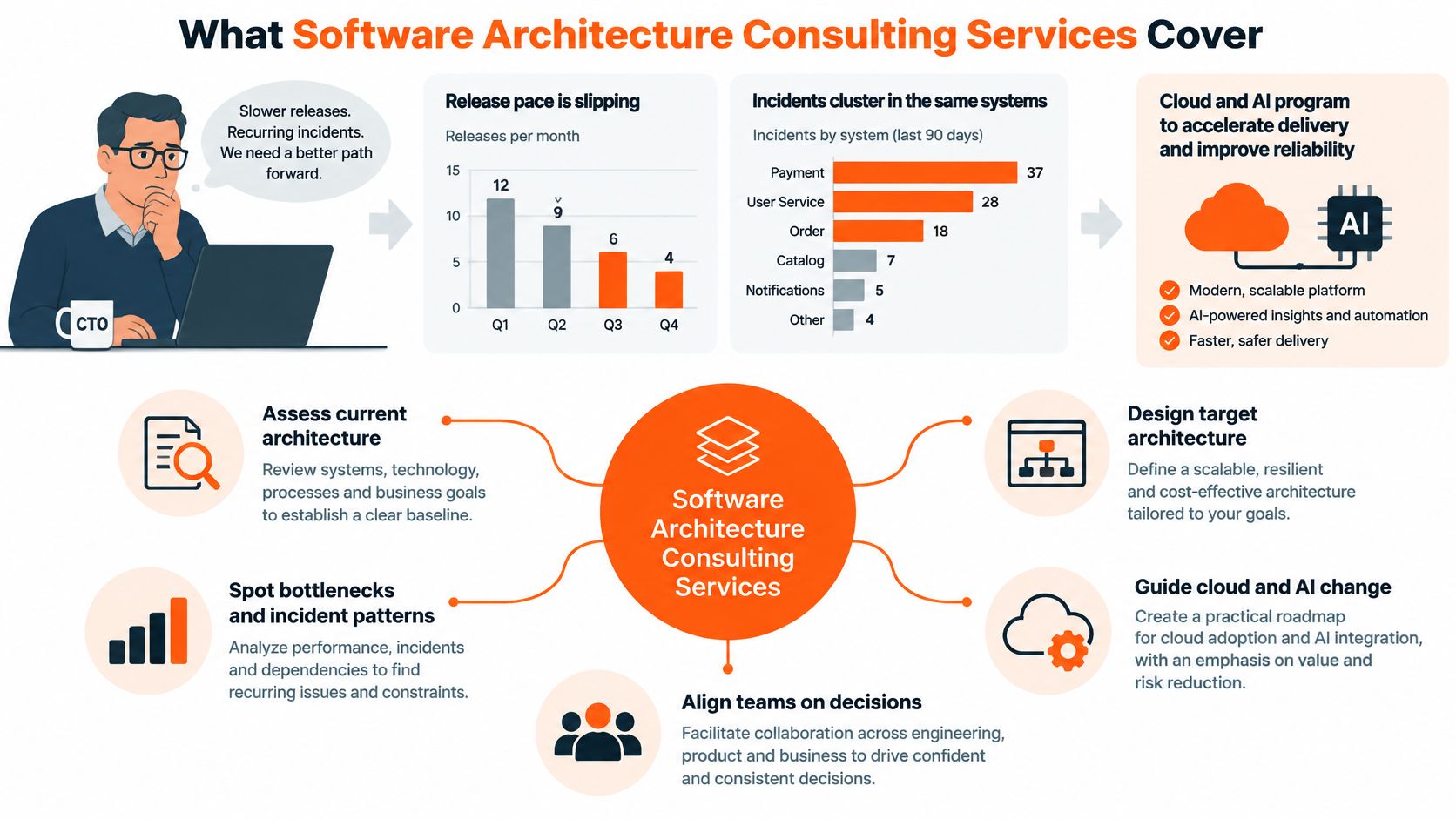
Say a product team can't release a billing change without coordinating with the reporting and identity teams. Incidents repeatedly involve shared data, yet leadership is considering a cloud migration as the remedy. Adding infrastructure won't necessarily remove those dependencies.
Software architecture consulting services provide paid judgment about system structure, boundaries, quality attributes, and decision rights before implementation spending accelerates. An architect should establish whether the constraint sits in application design, data ownership, operational controls, or the way teams approve changes.
Think of city planning. Streets, zoning, and utilities determine what people can build later. Replacing a building's facade doesn't fix an overloaded sewer, just as moving an application doesn't automatically fix shared database writes.
Buy decisions, not just documentation
A proposal should name the scope explicitly:
- Current-state assessment: Inspect code, infrastructure, dependency paths, and incident patterns.
- Target architecture: Define boundaries and quality requirements, including rejected alternatives.
- Integration and data ownership: Establish which component owns a record and who may change it.
- Security and compliance controls: Specify enforcement, evidence, and accountable owners.
- Modernization sequencing: Identify safe migration seams and stopping conditions.
- Measurement baseline: Record delivery and operational behavior before intervention.
The stakes aren't cosmetic. In its 2015 study, Carnegie Mellon University's Software Engineering Institute surveyed 1,831 engineers and architects across three large organizations, supplemented by interviews with seven engineers, and identified architectural decisions as the most important source of technical debt.
Architecture work is liability control, not decoration.
Staff augmentation addresses a different problem: insufficient implementation capacity. Once boundaries and ownership are settled, resources such as LatHire's LATAM developers can help buyers investigate staffing options. More developers aren't a substitute for resolving an unsafe integration contract.
A useful engagement therefore leaves more than a picture. It leaves a justified choice, evidence that could overturn that choice, and someone responsible for the result. Those requirements apply whether you're buying an assessment, funding modernization, or introducing regulated and AI-enabled capabilities.
Engagement Models and the Deliverables You Buy
Architecture consulting engagements and deliverables
The durations below are indicative scoping allowances, not guaranteed completion times. Contract against access requirements and acceptance criteria rather than the calendar alone.
| Engagement | Typical duration | Core deliverables | Buy it when | Skip it when |
|---|---|---|---|---|
| Architecture assessment | 2-4 weeks | Risk register, debt map, fitness functions | Fragility or a buy-versus-build call is unclear | A current target architecture exists and only build capacity is missing |
| Target-state design | 6-12 weeks | Context and container views, architecture decision records, integration map | Several systems must change together | The change is one bounded feature without cross-system impact |
| Modernization roadmap | 4-8 weeks | Rehost, refactor, replace, or retain portfolio; cost of delay; strangler seams | Legacy cost is over plan or migration is about to start | Every workload is already cloud-native and measured |
| Governance retainer | Quarterly or ongoing | Decision rights, review cadence, standards, exception log | Many teams ship in parallel | One team has one product and a short horizon |
| Regulated control design | 4-8 weeks | Resource inventory, policy ownership, audit schemas, enforcement map | Healthcare, education, legal, or privacy duties apply | There's no sensitive data or audit obligation |
| AI architecture advisory | 3-6 weeks | Versioning, evaluation set, permissions, rollback, cost per task | An LLM or agent is entering production | It's a sandbox demo without a production path |
Match the engagement to the unresolved decision
Circle one primary model. Treat the others as follow-ons that require their own approval. Buying assessment, target design, governance, and implementation together can make it difficult to stop when discovery invalidates the original business case.
An assessment should answer a bounded question. For example, can the existing platform support the proposed product expansion without replacing its persistence layer? Its fitness functions should be executable checks, such as dependency rules in ArchUnit, contract tests, or performance tests tied to a critical workflow.
Target-state design goes further. Context and container views explain responsibilities; architecture decision records explain why the team chose those responsibilities. Require alternatives and consequences, not just a preferred stack.
A roadmap is a portfolio decision instrument. It should connect each proposed intervention to a business owner, migration prerequisite, funding decision, and operational acceptance test. A chronological backlog without those connections isn't a modernization strategy.
Make access part of the agreement
These planning allowances assume access to maintainers, defect history, repositories, production telemetry, and a named business owner. Missing access stretches every engagement. Waiting for database permissions isn't architecture analysis, and the contract should distinguish the two.
Ask what happens when discovery reveals an undocumented integration or an unsupported component. The consultant should explain whether the finding changes scope, triggers a decision gate, or requires a separate investigation.
Governance also needs limits. Review consequential boundary and risk decisions, not every pull request. Otherwise, the architect becomes another approval queue.
If the actual gap is execution capacity, evaluate staff augmentation vendor checklists from nexus IT group separately from architecture proposals. Compare continuity, onboarding, and technical accountability without confusing additional staffing with independent architectural judgment.
Outcomes Worth Paying an Architect to Move
Migration completion isn't success. A team can move every application on its list and still struggle to release safely. A finished diagram, selected cloud, or newly adopted service records activity, not improved delivery.
DORA's metrics history identifies five delivery measures: change lead time, deployment frequency, failed-deployment recovery time, change-fail rate, and deployment rework rate. Together, they let a buyer examine throughput and instability rather than accepting speed claims in isolation.
Delivery metrics an architecture engagement should baseline
| Metric | What it measures | Architecture signal | Baseline practice |
|---|---|---|---|
| Change lead time | Time from commit to production | Boundaries let a small change ship alone | Record a representative value stream before intervention |
| Deployment frequency | How often a bounded capability ships | Modularity and automation support independent release | Segment by application and team |
| Failed-deployment recovery time | Time to recover from a failed deployment | Telemetry, rollback, and rehearsed recovery work | Repeat measurement after agreed milestones |
| Change-fail rate | Share of deployments requiring intervention because they fail | Verification matches change risk | Compare before and after, not against a vanity target |
| Deployment rework rate | Unplanned deployments addressing production problems | Teams reduce corrective work rather than relabel it | Track corrective deployments, not tickets closed |
Write down the causal bet
A consultant should explain what mechanism is expected to improve each relevant measure. Smaller batches and automated verification should shorten lead time without increasing failures. Telemetry, rollback automation, and recovery rehearsals should help operators recover from bad deployments.
A modular monolith can be the right answer when teams need enforceable internal boundaries without distributed operations. A service split earns its complexity only when teams can change and deploy a capability independently. Neither pattern deserves approval solely because it appears in the target diagram.
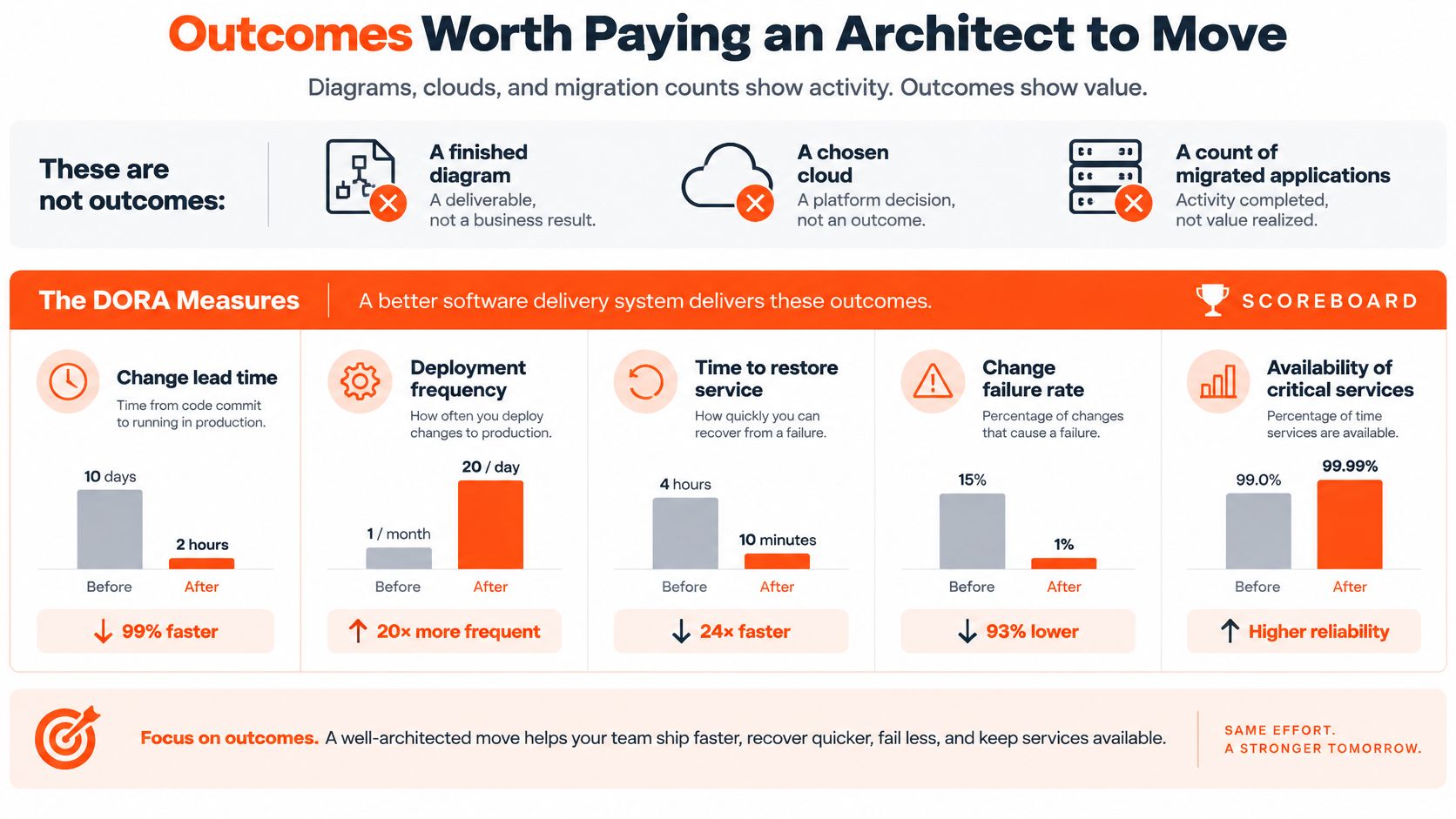
Use the metric definitions in the table as the measurement contract. Availability is a useful companion measure, but it doesn't replace deployment rework rate.
Aim at defect concentration
In a longitudinal study of a healthcare communications product, three architectural roots containing 296 files accounted for 80% of bug fixes; the file share associated with 80% of bugs moved from 17% before refactoring to 37% afterward, while the concentration pattern persisted.
That finding supports targeted investigation, not a universal refactoring formula. Join defect history to dependency graphs, code ownership, and change history before choosing a boundary to repair.
Acceptance rule: Require a before-and-after metric sheet in the statement of work, not a promise to measure later.
Record the baseline before work starts. Repeat measurement after CI/CD changes, database decoupling, or platform migration, and note concurrent staffing or product changes so nobody attributes every improvement to architecture.
Which Systems to Modernize and Which to Leave
Not every legacy system should move. In Ensono's 2025 survey of 500 IT decision-makers in the U.S. and U.K., 49% reported legacy-maintenance costs exceeding plan, 52% identified refactoring or re-architecting applications as their biggest cloud-migration challenge, and 57% of IT teams spent most of their time maintaining day-to-day operations.
A blanket migration can consume the people who keep the business running. The architectural decision isn't whether a workload is old. It's whether changing it now produces a defensible benefit at an acceptable transition risk.
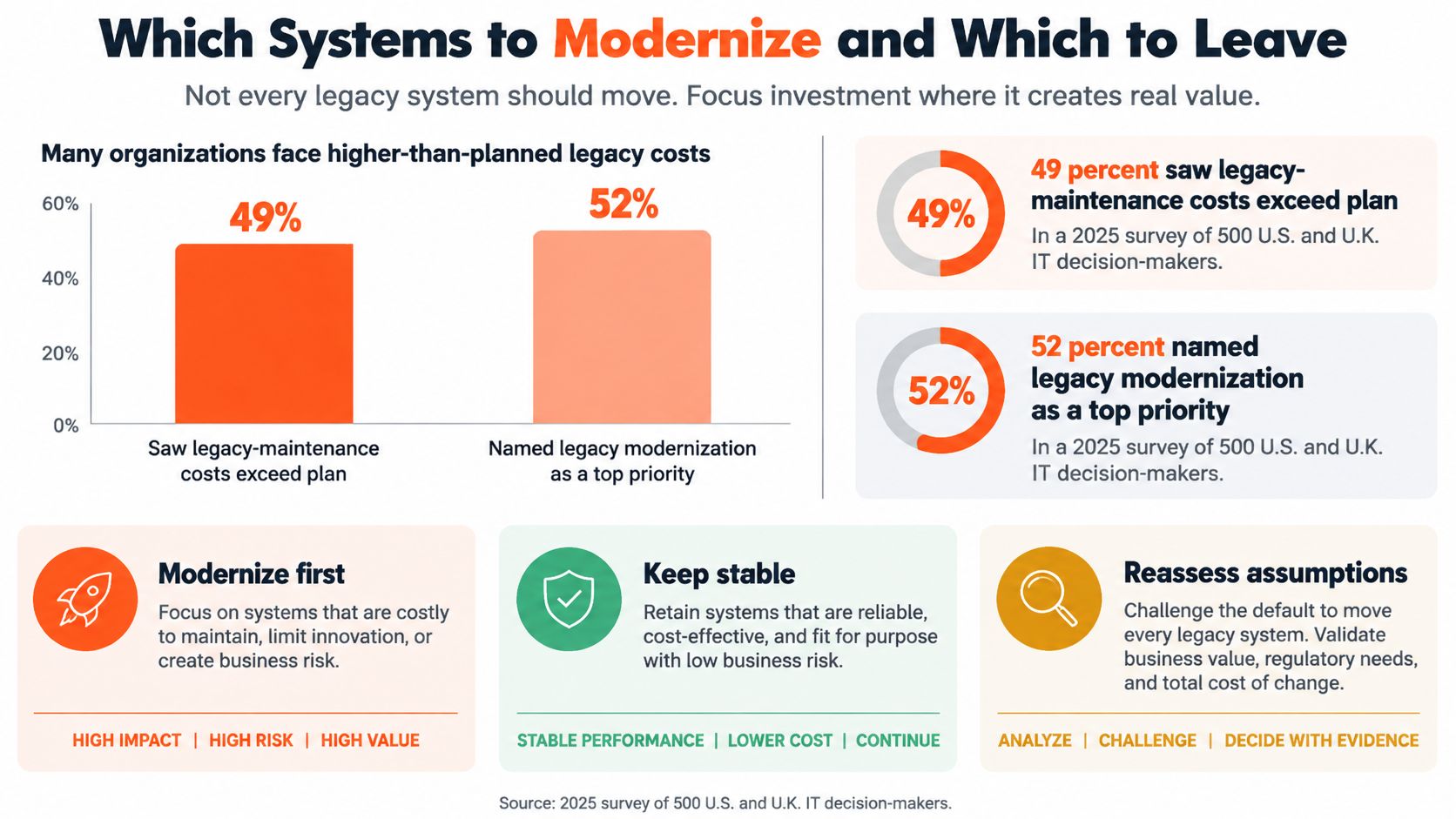
Score the workload before selecting the path
Record business criticality, change frequency, failure impact, compliance constraints, data dependencies, and total cost of ownership for each workload. Use an agreed qualitative scale and attach evidence. Don't average away a critical dependency or an unacceptable recovery risk.
Four modernization paths
| Path | Choose it when | Evidence to record | Skip it when |
|---|---|---|---|
| Rehost | The system is stable, rarely changed, and infrastructure cost or resilience is the opportunity | Criticality, change history, failure impact, compliance constraints | Defect-prone boundaries or an obsolete process are the real problem |
| Refactor | Frequent changes encounter concentrated defects and coupling | Dependency graph, defect concentration, change history | Hosting cost is the only material gap |
| Replace | The process is obsolete and a package or rewrite has a better economic case | Total ownership cost, process fit, conversion and integration costs | A bounded extraction can preserve a sound, auditable core |
| Retain | The business case, migration seam, or operating capability is weak | Cost of delay, missing skills, accountable owner, revisit date | An evidenced, funded intervention has safe rollback and a measurable benefit |
Rehosting preserves application-level liabilities. Refactoring preserves more business behavior but requires teams to understand it. Replacement can remove obsolete constraints while introducing difficult data conversion and workflow changes.
Retention isn't neglect. Record support exposure, compensating controls, and the condition that would reopen the decision. Estimate the cost of delay from identifiable maintenance work, incidents, or blocked business opportunities rather than inventing a precision score.
Preserve traceability during extraction
Say a healthcare platform has a settled records core and a frequently changing notification workflow. Wrap the core with controlled interfaces, then extract notifications through a strangler seam, a boundary that lets the new implementation gradually take over.
Keep historical records in place until reconciliation and audit evidence prove that the new path preserves traceability. The legacy modernization guide for business growth provides related context for connecting such technical sequencing to business priorities.
Each funding gate should name the owner, evidence, budget band, rollback mechanism, and delivery metric expected to improve. Include the cost of running old and new paths together. When those fields are blank, modernization can increase risk rather than retire it.
Control Designs for Regulated Environments
In healthcare, education, legal, and other privacy-heavy systems, architects must design how trust is decided, not merely select a perimeter product. A familiar network address isn't sufficient evidence that an account or workload should access sensitive records.
NIST SP 800-207 describes zero trust without implicit trust based on network location or ownership, using ongoing evaluation of access to resources. Its separation of decision-making from enforcement gives consultants a practical design model.
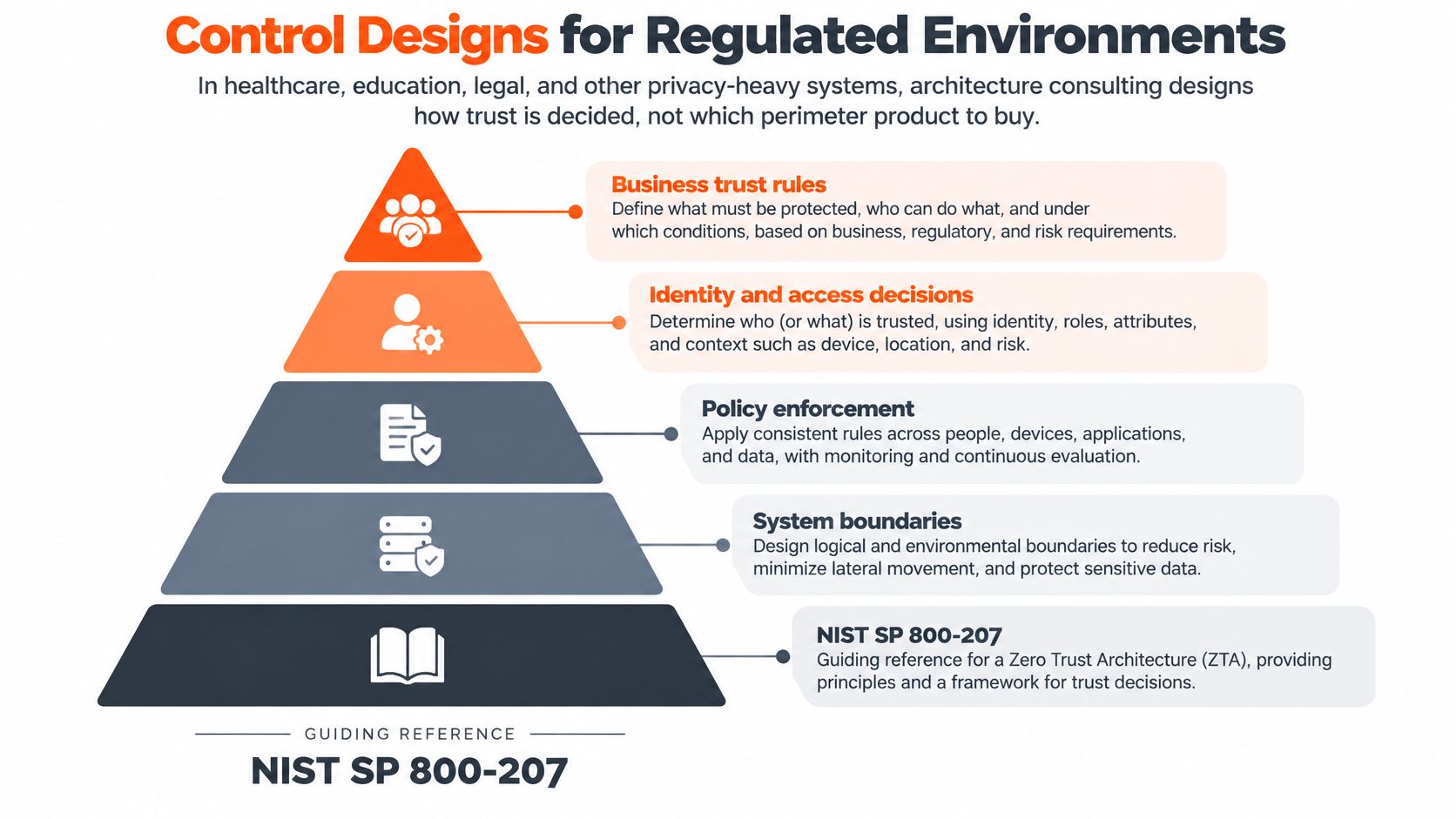
Separate the rulebook from the gate
The Policy Engine decides whether to grant, deny, or revoke access. The Policy Administrator turns that decision into session-specific authorization. Policy Enforcement Points enable, monitor, and terminate connections.
Think of a gate operating under a centrally maintained rulebook. The gate doesn't invent eligibility rules, but it must enforce the current decision and close when authorization ends. In software, enforcement may sit at APIs, gateways, service meshes, databases, and administrative interfaces.
Ask the architect to specify the evidence feeding decisions: identity, device posture, workload identity, resource classification, and security signals. Then test what happens when evidence is stale or unavailable.
Require artifacts operators can use
A regulated proposal should include:
- Resource inventory: Protected services, records, administrative functions, and owners.
- Trust-decision flows: Inputs, decision paths, enforcement locations, and dependencies.
- Policy ownership: Who approves changes and resolves conflicting access requirements.
- Failure behavior: Explicit fail-open or fail-closed choices for each critical interaction.
- Session revocation: How active access ends after compromise or entitlement changes.
- Audit-event schemas: Actor, resource, decision, policy version, correlation identifier, and outcome.
Connect those artifacts to a risks and controls matrix so reviewers can trace a risk to an implemented control and its evidence.
Say a student-records service account is compromised. Operators must revoke its sessions and block further access even if requests originate inside the campus network. Test that behavior through the actual enforcement path, including caches and long-lived connections.
Centralized decisions improve policy consistency; distributed enforcement helps restrict lateral movement. The trade-off is dependency management: policy services, caches, and enforcement components need explicit resilience behavior.
Controls can wrap an existing application before teams refactor its internals. That allows a strangler migration without creating an ungoverned access path. Reject a proposal that ends with a tooling list and leaves policy changes or audit events ownerless.
Operating Controls When AI Enters the Architecture
Choosing a model and connecting it to private data is the easy half. Production architecture must also define who approves behavioral changes, who evaluates outputs, and who stops the system when it acts incorrectly.
Global 2025 findings summarized by SAS identified non-optimized cloud data environments as a barrier for 49% of organizations, insufficient data governance for 44%, and specialist shortages for 41%; among more mature AI organizations, 57% cited building organizational AI architecture, while separate findings reported 71% couldn't fully trust autonomous enterprise agents despite 46% having governance policies and low policy adherence.
Treat evaluation as part of the data architecture
In 2025, 57.9% of companies were actively evaluating generative AI with large language models as part of modern data-architecture efforts, according to the Radiant Advisors and Unisphere Research study reported by DBTA. Alongside that interest, Cloudera's survey of 1,574 enterprise IT leaders across the United States, EMEA, and APAC found that 37% identified data integration as their biggest technical architecture limitation.
These are separate survey populations, not a combined benchmark. They nevertheless frame a practical requirement: model evaluation must include the retrieval and data-access paths, not just isolated prompts.
With more than half of companies in the DBTA-reported study evaluating LLMs within their data architecture, I would require model and prompt versioning, evaluation datasets, citation coverage, rollback, and cost-per-task tracking before production approval.
The operating specification should also name:
- Retrieval monitoring: Source freshness, permission filtering, missing evidence, and ranking failures.
- Human escalation: Review triggers and a queue with an accountable operator.
- Privacy boundaries: Permitted data flows, retention, redaction, and access checks.
- Incident response: Disablement, investigation, restoration, and notification ownership.
- Vendor exit: Exportable prompts, evaluation assets, integration contracts, and model substitution tests.
Test behavior, not policy existence
Consider enterprise search inside a legal product. The assistant should cite accessible source passages, refuse unsupported conclusions, and route consequential uncertainty to a reviewer. A bad prompt release should be reversible through configuration without requiring an application redeployment.
Measure accuracy by use case, refusal quality, citation coverage, latency, cost per task, and harm severity. A responsible-use policy doesn't establish any of those results.
Yalc's explanation of AI orchestration for revenue operations offers adjacent workflow context; enterprise architecture still needs explicit permissions and recovery behavior around each action. An AI governance framework should connect those controls to approval and incident responsibilities.
A proof of concept isn't a production architecture until someone owns its behavior.
Choose a Partner and Set the First Gate
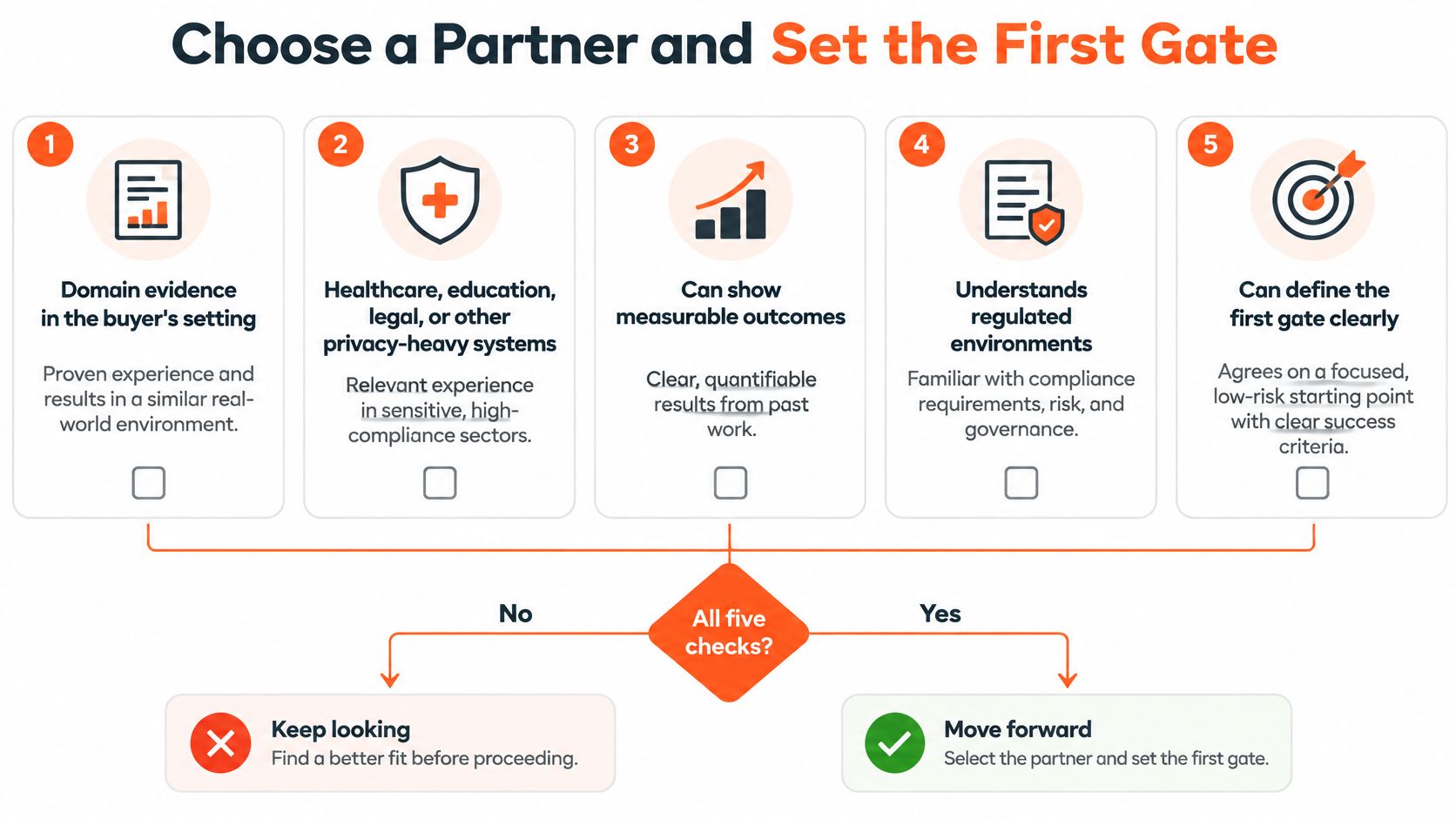
Choose a partner by how they make difficult decisions, not by how many technology logos appear in the proposal. Ask them to explain a trade-off in terms your product owner, security lead, and operations manager can challenge.
Use these selection tests:
- Relevant production evidence: Ask for systems in healthcare, education, legal, or a comparably constrained setting. A generic cloud story doesn't establish competence in auditability or sensitive workflows.
- Security-first delivery: Request an enforcement design, policy ownership example, and evidence trail, not a compliance slide.
- Measurement discipline: Look for willingness to baseline delivery behavior and recommend retaining a system when intervention isn't justified.
- Named architectural accountability: Meet the architect who will own the decision. Establish availability, review responsibilities, and handover expectations.
- Continuity into operation: Confirm who converts decisions into implementation tasks and who supports the system after release.
Commission a decision you can accept or reject
One option is devPulse, operating since 2015, with architecture leadership from CTO Anna Tukhtarova, whose experience exceeds 15 years. Its work spans education, healthcare, cybersecurity, and legal technology, with services extending from discovery through modernization and support. Evaluate the proposed team against the same evidence requirements you'd apply to any consultancy.
If debt hotspots are unknown, start with the bounded assessment allowance described in the engagement table. If the problems are already evidenced, commission a roadmap instead of paying to rediscover them.
Require workload scores across the portfolio criteria, an extraction candidate, a system explicitly retained, and a metric baseline. Add an acceptance meeting where business and engineering owners can reject recommendations whose benefits don't justify transition costs.
The first gate should release funding only when the consultant has resolved the decision you commissioned. Unanswered questions should appear as named risks or follow-up investigations, not disappear into an optimistic delivery plan.
Pick the decision still open, fund only that engagement, and refuse a proposal that can't name the artifact, the owner, and the metric.
devPulse offers architecture assessment, modernization planning, implementation, and ongoing support for custom enterprise systems. Visit devPulse with your application inventory, incident history, and unresolved investment decision to scope a first gate against your real portfolio.