














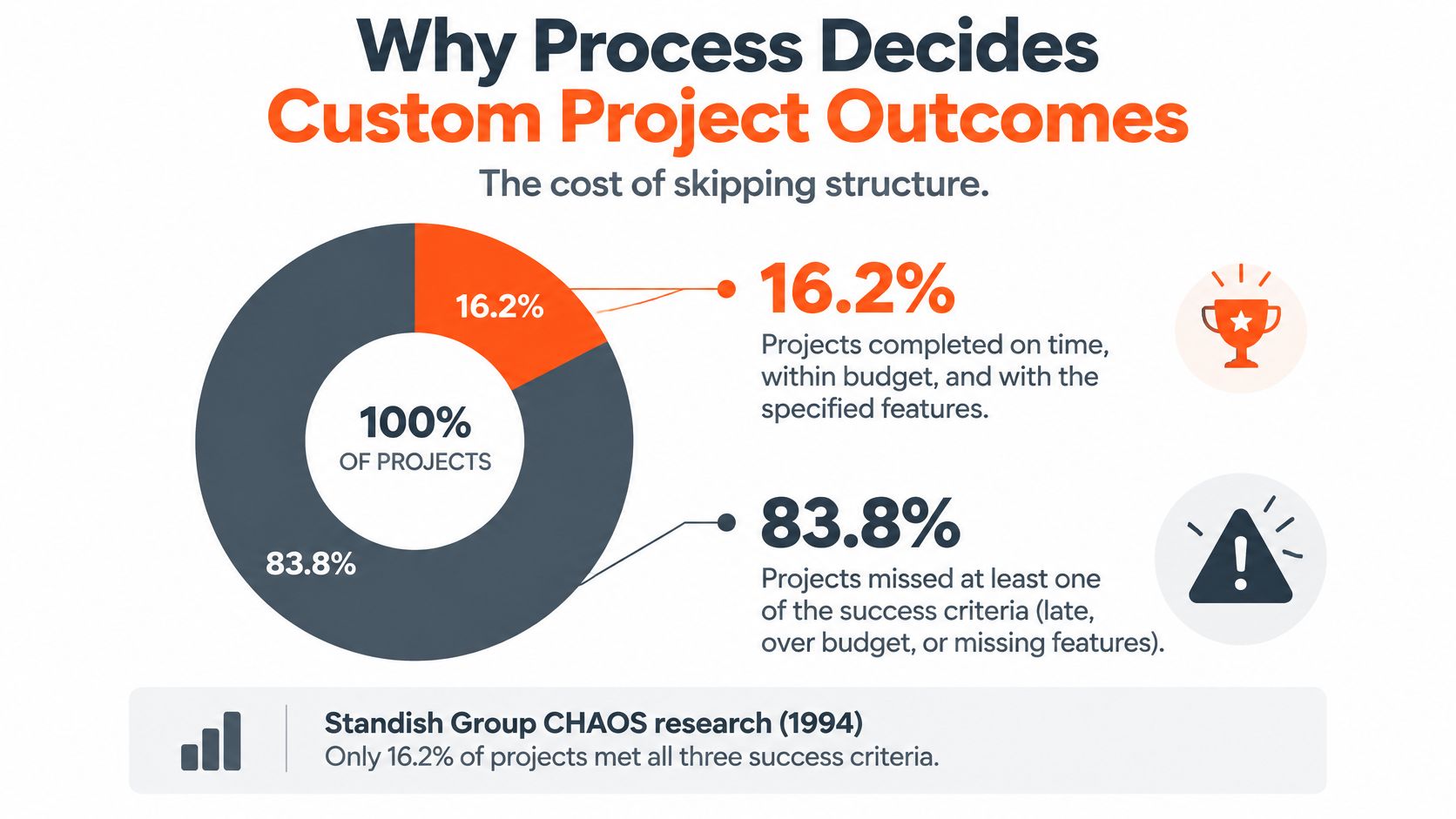
Only 16.2% of projects in the Standish Group's original 1994 CHAOS research were completed on time, within budget, and with the originally specified features and functions, according to the historical CHAOS project-outcomes summary. That figure reframes the custom software development process: process isn't paperwork wrapped around coding. It's how a team makes uncertainty visible early, limits the cost of change, and proves a system is ready to operate.
For enterprise teams, speed only matters when the software remains stable, secure, and maintainable. The practical test is not whether a team can produce code quickly. It's whether every stage leaves behind evidence that lets the next owner make a sound decision.
Table of Contents
- Why Process Decides Custom Project Outcomes
- Seven Stages and the Gate for Each
- Discovery and Architecture Before Coding
- Build Test and Release on Measured Quality
- Security Gates and AI Code Governance
- Maintenance Debt and a Safe Modernization
- Roles, Cadence and Engagement Model
- Decision and Two-Week Start
Why Process Decides Custom Project Outcomes
The 1994 CHAOS results distinguish between successful projects, challenged projects, and projects that were canceled or delivered but never used. The Standish Group's historical summary reports that 52.7% were challenged, meaning they finished late, exceeded budget, or delivered reduced functionality; 31.1% were canceled or never used. The figures describe a historical cohort, not a prediction for any particular project, but they show why “we'll sort it out as we build” is a risky operating plan.
Project size also changes the level of control a team needs. In the 2009 CHAOS Summary, overall success was 32%. Projects requiring less than $750,000 in labor had a reported 71% chance of success, compared with 38% for projects costing $750,000 to $3 million. For projects exceeding $10 million, the reported chance of finishing on time and within budget was 2%. Those historical figures don't mean a large initiative is doomed; they show that growing scope and organizational complexity need stronger controls.
A large custom system behaves less like a single feature and more like a hospital wing. Integrations, business rules, data ownership, and stakeholder decisions create dependencies that a bigger team can't absorb. Discovery reduces unknowns before significant build spend, architecture limits complexity, iterative delivery surfaces risk while it's still manageable, and release governance helps keep a technically complete system usable.
Seven Stages and the Gate for Each
A stage is complete when it produces an artifact someone can inspect and a named owner accepts the decision. The lifecycle below is a connected operating system, not a one-way waterfall: feedback and new evidence can send work back through an earlier gate. For a complementary overview of how product teams define lifecycle stages, see this product lifecycle stages guide from Figr.
| Stage | Purpose | Exit artifact | Gate to pass |
|---|---|---|---|
| Discovery | Reduce uncertainty before build spend | Problem statement, metrics, constraints, first-release scope | Sponsor accepts outcomes and out-of-scope items |
| Architecture | Control complexity as scope grows | Context diagram and recorded decisions | Interfaces, data, and failure modes are named |
| Development | Deliver increments with traceable change | Reviewed code in version control and a green pipeline | Each increment maps to an accepted story or decision |
| QA | Find costly defects before release | Test evidence for function, integration, performance, and security | Acceptance criteria pass or risks are explicitly waived |
| Deployment | Release the same build repeatedly | Pipeline, environment configuration, and rollback plan | Release owner can roll forward or back |
| Maintenance | Keep the system safe and changeable | Runbooks, SLOs, patch and incident cadence | On-call ownership and debt capacity are funded |
| Governance | Keep decisions, AI use, and risk auditable | Decision log, provenance, and approval record | Named approver signs scope, security, and AI-assisted changes |
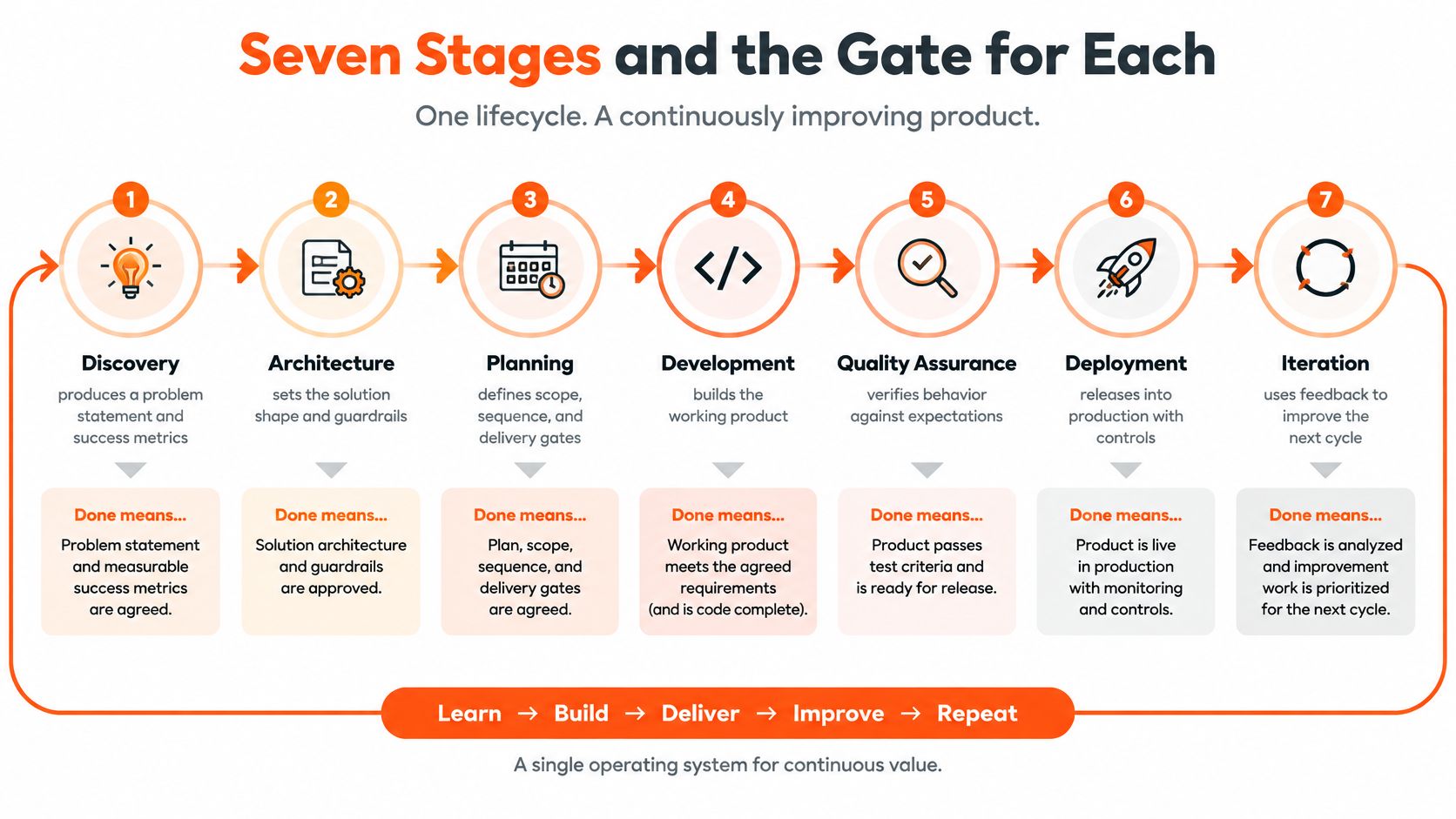
Think of gates as air-traffic control. Coding is the flight; gates are the clearances. Skipping a clearance doesn't make the flight faster. It leaves the team trying to move forward without confirming the route, the handoff, or the conditions for landing.
Use rule: Don't start the next stage until its exit artifact exists and a named owner has accepted the gate.
Governance runs across the stages, not only at the end. The sponsor approves outcomes and scope; technical and operational owners record decisions and confirm that risks have been addressed. In regulated healthcare, education, and legal work, each gate should carry the relevant security and audit evidence. A final-stage compliance check can't reconstruct decisions that were never recorded.
Discovery and Architecture Before Coding
Discovery and architecture are investment controls. They turn a broad goal into a bounded first release, then decide how that release can evolve without making the next change unnecessarily risky. Teams that need a structured way to define the work can also use this product discovery process guide.
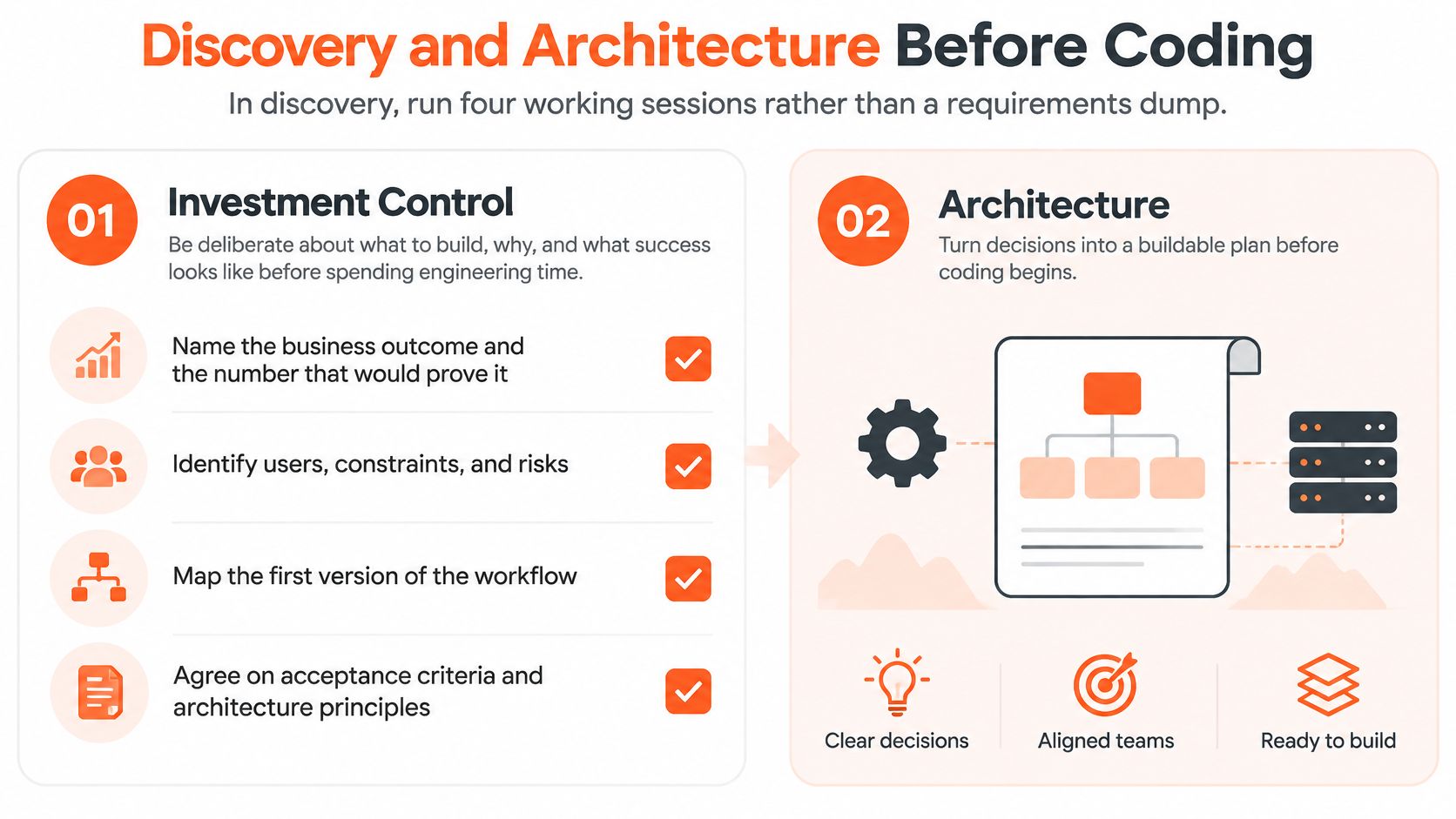
Rather than collecting an undifferentiated requirements list, run four working sessions:
Name the outcome and proof. Choose a business result and a measure that can show progress, such as cycle time, error rate, or release frequency. If the outcome can't be observed, the sponsor can't reliably decide whether the software is helping.
Map the people and rules. Identify users, downstream systems, and the business rules those systems already enforce. A workflow that appears simple on screen may rely on identity, approval, or data-retention rules elsewhere.
Bound the first release. Separate must-have behavior from later options. Make non-goals explicit so a team can say whether a new request changes the agreed scope.
Record immovable constraints. Document data residency, uptime expectations, identity requirements, and the budget band. Treat these as design inputs, not issues to discover after architecture has hardened.
The discovery exit should be a concise scope document with outcomes, constraints, in-scope behavior, and non-goals. It doesn't need to predict every future feature. It needs to give the sponsor and delivery team the same basis for deciding what comes first.
Make architecture decisions reversible where possible
Architecture decides how the scope can change. Record major decisions with their context, the options considered, and the consequences of reversing them. A context diagram should show systems, users, data flows, and the interfaces where ownership or failure could affect the rest of the product.
For legacy platforms, inventory current behavior before choosing whether to rewrite or migrate. List undocumented rules that users and integrations still rely on, then identify seams around those capabilities and keep a rollback path. It's like moving a load-bearing wall: shore the structure, move one opening, and check the result before going further.
Discovery checklist: Leave the stage with an outcome metric, bounded scope, integration map, threat and data notes, and the first recorded architecture decisions.
Build Test and Release on Measured Quality
A defect becomes more expensive when a team finds it late, after dependent components or business processes have been built around it. Independent software-quality research summarized by the National Institute of Standards and Technology found that approximately 45% of software errors were discovered during integration, after components had been created separately. The same findings reported that correcting a defect introduced through poor requirements or coding could cost about twice as much when found during integration, three times as much during testing, and up to six times as much after release.
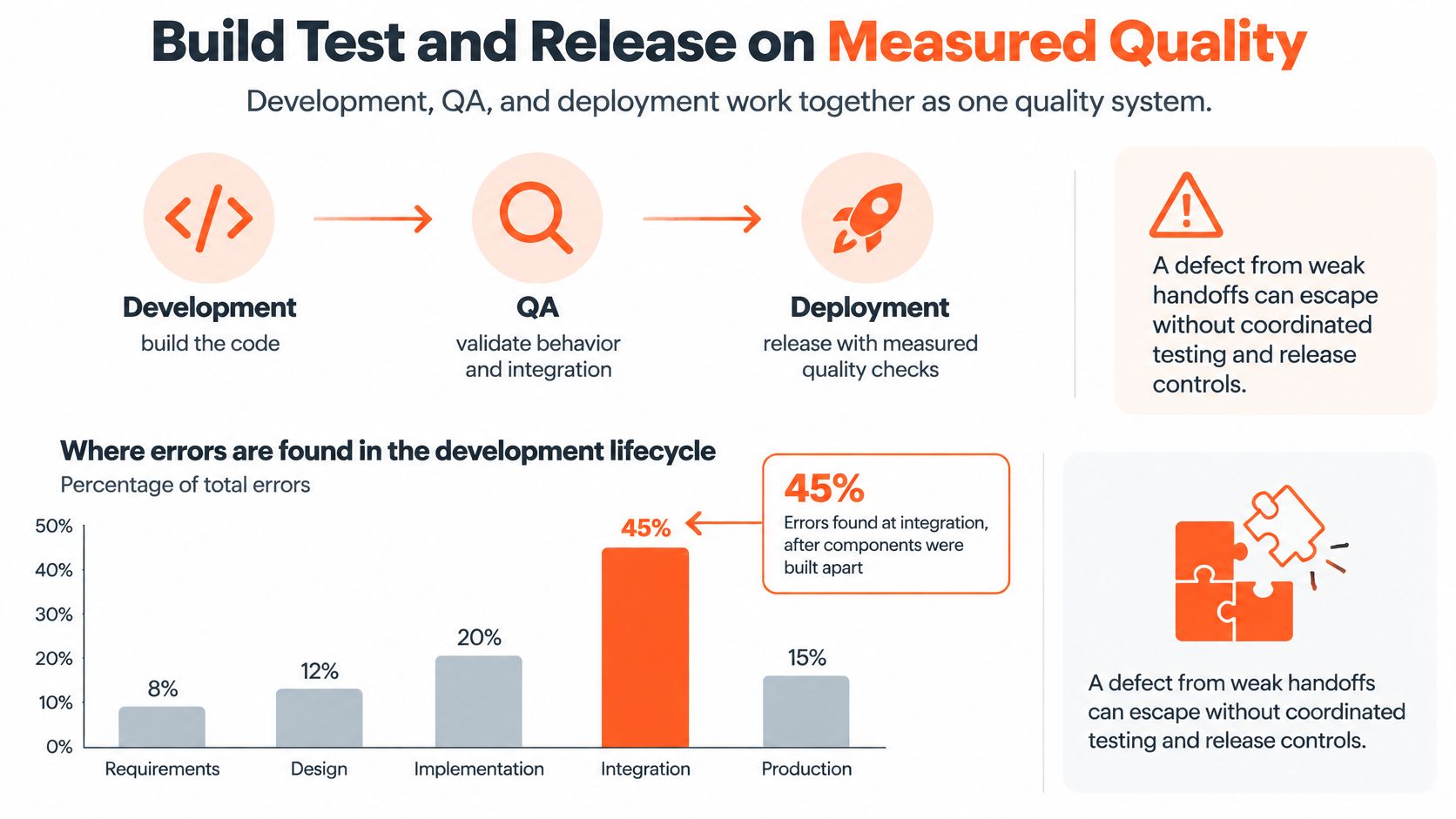
Treat development, QA, and deployment as one quality system. Developers merge small changes; the pipeline builds the software and runs unit, integration, and dependency checks. QA adds acceptance and performance evidence for the riskiest paths, while release owners promote the same tested artifact and confirm that rollback is ready. A practical QA checklist can help teams make acceptance evidence explicit rather than leaving it to a late bug hunt.
Track throughput and stability together
The 2024 DORA framework describes delivery through change lead time, deployment frequency, and failed-deployment recovery time, alongside stability measures including change-fail rate and deployment rework rate. DORA's metric definitions make the relationship concrete: change lead time runs from code commit to successful production deployment, while change-fail rate counts deployments that require immediate intervention. Deployment rework rate captures deployments spent on unplanned defect fixes.
Calculate change-fail rate as failed deployments divided by total deployments in the same period, multiplied by 100. A team whose deployment needs a hotfix or rollback has a failed deployment for this measure. The following benchmarks are the bands in DORA's metrics history, summarized by IBM:
| Band | Change failure rate | What it means | Example |
|---|---|---|---|
| Elite | 0–15% | Few releases need immediate repair | 4 failures in 40 releases is 10% |
| High | 16–30% | Stable enough to improve without freezing releases | 8 failures in 40 releases is 20% |
| Medium | 31–45% | Speed is creating noticeable production repair | 16 failures in 40 releases is 40% |
| Low | 46–60% | Nearly half of releases need a hotfix or rollback | 20 failures in 40 releases is 50% |
An internal developer platform isn't a delivery metric by itself. The 2024 DORA report says 89% of surveyed organizations use one, but platform adoption alone doesn't guarantee better outcomes. Teams with dedicated platform support showed a 6% productivity gain, while organizations requiring platform use across the application lifecycle experienced an 8% throughput decrease. Instrument the pipeline and incident systems, set baselines, then choose improvement targets. Don't accept a release-frequency goal that improves throughput by increasing failures and corrective work.
Security Gates and AI Code Governance
A security gate is useful only when it produces evidence a team can review and act on. NIST's Secure Software Development Framework groups practices into four areas: Prepare the Organization, Protect the Software, Produce Well-Secured Software, and Respond to Vulnerabilities. The framework fits into an existing lifecycle, so teams can connect its practices to work they already do.
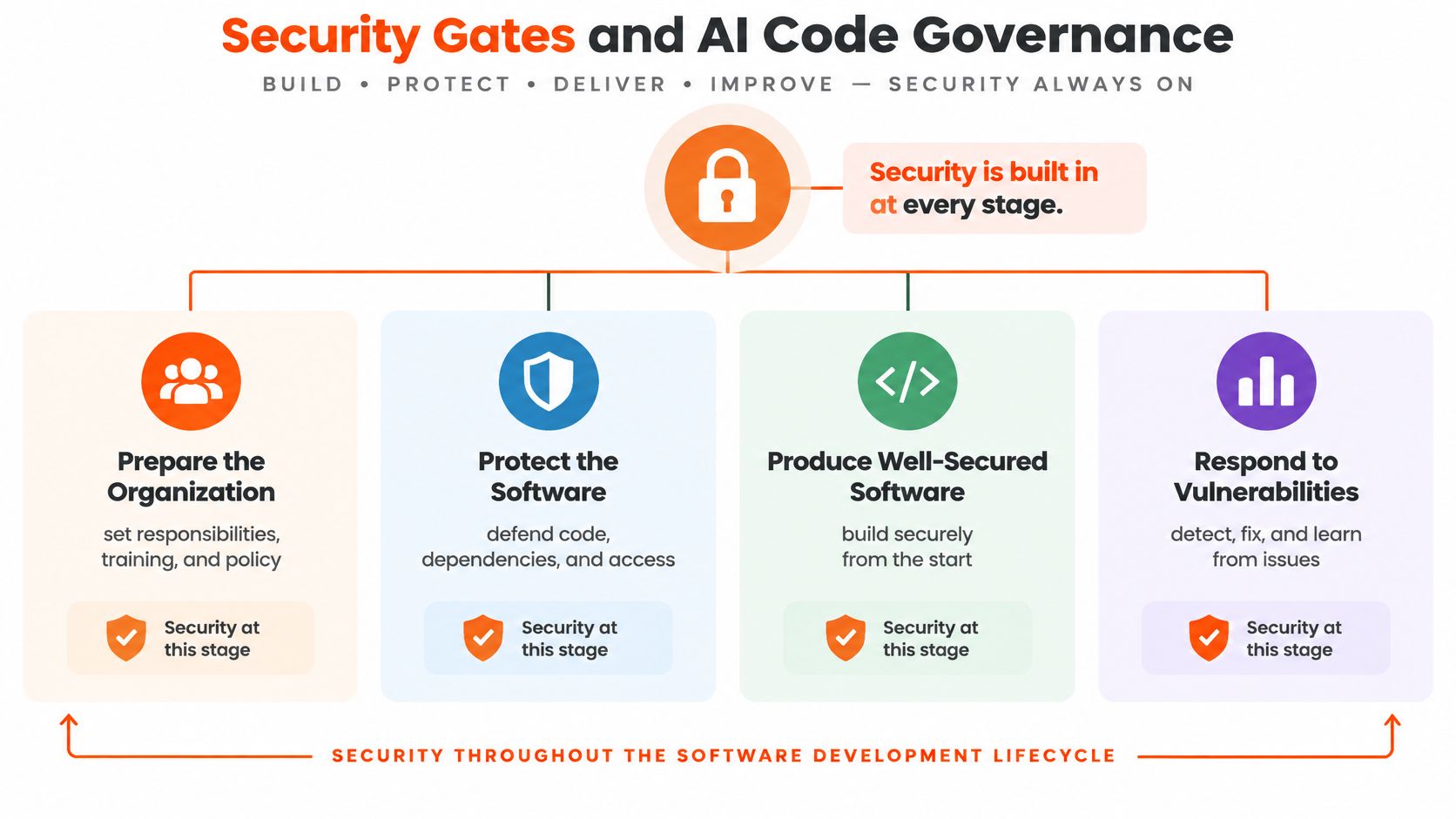
Turn those areas into controls at each stage. During discovery, document threat assumptions and acceptance criteria for authentication, authorization, data minimization, encryption, auditability, retention, and recovery. During implementation, protect repositories, dependencies, and build reproducibility, then run static, dynamic, and dependency analysis in the pipeline. After release, assign owners for vulnerability disclosure and patching, and track whether fixes prevent root causes from recurring. NIST's SSDF publication describes practices for reducing vulnerabilities in released software, limiting the impact of weaknesses that escape detection, and addressing recurring causes.
Treat AI-assisted code as governed change
AI tools don't remove the need for a delivery gate. They increase the need for traceability: teams should record which code, tests, documentation, or infrastructure definitions were AI-assisted, who reviewed them, and what evidence supports approval.
A 2026 GitLab survey of 1,528 developers and technology buyers across six countries found that 80% said their organizations adopted AI coding tools faster than they created governance policies, and 92% reported governance challenges involving AI-generated code. AI coding assistants are in widespread use, while governance and oversight remain uneven.
Require an approval record before AI-assisted changes enter operation. Keep the record tool-agnostic and include:
- Provenance: Record the assistant or model, the prompt class, and which artifacts were AI-assisted.
- Human review: Apply closer scrutiny to changes affecting permissions, sensitive data, regulated workflows, or core business rules.
- Supply-chain checks: Review dependency origin and licensing, and protect source repositories and build inputs.
- Regression evidence: Run relevant functional, integration, and security checks against generated changes.
- Approval: Store the reviewer's decision with release evidence, not in a disconnected chat thread.
For sensitive systems, set the evidence required to approve, operate, and maintain AI-assisted software before choosing how quickly an assistant should draft an MVP. A tool-agnostic AI governance framework can help teams turn that requirement into reviewable controls.
Adoption does not establish trust. Google's 2025 DORA research found that 90% of technology professionals reported using AI at work. DORA's analysis of trust in AI found that 30% of developers reported little or no trust in AI-generated code. JetBrains' 2025 developer experience and productivity research found that 85% of developers reported using at least one AI tool for coding or other development activities. Approval criteria should account for both widespread use and the need for accountable review.
Maintenance Debt and a Safe Modernization
A 2025 empirical study analyzed 774,051 methods across 49 open-source projects and found that methods containing self-admitted technical debt were larger, more complex, less readable, more bug-prone, and changed more frequently; the debt also often remained unresolved for extended periods, according to the study published in the proceedings of the International Conference on Mining Software Repositories. That makes debt an operating cost, not a matter of developer taste or a cleanup task that can safely wait until after launch.
Build a debt baseline during discovery. Classify each item by its effect on security, reliability, compliance, or changeability, then assign an owner and a checkpoint. Fund remediation capacity within delivery increments instead of creating a future cleanup project with no protected time. Use architecture decision records, automated tests, and production telemetry to confirm whether a debt item is resolved.
Modernize by bounded capability
Consider a regulated team running a document-heavy platform that still handles billing and access rules. Users and downstream integrations depend on behavior that the original documentation doesn't describe. Replacing the whole platform at once might remove visible complexity while putting critical business rules at risk.
A safer approach treats modernization as a controlled learning system:
- Inventory observed behavior. Document what users do, which systems exchange data, and where the current platform makes decisions.
- Instrument the existing path. Collect enough operational evidence to identify how the capability is used and what a replacement must preserve.
- Introduce a seam. Separate one bounded capability from the rest of the platform without changing its externally visible behavior.
- Migrate and compare. Run the new path against the intended workflow, check results, and keep the old path available while the team validates the change.
- Pass the checkpoint or roll back. Move forward only when the new capability meets its acceptance criteria; otherwise restore the prior path and address the gap.
Modernization is safer when each release teaches the team something without removing its ability to recover.
Maintenance then follows the same discipline at a smaller scale. Incidents update runbooks; security findings enter the patch and vulnerability-response process; delivery metrics show whether changes are improving without creating more rework. Keep a debt register with an owner, impact class, and checkpoint, not a backlog category called “cleanup.”
Roles, Cadence and Engagement Model
Name the person who accepts each gate before the first iteration. The sponsor owns outcomes, the budget band, and first-release scope; the product owner orders stories and accepts increments. The architect maintains the decision log, engineers own pipeline health and rework, QA or security leads provide acceptance evidence, and operations owns on-call readiness, runbooks, and rollback.
Use short iterations with a demo and acceptance review each cycle. Hold a monthly sponsor gate review and a quarterly review of the debt register and DORA trend. The value of a meeting is whether it resolves an ownership or risk decision, not whether it appears on the calendar.
Practical rule: Put the acceptance artifacts, signer, and response to a failed gate in the contract.
Fixed-price contracts fit a bounded first release with stable scope. Discovery-heavy or legacy work usually fits time-and-materials or staged contracts better, because the team learns about requirements and dependencies as delivery progresses. Internal teams and partners need the same named ownership. If you're evaluating distributed staffing, HireDevelopers.com's resource for hiring developers from Latin America can be one place to explore team options; the engagement still needs clear gate owners on your side.
Decision and Two-Week Start
Proceed only when the outcome owner has accepted the first-release scope and non-goals, the riskiest integration has a recorded architecture decision and rollback path, and the team can measure lead time, deployment frequency, change-fail rate, recovery time, and rework. Security criteria and AI provenance rules must travel through the same approval path as functional stories. If any of those controls is missing, pause. Adding developers won't create the missing decisions or evidence.
In week one, baseline the outcome metric, map integrations, open the debt register, and name an owner for each gate. In week two, set the first gate review and release dashboard, then choose one capability small enough to deploy and roll back. For enterprises modernizing regulated or content-heavy systems, devPulse is one full-cycle option for discovery, architecture, custom software development, security-first delivery, legacy replatforming, and ongoing support. Choose a staffing model based on who will own the gates after launch, and finish kickoff by asking: What evidence will exist before this software is approved, operated, and changed again?
devPulse helps enterprise teams take custom software from discovery and architecture through secure delivery, modernization, and long-term support. If you're preparing a first release or managing a legacy system, visit devPulse to discuss the gates, evidence, and ownership your delivery process needs.