













The most popular advice about language for website is usually wrong because it assumes a website has one universally best programming language. In practice, the choice spans browser behavior, backend workloads, deployment model, existing engineering skills, compliance needs, content operations, and the human languages customers must see. A fast marketing site, an AI-supported knowledge platform, a regulated healthcare service, and a cloud infrastructure product may need very different stacks.
The right question is not “Which language is most popular?” It’s “Which language fits the system we need to operate and evolve?” The comparison below treats eight technology options as architecture decisions, then connects them to localization, governance, legacy modernization, accessibility, and enterprise delivery. If the technical trade-offs still feel unclear, it can help to interview senior backend developers before committing to a stack.
1. JavaScript and TypeScript for full-stack web development
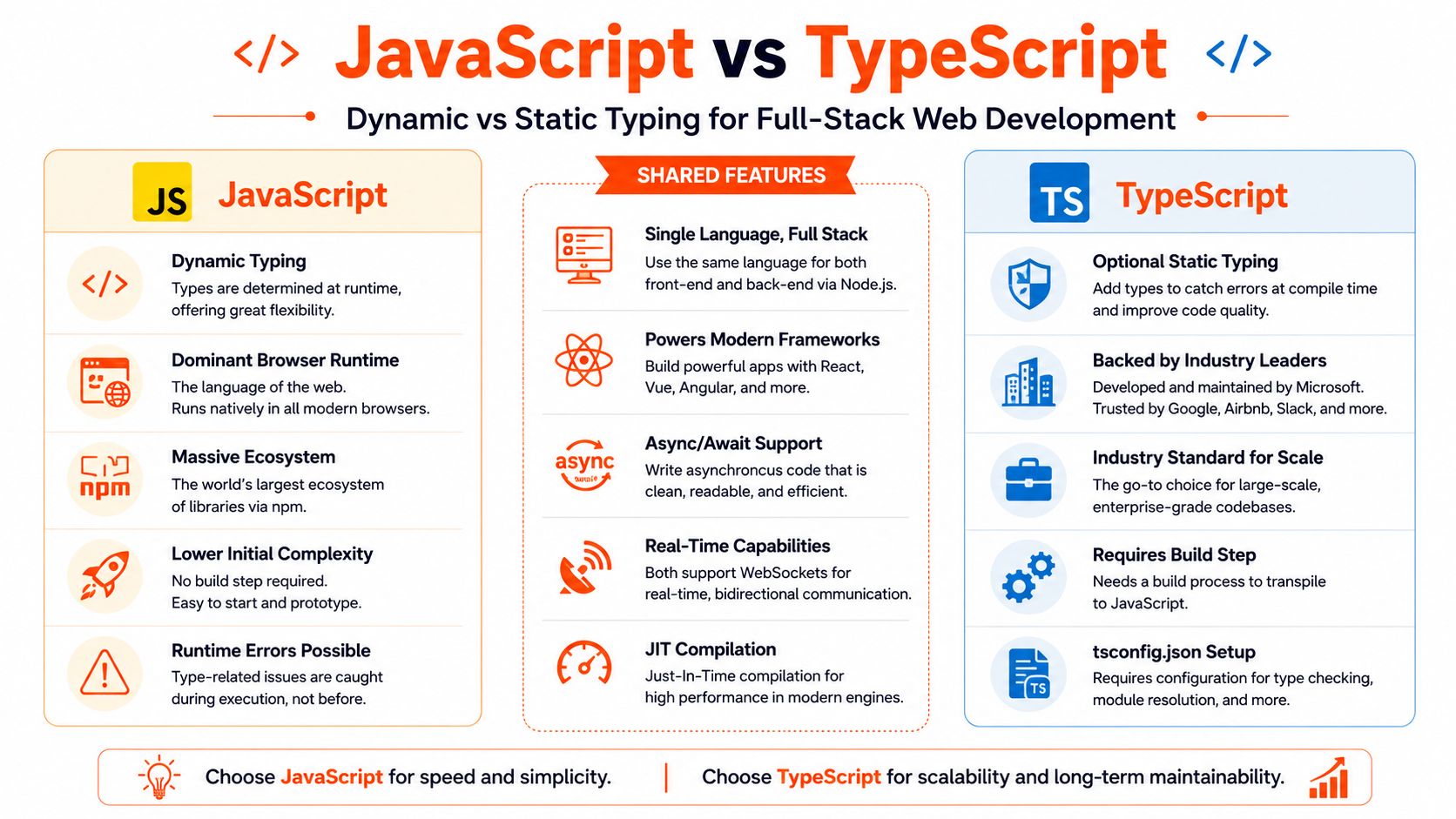
JavaScript remains the practical foundation of browser-based web applications. It runs where the user interacts with the product, so teams can build dynamic interfaces, client-side validation, real-time updates, and progressively richer experiences without asking the browser to understand another primary language.
TypeScript adds optional static typing and compile-time checks while preserving access to the JavaScript ecosystem. That distinction matters as a product grows. JavaScript can support fast experimentation, but TypeScript gives teams a stronger way to describe data contracts, component properties, API responses, and asynchronous behavior before code reaches production.
Where the shared ecosystem helps
React, Vue, and Angular all support substantial front-end architectures, while Node.js lets teams use JavaScript or TypeScript on the server. That shared language can simplify hiring, code ownership, and movement between client and backend teams. It also works well for products that need real-time behavior, such as collaboration tools, dashboards, messaging, and interactive learning interfaces.
Server-side rendering can improve the first experience for content-heavy pages and search-facing routes. Teams evaluating that architecture can use this guide to understand server-side rendering before choosing between client rendering, server rendering, or a hybrid model.
Practical rule: Use TypeScript strict mode, automated tests, dependency scanning, structured logging, and containerized deployment when the application handles regulated data or supports a large engineering organization.
The trade-off is ecosystem complexity. npm provides an enormous package ecosystem, but every dependency adds maintenance, licensing, security, and upgrade considerations. Teams should enforce CI checks, review asynchronous error handling, scan dependencies with tools such as npm audit or Snyk, and use load balancing or Node.js clustering where the runtime architecture requires it.
The supplied comparison graphic shows how JavaScript and TypeScript share browser and server capabilities while differing in type-safety discipline.
2. Python for data-driven website platforms
Python earns its place when the website is also a data product. Its readable syntax supports rapid development, while Django and FastAPI provide established routes for server-rendered applications, REST APIs, asynchronous services, and internal platforms. Python isn’t generally the language that powers the browser interface itself, but it can be an excellent control layer behind an intelligent website.
That makes it a natural fit for recommendation systems, document processing, content transformation, predictive features, and retrieval-augmented generation. Libraries such as NumPy, Pandas, TensorFlow, and PyTorch give product teams a direct path from experimentation to production services, provided they separate model serving from ordinary request handling.
Keep application and model workloads separate
A common failure mode is placing expensive inference or data-processing work directly inside the web request path. A better design isolates model serving in a dedicated service, then gives the website a predictable API with clear timeouts, fallbacks, monitoring, and authentication boundaries.
FastAPI is useful when teams need asynchronous services and automatically generated OpenAPI documentation. Django can be the better choice when the product needs a fuller application framework, integrated administration, mature data modeling, and conventional web delivery.
- Control dependencies: Use Poetry or uv to make builds reproducible, and isolate runtime dependencies in Docker containers.
- Add type discipline: Configure mypy in strict mode where errors could affect healthcare, finance, or compliance workflows.
- Monitor inference separately: Tools such as MLflow or BentoML can help teams manage model packaging and serving.
- Secure the pipeline: Include automated tests, Bandit or Safety scanning, and structured logs through libraries such as structlog.
Python’s flexibility can become a liability without boundaries. Teams should define service ownership, data contracts, model versioning, and rollback procedures early. A logistics platform, for example, may use Python for route optimization and content processing while choosing another language for its high-throughput transactional core. This kind of split is explored in custom software development for logistics.
The image below reflects the analytical and engineering context in which Python often supports modern website platforms.

3. Java for mission-critical enterprise systems
Java is a strong architecture choice when reliability, compatibility, and operational maturity matter more than minimizing the first release. Its static type system, JVM runtime, mature libraries, and extensive tooling support systems that must remain understandable and supportable over a long operating life.
Spring Boot, Spring Cloud, Jakarta EE, Hibernate, and related technologies cover common enterprise requirements, including REST APIs, microservices, dependency injection, persistence, authentication, and distributed configuration. That breadth can reduce architectural risk for banks, healthcare organizations, insurance providers, and large education platforms with complex integration requirements.
Reliability is an operating model
Java’s value isn’t limited to language syntax. Teams can standardize structured JSON logging, security controls, dependency injection, integration testing, and production diagnostics across a large estate. Spring Security supports authentication, authorization, and CSRF protection, while JUnit 5 and Testcontainers can make service and database testing more realistic.
Java also gives architects several runtime choices. Virtual threads in modern Java can simplify highly concurrent code, while GraalVM native images can reduce startup time and memory use for selected containerized workloads. Those options need testing against the application’s libraries, observability model, and deployment environment rather than being adopted as automatic improvements.
Java is often the safer decision when the cost of an operational mistake is higher than the cost of a larger platform.
The cost is ceremony and platform weight. A small brochure site rarely needs a full Java enterprise stack. A large organization with existing JVM expertise, long-lived integrations, and strict change controls may find that Java’s conventions are an advantage rather than overhead.
The server-facility image represents the type of operational environment where Java’s monitoring, compatibility, and sustained-load characteristics become important.

Teams comparing Java with adjacent enterprise options should evaluate modern technology stack choices against current skills, integration constraints, and the organization’s modernization roadmap.
4. Go for cloud-native website services
Go is designed for straightforward delivery, fast compilation, efficient binaries, and concurrency that remains relatively easy to reason about. Its goroutines and channels make it attractive for network services, agents, gateways, workflow systems, and infrastructure components that handle many simultaneous operations without carrying a large application framework.
Docker, Kubernetes, and Prometheus are prominent examples of Go’s infrastructure orientation. That doesn’t mean Go is the best choice for every website backend. It means Go is particularly persuasive when the service needs a small operational footprint, predictable deployment, and clear ownership of a narrow technical responsibility.
Choose explicit simplicity
Go’s explicit error handling can feel repetitive, especially to developers accustomed to exceptions. In production systems, though, that style can make failure paths visible. Teams should wrap errors with useful context, pass cancellation and timeout information through context values, and use structured logging with tools such as zap or logrus.
Gin, Echo, and chi can provide HTTP routing without forcing a heavy framework. A service might use Go for an authentication gateway, file-processing worker, observability agent, or high-concurrency API while leaving editorial workflows and complex back-office screens to another platform.
- Keep modules reproducible: Commit and maintain go.mod with deliberate dependency updates.
- Use concurrency carefully: Pair goroutines with cancellation, timeouts, bounded work, and clear ownership.
- Preserve project clarity: Separate commands, internal packages, and reusable packages according to the service boundary.
- Avoid abstraction for its own sake: Interfaces help testing and decoupling, but excessive interfaces make simple code harder to follow.
Go’s limitation is usually not runtime capability. It’s the amount of application-level functionality a team must assemble itself compared with a more opinionated enterprise framework. The coding image below captures the focused, service-oriented workflow common to Go projects.
5. C# with .NET for enterprise modernization
C# with .NET is a particularly strong option for organizations already invested in Microsoft identity, Windows infrastructure, SQL Server, Azure, or Microsoft developer tooling. Modern .NET is cross-platform and open-source, so choosing it no longer means restricting the system to a Windows-only operating model.
ASP.NET Core supports APIs, server-rendered applications, and real-time features through technologies such as SignalR. Entity Framework Core provides a familiar data-access layer and migration workflow, while dependency injection is integrated into the platform rather than added as an afterthought. This combination gives enterprise teams a coherent path from existing applications to cloud-hosted services.
Modernize without discarding institutional knowledge
A legacy .NET estate often contains valuable domain rules, integrations, and operational knowledge. Rewriting everything in a new language can destroy that context. A more controlled approach extracts bounded services, introduces automated tests around critical behavior, migrates workloads gradually, and keeps identity and audit requirements visible throughout the transition.
C# also supports practical safety improvements. Nullable reference types can expose potential null-related failures, while xUnit, Moq, and isolated database testing support a repeatable quality process. Serilog can provide structured, contextual logs suitable for centralized analysis.
Use Minimal APIs for small services and more complete ASP.NET Core structures when the application needs extensive middleware, conventions, validation, authorization, or domain organization. Containerize the result and deploy through the organization’s established Azure or Kubernetes operating model.
Modernization principle: The best language is often the one that lets the organization retire fragile components without losing the business rules that still work.
The trade-off is platform alignment. C# with .NET may be less attractive when a company has no Microsoft estate, no Azure strategy, and limited access to experienced .NET engineers. Where those foundations already exist, the integrated identity, cloud, and development experience can outweigh the cost of changing languages.
6. PHP for web-first and content-heavy enterprises
PHP was built for server-side web development, and that original focus remains an advantage. It can render HTML close to the application layer, deploy across widely available hosting environments, and support content-management and ecommerce systems with a large pool of existing expertise.
WordPress, Drupal, Magento, WooCommerce, MediaWiki, and Moodle illustrate why PHP remains relevant for publishing, education, community, and commerce. A content-heavy enterprise may not need a new distributed application platform. It may need a reliable CMS, a flexible editorial workflow, extensions, and a team that can maintain the system without creating unnecessary infrastructure.
Modern PHP is more disciplined than its older reputation suggests. Laravel and Symfony support structured application design, routing, data access, validation, queues, and security patterns. Teams can add declare(strict_types=1), PHPStan or Psalm, PHPUnit, database factories, and Monolog to establish a stronger production baseline.
The practical PHP decision
PHP works best when the content platform is central to the product and server-rendered delivery reduces complexity. Laravel is useful for custom applications, while WordPress or Drupal may be more appropriate when editors need established workflows and a broad plugin or module ecosystem.
- Use framework conventions: Don’t build a custom routing and security layer when Laravel or Symfony already addresses the requirement.
- Separate configuration: Keep secrets and environment-specific values outside source code.
- Test database behavior: Use factories and isolated test data to catch migration and persistence errors.
- Review performance deliberately: Caching, query design, asset delivery, and hosting configuration often matter more than language debates. These PHP speed techniques can help teams investigate the actual bottleneck.
The weakness is architectural drift. A PHP estate can become difficult to maintain when extensions are unmanaged, business logic sits in templates, or upgrades are postponed. Strong ownership, static analysis, dependency control, and a documented modernization plan turn PHP from a convenience choice into a sustainable web platform.

7. Rust for safety-critical and performance-sensitive components
Rust is most valuable when the team needs systems-level performance without accepting the memory-safety risks associated with less constrained languages. Its ownership model, borrowing rules, and compile-time checks prevent broad categories of memory and concurrency errors before deployment.
That makes Rust a focused architecture choice rather than a default language for every page, form, or administrative workflow. Actix Web, Axum, and Rocket can support web services, while Tokio provides asynchronous execution for I/O-heavy systems. Serde gives teams type-safe serialization and deserialization, and WebAssembly tooling can move selected performance-sensitive logic into the browser.
Use Rust where the boundary justifies it
Rust can suit a security-sensitive gateway, high-performance edge component, file-processing engine, cryptographic service, or carefully isolated API. It can also be useful when a component must run efficiently across environments and the team wants a compiled binary with strong correctness guarantees.
The trade-off is development complexity and a steeper learning curve. The compiler catches serious issues, but developers need time to understand ownership, lifetimes, async execution, and error design. That investment makes more sense for a component with demanding safety or performance requirements than for a conventional content site.
Use clippy and rustfmt in CI, define domain-specific errors with thiserror, use anyhow where application-level context is more important than public error types, and test serialization boundaries thoroughly. Cargo supports dependency and build management, while cross-compilation tools can simplify delivery to different target environments.
Rust also changes organizational expectations. A team can’t treat it as a drop-in speed upgrade without measuring the actual bottleneck and defining how the component will be supported. A small Rust service surrounded by familiar languages can be a strong design. Replacing an entire enterprise website with Rust may create more operational and hiring risk than it removes.
8. Kotlin for JVM and Android modernization
Kotlin gives JVM organizations a concise language with static typing, null safety, and full access to Java libraries. That combination makes it especially useful when a company wants to modernize Java code without abandoning the JVM, existing Spring Boot services, Hibernate mappings, monitoring tools, or institutional knowledge.
Kotlin is also Google’s recommended language for Android development, which makes it relevant to products where the website, backend, and mobile application share domain models or platform responsibilities. Coroutines offer a clear way to structure asynchronous work, while extension functions and concise syntax can reduce repetitive code.
A gradual path from Java
Kotlin doesn’t require an all-at-once rewrite. Teams can introduce it service by service, module by module, or feature by feature. Interoperability allows a mixed Java and Kotlin estate, although teams should define style rules, nullability boundaries, build conventions, and ownership so the codebase doesn’t become inconsistent.
Spring Boot and Hibernate remain available, so the architectural decision often concerns developer experience and modernization pace rather than abandoning the existing runtime. Kotlin can be attractive for backend services, internal platforms, and APIs connected to Android products.
The limitations are practical. Kotlin adds another language to a JVM organization, and mixed-language builds require disciplined tooling. Teams should assess compilation workflows, debugging, hiring, library compatibility, and the ability of operations staff to support both Java and Kotlin conventions.
Kotlin is a good fit when the organization values JVM stability but wants more expressive application code. It’s also a reasonable choice when Android is a strategic channel and the company benefits from shared language expertise across mobile and backend teams.
8 Web Languages Comparison
| Language / Stack | Implementation complexity | Resource requirements | Expected outcomes | Ideal use cases | Key advantages |
|---|---|---|---|---|---|
| JavaScript / TypeScript | Low → Medium (JS simple; TS adds build/type config) | Moderate (Node.js runtime; npm dependencies; I/O efficient) | Rapid front-end delivery, unified full‑stack, good I/O performance | SPAs, real‑time apps, REST APIs, rapid prototyping, full‑stack projects | Single-language stack; huge ecosystem; TypeScript compile‑time safety |
| Python | Low (fast prototyping) → Medium (production packaging) | Moderate → High for ML (GPU/CPU for models) | Fast AI/ML integration, data pipelines, backend services | Generative AI, ML, RAG, ETL, data‑driven backends | Best-in-class ML ecosystem; high developer velocity; readable syntax |
| Java | Medium → High (verbose, enterprise patterns) | High (JVM memory, tuning; long‑running processes) | Stable, scalable, long‑lived enterprise systems | Mission‑critical finance/healthcare, large microservices, EHRs | Strong typing; JVM optimizations; mature enterprise tooling |
| Go (Golang) | Low → Medium (simple syntax; explicit errors) | Low (small binaries; minimal runtime) | High‑throughput, low‑overhead cloud services | Cloud‑native microservices, infra tooling, high‑concurrency APIs | Lightweight concurrency (goroutines); single binary deployment; fast compile |
| C# / .NET | Medium (rich framework patterns) | Moderate (cross‑platform .NET; best on Azure/Windows) | Enterprise-grade web APIs, Azure‑integrated systems | Azure‑first enterprises, real‑time apps (SignalR), legacy modernization | Strong type system; integrated ecosystem; excellent IDE and Azure integration |
| PHP | Low (server‑side scripting; minimal build) | Low (ubiquitous hosting; small infra) | Fast time‑to‑market for content sites and e‑commerce | CMS customization (WordPress, Drupal), e‑commerce, SSR sites, MVPs | Ubiquitous hosting; Laravel ecosystem; simple deployment |
| Rust | High (steep learning curve; strict compile checks) | Low runtime overhead (no GC); moderate compile costs | Memory‑safe, high‑performance native services | Systems programming, performance‑critical services, WebAssembly | Compile‑time memory safety; native performance; fearless concurrency |
| Kotlin | Medium (concise JVM, interoperable) | Similar to JVM (runtime memory) | Concise, safer JVM apps; productive Android development | Android apps, JVM backend modernization, Spring Boot services | Null safety; coroutines for concurrency; full Java interoperability |
Choose the stack and the language your users need
A sound website architecture separates decisions that teams often collapse into one. The front-end language determines how the browser behaves. The backend language shapes APIs, business logic, data processing, and operational tooling. The runtime affects deployment, concurrency, observability, and scaling. The content platform determines how editors create, review, translate, and govern information. The human language experience determines whether customers can understand and complete important tasks.
That separation prevents a common mistake: choosing one programming language and expecting it to solve localization, content governance, accessibility, and legacy constraints by itself.
Treat localization as architecture
English remains the dominant content language on the web, but its share is declining. W3Techs reports English on 49.5% of websites whose content language is known, while Statista reported more than 49.4% as of February 2025. A separate multilingual-web study found English on 49.3% of the top 10 million websites in December 2025. The figures are close, but the architectural message is broader: English reaches a large audience, while the rest of the web is distributed across many languages. See the W3Techs content-language benchmark for the continuously updated reference.
Multilingual publishing remains a minority practice overall, yet it appears more often among high-visibility websites. The OBDILCI project reports that 15% of the whole web was multilingual, compared with 33.7% of the one million most visited sites. In that top-traffic group, multilingual sites averaged 5 languages, while its wider research reported an average of 5 languages on the whole web and 7 among the most visited sites. That gap supports a strategic approach that prioritizes meaningful markets instead of adding one translation as a symbolic gesture. The WWW State of Multilingualism project provides the benchmark.
User demand makes the choice commercially and operationally important. A survey of 8,709 consumers across 29 countries found that 76% prefer product information in their native language, and 40% said they'd never purchase from websites in other languages. Independent usability research found that 69% of participants rated the English version superior across usability factors, while 42.1% felt localized content matched their needs and 55.5% of non-English participants reported reading difficulties connected to font size and character complexity. The multilingual website usability analysis shows why translation review must include interaction design and typography.
Prioritize high-stakes journeys
A recent European multi-country survey found that 59% of web users prefer content in their most preferred language, with older users especially likely to abandon pages unavailable in that language. Preferences vary by task. The study reported demand for preferred-language content at 65% for news, 54% for government, 48% for health and medical content, 44% for ecommerce, 43% for social networking, and 42% for banking. The European linguistic diversity research supports prioritizing high-stakes journeys rather than translating only the homepage.
A practical rollout should begin with sign-up, search, checkout, account recovery, consent, support, and health or financial workflows where misunderstanding creates direct harm. Model localized fields in the content system, define translation ownership, preserve terminology, and give reviewers a way to identify stale or missing variants. Machine translation can accelerate drafts, but it shouldn't be treated as equally satisfactory for every demographic or language. Recent research highlights variation in satisfaction with translation technologies, supporting a workflow that combines automated translation with human review, terminology control, and content governance. The machine translation accessibility research is relevant when trust and accessibility are material risks.
Build accessibility into the language layer
The page's primary human language must be programmatically identifiable. WCAG guidance requires the default language of each page to be determinable, typically through the HTML lang attribute, and it requires distinct language segments to be marked when a page includes passages in another language. Review the WCAG 2.2 language requirements and the related language-attribute implementation guidance.
Localization QA should test script rendering, font fallback, line wrapping, text expansion, date and number formatting, search behavior, validation messages, screen-reader pronunciation, and right-to-left layouts. The Unicode CLDR project maintains structured locale information for language, region, calendar, number, and date formatting, making its public locale charts a useful reference for implementation.
The strongest stack is the one your organization can secure, operate, localize, and evolve. devPulse can help with architecture planning, technology consulting, legacy modernization, security-first delivery, content engineering, AI integration, and long-term support across regulated and content-heavy systems. Its role should be evaluated against the core problem, whether that's a fragile platform, an AI-enabled content pipeline, a multilingual product experience, or a cloud migration that needs dependable operational ownership.
devPulse helps enterprises choose and implement website architectures that balance programming languages, runtimes, localization, security, and long-term support. Visit devPulse to discuss technology consulting, legacy modernization, content engineering, or AI integration for your next platform decision.