













The most popular advice about an insurance software development company is usually wrong in the way that matters most. It treats transformation as a race to adopt AI, launch embedded products, or move every workload to the cloud. Those capabilities matter, but they won't rescue a carrier whose policy administration, claims, billing, and data systems still depend on undocumented rules and brittle integrations.
The better question is more practical: Can the development partner modernize the core without interrupting the business, preserve the meaning of insurance data, and govern automation well enough for regulators and claims professionals to trust it? That standard changes the buying decision. You aren't looking for a generic team that can build a portal. You're looking for an engineering partner that can manage coexistence, migration risk, domain logic, security, and measurable operational change.
Table of Contents
- How Insurance Technology Transformation Actually Works
- Domain-Specific Requirements for Insurance Platforms
- Navigating Regulatory and Security Constraints
- Architecting Integrations and Legacy Coexistence
- Deploying AI and Automation Responsibly
- Assessing Vendor Capabilities and Track Record
- Building a Phased Modernization Roadmap
How Insurance Technology Transformation Actually Works
Insurance transformation is an infrastructure and capital allocation problem before it becomes an AI adoption project. New models, cloud services, and digital channels cannot compensate for undocumented rules, fragile integrations, or a core system that the business cannot safely change.
A 2026 industry survey found that 74% of respondents still use legacy systems for core operations, while 43% said more than 30% of business functions depend on that infrastructure. More than 70% rated replacement of critical systems as difficult, citing cost, vendor scarcity, and incompatibility with modern platforms. That explains why a carrier can launch a polished customer portal yet struggle to introduce a product or alter a claims workflow. The interface changes first. The operating system underneath remains the constraint. (Industry Business Magazine's survey coverage)
Budget pressure reinforces the problem. Decerto reports that more than half of insurers spend 51% to 75% of IT budgets on keep-the-lights-on work, while 52% delayed or canceled two to three strategic initiatives because of budget constraints. Policy administration systems also remain old enough to restrict planning. Nearly half of insurers report systems aged six to ten years, nearly a quarter report systems older than a decade, and most expect modernization to take another three to seven years. (Decerto's 2026 insurance software development guide)
What this means for the buyer
A carrier should reject a modernization proposal built around a clean cloud-native rebuild alone. Approve the plan that names which business capability improves first, which legacy dependency remains, how data and rules stay aligned, and how the team will prove parity before switching traffic.
Phased delivery is not a compromise. It is the operating model. Keep the legacy core where it still performs reliably, place controlled services around it, and replace functions only after the new path has produced comparable results. That approach also creates a proper boundary for AI. Automation should have defined inputs, approval points, audit records, and a clear owner when its output affects underwriting, claims, or customer communication.
The insurance software market explains why vendors continue promoting transformation. Mordor Intelligence values the category at USD 14.14 billion in 2025 and projects USD 20.41 billion by 2031, with a projected 6.31% CAGR. Cloud delivery held 65.10% of market share in 2025, while insurance companies accounted for 61.60% of revenue share, confirming that carriers remain the primary buyers. (Mordor Intelligence's insurance software market analysis)
Growth expands vendor choice. It does not remove operational constraints or justify an unsafe cutover.
Practical rule: Choose an insurance software development company that can make the old and new systems work together before asking you to retire either one.
For broader business context, explore digital change with PIA Southern. The technology decision remains architectural: fund controlled improvements, coexistence, and governance rather than a single transformation event.
Domain-Specific Requirements for Insurance Platforms
An insurance platform isn't a standard enterprise CRUD application with a few compliance screens. It must preserve business meaning across policy issuance, endorsements, renewals, rating, billing, underwriting, claims, recoveries, and reporting. Each function carries rules that interact over time, and a change to one calculation can affect downstream documents, reserves, customer communications, and regulatory records.
A rating engine, for example, doesn't merely store a price. It applies product, coverage, risk, geography, eligibility, discount, surcharge, and effective-date logic. Underwriting workflows must distinguish between straight-through decisions, referrals, overrides, and prohibited or incomplete inputs. Claims systems must handle notification, coverage validation, adjudication, reserve changes, payment, subrogation, fraud review, and appeals without losing the reason behind each decision.
The domain model is the product
Generic software vendors often begin with screens and endpoints. An insurance-specialized team begins with policy and claims semantics.
The distinction becomes critical during modernization. A new service may represent a policy status differently from a legacy core, even if both systems use the same label. A date can mean inception, effective, transaction, accounting, or reporting date. A claim amount can represent an incurred value, paid value, reserve, recovery, or adjustment. If the new platform changes those meanings, the carrier may achieve technical migration while breaking business logic.
A 2023 industry study found that the average lifetime of a core insurance platform was 7.7 years, with 31% of systems less than five years old and 15% in use for at least ten years. Nearly three out of four insurers using two or more systems planned to migrate within the next two years, while every respondent with on-premises systems expected modernization within ten years or more. (Global Market Statistics' core-system findings)
Those conditions demand more than a configurable product demo. Ask the vendor to show how it handles:
- Versioned policy rules: Can the system apply the correct terms and rating logic based on the policy's effective date?
- Exception paths: Can underwriters and claims professionals override an automated decision with a recorded reason and approval trail?
- Long-running workflows: Can an endorsement, renewal, or disputed claim continue safely when several systems participate?
- Data equivalence: Can the team demonstrate that migrated data preserves the meaning and behavior of the source system?
- Operational accountability: Can users explain why the platform produced a quote, referral, payment, or denial?
Security must sit inside those domain decisions, not beside them.
A capable insurance software development company can translate actuarial, underwriting, claims, finance, and compliance requirements into a shared model. That translation is often more valuable than a fashionable framework choice. The architecture should make rules visible, testable, versioned, and traceable from source data to customer or regulator-facing output.
Navigating Regulatory and Security Constraints
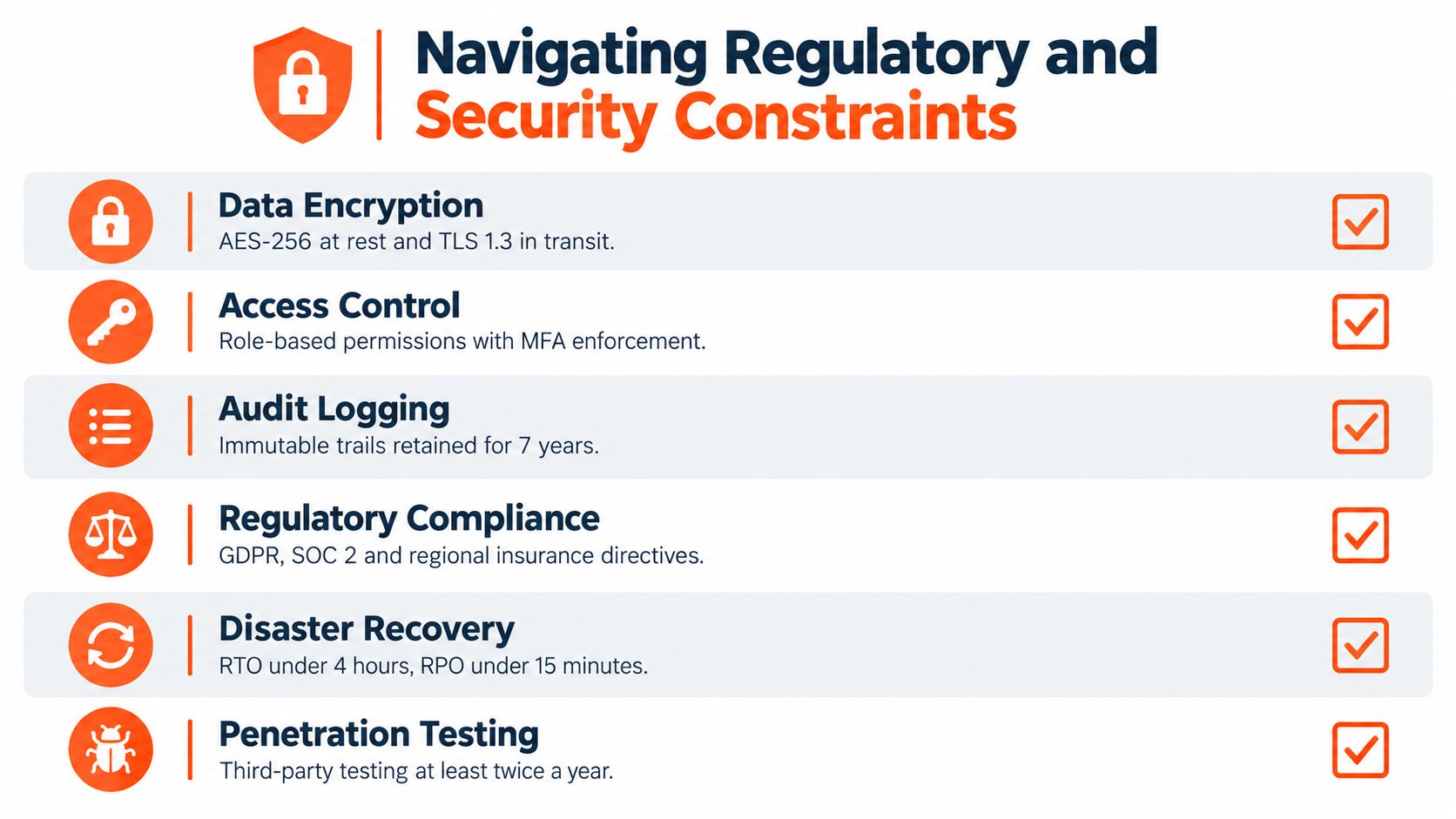
Security and compliance aren't features to add after the first release. They are architectural constraints that shape data models, workflows, deployment, and vendor access from the beginning.
Start by asking how the partner turns obligations into engineering controls. A credible answer should include data classification, least-privilege access, secrets management, encryption, retention rules, environment separation, vulnerability management, incident response, and evidence collection. It should also identify who owns each control and how the team tests it continuously.
Put governance in the delivery system
A reliable evaluation process has five practical checkpoints:
Map sensitive data and decisions. Identify personal, financial, health, claims, payment, and underwriting data. Mark where it enters, changes, leaves, and gets copied. For automated decisions, document the inputs, model or rule version, confidence or threshold logic, human intervention, and final outcome.
Define access by job responsibility. A claims handler, actuary, broker, engineer, and administrator shouldn't receive the same permissions. Require role-based access, strong authentication, privileged-access review, and auditable administrative actions.
Automate compliance evidence. CI/CD should check dependencies, infrastructure changes, container images, configuration, access policies, and test results. A control that exists only in a spreadsheet will eventually drift. A control enforced during build and deployment is easier to verify and repeat.
Preserve decision history. Store the relevant data version, rule or model version, user action, override reason, and downstream result. Audit logs must be useful to investigators and business owners, not just technically present.
Test resilience before migration. Validate backup restoration, failover, reconciliation, recovery procedures, and degraded-mode operations. A vendor that discusses uptime but can't demonstrate recovery behavior hasn't completed the design.
Regulatory expectations vary by jurisdiction, product, and operating model. Teams working across financial services can also use adjacent compliance material, such as vehicle trade software regulation insights, to compare how sector-specific obligations become product and workflow controls.
Explainability belongs in the operating model
AI governance isn't satisfied by adding a model card to a repository. Underwriting and claims teams need a defined response when an automated recommendation conflicts with professional judgment. They need a human review path, an escalation rule, an explanation appropriate to the decision, and a record that shows what happened.
Use a risks and controls matrix to connect each material risk to an owner, preventive control, detective control, test method, and evidence location. Apply that matrix to both legacy integration and new automation. It should be visible in architecture reviews, release approvals, and post-incident analysis.
The vendor should demonstrate these controls in a working environment. Don't accept a slide that says “compliant by design.” Ask to see how a developer gets access, how a sensitive field is masked in non-production, how a model decision is logged, and how an auditor retrieves evidence without asking engineering to reconstruct it manually.
Architecting Integrations and Legacy Coexistence
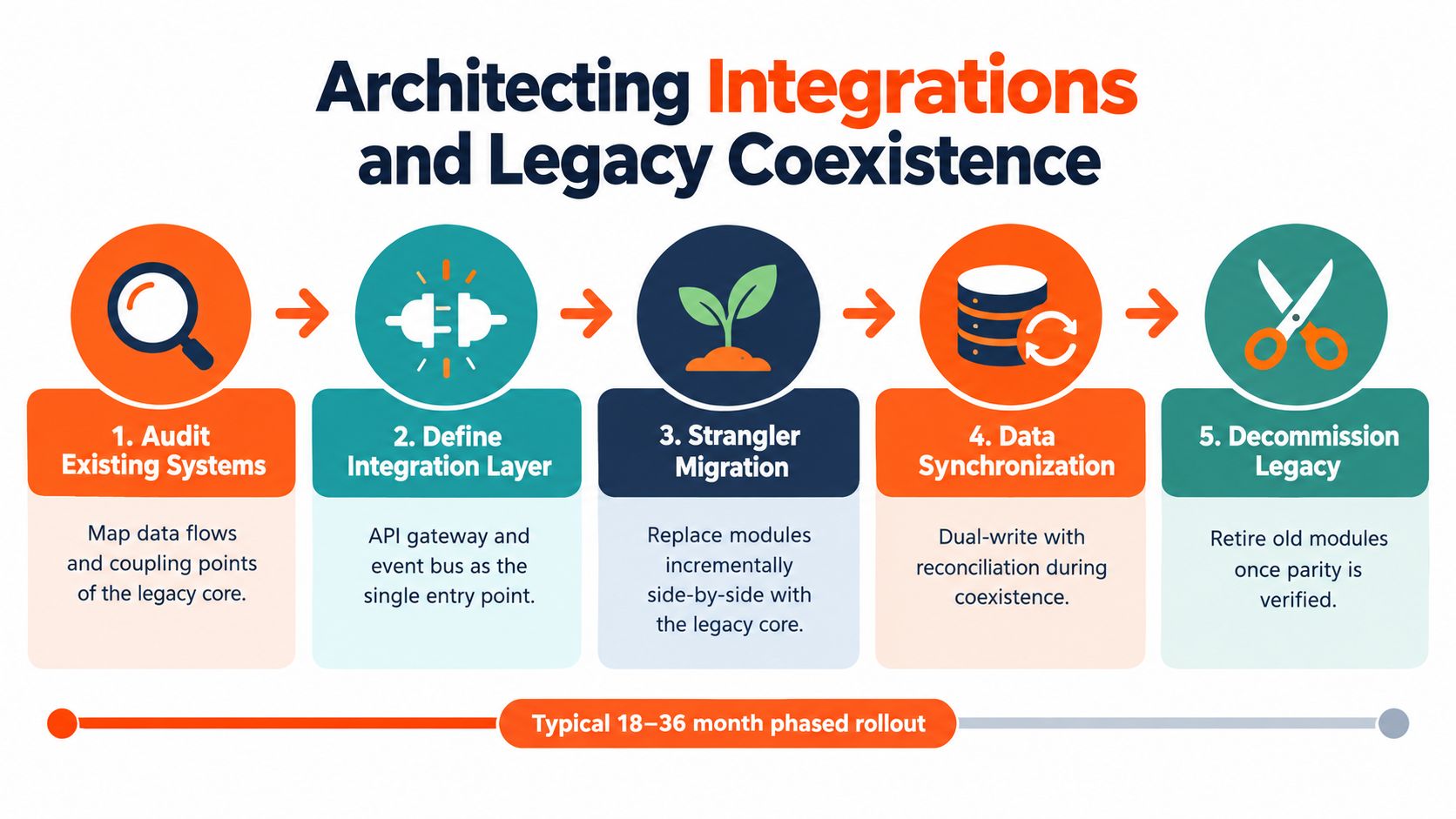
Big-bang replacement is usually the wrong default for an insurer. It concentrates migration risk, forces uncertain business rules into a fixed deadline, and turns every unresolved dependency into a release blocker. Side-by-side coexistence gives the carrier a safer path, but only when the integration layer stops the new platform from becoming another tightly coupled core.
Start with API-first integration. An API gateway should expose controlled entry points for customer channels, broker tools, internal applications, and partner services. An event bus can then distribute meaningful business events, such as policy issued, claim opened, payment allocated, or endorsement completed. Do not expose every legacy function because an endpoint is technically possible. Establish stable contracts so consumers do not depend on the core's internal implementation.
Three design choices determine the outcome
Canonical data models stop each new service from inventing its own interpretation of policy, customer, coverage, claim, and transaction data. Define ownership, identifiers, effective dates, permitted states, validation rules, and mappings to legacy fields. Document fields with no clean equivalent instead of hiding the ambiguity. Unresolved definitions become reconciliation failures later.
Anti-corruption layers keep legacy quirks at the boundary. A translation service can convert old status codes, date conventions, product identifiers, and transaction structures before data reaches the new domain model. The extra work is justified because it prevents legacy assumptions from spreading through every modern service.
Automated deployment pipelines make coexistence manageable. Infrastructure as code, repeatable environments, contract tests, regression suites, observability, and controlled releases let a team change one capability without destabilizing the rest. Test harnesses should compare legacy and modern outputs for representative policies, claims, billing events, and exception paths.
Architecture decision: Keep the legacy core authoritative for a capability until the replacement proves behavioral parity, data reconciliation, operational readiness, and an acceptable control posture.
Industry reporting has highlighted how heavily insurers still depend on legacy systems for core operations and how difficult replacement can be. Treat phased replatforming and coexistence as the default planning position, not as a compromise adopted after a failed replacement program.
Control synchronization carefully
Dual-write designs can reduce disruption, but they create consistency risk. Assign ownership for every business field, define conflict resolution, specify event replay procedures, and make reconciliation detect divergence. Two systems must not update the same business fact without an explicit authority and recovery process.
Use contract testing at every boundary. Measure parity through business outcomes, not only HTTP responses. A migration is not ready because an endpoint returns a successful status. It is ready when the carrier can explain why the new path produces the same, or intentionally improved, result across ordinary cases and known exceptions.
Sequence migration around business capability rather than technical convenience. A legacy system modernization guide for business growth provides a broader framework for evaluating that commercial and operational decision. For an insurer, the practical test is whether each phase reduces dependency on the old core without creating an ungoverned parallel process.
The same discipline applies to AI-enabled services introduced during modernization. Keep model inputs, outputs, overrides, and approval records within defined service boundaries. Assign an owner for each decision, preserve the evidence needed for review, and prevent an experimental service from becoming the system of record without notice. Architecture should make control responsibilities visible before production use.
Deploying AI and Automation Responsibly
The responsible AI project in insurance doesn't begin with “build a model.” It begins with a controlled workflow.
Consider claims triage. An AI service can classify incoming documents, identify missing information, suggest a priority, or route a claim to a specialist. It shouldn't determine the final outcome without transparency when the carrier can't explain the inputs, reproduce the decision, or show who reviewed an exception. The useful design embeds the model inside an existing operating process, with human review thresholds and a fallback path when data is incomplete or confidence is low.
The same principle applies to underwriting. A model can surface risk indicators or recommend referral. The underwriter remains accountable for decisions that require judgment, and the system records the evidence used, the model version, the recommendation, the override, and the final disposition. That record supports governance while giving operations teams a way to improve the workflow rather than merely monitor model accuracy.
Adoption doesn't equal redesign
The gap between using AI and rebuilding a function around AI is substantial. A 2026 KPMG survey reported that 44% of insurance respondents placed their organizations in the top quartile for AI transformation, yet none had fully redesigned sales and distribution or underwriting around AI. Only 3% had done so in policy servicing and claims management. (KPMG survey coverage from Insurance Business Australia)
| Insurance Function | AI Adoption Rate | Full Redesign Rate |
|---|---|---|
| Sales and distribution | No full redesign reported | No full redesign reported |
| Underwriting | No full redesign reported | No full redesign reported |
| Policy servicing and claims management | AI transformation reported by the survey | 3% |
The table reflects the survey's reported redesign signal. It shouldn't be read as evidence that AI has no operational value. It shows that deploying a model is easier than changing ownership, controls, workflows, incentives, data quality, and customer communication around that model.
EIOPA reports that AI is already used by 50% of non-life insurers and 24% of life insurers. Another 30% of non-life insurers and 39% of life insurers expect to adopt AI within the next three years. Insurers allocate an average of about 8% of gross written premiums to digital transformation, and EIOPA expects that share to remain stable over a three-year horizon. (EIOPA's report on digitalisation in the European insurance sector)
A production path that works
Start with a narrow use case where the decision boundary is clear and the human owner is known. Establish baseline workflow behavior, data quality checks, approval rules, and audit requirements before selecting a model. Then run the system in recommendation mode, compare results with human decisions, investigate errors, and define the conditions for limited automation.
Don't place an LLM directly in a critical decision path without retrieval controls, prompt and response logging, data leakage protections, access boundaries, evaluation sets, and an escalation route. For document-heavy work, retrieval-augmented generation can assist with search and summarization, but source citations and human validation still matter. A model that produces a fluent answer from the wrong policy wording creates a governance problem, not a productivity win.
Assessing Vendor Capabilities and Track Record
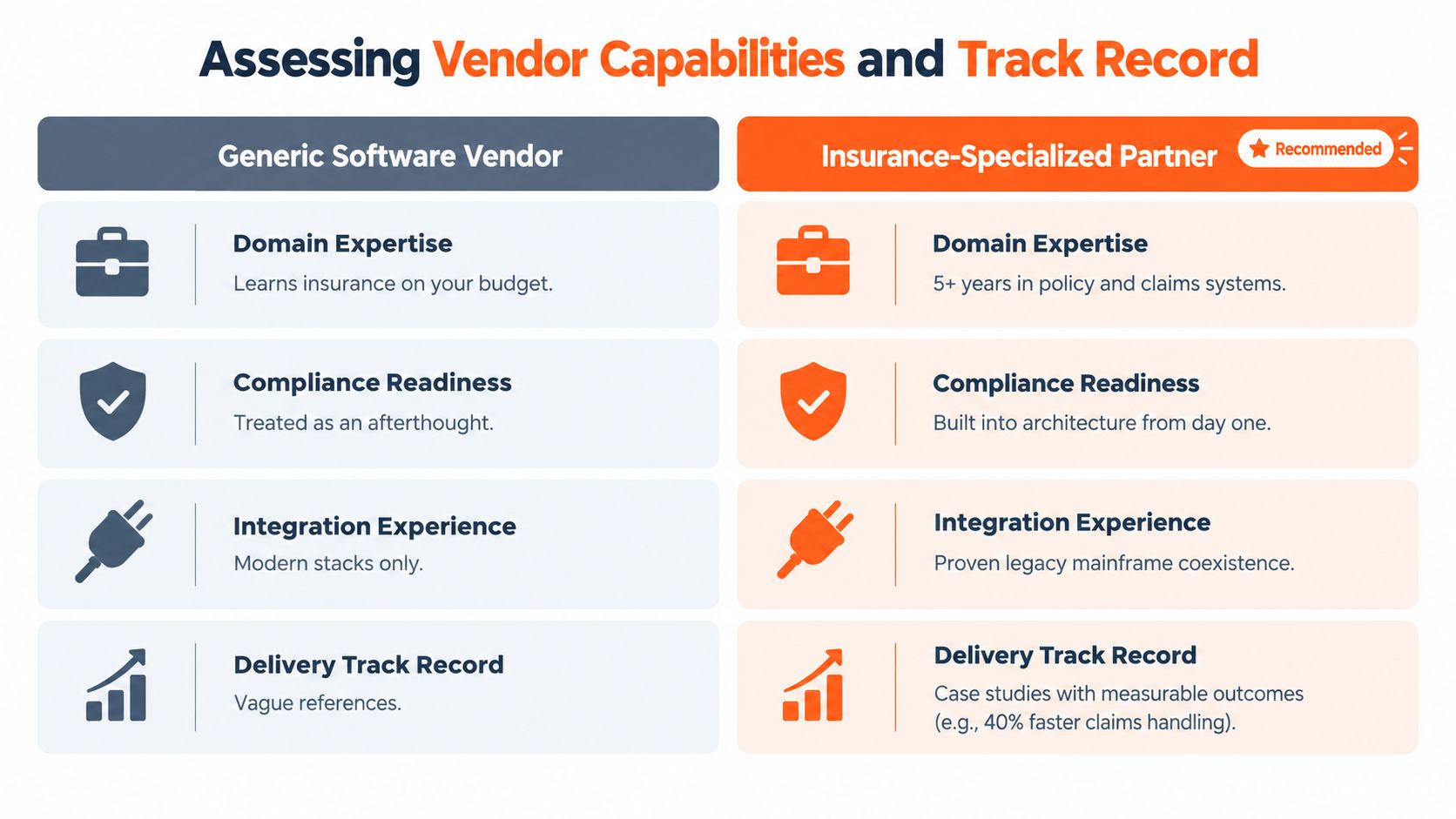
A vendor's technology vocabulary tells you very little. Nearly every software development company can discuss Kubernetes, event-driven architecture, machine learning, and cloud migration. The useful distinction is whether the team can explain how insurance rules survive technical change.
Compare vendors against evidence, not presentation quality.
| Evaluation Area | Generic Development Shop | Insurance-Specialized Partner |
|---|---|---|
| Domain understanding | Learns policy and claims terminology during delivery | Demonstrates how rating, underwriting, billing, and claims rules are modeled |
| Modernization method | Proposes replacement around a target stack | Maps dependencies, defines coexistence, and proves parity incrementally |
| Data migration | Treats migration as extraction and loading | Preserves semantic meaning, effective dates, exceptions, and reconciliation |
| Governance | Adds security and audit work after feature design | Includes control ownership, evidence, and explainability in architecture |
| Delivery proof | Shows technical demos and broad references | Explains outcomes, failure modes, handoffs, and production support |
| AI capability | Starts with a model or chatbot | Starts with a governed workflow, data boundary, human review, and evaluation plan |
Questions that expose delivery maturity
Ask the prospective insurance software development company to run a technical discovery before it estimates a large program. The discovery should produce a dependency map, capability boundaries, data ownership model, risk register, migration hypotheses, test strategy, and a sequence of small releases.
Then request specific evidence:
- Core-system experience: Ask for an example of a team working alongside a legacy policy, claims, or billing platform. Have them explain what remained authoritative and how parity was tested.
- Domain fluency: Give the team a policy change, an endorsement, or a claim exception. Listen for questions about effective dates, state transitions, approvals, financial impact, and downstream reporting.
- Security practice: Ask how the team handles production access, sensitive test data, vulnerability remediation, audit evidence, and incident response.
- AI controls: Request the proposed logging, review, evaluation, rollback, and model-change process. “Human in the loop” isn't enough unless the workflow defines what the human sees and can change.
- Commercial transparency: Require assumptions, dependencies, decision gates, and exit criteria. A low initial estimate that excludes data cleanup and integration testing isn't a low-cost program.
The vendor should also explain how it supports the system after launch. Insurance platforms need observability, incident response, release management, performance testing, and controlled change. A partner that disappears after the first production release leaves the carrier with the same operational dependency it was trying to remove.
Use a structured technology partner evaluation guide to score discovery quality, architectural judgment, security maturity, communication, and long-term ownership. Score the proposed working model as carefully as the proposed technology.
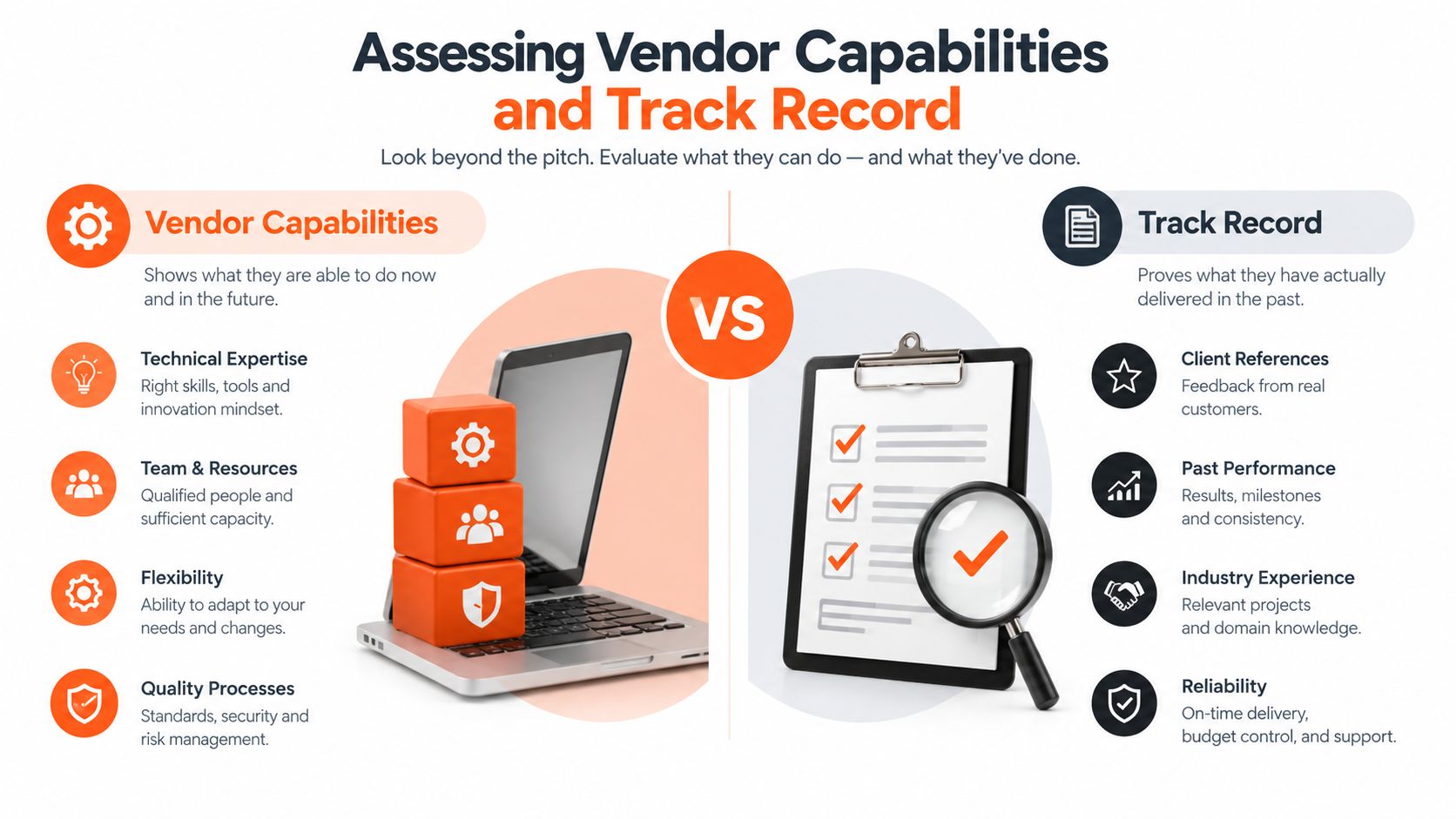
One warning deserves emphasis: don't select a specialist solely because it knows insurance terminology. A domain expert with weak engineering discipline can encode old assumptions into a new system. Select the team that combines domain reasoning, integration architecture, automated testing, security controls, delivery management, and production accountability.
Building a Phased Modernization Roadmap
A modernization roadmap should start with the capability that creates the clearest operational or financial case, not the subsystem that looks most elegant on an architecture diagram.
Begin by documenting current behavior, dependencies, data ownership, and failure points. Choose a bounded capability, place a stable integration layer around it, and define parity tests before writing the replacement. Run the new and old paths together where risk demands it. Decommission only after reconciliation, controls, user readiness, operational support, and rollback plans have been demonstrated.
The financial case should remain visible throughout the program. Accenture reports that outperformers improved premium revenues by an average of 8.1 percentage points and reduced expense ratios by 2.6 percentage points. Those figures don't guarantee a result for any carrier, but they show why modernization should be tied to revenue capacity and operating efficiency rather than framed as an IT refresh. (Accenture's insurance transformation research)
Use quarterly decision gates with explicit evidence: reduced manual work, faster controlled change, fewer reconciliation failures, stronger audit readiness, improved service reliability, or validated product economics. If a workstream can't show a credible connection to one of those outcomes, pause it or redesign its scope.
The right insurance software development company won't promise that legacy complexity disappears quickly. It will make the complexity visible, isolate it, modernize it in manageable slices, and build the governance needed for responsible automation. That is how a carrier protects current operations while creating room for embedded insurance, real-time underwriting, and future digital products.
devPulse provides discovery, architecture, custom software development, legacy modernization, DevOps, security-focused engineering, and governed AI integration for enterprise systems. Visit devPulse to discuss a phased insurance modernization roadmap grounded in integration risk, operational controls, and measurable business outcomes.