













For U.S. healthcare organizations that need secure, compliant, and cloud-native custom software, Devpulse is the engineering partner built for that work. Whether you’re replacing a fragile legacy EHR integration, building a telehealth platform from scratch, or embedding AI into clinical workflows, Devpulse delivers end-to-end engineering with HIPAA readiness, FHIR-native architecture, and the regulatory fluency your procurement team will require.
Three things you can confirm before your first call:
- Compliance readiness: Devpulse builds with HIPAA privacy and security controls, Business Associate Agreement (BAA) support, and audit-ready documentation baked into the delivery process, not added at the end.
- Cloud-native and AI readiness: Every architecture decision accounts for cloud-native scalability and embedded AI/ML, so your platform can grow without a costly rebuild in two years.
- Legacy modernization expertise: Devpulse has a direct track record modernizing aging health IT systems, migrating data, and re-platforming clinical applications without disrupting live operations.
Schedule a discovery call to receive an initial timeline estimate, a budget range, and a clear view of the top technical and regulatory risks in your project.
Key Takeaways
Custom healthcare software development succeeds when compliance is built into architecture from day one, not retrofitted after launch.
| Point | Details |
|---|---|
| Compliance is a baseline, not a feature | Require a signed BAA, SOC 2 Type II, SRA evidence, and a pen test report before any vendor engagement begins. |
| Discovery drives accurate estimates | Fixed-price quotes without a discovery phase almost always lead to change-order cost creep on complex healthcare projects. |
| Interoperability standards are non-negotiable | FHIR R4, HL7v2, and DICOM support must be confirmed in vendor proposals for any EHR-connected or data-exchange product. |
| AI in clinical workflows requires governance | Embedding AI features without a validation and governance framework creates patient safety risk and regulatory exposure. |
| Devpulse delivers end-to-end healthcare engineering | From EHR integrations and telehealth platforms to AI/ML and legacy modernization, Devpulse builds with HIPAA readiness and clinical workflow expertise from day one. |
What does healthcare software development actually cover?
Custom healthcare software development, also called clinical software engineering in more technical contexts, spans a wide range of products and integrations. Before evaluating any vendor proposal, you need a clear picture of what a full-service partner should offer.
Core services to expect:
- EHR/EMR integration: Bidirectional data exchange with Epic, Cerner, Oracle Health, and other major platforms via FHIR R4 and HL7v2 APIs.
- Telehealth and virtual care apps: HIPAA-compliant video, asynchronous messaging, and care coordination platforms. Devpulse’s telehealth software development practice covers the full stack.
- Remote patient monitoring (RPM): Device connectivity, data pipelines, and alert logic for wearables and home health devices.
- Software as a Medical Device (SaMD): Development under FDA’s SaMD framework, including design controls, risk classification, and pre-submission planning.
- Revenue cycle management (RCM) and billing integrations: Claims processing, eligibility verification, and payer API connections.
- Patient portals and engagement platforms: Secure messaging, appointment scheduling, care plan access, and patient-reported outcome collection.
- Analytics and population health: Data warehousing, dashboards, and predictive models for utilization, risk stratification, and quality reporting.
- AI/ML model development and MLOps: Clinical decision support, ambient documentation, and agentic AI features with model governance pipelines.
- API and interoperability work: FHIR, HL7v2, DICOM, IHE profiles, and Health Information Exchange (HIE) connectivity.
- Legacy modernization and cloud migration: Re-platforming monolithic clinical systems to microservices or cloud-native architectures.
- QA and regulatory testing: Functional, performance, security, and compliance-specific test plans.
- UI/UX and clinician workflow design: Human-centered design sprints that reduce documentation burden and improve adoption.
- DevOps and managed hosting: CI/CD pipelines, infrastructure-as-code, and HIPAA-eligible cloud environments (AWS, Azure, GCP).
- Training, change management, support, and maintenance retainers: Go-live support, staff training, and ongoing engineering coverage.
Vendors typically package these services as fixed-price projects for well-scoped work, time-and-materials (T&M) engagements for evolving requirements, or dedicated engineering teams for organizations that need embedded capacity over months or years.
Why vendor trust signals matter more in healthcare than in other industries
Healthcare software carries direct patient safety implications. A vendor who cannot produce compliance artifacts during procurement is a vendor you cannot afford to onboard.
Trust signals to verify before signing:
- Years of healthcare IT experience: Ask for a portfolio of shipped clinical products, not just general software work.
- ISO 27001 and SOC 2 Type II certifications: These confirm that security controls are independently audited, not self-attested.
- HIPAA program and audit readiness: Vendors should maintain a documented Security Risk Assessment (SRA), workforce training records, and a BAA template ready to review.
- FDA and ONC familiarity: For SaMD projects or interoperability work under the 21st Century Cures Act, the vendor’s team should understand pre-submission meetings, design controls, and information-blocking prohibitions.
- Published case studies with measurable outcomes: Vague references are not evidence. Ask for specific metrics: integration timelines, uptime figures, or adoption rates.
- Penetration testing and third-party security audits: Annual pen tests from a named third-party firm, with findings and remediation evidence, are the baseline expectation.
- Staff background checks and security clearances: For projects handling protected health information (PHI), confirm the vendor’s hiring and access-control policies.
The HIPAA Privacy Rule sets the legal floor for how PHI must be handled. Treating compliance as a checkbox rather than a verified artifact set is one of the most common and costly procurement mistakes healthcare organizations make.
Stat to know: Research consistently shows that organizations that validate vendor security artifacts before contract execution face significantly lower breach-related costs and regulatory exposure than those that rely on vendor self-certification alone.
How a well-run healthcare software project is actually delivered
Common engagement models
- Fixed-price project: Best for well-defined scope with stable requirements. Predictable cost; change orders required for scope changes.
- Time and materials (T&M): Best for exploratory or evolving work. Maximum flexibility; requires active client oversight of hours and scope.
- Dedicated team / managed engineering: Best for multi-year product development or ongoing modernization. Embedded capacity with consistent team knowledge.
- Outcome-based milestones: Payments tied to defined deliverables (e.g., passing a security audit, completing EHR integration testing). Aligns incentives but requires precise acceptance criteria.
- Support retainer: Post-launch engineering coverage at a fixed monthly rate.
The delivery process, step by step
- Discovery and product discovery: Define clinical workflows, user personas, integration points, and regulatory classification. Output: project charter, risk register, and compliance scope document.
- Architecture and compliance gap assessment: Select cloud platform, data model, and interoperability standards. Identify HIPAA, FDA, or ONC obligations. Output: architecture diagram and compliance checklist.
- Prototyping and design sprint: Build clickable prototypes with clinician input. Human-centered design at this stage measurably reduces documentation burden and improves adoption post-launch.
- Iterative development and validation: Sprint-based delivery with continuous integration, automated testing, and clinical SME review at each milestone.
- Integration and system testing: Security testing, FHIR/HL7 integration validation, performance testing, and regulatory test execution. Rigorous testing at this phase reduces adoption risk and improves safety outcomes.
- Deployment and cutover: Blue-green or canary deployment strategies, rollback plans, and go-live runbooks.
- Training and change management: Role-based training materials, super-user programs, and adoption tracking.
- Support and scaling: SLA-backed incident response, platform monitoring, and planned capacity scaling.
Typical timelines
| Project complexity | Typical timeline | Key schedule drivers |
|---|---|---|
| Small (single integration or portal) | 3–5 months | Scope clarity, EHR sandbox access |
| Mid-size (telehealth or RPM platform) | 6–10 months | Regulatory classification, integration count |
| Large (enterprise EHR modernization) | 12–24 months | Data migration volume, multi-system integrations |
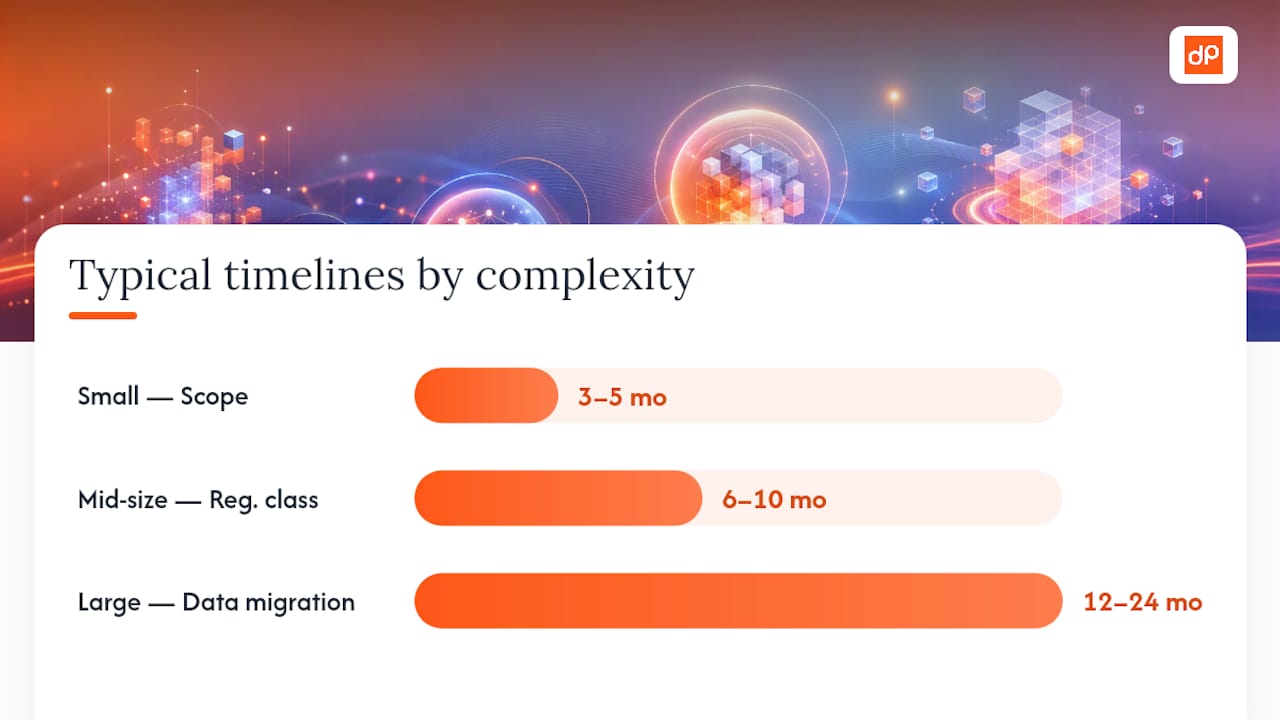
Schedules shorten when EHR sandbox environments are available early and clinical SMEs are accessible for workflow validation. They lengthen when regulatory classification is unresolved at project start or when legacy data requires extensive mapping.
What technical capabilities should you require from a vendor?
Deployment architecture
Cloud-native deployment on HIPAA-eligible environments (AWS GovCloud, Azure for Healthcare, or GCP with a BAA) is the right default for most U.S. healthcare organizations. On-premises deployment still applies for organizations with strict data residency requirements or highly regulated research environments. Hybrid architectures, where PHI stays on-premises but analytics and AI workloads run in the cloud, offer a practical middle path for health systems mid-modernization.
Interoperability standards to require
- FHIR R4: The current U.S. standard for patient data exchange, mandated under ONC rules.
- HL7v2: Still the dominant standard for lab, ADT, and order messages in most hospital environments.
- DICOM: Required for imaging workflows and PACS integrations.
- IHE profiles: XDS, PIX/PDQ, and related profiles for cross-enterprise document sharing.
- OAuth2 / OpenID Connect: For secure API authentication and patient-facing app authorization.
Security controls
Under the HIPAA Security Rule, vendors must implement encryption at rest and in transit, role-based access control (RBAC), multi-factor authentication (MFA), and comprehensive audit logging with tamper-evident provenance. Identity and access management (IAM) policies should follow least-privilege principles, and all PHI access events must be logged and reviewable.

Pro Tip: Ask every vendor candidate for their EHR sandbox access process. Vendors who have pre-established sandbox relationships with Epic, Oracle Health, or Cerner can cut integration testing timelines by weeks. Vendors who have never worked in a sandbox environment will cost you time and money during the integration phase.
U.S. regulatory and compliance requirements you must plan for
Healthcare software in the U.S. operates under a layered compliance framework. Every vendor proposal should address all of the following:
- HIPAA Privacy Rule: Governs how PHI is used, disclosed, and protected. Review the HHS Privacy Rule guidance and confirm your vendor can produce a compliant BAA and data use policies.
- HIPAA Security Rule: Requires administrative, physical, and technical safeguards. Verify encryption standards, access controls, and audit logging capabilities against HHS Security Rule requirements.
- Breach notification: Under the HIPAA Breach Notification Rule, covered entities and business associates must notify affected individuals and HHS within defined timeframes. Your vendor’s incident response plan must specify notification procedures and timelines.
- Security Risk Assessment (SRA): Required under the Security Rule. Vendors should provide evidence of a current SRA and a remediation plan for identified gaps.
- FDA SaMD pathways: If your software makes clinical decisions or influences diagnosis, treatment, or prevention, it may qualify as a Software as a Medical Device. Confirm the vendor understands FDA’s risk-based classification framework and pre-submission processes.
- ONC and 21st Century Cures Act: Interoperability mandates and information-blocking prohibitions apply to most health IT products. Vendors building patient-facing apps or EHR-connected tools must understand these obligations.
- Department of Labor HIPAA intersections: For employer-sponsored health plans, DOL’s HIPAA guidance covers additional employer obligations worth reviewing with legal counsel.
Compliance checklist to request from any vendor:
- BAA template (review before signing)
- SOC 2 Type II report or ISO 27001 certificate
- Penetration test report (dated within 12 months, from a named third-party firm)
- SRA evidence and remediation log
- Incident response and breach notification policy
- Workforce HIPAA training records
This article provides general information about U.S. healthcare software compliance requirements and is not a substitute for legal or regulatory advice. Confirm your specific obligations with qualified legal counsel and the relevant primary sources.
For healthcare founders and early-stage teams, this regulatory primer from The Startup MD offers a practical overview of U.S. regulatory basics worth reviewing before your first vendor conversation.
What Devpulse brings to healthcare projects
Devpulse’s healthcare engineering practice covers the full product lifecycle: custom application development, cloud migration, AI/ML integration, UI/UX design, QA, and ongoing support. The team works across EHR integrations, telehealth platforms, RPM systems, and SaMD-adjacent products, with architecture decisions made to support HIPAA compliance and ONC interoperability requirements from day one.
Outcomes from Devpulse-delivered projects include measurable reductions in integration delivery timelines through pre-built FHIR connector libraries, faster clinical adoption through iterative design sprints with end-user validation, and reduced operational risk through structured compliance documentation and third-party security testing. You can review specific project outcomes in the Devpulse case studies portfolio.
Excessive clinician documentation and administrative overhead are among the leading contributors to burnout and reduced patient care time, according to peer-reviewed research. Devpulse addresses this directly by prioritizing ambient documentation features, workflow automation, and AI-assisted charting in clinical product designs, reducing the time clinicians spend on non-clinical tasks.
On the AI side, Devpulse’s data and AI practice covers model development, MLOps pipelines, and governance frameworks. AI features in clinical workflows require careful validation to avoid unintended harms, as recent research confirms. Devpulse builds AI governance into the delivery process, not as an afterthought.
Support and SLAs: Post-launch, Devpulse offers tiered support retainers with defined mean time to acknowledge (MTTA) and mean time to repair (MTTR) targets, scheduled maintenance windows, and escalation paths to senior engineers. Knowledge transfer is structured as part of go-live, with role-based training materials and documentation delivered before handoff.
What drives cost in custom healthcare software projects?
Cost in healthcare software development is driven by complexity, compliance scope, and integration depth, not just engineering hours.
Primary cost drivers:
- Regulatory testing and validation: SaMD projects require design controls, risk documentation, and formal test execution. This adds cost that general software projects do not carry.
- Integration scope: Each EHR or third-party API connection requires sandbox testing, data mapping, and error-handling logic. More integrations mean more cost.
- Data migration complexity: Legacy data with inconsistent schemas, missing identifiers, or non-standard formats requires significant mapping and validation work.
- AI/ML model development: Custom model training, evaluation, and MLOps infrastructure add cost beyond standard application development.
- Security and penetration testing: Annual third-party pen tests and remediation cycles are a recurring cost, not a one-time expense.
- Hosting and high-availability requirements: HIPAA-eligible cloud environments with multi-region failover cost more than standard hosting.
- Vendor labor model: Onshore U.S. teams carry higher day rates than nearshore or offshore teams. The right mix depends on your compliance requirements and communication preferences.
- Warranty and support terms: Extended warranty periods and SLA-backed support retainers add to total cost of ownership (TCO).
Ballpark ranges by project complexity:
- Small projects (single integration, patient portal, or RPM dashboard): typically in the low-to-mid six-figure range.
- Mid-size projects (telehealth platform, analytics solution, or multi-EHR integration): typically in the mid-to-high six-figure range.
- Large projects (enterprise EHR modernization, SaMD development, or multi-system migration): typically seven figures or more.
Precise estimates require a discovery engagement. Any vendor quoting a firm price without a discovery phase is either underscoping the work or planning to recover cost through change orders.
Pro Tip: Structure your contract with milestone-based payments tied to defined acceptance criteria. This gives you leverage at each phase and forces the vendor to be specific about what “done” means before work begins. Include a formal change-control process so scope additions require written approval before they affect the budget.
Pricing model comparison: fixed-price contracts give budget certainty but require tight scope definition upfront. T&M gives flexibility but requires active oversight. Dedicated team models work best for multi-year programs where the team’s domain knowledge compounds over time. Outcome-based pricing aligns incentives but demands precise, measurable acceptance criteria.
Post-launch support, monitoring, and scaling your platform
Shipping the software is not the finish line. Healthcare platforms require continuous monitoring, security patching, and capacity management to stay compliant and performant.
Common support offerings to require:
- 24/7 network operations center (NOC) coverage or on-call engineering for critical systems
- Platform maintenance, dependency updates, and security patching on a defined schedule
- Managed hosting with HIPAA-eligible infrastructure and documented change management
- Compliance reporting support for annual audits and SRA updates
SLA metrics that matter:
- MTTA (mean time to acknowledge): How fast the vendor responds to an incident alert. Critical systems should have MTTA measured in minutes, not hours.
- MTTR (mean time to repair): How fast the vendor resolves an incident. Define separate MTTR targets for P1, P2, and P3 severity levels.
- Uptime: 99.9% is the common baseline for clinical systems; mission-critical platforms often require 99.95% or higher.
- Scheduled maintenance windows: Define blackout periods (e.g., no maintenance during peak clinical hours) in the contract.
For monitoring, require logging, metrics dashboards, alerting, synthetic transaction testing, and documented runbooks for common failure scenarios. Scaling plans should address database read/write capacity, multi-region failover, and cost projections for traffic or data volume growth.
How to choose the right healthcare software vendor
Must-have criteria
- Signed BAA and documented HIPAA compliance program with SRA evidence.
- SOC 2 Type II or ISO 27001 certification from an accredited auditor.
- Penetration test report dated within 12 months.
- Demonstrated EHR integration experience with at least one major platform (Epic, Oracle Health, Cerner).
- Published case studies with clinical or operational outcomes, not just feature lists.
Should-have criteria
- FDA SaMD experience if your product may qualify as a medical device.
- ONC/21st Century Cures familiarity for interoperability and information-blocking compliance.
- FHIR R4 native development capability.
- Dedicated healthcare practice or vertical team, not just general software engineers assigned to healthcare work.
Differentiator criteria
- AI/ML governance framework and MLOps capability for clinical AI features.
- Pre-built EHR connector libraries or sandbox relationships that accelerate integration.
- Clinician-centered UX practice with documented design sprint methodology.
Interview questions to ask
- “Walk us through how you handled a HIPAA breach notification scenario with a past client.”
- “What is your process for classifying a new feature as SaMD versus general wellness software?”
- “How do you manage EHR sandbox access and integration testing environments?”
- “What does your AI validation process look like for a clinical decision support feature?”
- “Who owns the IP and source code at contract end, and how is data portability handled?”
Red flags to watch for
- No BAA template available before contract signing.
- Vague answers about regulatory obligations (“we follow best practices” with no artifacts).
- No named third-party pen test firm or test reports older than 18 months.
- References who cannot speak to clinical workflow experience.
- Change-order clauses that allow unilateral scope additions.
Contracting essentials
Lock in IP ownership, data portability rights, liability caps tied to contract value, and performance SLAs before signing. Acceptance criteria for each milestone should be written in measurable terms. The BAA must be executed before any PHI touches the vendor’s systems.
A direct note on how Devpulse approaches healthcare work
Healthcare projects carry a different weight than most software engagements. A poorly designed patient portal or a misconfigured EHR integration does not just create technical debt; it affects care delivery and creates regulatory exposure. That reality shapes how we structure every engagement at Devpulse.
We start every healthcare project with a compliance-first architecture review, not because it is required, but because it is the only way to avoid expensive rework later. We bring clinical workflow expertise into design sprints, treat security testing as a delivery milestone rather than a final-phase checkbox, and build knowledge transfer into go-live so your team is not dependent on us indefinitely.
If you want a no-obligation project assessment, including an initial view of your technical risks and compliance scope, schedule a call with the Devpulse engineering team.
Devpulse’s healthcare software engineering services
Custom healthcare software development requires a partner who understands both the technical depth and the regulatory stakes. Devpulse’s engineering services cover the full spectrum: EHR integrations, telehealth platforms, AI-powered clinical tools, legacy modernization, and post-launch support, all delivered with HIPAA compliance built into the process.
For organizations evaluating AI-enabled clinical features, Devpulse’s generative AI development practice covers ambient documentation, clinical summarization, and AI copilot tools with the governance frameworks that healthcare environments require.
Request a project assessment today. You will leave the first call with a realistic scope, a budget range, and a clear picture of your top risks.
Sources
These primary sources should be on your desk during vendor evaluation and referenced in any compliance documentation your vendor produces: